“Only those who dare to fail greatly can ever achieve greatly,” Robert F. Kennedy once said. But how do you really deal with the feels and heal when failure really does hit you in the face? We asked our interviewees for tips.
Choo Bin Yong, game designer who runs solo: I think just looking at the history of how most successful people had experienced failure before they achieved success makes it feel easier to move on from failure instead of wallowing in it.
Jack, who moved from China to Cambodia in the thick of the COVID-19 pandemic: It’s like I’m constantly telling my daughter, keep things in perspective. We all fail. I’m nobody special, so I’m going to fail, too. And, I use some very self-deprecating humor too.
Pamela Ellis, who survived an ectopic pregnancy: I try not to be so hard on myself. I survived something that almost killed me, it’s okay if I fail. My self-talk has become more loving and caring. I talk to myself with more compassion and understanding than I would have in the past. It’s okay. Everything will be okay.
Tiffani “Oling” Lim, esports professional: When that happens I will take some time off, read some books and reconnect with friends; it’ll really helps clear my mind and put things into perspective. Once I’ve recovered and readied myself with a fresh mindset, newly-armed with yet another valuable lesson in life, I can bounce back stronger than ever.
Caren Robinson, who survived a major traffic accident: When I am experiencing failure it usually includes an emotional breakdown of some sort. The extent of that feeling is highly dependent on the perception of the importance of the potential success that I somehow failed at. I have gotten better about preparing for that potential and back up plans and support around that possibility. I force myself to focus on positive self- talk and focus on the things I have accomplished that day, or in that moment. Positive quotes and memes are helpful. Something else that helps is sleeping. Just taking a nap to escape for a bit. Sometimes it is also helpful to just rage out and vent to somebody.
Jessica, who has Crohn’s Disease: Recovery time, resting, taking personal time for myself to meditate, sit outside for 15 minutes, take a hot shower, if all else fails talk to my support system, my sister.
Joan, a minimalist: Talking it out to friends/team mates and working towards plan B. Sometimes, the perceived failure in one’s mind overwhelms the reality of it. What may seem like a failure is usually a huge learning curve forward for you and your team.
Dr Bob Rich, author of many books: There is no such thing as a failure, fault or defect. There are only learning opportunities. And if someone else can do it, I can learn it. Hmm… that’s except for singing. You really, really don’t want to hear me sing.
Also, Edison once said, “So far, I have found 99 ways that you cannot produce an electric light.” He did get there in the end, didn’t he?
Since 2015, one of my major projects has been to write a science fiction series, and for the past several months, I’ve got serious about pestering agents and publishers about it. Long way to go before I reach 99. I could self-publish, but it’s too good for that. Harry Potter, look out! At my blog, Bobbing Around, I have a long list of short stories, and several are extracts from this series, so you can see for yourself.
The Amateur Trader, self-employed occasional trader: To remember that if I had the courage to begin, then I have the courage to succeed.
Sy, founder of LUCK-IT: I remind myself of the long game always.
What about you? What do you do when you meet with failure? Tell us in the comment box below and we’ll add it to the list. More questions for you to answer in The Wisdom of Crowds series here.
Want to be featured too? Say hi in the comment box below or tell us here. If you found this article useful:
A quarter of 2021 is already over. What have you done since the year started and what will you be doing next? Let us know in the comment box below and we will add it below!
Jessica, who has Crohn’s Disease: I am on a weight-loss journey. My goal is to lose 60 lbs.
Pamela Ellis, who survived an ectopic pregnancy: Survive it as I did in 2020. 🙂 I plan on taking this year to do a lot of introspection. Having a near-death experience has really shaken me to my core and I’m having the desire to “find my true self” after this ordeal.
Dr Bob Rich, author of many books: Live in the moment, mostly. After all, that’s all there is.
One of my award-winning books has been republished through a different publisher. This is “Sleeper, Awake”. To publicise it, I am offering a FREE electronic copy to every subscriber to my monthly newsletter, and to every follower of my blog, Bobbing Around.
And a wonderful new British publisher is in the last stages or reissuing one of my favourite books. We have worked together to improve it, add new bits, and came up with a new cover and title: “Maraglindi: Guardian Spirit”.
One of my current writing projects is a short story collection with a difference or three. It is to be a companion volume to “From Depression to Contentment: A self-therapy guide”.
Choo Bin Yong, game designer who runs solo: My plan for 2021 is to release the 2 games that I have been developing since last year. The first game will hopefully be able to be released before June and on multiple platforms (PS4/XBOX/PC). Besides these 2 games, I am also developing a 3rd game with a story based in Singapore.
Tiffani “Oling” Lim, esports professional: Focus on my health and family, work on player rights and female empowerment work in esports, and continue gaming every day.
Joan, a minimalist: Resume volunteer work with animals, get to know more self-starters/female leaders and read books.
Jack, who moved from China to Cambodia in the thick of the COVID-19 pandemic: In 2021, I’m planning on learning Khmer. One of the things that I disliked about living in China and Viet Nam was the difficulty of learning the languages. They are tonal and I’m tone deaf. I literally could not reproduce the tones or interpret them. Khmer is very different from English, but I can make the sounds and understand what people are saying.
My other big goal for 2021 is to expand the blog and hopefully produce an adequate income stream from it. I have advertising on it now, and am making a little money. I have to improve my SEO and expand my readership a bit more, but it is coming along.
And, of course, exploring Cambodia. I’m anxious to get up into the highlands along the Vietnamese border and up to the Laotian border.
Caren Robinson, who survived a major traffic accident: I plan to build the HOPE TBI website and add more information/pages. I plan to add more Survivor and Caregiver stories. I plan to commit to an activity/exercise schedule for myself. I plan to continue to build my Coaching business www.vitalability.com and pay additional attention to my education growth.
Sy, founder of LUCK-IT who successfully quit smoking : Finish and release Replay Life—the life simulator game I’ve been making for PLAY-IT.
The Amateur Trader, self-employed occasional trader: Put my 2020 experience to good use and may that help me be more profitable in the stock market.
What about you what do you plan to do in 2021? Tell us in the comment box below. More questions for you to answer in The Wisdom of Crowds series here.
Want to be featured too? Say hi in the comment box below or tell us here. If you found this article useful:
Next up in this year’s The Wisdom of Crowds series is a question about goals. Here’s what our 2020 interviewees and interviewers have been living for. What about you? What’s your goal in life?
Q: What is your goal in life?
Oliver Chong, a theatre practitioner who has schizophrenia: To give meaning to this meaningless existence for my time being.
Leanne, popular Instagrammer: To create happy memories with many.
Victor Fernando R. Ocampo, speculative fiction author: I have two main goals: To be remembered and, as far as possible without surrender, to always be kind.
Sy, who runs LUCK-IT: Personally it is to make every second count. Socially it is to provide for the world what other people are not providing.
Choo Bin Yong, game designer who runs solo: My goal is to make a great game or a hit game.
Cho Jun Ming, N-Level student and film-maker who lost his father early: My goal in life is actually to represent Singapore one day in international film festivals. I’d like to let countries outside of Singapore know that the Singapore media industry is not dying and that Singapore media is actually growing to be better by giving an opportunity to talented individuals. One day we can also make high quality films—not just Korea, Taiwan or Hollywood.
Ms Lena Lok, founder of an art school: My goal in life is actually to represent Singapore one day in international I want to continue to serve the community with my art knowledge and skills. My wish is that Singapore’s Art education scene will flourish and become as progressive and developed as Melbourne’s in years to come.
Sean Munger, a former Atheist: To contribute something worthwhile and significant to reversing climate change, which is the world’s biggest and most urgent problem.
Kauai, 2020 LUCK-IT Interviewer: To spend more time practicing painting and learning to appreciate art.
Siddharth Mazumdar, 17-year-old inventor: To never stop learning and growing, while helping people along the way.
Dr Bob Rich, author of 18 books: To be of benefit. That’s why I am a Professional Grandfather, striving for a survivable future and one worth surviving in. One of my gifts in this life is to be able to heal with words, and I am joyful when I can make a difference in someone’s life.
Tony, 80-year-old blogger: My goal is to continue to live a happy healthy life and produce my blog on that same subject, hopefully, helping people to do the same.
Cedric, child-free by choice: To crush my enemies, see them driven before me, and to hear the lamentations of their women. And not have kids.
Norsham Mohd, a former Muslim: To live a productive and meaningful life free from mental and physical slavery. I do not want to die leaving behind debts.
Kinge, who quit social media: To have the truest and fullest human experience that the creator intended me to have when he created me, in the context of I am a spiritual being having a human experience.
Jason Koh, dungeon master: Rather than having one fixed goal far off in the horizon, I believe in having multiple smaller ones, and taking tangible steps to systematically realise them. Right now, it’s creating more opportunities for local creators and designers to showcase their pop-culture themed work to an international audience.
Joan, who we interviewed earlier about being a minimalist, first decided she never wanted kids at age 14. 15 years later, she met Cedric Chew who, at age 12, had decided not to have children too. Now that they’ve been in a relationship for about 2 years and enjoy living with their fur-kids, we asked them why they made the choice not to have kids and what the outcome of that choice has been like.
“Even as a child I found other kids annoying.”
Q: Hi Joan! Thank you for coming back to talk about a different topic today, and with your partner too! To start, could you tell us a little about yourselves? Who are you and how do you tick?
Joan: Hello. I am Joan, founder of Minimalism in Singapore, mummy to two cats and am in a managerial position in the private education industry.
Cedric: Hi, I’m Cedric, dad to one very spoiled cat and many, many guitars, and I’m a sales manager for a Pro Audio company.
You both identify as wanting to be child-free. Did you both decide on that together or was that what led you both to choosing each other?
Joan: It was pretty much a pre-requisite for me before we started to date, imho haha.
Cedric: Wanting kids is a deal breaker for me when it comes to getting into long term relationships
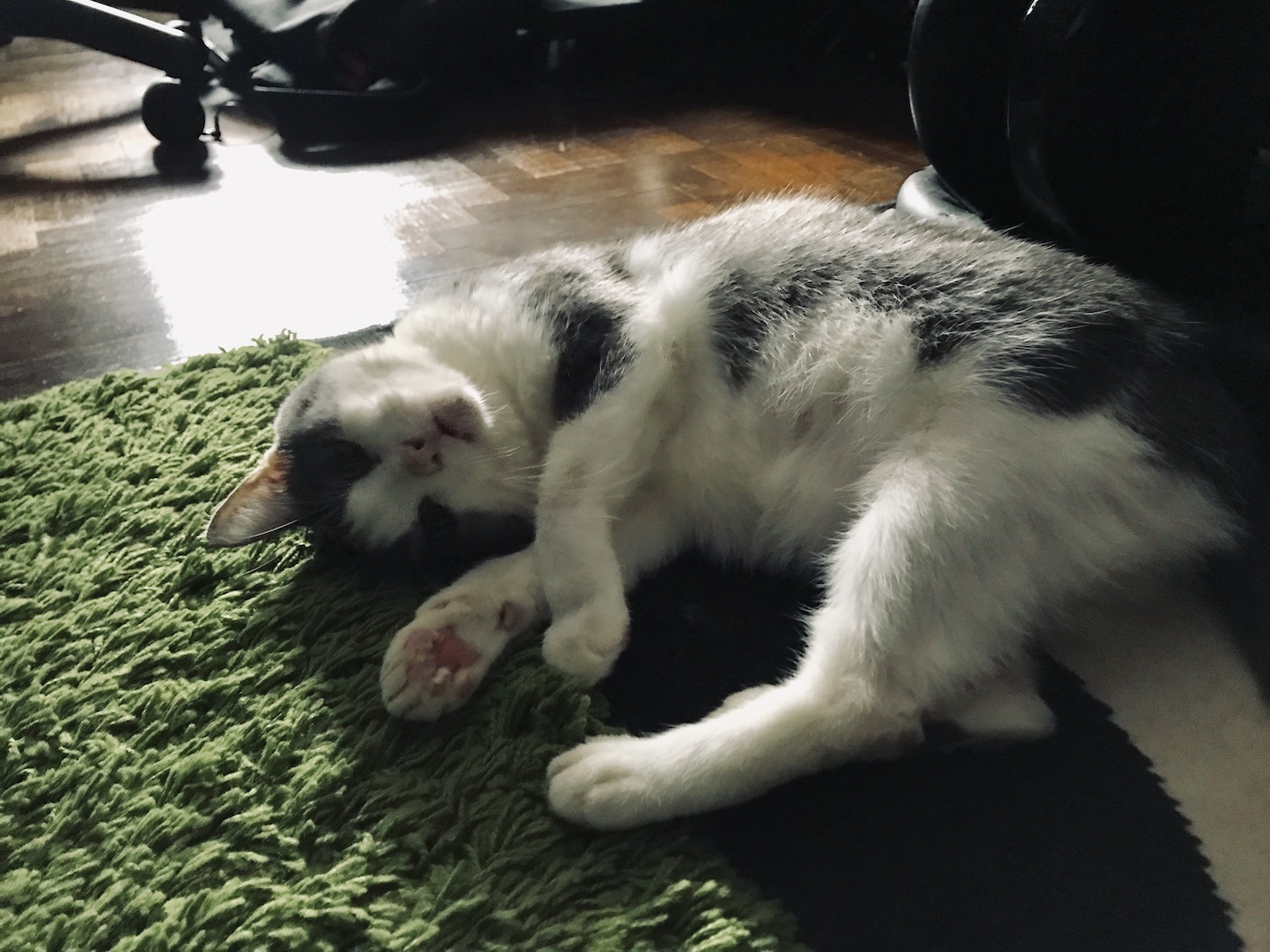
Joan and Cedric’s cat.
What are your individual reasons for wanting to be child-free? What makes you feel that way?
Joan: Being career driven and understanding the repercussions of being a parent to a child that needs almost a 30-year (or more!) commitment is too much of a balancing game to me. I like to plan for the future, and I would prefer to see myself in a relaxed state of mind when I am old and wrinkly.
Cedric: I’ve never liked children or the costs involved in their upkeep. Even as a child I found other kids annoying. Then over the years I realised how much money my parents spent raising me and I thought, “Man if I ever had that money I’m keeping it for myself!”
Why do you think you want to be child-free when many other people feel strongly for the exact opposite? Is it something about your personality, or past, or…?
Joan: Firstly, I hate to fail. To me, being a parent is daunting as managing a young one is not easy and you’d definitely be criticised no matter what you do. Secondly, being an educator, I think I have “parented” enough for a lifetime. I do enjoy watching my students flourish, but I don’t think I can come home to another batch of children and unwind at the same time.
Cedric: I’m an only child, and even during extended family gatherings I never liked playing with most of the other kids my age—I would either be reading or playing Gameboy by myself, or listening to the adults talk.
What’s the best part about being a child-free couple, and what’s the worst?
Joan: Best part: I get to spend my money on relationships, self-care, health care that many put off if they have kids due to financial allocation. I also have less stress should I face a period where I do not have income coming in. The worst would probably be having to face relationship challenges head-on without an external distraction (but it is something I’d prefer than avoid) and missing out on “family nucleus only” financial subsidies from the government.
Cedric: The best part is not having to reshape and plan our entire lives around a child, not just financially, but socially and emotionally. I really can’t think of a downside!
How have the people around you reacted to your decisions to be child-free and how have you dealt with their reactions beyond ignoring them?
Joan: Well, clearly it is not supported by the family. My mother tries to convince me that having a child is equivalent to adopting a puppy. I’d much rather adopt a puppy.
Cedric: My parents don’t really care. I think having seen how I turned out they probably secretly agree that it’s best I don’t breed.
Another one of Joan and Cedric’s cats.
The Singapore government is trying its best to encourage more Singaporean couples to have Singaporean babies. What do you have to say to them?
Joan: Economically speaking, having a growing birth rate would help the country on a macro scale. However, it comes with intangible responsibilities that are not well supported by the government. One area that comes to mind is definitely postpartum depression.
Cedric: No thank you, have you seen the cost of living lately?
What advice do you have for those intending to spend their lives child-free too?
Joan: Don’t get evangelical over it. It is a choice that is outside of the norm. However, do plan well for the future—especially when explaining your choice cordially or to even stave off loneliness when you get older. Personally, I have a bucket list that I consistently strive to check off in different phases of life. I think it’s a pretty fun thing to hone and helps you grow outside your comfort zone.
Cedric: Live the way you want, not how society tells you to. And invest in quality contraceptives or make skilful withdrawals.
Which 3 things or people are most important for those wanting to be child-free?
Joan: Your support system, your plan for the future, to be flexible to change.
Cedric: Your accountant, lawyer, and real estate agent. They’ll be invaluable in helping you spend and manage the money you’ll be saving by being child-free!
Which place is most useful?
Joan: …
Cedric: The place without any children.
More of Joan and Cedric’s cats.
Lastly, what if… just what if… you end up with a child anyway by the hand of fate?
Joan: Abortion is the first route we’ve agreed on. Firstly, it’s not as dangerous as it seems. Secondly, giving the child up for adoption may leave a child traumatised in future anyway.
Cedric: Yes, and the hand of fate will be given a firm slap on the wrist.
Joan plans to work on her career, work on her bucket list and improve relationships with friends and family in the next year. Cedric says he’ll be working on a Death Metal album for children about being child-free—“I’ve already booked a kindergarten to record in.” You can find out more about them on Joan’s website, minimalisminsingapore.wordpress.com.
Before becoming a minimalist, Joan enjoyed buying things on the fly just because they were quirky or seemed useful or were cheap. In her early 20s however, she jumped headlong into the minimalist lifestyle and changed her living habits entirely. Now that it’s been almost a decade since she adopted minimalism, we asked her what that’s been like.
“Stop buying shit to impress people who don’t give a shit about you.”
Q: Hi Joan! Thanks for talking to us! Before we go further, can you explain what it means to be a minimalist?
A: Hello! To keep things concise, to be a minimalist equates to being someone who lives life with intent.
How did you end up as a minimalist?
I have always been enamoured by the chicness of Japanese meets monochromatic décor, as well as elements of the spartan lifestyle of vagabond meets cyber-punk/grunge from The Matrix and similar sci-fi movies.
However, after graduating from university at age 20, I had my first existential crisis on what do I want to do with my life. That lead me down the rabbit hole of a minimalistic lifestyle.
All that Joan keeps in her purse these days.
Can you describe what your living space was like before you adopted minimalism and how it looked after you did?
As most Singaporeans do, I lived with my parents for most of my life. It was incredibly cluttered with no personal line drawn. However, post decluttering, my desk is pretty much empty.
How did your routines change as a result of you adopting minimalism?
Wow. Honestly, the change was a huge relief to my mental health after making the switch. But it did take a few years to figure out what works and what does not.
Before, it was haphazard as I did not follow a routine and was constantly worrying that I’d be late for school or work. Additionally, not everything I did was beneficial to me. From worrying about what to wear (which ends up being the same few outfits) and what to do next. It led up to quite a bit of mental fatigue.
Thus, my younger self thought it was a huge waste of time and energy to not have a simpler routine.
Nowadays, it is a bit more structured but it’s on auto-pilot. I wake up to feed my two furry bottomless pits at 8am. After which, I would exercise and get my coffee. I start work at 1PM but I like to have a lot of time to myself in the morning, time block my priorities for the day and spend time with my partner and cats before that.
My job is fast paced, but thanks to time blocking in advance, I don’t have to use mental energy to think about what to complete in a limited time span.
So what did you have to actually do to become a minimalist? What did you have to throw and how long did the whole process take?
To become a minimalist, I think you need a lot of dedication and commitment to a lifestyle that really limits your ability to accumulate baggage, physical or otherwise. It really throws you into a monthly reflection cycle. If you do not find introspection and being intentional with your choices a source of joy, minimalism is really not a lifestyle to hop into.
The first time I decluttered was in my early 20s. But I recall bringing over 7 huge garbage bags of rotted textbooks, ill-fitting clothes that were crumbling into shreds to the garbage collection bins. Additionally, I discarded or donated almost all of my shoes (over 50 pairs) that were purchased because they were pretty, but barely used. Soon, they too disintegrated or were not worth selling off.
The whole process is ongoing, but I believe the first 3 years is integral to learn to pace yourself on what and how to declutter to prevent any more regrets or impulsive discarding.
Which was the hardest thing to do for the above and which was the easiest?
Hardest was definitely selling my CDs away. They are so sentimental (and expensive) to me but I don’t even have a CD player now. Even though I ripped them, I don’t play them as well. I only listen to a few albums (funnily enough, it’s also those I kept) on Spotify. My only worry now is if Spotify is taken away from my life, I might just die.
The easiest was definitely decluttering stuff that needed to be discarded like crumbling clothes, books etc.
Joan’s desk back in 2019.
How did the people closest to you react to your decision to become a minimalist? And how did you react to their reactions?
It was a mix of skepticism and encouragement, really. My friends and brother were onboard. However, I learnt that my mom was very much a sentimental person who did not like to part with things. Throwing away things around the house that clearly needed to be discarded caused quite a lot of friction between myself and my mother.
So what’s life like for you now that you’re a minimalist? Do you think it’s better, or worse?
Easier. There’s no turning back for me. It’s probably one part of me that I do not regret honing from a young age.
Is there any part of your non-minimalistic life of before that you miss?
Indulging in a more colourful wardrobe. I do have a few pieces that are not black, but I still rarely wear them. They are my designated “ran out of clothes” days or for occasions that call for some colour in the ensemble.
How many items do you own now and which 5 are most important?
I don’t count how many items I own as things are transient as we use them up, repurchase, get gifted etc.
My 5 most important (physical) items: Hair straightener. Work essentials (Phone + laptop). Make up (not 1 but I use the same palette daily, just switching up the intensity when needed). Supplements (saving grace for energy, cramped muscles and brain fog). Good Coffee.
Which 3 places are most useful for you as a minimalist?
A quiet space to introvert. A chill out bar to chill with friends. A well-equipped kitchen to reconnect with your food and body.
Can you list 3 things you realised only after leaving consumerism behind?
The things I own can define me only to a certain extent. The more accessible something is, the easier it is to lean towards purchasing those items. Happiness comes from you assigning that emotion to that purchase or experience.
Joan’s desk in 2020.
What advice do you have for those currently thinking of becoming minimalists too?
Don’t be overzealous. It’s not a cult, it is a lifestyle. It’s ok to take a break from this lifestyle.
What advice do you have for humans in general?
Stop buying shit to impress people who don’t give a shit about you. Instead, try to show them that you care about why they do certain things. Some will let you in, some won’t. Cest la vie.
Lastly, if you don’t spend your money on stuff, what do you do with it?
Investing in dividend stocks/bonds (because I have no energy nor interest in higher risk financial instruments). Invest in relationships I treasure. Invest in my bucket list.
Joan in Aug 2020.
Joan is presently working on her career and bucket list, improving relationships with friends and family deliberately and growing the awareness of minimalism and how it can help the mental health of those with fast-paced lifestyles. You can get more minimalism tips from her at her blog, minimalisminsingapore.wordpress.com, and Facebook page, or discuss your own minimalism journey using the comment box below.
15 years ago, depressive symptoms led to T getting her first diagnosis of mental illness. 5 years after that, after having a hypomanic episode, she was diagnosed with bipolar disorder. We reached out to find out what it’s like to be in her shoes, and what a regular person can do to help.
* Trigger Warning: The following interview involves a discussion about self-harm and suicide. Please do not read on if you may be sensitive to such topics.
“Getting diagnosed actually felt freeing and empowering to me, as I finally felt that my constant lifelong struggles were validated.”
Q: Hi T, thank you for coming on to share your story. Could you tell us a little bit about yourself and how old you are now?
I’m a 36-year-old Singaporean Chinese woman. I’m single but currently have 2 furkids (I used to have 5 but the others have since passed on). I work full-time in customer service.
When did you first realise you had bipolar disorder and how did you end up getting diagnosed?
I was initially officially diagnosed with major depressive disorder (MDD), anxiety, and personality disorder in early 2005, weeks before my 21st birthday. It was only after my first hypomanic episode in 2010 that the diagnosis was changed from MDD to bipolar disorder type ii.
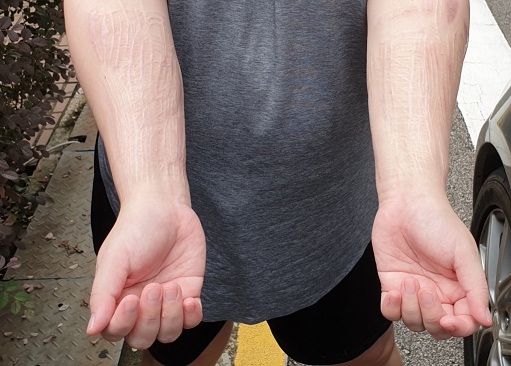
By my first visit to the Institute of Mental Health (IMH) in 2005, I had been self-harming by cutting my arms with a razor blade for several years already. However, the cuts were getting deeper and more frequent. I also cried daily for no identifiable reason, and had constant suicidal thoughts and feelings.
Prior to my diagnosis by my psychiatrist at the IMH, I saw a University counsellor who told me that there was nothing wrong and I had no reason to worry, despite his full knowledge of my symptoms. One day, after having inflicted several severe cuts on my wrists, I felt so desperate that I decided to visit the polyclinic to request for a referral to IMH. However, a referral appointment would take weeks or months, and the doctor who attended to me was alarmed at the severity of my symptoms so she wrote a memo for me to be seen at IMH A&E that very same day. It was my psychiatrist at IMH who eventually diagnosed me, first with MDD and subsequently with bipolar ii disorder.
A portrait sketch of T. “Done by a dear artist friend sometime during the first 2 or 3 years of my diagnosis (which he was aware of).”
In hindsight, what were the earliest symptoms you had and how old were you when those happened?
I first hurt myself at age 14 by clawing at my own arm with my nails until I drew blood. After that incident, the next time I hurt myself was when I was 18, by cutting my arms with a razor blade. The self harm became regular then, and slowly became a daily affair.
By the time I sought medical treatment, I was cutting myself several times a day. It took several years of treatment by my psychiatrist at IMH until the frequency of the self-harm decreased. By my 30s I only cut myself on a handful of occasions a year, and in the past 3 years the frequency has diminished to only about once a year, and the cuts are less deep and scarring.
This self-harm was the most visible symptom of having a mood disorder. However, looking back, there were signs that I had already experienced depressive episodes since childhood. The earliest I remember was when I was around 7 or 8 years old. I had extremely poor self-esteem and would have bouts of crying for no reason. And when I was 12, I was obsessed with suicide, although I did not have severe suicidal thoughts or feelings then. It manifested in me drawing fake scars on my wrists and bandaging them as if I had real wounds. My Chinese teacher thought the scars and bandages were real but I don’t recall if she did anything to help. So, in essence I have had depressive tendencies, thoughts, and behaviours since childhood.
How did it feel to be diagnosed with bipolar disorder? How old were you then and how did you think it would affect your life?
I was just about to turn 21 when I received my first psychiatric diagnosis of MDD, anxiety, and personality disorder. 5 years later, at 26, I had my first hypomanic episode and the diagnosis was changed to bipolar type ii disorder.
I never thought about how it would affect my life because as mentioned earlier, I had actually had depressive tendencies since childhood, so to me it was all normal. I was used to a constant low mood, crying often for no reason, and an obsession with self-harm and death. Frankly, getting diagnosed actually felt freeing and empowering to me, as I finally felt that my constant lifelong struggles were validated, they finally had an explanation and I wasn’t just being self-absorbed and self-pitying.
Were your first presumptions right? Is living with bipolar disorder what you thought it would be?
I didn’t go into this with any presumptions. As mentioned earlier, I had lived a life of dysregulated mood, and had been displaying symptoms for years, so this was status quo for me, just that now I had a name for it and I had people (my Dr) who cared, understood, and wanted to help. Other than that, I was too busy crying, cutting myself, and trying not to commit suicide to think about how my life would change after diagnosis.
Can you describe what bipolar episodes are like for you? How often do you have such episodes?
I have type ii bipolar disorder which involves depressive episodes as well as hypomanic episodes.
My first hypomanic episode was in 2010 and I have only had a few more over the years since then. However, the rest of the time that I was not hypomanic, I was deep in the depths of severe, suicidal depression, since around the time I turned 18.
I think most people understand depression, including the feelings of hopelessness and worthlessness. Perhaps less understood would be hypomania. My mind would race non-stop, 24 hours a day. I would survive on a couple of hours of sleep a day, even without drinking coffee. I was constantly writing things down in my notebook which made sense to me at the time, but later on after the episode I wouldn’t fully understand the notes. They weren’t exactly gibberish, just that there was no point or sense to them. I felt euphoric, on top of the world, the complete opposite of when I was depressed. I constantly had new ideas about the amazing things I could and would do. I had slightly delusional thoughts like thinking I could become a famous successful person.
Thankfully, my few hypomanic episodes over the last 10 years have only lasted a week or two each time. In the past few years I have had periods of 2 or 3 days when very mild and slight hypomanic symptoms would appear, but I would not categorise them as full hypomanic episodes. I am careful not to let myself feel as if I am flying, I am careful to recognise the signs and thankfully so far I have not needed to seek extra help or support during those periods. As for the severe, constant depression, it finally eased in late 2017 and I am very carefully cautious when I say that my depression has been much milder in the 2.5 years since then.
“Not all mental illness is only in the mind. My scars are proof of my survival and I am not ashamed of them.”
What was your worst episode like?
In terms of depression, I was pretty much at rock bottom from 2005 to 2017. I cried and cut myself daily. I was constantly suicidal. It was pretty much one long episode.
In terms of hypomania, the worst episode was my first in 2010. I couldn’t focus at work as my mind was constantly racing and flitting from one new idea to the next. I was planning my sister’s bachelorette party and it was extremely hard to concentrate on what I needed to do to make it happen. However, the energy from the hypomanic episode did help in motivating me to arrange all the logistics and procure all the items needed for the party within just a couple of days, whereas my normally-depressed self would have had no energy whatsoever to leave the house even once a week. Not that hypomania is a good thing, but it can make people very productive. But not necessarily in the right ways or directions.
How is your bipolar condition presently being managed? What medications or treatments are you on and what do they do?
Currently my condition is managed by taking daily medication and seeing my psychiatrist monthly. The psychotropic medication I take includes: Antidepressant, Mood stabiliser, Antipsychotic. I also have medication to ease anxiety and promote sleep, which I take as needed.
Do you have any plans to get off those medications someday? Why so?
I don’t have any plans or intention to stop taking medication anytime in the future.
I have been on psychotropic medications to treat my mental illness for 15 years without any breaks in between. Medication has changed my life. I tried several different antidepressants before I found the one that worked for me, and I remember very clearly that it was “like flipping a switch”—I was in such a dark place before medication but once I found one that worked, it was like a small light was switched on and it helped make it less nightmarish to get through each moment.
I have tried before to reduce dosages of my various medications. At one point, I was taking 120mg of antidepressant daily but I have since reduced to 30mg. However, my attempts at reducing others like the mood stabiliser have not been as successful, as even small dosage reductions made the symptoms return. Some months ago, I also inadvertently ran out of antidepressants for a week, as I had left my bag of medication at the hospital pharmacy and didn’t have time to go pick it up before running out of antidepressant. That one week was pure hell for me, as the severe suicidal depression returned and I was crying daily and almost unable to cope with work. Thus, that “accidental stoppage” of a medication has showed me that I need a certain minimum dosage to continue to function, so I don’t have any plans to try cutting down on medication any time soon.
Some people like to shame others who are on medication for psychiatric conditions, saying that we should just use “natural” treatment methods such as yoga, exercise, and healthy eating. Some people say it’s bad to keep putting chemicals into our bodies. I don’t share those sentiments. I feel that if a person needs pharmacological therapy to help with the treatment of an illness, then they should be allowed to do so without being shamed.
I have accepted that I may need to be on psychiatric medication for life, but it is this that helps me to stay functional, to keep a full-time job and not to stay in bed crying and cutting myself daily. No one should be allowed to shame me for that, just as no one should be allowed to shame others for depending on spectacles to correct their vision.
The medications T has to take on a daily basis.
Which 3 items or people help you most when it comes to coping with your bipolar disorder?
My cats definitely help me to cope with my bipolar disorder. They are calm and comforting, always there for me, and always showing me unconditional love.
My family (parents and 2 siblings) are also a source of support. I have always been close to my siblings, but my relationships with my parents has only improved within the past 5+ years. My family provides emotional support but also sometimes financial support, such as during the period when I was jobless and unable to afford my treatment at IMH.
Finally, having my razor blade and medications nearby at all times helps me to know that it’s always there just in case I need it. Cutting myself helps release tension and brings about calmness and brief relief from the emotional pain, so even though I seldom cut myself any more, it’s still comforting to know I have the tools to do so if I need. This may not be a healthy coping mechanism, but it works for me at this point in my journey. Having my medication on standby also helps me to know that I can take an anxiety pill or sedative in the event that I really need it.
Which place helps most?
My bedroom is the centre of my world, one of the only places where I’m really allowed to be myself. I’m extremely introverted and need a lot of time alone to deal with my bipolar disorder and anxiety, as well as to rest and recharge after spending time with others.
Apart from my bedroom, the IMH hospital has also come to be a safe space for me, as I know there are medical professionals around who can help me. I have had many sessions with my psychiatrist and psychotherapist at IMH which have brought me healing and recovery, and many of the other staff (nurses, administrative staff) at the clinic are also very helpful in dealing with patients who are not coping well. And I get my medication from IMH, which as I have mentioned is crucial to my day-to-day functioning. So, being at the clinic helps me to feel safe and validated.
What advice do you have for those who’ve only just been diagnosed with bipolar disorder?
Learn as much about the disorder as possible, so that you can recognise the signs and symptoms.
Understand what treatment is helpful, and stick to a treatment plan even if it doesn’t seem to be working at first. It took me years to find a treatment plan (including medication) that worked.
Hang in there. Build a support network—family, friends, pets, your healthcare professionals (even my GP helps briefly counsel me when I have acute episodes, and lets me know if he thinks I ought to seek emergency treatment at IMH A&E).
Have a structure and routine, it helps a lot to have a fixed schedule so that when you are too depressed or hypomanic to think or plan rationally, you still have a sensible routine to follow whilst you wait for the episode to be over.
And don’t be ashamed to reach out for help. You don’t have to go through this alone.
What advice do you have for everybody else when interacting with those with bipolar disorder?
Just like with any mental illness, people with bipolar disorder are not freaks or mentally deficient. There is a lot of stigma and many people think that persons with mental illness should be relegated to simple, menial jobs where they don’t need to interact with other human beings, as people fear that all mentally ill people will cause harm to people around them. This is not true. So many people with mental illness are smart, intelligent, kind, empathetic human beings. We just need you to educate yourself, seek the truth about mental illness, and be supportive instead of stigmatising us.People with bipolar disorder can suffer from extreme moods and mood swings. Please understand that these are not under our control, and we don’t mean to harm you or take it out on you. Look for the signs and symptoms of episodes, and provide support (including encouraging the person to seek treatment) where possible. If not, just be there for us. You won’t know how much it means to us for you to do so.
If you would like to ask T questions about mental illness or show your support of her, you may do so using the comment box below.
More interviews with people who have been through grief or other physical or mental hardships. available here.
Photographs courtesy and copyright of T. Interviewer: Sy Sponsor or support The Strong series here. Want to be featured too? Tell us here. If you found this article useful:
21 years ago, Oliver Chong, a theatre professional we interviewed earlier this year, developed the symptoms of schizophrenia. He began having symptoms once every 3-4 days, then once a month, once every 3-4 months, once every year, till finally years would go by before he developed further symptoms. We had a chat with him about his journey with schizophrenia.
“I decided that I had to observe and study it in order to overcome it. I had to behave and look normal when it comes so that nobody could tell. I had to figure out the trigger. But first, I had to overcome my fear of it.”
Q: Hi Oliver, thank you for returning to share another side of yourself with us. Let’s talk about schizophrenia this time. When did you first realise you had it and what were the symptoms?
When I was nine. I didn’t know that it was schizophrenia until I was twenty-two.
It felt like someone had suddenly put a fish bowl over my head. The surrounding sounds suddenly became distant, like how you would hear them from inside a fish bowl, except that the sounds are now at half speed. Not only so, as far as my eyes could see, everything that moved also appeared to move at half speed. So everything that I could see and hear was in slow motion. On top of all these, there was a perpetual noise in the more distant background. It sounded like it might have come from a kitchen with many people holding unintelligible conversations with one another, over the noises of pots and pans.
In the beginning, I was very afraid and confused. I waved my hand in front of my face with all my might to make sure that it was really moving fast, but all I saw, was my hand waving in slow motion. When I talked, I heard myself speaking in a dragged-out fashion, but I really wasn’t. I told my mother about it and she was as clueless. She said perhaps I was just too tired and told me to go take a nap. Indeed, a nap always worked. The next morning I would be back to normal, until the next time it was triggered.
After a while, I decided that I should confront it instead of sleeping it out. I decided that I had to observe and study it in order to overcome it. I had to behave and look normal when it comes so that nobody could tell. I had to figure out the trigger. But first, I had to overcome my fear of it.
When it’s triggered, people would tell me that I was moving and speaking “too fast”. And I realised that I had inadvertently moved and talked faster than usual because everything appeared slow. I had to manage and adjust the speed of my movement and speech, and not be misled by my warped perception of time.
I studied the pattern, duration, frequency and circumstances under which it would be triggered. And then, I would experiment with putting myself under different circumstances, to find one that might be able to stop it. But as soon as I figured all these out, they would all change. And I would have to repeat the whole process over and over, like it was playing catch with me. However, the duration and frequency of the “visits” had decreased steadily over the years.
Over the years, I have long overcome my fear of it. And the process of investigating it has become a welcomed distraction from the mundane. Like a game with a friend of many years. The frequency of occurrence and duration has decreased so much and I would miss it and feel delighted when it “visits”. I wouldn’t want to do anything to make it go away because it would only “stay” very briefly. I would even feel a tinge of sadness when it “leaves” because I wouldn’t know when I would see this “friend” again. The last time it visited was at least four years ago, when I was in my late thirties.
It was only through consultation with a psychiatrist when I was twenty-two that I got to know its name.
How did it feel to be diagnosed with schizophrenia? How old were you then and how did you think it would affect the rest of your life?
Surprised. I only got to know that it was schizophrenia when I was twenty-two, after living with it for thirteen years. I had long gotten used to it by then and had managed it so well that nobody ever knew and it didn’t bother me at all. I felt very very lucky that I’ve had it easy, knowing that many people suffered and struggled with it. I did not think it would affect the rest of my life as I was confident I could manage and cope with it.
Were your first presumptions right? Is living with schizophrenia what you thought it would be?
I was right. I have been coping well so far. Though the symptoms are no longer a cause for worry, I do experience bouts of depression occasionally, a possible spin-off from the condition, which I have to fight and fend off.
Can you describe the last time you had a schizophrenic episode? What was that like, what triggered it, and how long ago was it?
It was at least four years ago. Please refer to the symptoms in the above response (fish bowl auditory, warped auditory and visual perception of time; and “voices”).
At the very beginning, the trigger was always stress and anxiety, and under the condition when I was alone in a quiet place. The remedy was to go to somewhere noisy with people and the duration of the episode would be shortened.
Once I figured out this pattern, it evolved. And the condition became that when I was with many people in a very noisy environment. The remedy was to go to somewhere quiet and be alone.
And then, the condition rule stopped applying. The remaining constant was still stress and anxiety. The remedy was to ignore it and focus on what I was doing. I wasn’t bothered by it because I could function as normal and I could be doing a presentation in a meeting with people and nobody could tell.
And finally, no rules. Not even stress. I could be on a holiday trip in the mountains when it happened. By then, the frequency of the symptoms was like once a year, and I was more than happy to welcome this “friend” of many years. I would enjoy its company and feel nostalgic when it leaves too soon.
What about your worst schizophrenic episode? What was that like?
The worst was at the very beginning when I was very afraid and confused with what I was hearing and seeing that was obviously different from everybody else’s. The harder I fought it, the worse it got, and I could hear my heart thumping very loudly in my head and it felt like my brain was going to explode. All I could do was to force myself to fall asleep and it would be gone when I woke up.
How has your schizophrenia been managed since your diagnosis? What medications or treatments have you had to cope with it?
The way I had been managing it years before the diagnosis. No medications or treatment. Though the psychiatrist I consulted with when I was twenty-two did prescribe me something, I didn’t follow [the prescription] because I had been coping fine all those years without any.
LUCK-IT will receive a tiny commission when you purchase this product, at no additional cost to you.
Has the diagnosis of schizophrenia affected your relationships with other people in any way? At work, at home, or romantically?
No. Very few people even know about it until I told them.
What about physically? Is there anything you cannot do now because of schizophrenia, or anything you must do to avoid further symptoms of schizophrenia?
No.
You are a creative person by profession. Has there been any positives to having schizophrenia in that regard?
I wouldn’t know as I grew up with it. Perhaps the positives of experiencing something more than people without it? I realise, perhaps the years of dealing with the symptoms have made me very sensitive to space and time and others’ perception of it. This sensitivity is especially useful in my work as a director, actor and designer.
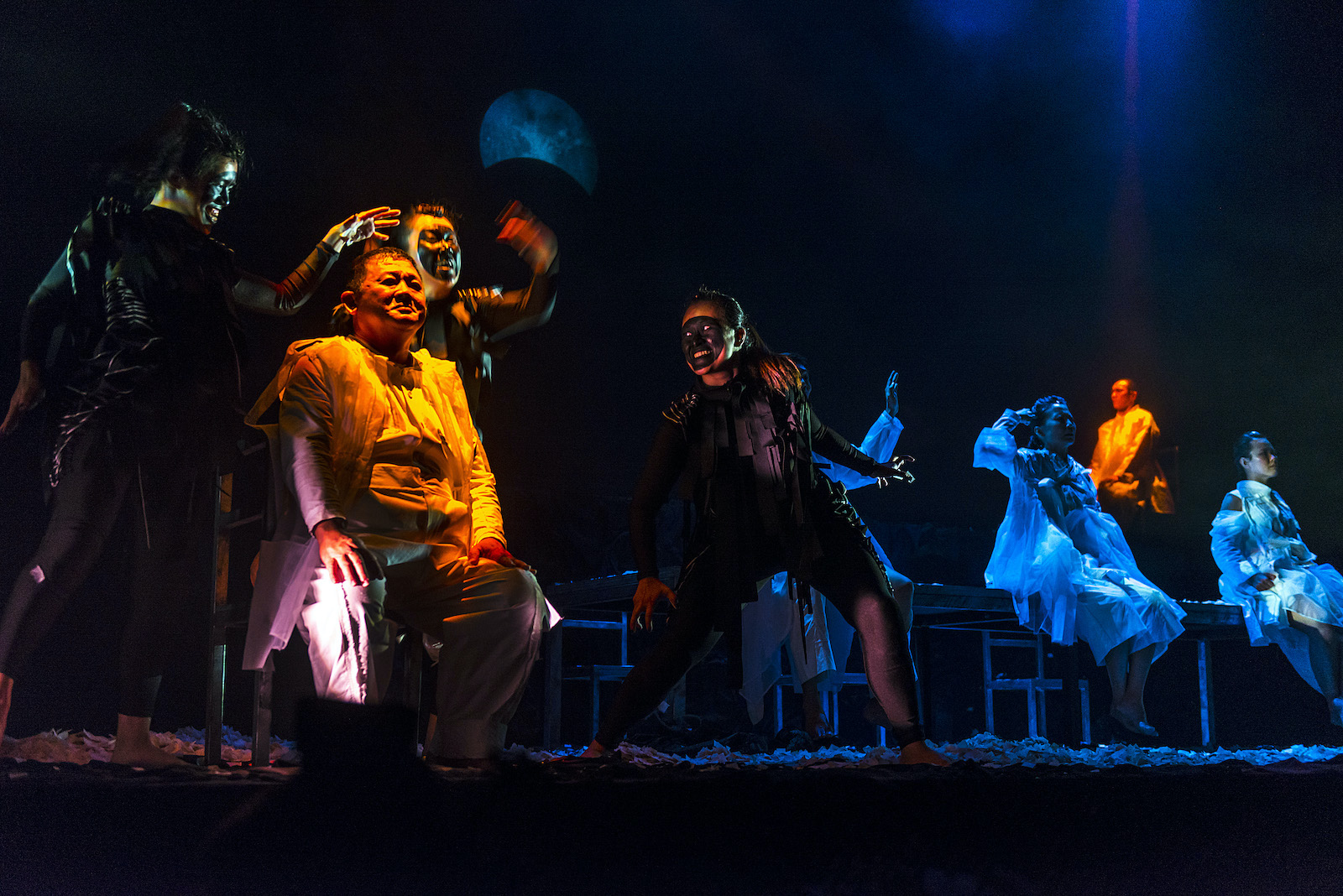
A production Oliver was in during which his experiences with schizophrenia served as a source of inspiration.
Which 3 items or people help you most with your schizophrenia? Why?
I can only think of one, and that would be how my dad had brought me up. He had always said that we should confront our fears, that we should always strive to choose fight over flight from our weaknesses, and there is more than one way to fight them than with just brutal force.
Which place in Singapore helps the most? Why?
Then, it changed according to the evolving trigger conditions. For noisy places, Orchard Road or hawker centre. For quiet places, library or the store room at home.
What advice do you have for those who have only been diagnosed with schizophrenia?
I wouldn’t dare. Not from someone like me who had it easy. Perhaps my dad’s advice might work for some people, but please listen to your doctor.
What advice do you have for those without schizophrenia, when interacting with those with schizophrenia?
Do not confuse sympathy for empathy. People with schizophrenia don’t need your sympathy.
What have you learned from having schizophrenia that you didn’t know before?
The fragility and reliability of reality.
Lastly, looking back to your childhood or younger days, were there any indications you might one day grow up to have schizophrenia?
I had it when I was nine. I did not see it coming at all. Not that I knew anything about schizophrenia then anyway.
Oliver will be striving to foster more collaborations with local and international artists over the next year. He hopes that his works and practice will continue to be desirable to his audience and relevant to the times. You can follow his work at his Facebook page or ask him more about schizophrenia using the comment box below.
More interviews with people who have been through grief or other physical or mental hardships. available here.
Photographs courtesy and copyright of Oliver Chong. Interviewer: Sy Sponsor or support The Strong series here. Want to be featured too? Tell us here. If you found this article useful:
Sean Munger first became an atheist after doubting Christianity at age 13, but later found himself with the same doubts about Atheism at age 36. At age 42, just 5 years ago, he converted to Judaism. We asked him why he made all of those decisions.
“When you sense the eye of God looking at you, it’s kind of hard to take atheism seriously after that.”
Q: Hi Sean, thank you so much for agreeing to share your experience with us. To start, could you share how you ended up as an atheist?
A: I kind of drifted into it. My family was nominally Christian but in practice not very religious; I remember going to church last when I was about 6. In my early teens I began questioning why people believed stories in the Bible as true. The story of Noah particularly bothered me. The hypocrisy and pettiness of religious right types—this was the 1980s—really grated on me, and I began to conflate, as many atheists do, fundamentalism and religiosity in general. From a rational standpoint the universe made much more sense without God than with Him. By college I was fairly entrenched, and even somewhat militant. God definitely did not exist!
What was life like for you as an atheist? What was compulsory, what was forbidden and what was most important?
At first, there really wasn’t a “code.” The rise of the Internet in the 1990s and early 2000s started to change this, and atheism became sort of a cult. Fans and followers of public atheists like Richard Dawkins, Sam Harris and Christopher Hitchens increasingly began to define atheism as a belief system, but it was based not on a set of positive beliefs, but upon antagonism to others’ beliefs. What was most important was not giving any quarter, not even considering the possibility of the existence of God. It was a badge of purity and of moral achievement to be absolutely certain in your own non-belief, which usually manifested itself in maximum hostility to the views of others regarding religion. So, what was most important was “virtue signaling” how deep and perfect your own atheism was, which usually meant going on the attack against religious people or ideas. For an example of this, try mentioning the words “Mother Teresa” to a group of atheists online, and watch how quickly they rush in to demonize her.
When then did you first start having doubts about atheism? What triggered your doubts?
My very first job, in high school, was as a counselor at a summer day camp run by a Jewish community center. They did not require you to be a Jew or have any kind of belief to work there. Though I wasn’t part of their faith, I loved their songs, their culture, the sense of shared community and the joy they took at being part of that community. The theology was incidental. I always considered myself a spiritual person, but while I was an atheist I was careful to define my belief in non-sentient terms. “I believe in nature” or “I believe in a cosmic balance of the universe” were things I would say. When I was in my late 30s I began to consider, if I truly believed in “nature” and “balance,” whether it was so far a jump from believing that to consider whether “nature” and “balance” could themselves be sentient and could have a consciousness. If they did, that could only be described as God, or at least some sort of God. So I realized I could no longer be certain that God did not exist.
I also realized that atheism lacked the means to explain at least half of the human experience. Rationality and “show me proof” works very well for things in the tangible and measurable world. The world of the mind and heart, the world of artistic expression, creativity, and meaning, works along a totally different set of rules, where measurement and “proof” are useless. How can I “prove” that I love my family, or that a Michelangelo painting is beautiful? You can’t do it. Instead of trying to explain this aspect of being human, atheists generally ignored it. And most atheists I encountered weren’t really more contemplative about their beliefs than the fundamentalists they railed against. If it came out of the mouths of Dawkins, Harris or Hitchens, it was good and true. If not, they didn’t have much regard for it.
When people, especially atheists, hear that I’m an ex-atheist, most of them assume that I found “proof” that God exists. That’s not what happened at all. It was a much less linear or empirical process.
Sean when still an atheist. “Here I was in 2003, visiting Hamburg, Germany, ironically at a church (Nikolaikirche, the Gothic cathedral bombed out during World War II).”
How long did it take you to go from doubting atheism to deciding you had new beliefs? What pushed you past the point of no return?
I guess I started to have doubts in the early 2000s, but the “point of no return” was one moment on a very hot Saturday morning in July 2009. I was considering a lot of life changes (like going back to school to get my Ph.D. in history), had entered a new relationship (with my now husband), but life was still very fraught for me at the time. Apropos of nothing, as I was getting out of bed, I had a very strong sense that a powerful presence had its eye fixed on me. For an instant, and no more than that, the eye of God was watching me. What I sensed was God looking at me and thinking, “Okay, so how’s he doing?” and then concluding, “Oh, he’ll be fine. He doesn’t need my help. Move on.” And then His eye wandered off to look at someone else. It has never happened since and I don’t ever expect it to, but when you sense the eye of God looking at you, it’s kind of hard to take atheism seriously after that. Still, even after that it took a while to really commit to Judaism.
How does one leave atheism? Did you have to do anything special?
I don’t even know how you leave—write a letter of resignation to Richard Dawkins? One leaves atheism, at first, by conceding the possibility that God might exist. At that point you might be an agnostic, but you’re not an atheist anymore. Then you begin to explore the dimensions of God in your own mind. It’s about asking questions, not necessarily finding answers. This is what atheism, as a belief system, has so much in common with the fundamentalist religion it railed against: it professes certainty and discourages deviation from that certainty.
How did the people closest to you react to your decision to leave atheism behind? And how did you react to their reactions?
Most of the people close to me were casually, not devoutly, religious, so they were fine with it. My father, who is devoutly religious (Methodist) and became so late in life, was quite happy. I did have friends who were atheists who simply couldn’t understand it but generally they just shrugged. The people who were most hostile were, predictably, strangers on the Internet who were very offended by the choice that I, a person they did not know, had made. I posted a blog article about leaving atheism which got a fair amount of traffic. It was linked on atheist message boards and Twitter threads where people reacted angrily and concluded that I “never understood” atheism, or that I was never “really” an atheist. That, incidentally, is a logical fallacy called “No True Scotsman,” a profound irony considering that most atheists see themselves as governed by logic and reason. Some tried to debate me and angrily demanded I give them proof that God exists. Clearly they missed the point of what I was trying to say.
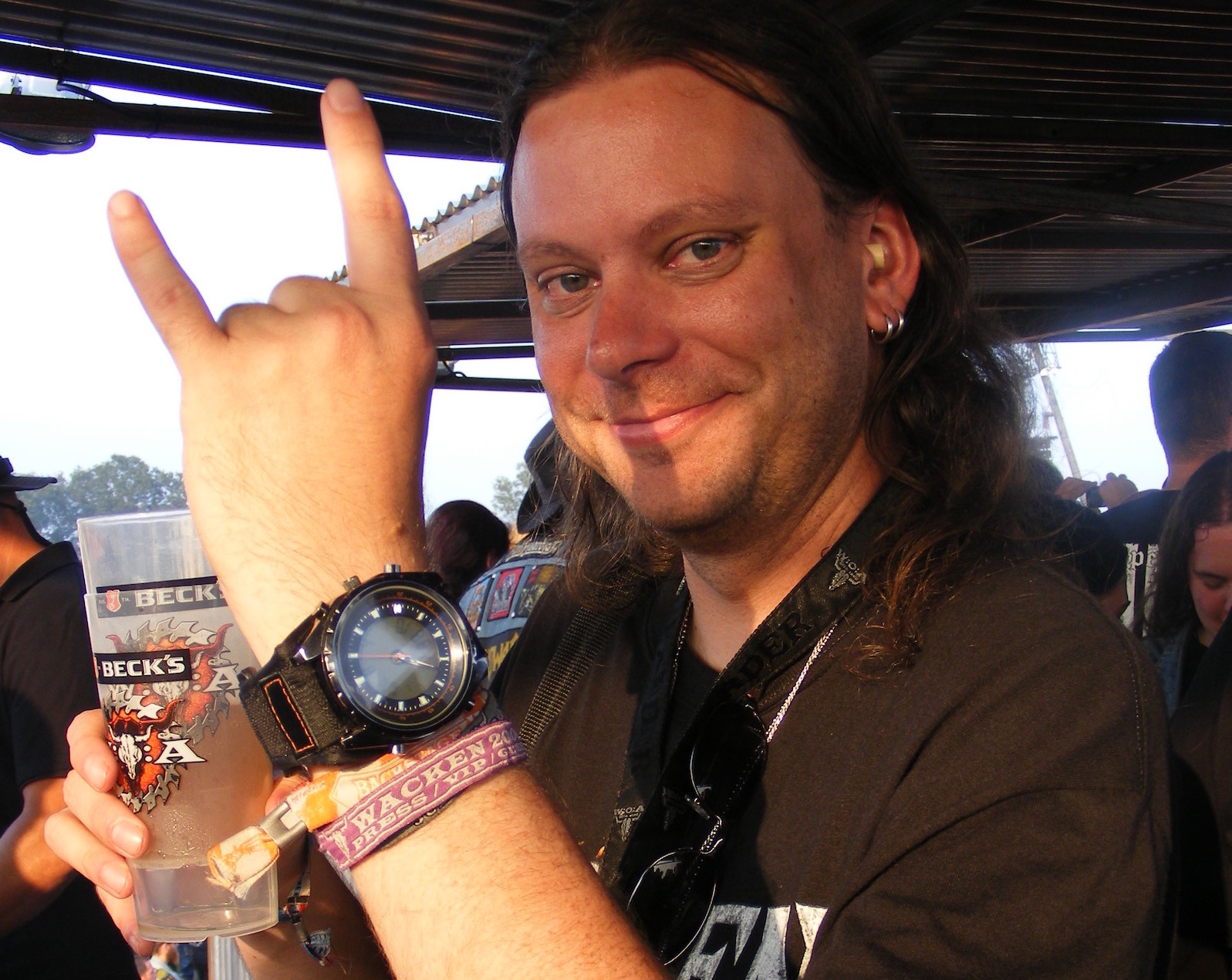
“I was at the Wacken Open Air heavy metal festival in Germany in 2011, about the time I was deciding to become Jewish.”
What’s life like for you now that you identify as a Jew? Do you think it’s better, or worse?
Much better. I’m now part of that community I admired when I worked my first job. I like to say that I was born a Jew, I just didn’t know it for the first 40 years of my life. Judaism works for me because it’s about questioning God, not finding certain answers, and because the Judaic tradition judges you as a person by what you do, not by what you believe. What other religion makes it a sacrament to eat freshly baked bread and drink wine to celebrate the coming of the weekend? We’ve been “thanking God it’s Friday” for 4,000 years. The holidays are beautiful. The sense of community is meaningful. It’s made my life much richer.
Is there any part of your life as an atheist that you miss?
No, I really don’t. Atheism gave me nothing of any particular value. I respect it as a belief and an intellectual tradition, but it did nothing for me, personally.
Which 3 people or things in your life are most important to you right now?
My husband; fighting climate change; and understanding the past.
Which item, bought or received after you became a believer of Judaism, has been most useful to you?
If you’re talking about physical items, I can’t really answer that. It’s not about material items, really.
Can you list 3 things you realised only after no longer being an atheist?
First, being a person of faith is not a betrayal or an abrogation of reason. It doesn’t make you “less rational.” The mistaken view I had of religion when I was an atheist was that it was basically a zero-sum game, that any belief of a religious nature was tantamount to being a fundamentalist. Atheists make a lot of good critiques of fundamentalism, but they don’t really have much to say to people for whom faith is a reasonable part of a well-lived life.
Second, most people, the vast majority, do not follow religions because they’re afraid of judgment in some sort of afterlife. Atheists often assume that religion is a form of extortion: “Follow this set of beliefs, or you’ll go to Hell!” That’s a ridiculous idea. Maybe that was true in the Middle Ages, but I don’t know anyone who seriously thinks that way now. As a Jew I don’t even believe in Hell; I have no idea what happens after death and frankly I doubt I’ll have time to worry about that until I do actually die.
Third, most people of any faith fully recognize that religion is a construct of human beings, not of God. It was people, not God, who wrote down the Torah and created the mitzvot and established the cultural and theological features of Judaism. Going back to the story of Noah, which bothered me so much as a kid, now do I literally believe it happened? Of course not. It’s just a story, like many stories in the sacred books of most religions. No one has ever asked me to take it literally.
A more recent photo of Sean. “My Tanakh sitting on the bookshelf, visible over my right ear.”
What advice do you have for those currently contemplating leaving atheism?
Don’t announce on Twitter that you are no longer an atheist—you’ll receive a ferocious tidal wave of abuse! Seriously, though, I would say that deciding whether you believe in God, or leaving the question open as a serious possibility, is not a moral failing. It won’t make you stupider or more irrational. You’re not suddenly going to wake up and want to join the Westboro Baptist Church.
Is there anybody you presently look up to, who you would like to learn from?
There’s a reason the wisdom of the Talmud scholars has survived for 1400 years. As I explore Judaism, I would like to learn more of that wisdom.
Lastly, what is your perspective on life and the afterlife now?
As I said, what happens in the afterlife doesn’t motivate me very much. I certainly do believe there are other universes and planes of existence besides our own, but whether I’ll ever see them I have no idea. In this life I think you have an obligation to try to leave the world at least a little better than you found it. This is one reason why I work on climate change—we have to reverse the effects of climate change, urgently, and I feel like I have to contribute to that project.
Sean hopes to continue to speak about, consult on and teach climate change and historical topics as much as he can in the future, and also put out another book soon. You can read more about him on his website, seanmunger.com or chat with him using the comment box below (“With the caveat that I do not wish to debate atheists (or anybody) on the existence of God. It’s been my experience that atheists think anyone who expresses a religious faith is eager to have this debate. In reality, no one other than atheists have any interest in having this debate. So please don’t send me demands for ‘proof’ that God exists. That’s not what this interview is about or why I did it.”).
More interviews with people who have left habits, lifestyles and religions available here.
Photographs courtesy and copyright of Sean Munger. Interviewer: Sy Sponsor or support The Exes series here. Want to be featured too? Tell us here. If you found this article useful:
Kinge from Kenya first began using social media when he was 18, and by age 25, found himself spending more than 2 hours a day on it, while being greatly affected by social pressure. A year later, he decided to quit social media for good, and did just that for the next 4 years, until he decided to go back to using social media less than a year ago. We asked him why.
“Social pressure is real. Observing it from outside makes it even clearer. You see people around you being controlled by other people, strangers and friends on the platform, trying hard to belong, fit in.”
Q: Hi Kevin, thank you so much for agreeing to share your experience with us. To start, could you share when you first started using social media? Which platforms were you on?
A: I first joined social media in 2008. Then, mobile devices’ penetration in this part of the world was limited. The network coverage was poor too, using 2G network on tiny screens mostly Motorola and Nokia phones. Internet in homes could only be found in the capital city and the other option was accessing a cybercafé, unlike today.
The most popular platforms then were Myspace and Facebook. Their popularity was growing. I joined both, they were both website platforms then.
What was life like for you when you used social media regularly? What routines did you have?
In the early years, social media was for a different use, it was a place friends could check on each other, communicate on a regular basis and share happy photos of good times spent. There were no individual profiles because they were wall based. They then changed the model to having a public and personal wall, then more platforms became popular such as Twitter, and later Instagram.
I loved using it in the beginning, it was plain, innocent and simple. Posting on the public wall, everything to your friends. Later, it evolved to platforms for displaying one’s lifestyles, status and a little about the general social life with friends and family. When it got to this, years just before I quit, there was always a need to keep checking and see other people posts, see what they are up to and an unnecessary drive to want to post, of places you’ve been, things you did.
I found myself wasting several hours per day, maybe 3 hours on social media, and instead of the joy that was, the feeling changed to want which brought pressure.
When then did you first start having doubts about having social media in your life? What triggered those doubts?
Around 2015 with the rise of social influencers.
This pushed the lifestyle and ‘notice me attitude’ a notch higher. There was real pressure among people to compare and show off. Basically the influencers’ work was to drive traffic to expensive products and destinations and get paid for that. Initially many people did not know it was a business and the desire to have such a lifestyle was fuelled with a few friends in your network managing to afford some of those lifestyles, creating pressure to most. I then saw friends go into debt-chasing lifestyles, others making bad critical life decisions trying to fit in and I will admit some pressure on my part to all this.
Social media felt like it was controlling the people, us, unlike in the beginning when we were using it for good, a place one would go to check on the digital album of genuine happy moments and say hello to friends in all regions of the world conveniently and affordably.
When then did you decide to quit social media? What pushed you to the point of no return?
I decided to quit social media when the intense drive for comparison grew to an unhealthy level, where someone would call to ask what you are up to, where you were during the weekend because you did not post these details on social media—the aim not to check on you but to compare. I quit because of the amount of pressure the platforms had. The amount of time wasted and loss of meaning pushed me to the limit.
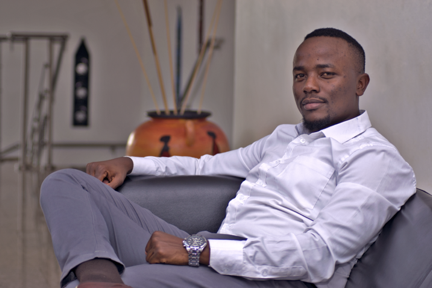
This is Kinge.
How does one leave social media? What did you have to do to get off it?
I don’t know if my method would work on others because I tend to have self-control. Basically, delete the apps now and do not install them back. Over time, you’ll forget about them and it becomes your norm. Find new activities to do with the extra time and grow the new habits; it can be reading a few chapters of a book a day, exercise, journaling or something other which will grow you gradually and bring you so much peace.
How did it feel in the days right after you quit social media? Did you feel any regrets or an urge to get back into it?
It was strange in the beginning, with a strong urge to check on what people are up to, then over time, it grows on you but you somehow find yourself distancing yourself to most of your friends. I then realised how much communication goes on social media but no, there was no regret. You can always catch up on texts and calls plus WhatsApp to me is more than a messaging app, having it is almost like a harmless social media until they introduced stories but I was still on it, just ignored the stories and I know many others who do.
How did your life change in the 3 years you spent without social media? Was it better or worse for you—emotionally, mentally, physically and in terms of productivity?
My life changed for the better. I increased my productivity at work, with the extra saved time. The new habits developed grew in time and I kept adopting more and more such as reading and with more reading of self-help books, they pushed me to a new world of productivity, emotional, mental and physical growth.
I made it a habit of working out a minimum of 4 hours a day, I began reading more books per year, applying what the books told me, growing in mind and productivity through better decisions, strategies and virtues. Socially, I valued the true friends in my life and family, my interactions became more present and aware which is really beautiful and fulfilling.
The act of quitting social media did not solely lead to all this, but it contributed greatly to this outcome.
Which 3 people or things in your life became most useful in the absence of social media?
1–Personal growth: I put more focus on myself without external pressure but on my own terms.
2–Relationships: The relationships that mattered most grew deeper.
3–Inner peace: Just like the peace you get not watching television news or newspapers but filtering the news that you consume, for example reading specific newspapers such as the financial newspapers because most news if not all is literally fear-based, such peace comes when you know how to use social media for you.
Can you list 3 things you realised only after leaving social media?
1–Social pressure is real. Observing it from outside makes it even clearer. You see people around you being controlled by other people, strangers and friends on the platform, trying hard to belong, fit in, which if not careful might make one get lost.
2–I did not know myself the way I needed to find my purpose. This I came to realise later when I adopted the habit of reading, researching by asking the right questions and applying most of the lessons gradually. I came to realise that humans are spiritual beings having a human emotion, and our purpose is service to others. That we are one with nature although we try to live separate from our ignorance, that I am not my body by living in it, that there exist an ether which all things are connected to. I learnt of the mental laws which we are to use for a more harmonious life and the significance of service.
3–Social media is good only if you use it and not let it use you. For example, the platforms exist to make a profit from people, through driving agendas and ideas, most of them consumer oriented. This is where the influencers profit from so they are using the platform for their benefit and monetary growth but the millions of their followers who are un-aware of this dynamics fall prey of the platform system.
Why then did you end up going back to using social media?
4 months ago, I begun blogging. Reason for blogging is to share the many timeless lessons on mind, body, spirit and personal development that I have learnt in the last few years and am still learning with the world, with the hope of changing someone’s life for the better, maybe many eventually. So, in my research of how to run a successful blog, there is an insistence of the proper use of social media to help push traffic to my blog and it being one of the most efficient methods. This is why I went back to social media, to use it to drive traffic to my blog. This time, I am the one using it and I understand how it works.
How does it feel to have social media back in your life? What are the pros and cons of having them back?
I was resistant to it initially until I was able to convince myself that I am using it for me, for a purpose I am now comfortable with but I am very surprised with how monetized it is, the extreme level of algorithm uses on the platform and the same craze of having followers.
Pros: 1–Boost of online presence for my blog. 2–Driving traffic to my blog, although only promotions works for this. 3–I can control myself while on it. I only visit for purposes of the blog, re-posts of the same, separating myself from it in a way spending less than 30 minutes on all the platforms that I use which is enough for the day’s update.
Cons: You have to pay to grow your traffic
What advice do you have for those currently contemplating leaving social media too?
It is okay to leave if you feel overwhelmed by it. Take a break, maybe take some time to understand how it works and in that time better understand oneself.
Is there anybody you presently look up to, who you would like to learn from?
Vusi Thembekwayo. I have seen his gradual growth over the years and what it has taught me is to just begin and belief. Vusi is a Global speaker, author, consultant and a dreamer. Lately I have been working to shape my career in the same direction and this is why I would like to learn from him.
Lastly, do you think you’d be quitting social media again in the future?
Yes, I will. When the blog grows to a successful business, I will have someone look after the social media platforms within the business context and I will focus on other duties such as product/service advancement and strategies.
Kinge has just written a book about good values for the young and is presently looking for a traditional publisher to get it out into the world. He is also in the midst of doing a Masters in Management and hopes to be able to launch a consultancy once he graduates. You can find out more about his progress by reading his blog, www.kevinkinge.com or ask him questions about quitting social media using the comment box below.
More interviews with people who have left habits, lifestyles and religions available here.
Photographs courtesy and copyright of Kevin Kinge. Interviewer: Sy Sponsor or support The Exes series here. Want to be featured too? Tell us here. If you found this article useful:
Norsham Mohd was born into a Muslim family but began doubting Islam at age 18 and within a year stopped practicing Islamic rituals entirely. She is now 56 years old, still an ex-Muslim, and reached out to us to share her story.
“I asked her a lot of questions hoping to get some answers but I never got any. Instead all I got was negative remarks about the kafir and the non-believers.”
Q: Hi Norsham, thank you so much for agreeing to talk about your experience with us. To start, can you share how you ended up as a Muslim?
A: Both my parents are Muslim. So I’m a Muslim by birth.
What was life like for you as a Muslim? What was compulsory, what was forbidden and what was most important?
Growing up there was nothing much to say. We were taught how to pray and fast. We were also send to the local madrasah at a nearby mosque for our religious classes and reciting of the Quran. My mother too often would teach us recitation at home.
When then did you first start having doubts about Islam? What triggered your doubts?
When I was about 18 years old while in nursing school. I saw people in pain, abandonment and neglect. I was disturbed by what I saw. I turned to my religious teacher—I used to attend religious classes at the neighbourhood, twice a week and always in the evening—I asked her a lot of questions hoping to get some answers but I never got any. Instead all I got was negative remarks about the kafir and the non-believers.
How long did it take you to go from doubting Islam to deciding you were no longer a believer? What pushed you to the point of no return?
Didn’t take very long but I cannot tell you the time frame. By the time I graduated from nursing school, say 2 years, I stopped practising. I was not happy with what I saw and hear especially during the religious sermons.
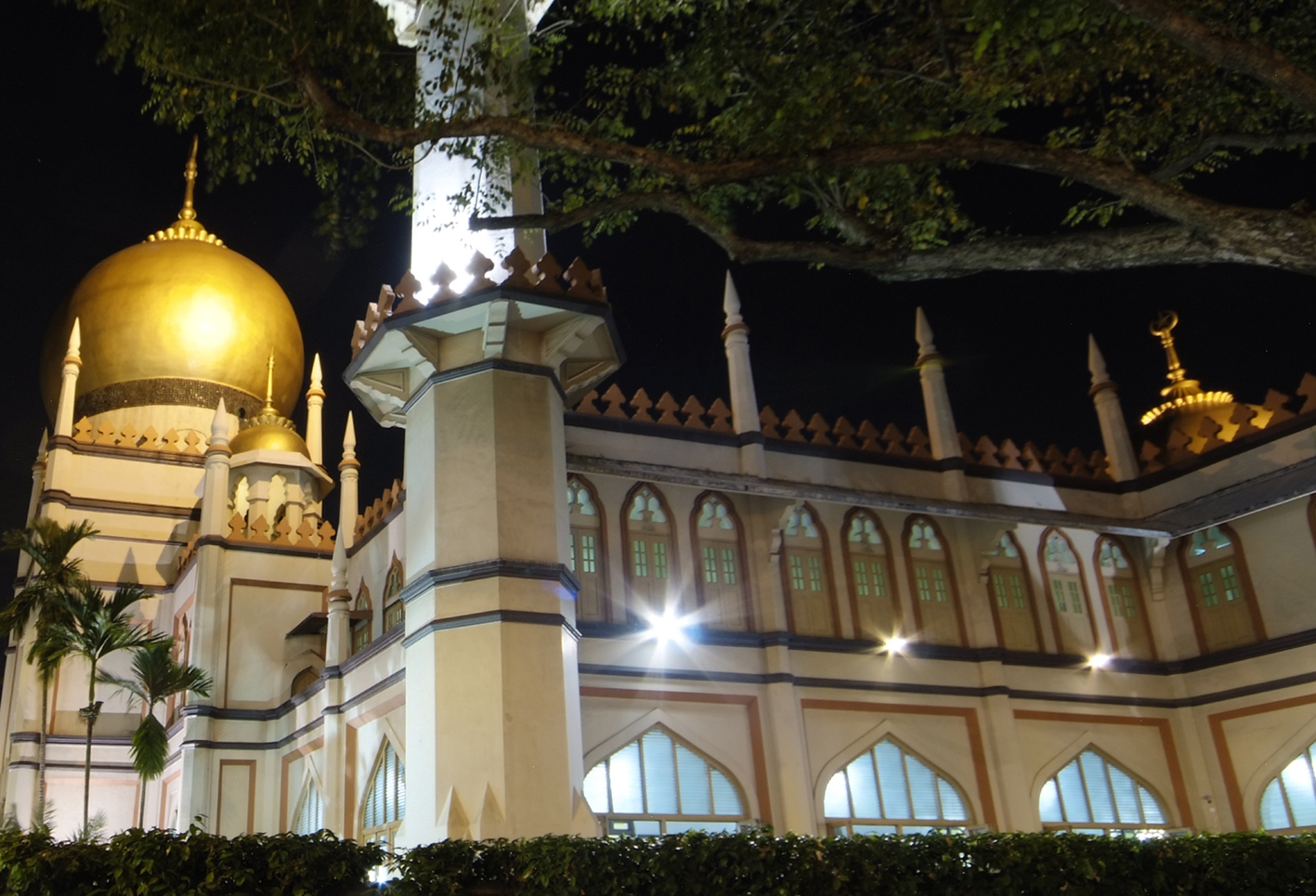
Mesjid Kassim along Changi Road where Norsham used to attend religious classes.
How does one leave Islam? Did you have to do anything special to become a non-Muslim?
Well in Singapore, you can renounce legally, that is you need to do a Statutory Declaration, then submit the SD to MUIS [Majlis Ugama Islam Singapura (Islamic Religious Council of Singapore)]. And MUIS will give you a cert/documents to certify that you are no longer a Muslim and have your name taken out from the Muslim registry.
How did the people closest to you react to your decision to leave the religion? And how did you react to their reactions?
They’re not happy obviously. They stop inviting me to their outings or to their houses. They don’t talk as much to me as before. How I react? I understand their reaction and honestly I don’t blame them. I am seen as a traitor… a person who betrayed their faith. There is nothing much I can do about it because I do not depend on them and my life does not revolve around them.
What’s life like for you now that you’re an ex-Muslim? Do you think it’s better, or worse?
My life is good now that I’ve moved away from the faith. Nobody will force me to do something I don’t like. And yes it’s for better.
Which 3 people or things in your life are most important to you right now?
My family, including my siblings, My cats and my business.
Which item, bought or received after you stopped believing in Islam, has been most useful to you?
Nothing. Can’t think of any now or perhaps my baju kurongs. I still treasure them.
Can you list 3 things you realised only after leaving Islam?
1–You can be good without religion. 2–You can still have your peace of mind without religion. 3–Stories told to me were so ridiculous, I am wondering how come I believed in them when they were related to me initially.
Is there anybody you presently look up to, who you would like to learn from?
My husband.
Lastly, what is your perspective on life and the afterlife now?
My perspective on life: I do not want to spend my time asking “What is the purpose of my life”. Instead I would say: this is how my life has become, this is what I have, what can I do now to make my life more meaningful and productive?
About the afterlife: I do not believe there is an afterlife.
Norsham hopes to be able to help other ex-Muslims in the future, “especially those still in the closet”. You can try to find her on Facebook through her profile page “Norsham Mohd”, or ask her questions about leaving Islam using the comment box below.
More interviews with people who have left habits, lifestyles and religions available here.
Photographs courtesy and copyright of Norsham Mohd, William Cho. Interviewer: Sy Sponsor or support The Exes series here. Want to be featured too? Tell us here. If you found this article useful:
How does a person’s perspective of life change over decades? What does a person in his later years perceive that a 20-something doesn’t? To find out, we ask Dr. Bob Rich, the 77-year-old we interviewed just 2 weeks ago, to get a glimpse at how his perspective on the major matters of life has changed in the 50-odd years he’s been alive.
“The aches and pains and gradual organ failures are needed to make the thought of death acceptable to most people.”
Q: Hi Bob, can you describe yourself at age 21 and also yourself now.
21: An intelligent, creative, physically attractive, athletically and academically high achiever. A Buddhist who didn’t know he was a Buddhist. And because of the lies of depression, he believed himself to be the opposite of all of these qualities.
Now: A Professional Grandfather. Every person born in 1993 or later qualifies as my grandchild, anywhere on Earth. I am on this planet to strive for a survivable future for all my millions of grandchildren, and one worth surviving in. The second is as important as the first. What’s the point of living in a world where a few billionaires accumulate ever more wealth so others can starve, where people hate and hurt each other for trivial differences, where our natural being of empathy and compassion is overridden by an insane culture?
Birth and Death, why do these exist?
Then:
In the ancient days when I was 21, I was too miserable to worry about such issues. If I’d thought about it, I’d have felt sort of immortal: “Death? I suppose so, sometime. I wouldn’t mind not-living now.”
Since 5 years of age, I “knew” that I was ugly, and stupid, and no one could ever love me. My self-description was, “If there is a wrong way of doing something, or even if there isn’t, I’ll do it that way first.” This was a literally translated version (from Hungarian) of my stepfather’s opinion of me, though I didn’t realise this until I was about 20, and had a flashback to the occasion.
Now:
I am a sceptic. I don’t believe anything, but use whatever information I have to construct a tentative model of reality. Over many years, this model has evolved into the theory:
The Universe is a living Person. I think of Her as a young, growing, sentient Flower of great beauty. The Universe is Life Energy. What we perceive, what we are parts of, is the universe of matter and energy that the Universe creates by observing it. Max Planck, one of the originators of quantum mechanics, said, “I regard consciousness as fundamental. I regard matter as derivative from consciousness. We cannot get behind consciousness. Everything that we talk about, everything that we regard as existing, postulates consciousness.”
Because She is growing, the Universe needs to develop the equivalent of brain cells. The material universe is a school for souls. All of us are apprentice Buddhas, whether we realise it or not. Our reason for being born is to go around, life after life after life, caterpillars feeding on the green leaves of experience, until we graduate. This is when we automatically, intuitively give unconditional love to every other living being. Because the English word “love” has so many meanings, I prefer the Buddhist term “metta.”
“Bob and Ochre.” Now much older.
What happens after death?
Then:
I thought of life as an emergent quality. When I open my hand, where did the fist go? The fist is a spatial organisation of fingers: an emergent quality. A burning candle is wax + a wick + energy. When you blow it out, where does the flame go? You look at a beautiful building. That beauty, the very shape and functions of the building, cannot be predicted from the parts it is composed of.
So, I thought, make an organised collection of chemicals complex enough, and you have the emergent quality of life. Make a living being complex enough, and you have the emergent quality of consciousness.
Now:
There is scientifically very convincing evidence for reincarnation. I set it out in a chapter of my book, “From Depression to Contentment: A self-therapy guide” and because I consider it important, I’ve posted this chapter to my blog.
Also, many millions of people of all religious persuasions, and no religion at all, know it happens because of personal experiences. I am one of them. In 2007, I gained recall of 6 of my past lives. The story is in “Ascending Spiral: Humanity’s last chance” in fictionalised form. I had to make it fiction to protect the guilty, not that they’d gain much by suing me.
So, part of the model of reality I’ve mentioned is that after death, you face a superior Person. How this Person appears depends on your cultural background. For example, reports after clinical death experiences from Asian people don’t usually have a darkness with a bright light at the end of it, while most Europeans do.
LUCK-IT will earn a tiny commission when you purchase this product.
I once had a client who had died from pneumonia, but was brought back. She has an unshakeable memory of sitting on a log looking at a chattering creek, with her long-dead grandfather comfortingly sitting beside her.
This superior Person does not judge, but accepts you with perfect metta. However, you are guided to re-experience your just-ended life, for some reason from the death, gradually back to birth. Only, what you experience is your effect on other people. If today I do an act of kindness, I’ll experience the pleasure and gratitude of its recipient, and this is very powerful motivation for building on my strengths. If I do an act of cruelty, I’ll experience the pain I’ve caused, and this is even more powerful motivation to make restitution, and to set up Lessons to learn in the next life. The Guide and the deceased person then choose a life that will expose the spirit to the necessary situations to achieve these.
So, the Lessons are not reward or punishment, but freely chosen by the spirit. For example, one of the spirits who has been travelling with me was my cruel rapist of a husband two lives ago. He was there because I chose a life in which I needed such a person. He was a very young soul, and was incapable of love, empathy, any of the positive emotions. In my current life, I again had this person as part of my family. In this one, he still had no empathy, but instead of a rapist, he was a seducer. I deduce that one of his chosen lessons was to be able to give pleasure to women, instead of taking it from them. He is dead now, and hopefully will learn empathy in his next life.
LUCK-IT will earn a tiny commission when you purchase this product.
Why do bad things happen to us?
Then:
Again, at 21 I just knew that anything bad proved what an awful failure I was, in every way. When something good happened, which actually was often, it was luck, or due to the kindness of another person, or not that important anyway, or well, I never even noticed it. For example, at the half-yearly exams in first year university, I “only” got a Credit in chemistry, and this showed I was stupid. I simply accepted the High Distinctions and Distinctions in my other subjects without celebrating them in any way.
Now:
I have two dear friends, though I have only met them both through the internet.
One is Petrea King. You just have to read at least one of her wonderful, inspirational books. They might change your life—for the better. She was raped when she was 17. Possibly as part of the long-term consequence of the trauma, she developed cancer at 32. The bloody doctor told her she wouldn’t see the next Christmas. Devastated, angry, resentful, she went from Australia to Europe, and travelled around. Then she spent time in St. Francis of Assisi’s cave, and peace came to her. She is a little younger than I am, 76, and still going strong. She has been of benefit to tens of thousands of people experiencing life-threatening diseases like cancer, AIDS, MS, etc., and also people like teenagers suffering from environmental despair. I am sure she is an enlightened spirit, and need not return for another life.
The second friend is Rosemary. She is now 68, but has been forced to spend a great many years in a nursing home, among the elderly. She has been wheelchair-bound for a long time, and her health continues to deteriorate. All the same, she has joy in her life, because she can be of help to others. She hoons around in her wheelchair, running messages for less mobile people, reads to those who can’t anymore, helps the staff in whatever way she can. Sure, she has times of despair, but mostly, she lives a good life.
This is what suffering is for. It is a spur to spiritual growth. There is no need to change anything when things go well.
That suffering may be a Lesson situation you arranged before birth, or accident, or being caught in the crossfire of someone else’s actions. That doesn’t matter. Whatever, whyever, it is an opportunity to become a better person, to move closer to enlightenment.
Why do good things happen to us?
Then:
Oh, good things happen to other people, because they deserve them. Me? I try and try and try, but know I’ll fail anyway.
Now:
About a third of my book on depression teaches you the tools of positive psychology, which bear a remarkable similarity to Buddhist actions.
When something bad happens, simply accept it. This, too, shall pass, and if it doesn’t, so what. It probably won’t kill me, and if it does, that’s all right too. When something good happens, celebrate it, enjoy it, but stay unattached. When it ends, as all things do, that’s fine. Why? Things can be measured on many dimensions, “good-bad” being one of them. So, sometimes up, sometimes down, so what.
What is the point of marriage?
Then:
Oh if only! Girls were a sweet torture, to be admired from a distance. I was a lost puppy looking for a home.
During first year at University, I set myself an extra subject: Girls 101. Once a week, I got brave enough to approach a stranger, and tried to make the conversation last 5 minutes. At night, I made records of what went well, what didn’t, and how I could try to do better next time. This resulted in over 30 “sisters,” but no lover. They were put off by my intensity. One told me, “If I let you get too close, I know I’ll have you for life, and I’m not ready for that, with anyone.”
But then, all of these sisters came to my wedding in 1967, glad to have me off their hands.
Now:
After nearly 53 years, I am still grateful to my wife for having rescued me from that.
All the same, to me, a marriage is not a piece of paper, or a contract, but a commitment. If two people are committed to each other, legally or informally, they are married. If they have the piece of paper but care nothing for each other, they are not. You may be interested in my summary of how to have great relationships, and how to have terrible ones.
What is the point of work?
Then:
Everything I do in every waking moment is work. Studying, working as a tutor or in a summer job, running (both training and competition), environmental activism, helping to run a scout troop, having people cry on my shoulder, studying Girls 101… everything is a duty, everything is competition, not against others but against myself.
Now:
Life is too short for the seriousness it deserves. Some activities are for money. Some activities are not. It makes no difference. Often, money costs far more than it is worth. Some activities are interesting, some are boring. I’ll gladly do a boring one if in that way I can be of benefit to someone. For example, I do editing (for money), and the stuff sent to me may be TERRIBLE. But, after my feedback, not only does the client have the opportunity to improve that piece of writing, but also to improve in general writing skills. So, it’s worthwhile.
When I review a book, I do much the same thing, only I don’t get paid for it. Doesn’t matter: I still do my best to be of benefit to the author. If I need to make many suggestions for improvement, I go to considerable trouble to track the author down so I can be of service.
Can you organise these aspects of life—Purpose, Status, Money, Knowledge, Health, Peace, Love, Friendships—in order of importance, starting with the most important.
Then:
I was too busy being properly miserable to worry about such issues. I dreamed of Success, not because I wanted status or money or fame, but because every instant I needed to prove that I was not a no-hoper, only to need to prove it again in the next instant.
I was of benefit to many people, and there were wonderful people in my life I think of as my angels who taught me how to climb out of my hell, but I didn’t even know I had friends. Who would be MY friend? Come on!
I dreamed of love, but it was a yearning for the impossible.
Now:
The most important is not on your list. This is to be of service. I get joy from making life better for someone, like fishing an insect out of a puddle, or taking an old woman to her doctor’s appointment although I hate the way she behaves, or answering an emailed cry of despair and leading the other person to a good life.
I do value knowledge. I am an endless sponge for it. A friend once described me as a walking encyclopaedia. Love is something I have given all my life. Over the past decade or so, I have gradually also learned to accept it. Health is great. Getting old is not for the fainthearted. But then, if you stayed a vibrant 21, there would be no acceptance of death, and the planet is overpopulated enough as it is. Besides, spiritual growth is only possible by assessing a life, then setting up new Lessons, so death is necessary. The aches and pains and gradual organ failures are needed to make the thought of death acceptable to most people.
Wealth, status, fame… all the Monopoly tokens of our insane culture, don’t turn me on at all. My wife and I have deliberately lived below the poverty line since 1978. If you want to understand why, read “How to change the world”.
Who should we turn to when we’re in trouble?
Then:
No one. If I can’t handle it myself, I prove to be hopeless and useless. Grit teeth and charge at the problem.
Now:
I used to be one of the physically strongest people in my acquaintance, and also had fairly formidable unarmed combat skills. All gone now, and I often need physical help. I accept it with gratitude, because I know that the more you give, the more you grow, so I am making the gift of the opportunity to be helpful to my benefactor.
When I lack skills or knowledge, I know that “If someone else can do it, I can learn it.” So, I seek out an expert or three, and welcome being taught.
Is homosexuality okay? What about abortion, pre-marital sex, having a baby outside of marriage, divorce, polygamy and alcohol?
Then:
I have always rejected alcohol, tobacco, marijuana, every other drug (except for chocolate, which is my favourite vegetable). This is because I did my drunkenness in a previous life, when it killed me. Having learned that Lesson, I am now free from it.
Abortion is better than an unloved, deprived, abused life. Pre-marital sex? I wish… sex of any kind! But if a girl had allowed me that close, that would have been marriage, ceremony or not. But all this was unthinking. I didn’t give any such issues explicit consideration.
Now:
Above all, do no harm. If you can, do good. If you can’t do good, change the situation until you can. I have applied this to homosexuality. You can apply it to any other issue. On my relationships page, I explain that there are 4 possible outcomes: together happy, together unhappy, separately happy, separately unhappy. What matters is that this situation should result in growth, increased wisdom, learning better ways of doing things.
Polygamy, polyandry, polyamory are all in principle OK, if there is mutual love and commitment. If someone is forced into a multiple relationship, if there is jealousy and resentment, then it is not OK.
What makes a person a ‘good’ person? What makes a person a ‘bad’ person?
Then:
I was as yet unable to separate a person from the action. I judged people by the effects of what they did. I hated bullies, having been on the receiving end all too often.
Now:
There is no such thing as a bad person. Some are spiritually immature, and know not what they do, yet. I often disapprove of what people do, but my motivation is, if I can, I want to lead them to growth.
Is there a powerful being somewhere up there looking out for us and pre-designing our lives for us?
Then:
No. If there was, then why is there so much suffering? If there was a God, and allowed the crap to happen, I’d spit in His face for it.
Now:
We go back to quantum mechanics. Time exists in the material universe, so all that was, and all that is, and all that will be is “written down in the Book of Life.”
But there is no Puppet Master in the Sky. There is choice, and free will, because if there wasn’t, we would not be able to grow, and that’s the purpose of life.
Here is an analogy. You have a favourite book, which you are now reading for the fifth time. You know how the story will end. But the hero in chapter 2 doesn’t, and is agonising over a choice. You enjoy reading because you identify with this hero. If it was “Oh, just a story,” there would be no point in reading it again. So, you are IN THERE, in the story, and facing the terrible choice, even though if you take a breath and move back into your own life, you know the outcome.
Bob is presently doing his best to live every moment as if he were to live forever, while also living every moment as if it were his last. He is presently looking for beta readers for his latest science fiction series, “The Doom Healer” (“In my unbiased opinion, it has the potential to join Harry Potter.”), so if you’re interested in being his beta reader, you can contact him via his website, Bobbing Around. You may also chat with him using the comment box below (“Delighted to chat with anyone. People posting comments will be rewarded with a big blast of metta.”).
At 21, Tony wanted to become a writer. He ended up being one, and a journalism lecturer, and a bond investment manager, on top of marrying twice and having 2 children, while also experiencing the shock and joys of being fired. (“I was let go by a publisher in a small company. He was interested in one of the women editors there and because I was friends with her, he fired me. Ironically, it was one of the most positive things that ever happened to me. He gave me 2 weeks severance pay. My wife had just given birth to our son the day before. I went to the hospital and told her what happened. That weekend I found an ad in the Chicago Tribune looking for a writer. It was Reuters. They hired me.”). We asked him what it is like being 80.
“One of the traps in retirement is to think ‘I don’t have to work any more.’ Wrong you still need to work to keep you body healthy.”
Q: Hi Tony, thank you so much for being here with us. Could you tell us a little bit about yourself and how old you are now?
A: I am 80 years young. Turned 80 on Jan 26. I retired from a major philanthropy in 2000 where I managed $900 million in bond investments for the prior 5 years. Before that, I wrote a newsletter for the Investment Department. Worked there 10 years total. Before that I was a journalist for Reuters News Service. Enjoyed a one year posting to London in 1977. Worked there 20 years. Previously I had edited men’s magazines for some years after graduating college with a degree in finance. I know that is a strange career track.
Currently I write my blog Diet, Exercise and Living Past 100 (guysandgoodhealth.com) which I began 9 years ago. I ride my bike around 100 miles a week year ’round here in Chicago. I eat healthy and get a full night’s sleep. Go to Las Vegas 4 times a year with my girlfriend and play video poker.
“This is me in my 20’s flying a kite.”
What are your current daily and weekly routines like?
I try to get a good night’s sleep because that is a great reboot for the brain and body. Have written a number of posts on the value of a good night’s sleep. Ride my bike daily. Play video poker at the casino twice a week. It is a fun game that allows the player to choose the best cards to hold to make the strongest hand. I eat intelligently. My weight has been in the 155-160 lb range for 10 years. I walk a couple of miles a day, some with my pooch and otherwise every chance I get. Walking is a great weight-bearing exercise.
How is your body different from what it was like at age 70?
I think it is healthier now than when I was working because I pay attention to healthy practices like sleeping well, eating intelligently and exercising regularly. When I was working I weighed in the 180’s and after I retired I got more careless about my weight and ballooned up to 225. I felt terrible and looked terrible with a big pot belly. I decided to straighten myself out.
Tony when younger.
What brings you joy these days?
I enjoy writing my blog and I am active on social media. Big Wonder Woman fan. She was created in 1940, so I have been a fan since reading her comics in the ’40s as a kid. Belong to several Wonder Woman groups on Facebook. Have my own group on the Mewe social network. I like Pinterest. I have boards on video poker, Wonder Woman, puns, Alice in Wonderland, geometric pics and animal memes. My girlfriend and I go to the theatre and concerts as well as Las Vegas and the local riverboat. Lastly, I have a 25-year-old daughter who teaches kindergarten in Indianapolis. I also play backgammon on the web.
Which item, bought or received in the past year, has been most useful to you?
LOL My car. I drive a white Mini Cooper with black racing stripes on it. Hadn’t owned a car for 25 years, then saw The Italian Job movie and got a car crush on the MINI. Bought one in 2004 and now am driving my fifth one. It is a three-cylinder car with a manual transmission. I am one of the dinosaurs that still shifts gears with a clutch. Great fun car to drive.
LUCK-IT will earn a tiny commission when you purchase this product.
What were you like as a middle-aged adult and how have you changed since?
In middle age, I was still working. I was married to a much younger woman so I became a father at 55. Great experience raising a child at the age. Someone called it having your own grandchildren. I was managing money and involved in the market on a daily basis. I use the same money management principles in the casino today that I did when I managed money professionally. Limit your losses; let your profits run. The biggest thing, then, and now, is discipline.
Can you list 3 things you realised or learned only after age 80 that you didn’t know before?
Well, technically, I can’t. I have only been 80 for a couple of weeks. I can tell you what I have learned since retiring at 60. I don’t rush so I live with minimal stress. I know how important it is to exercise daily. One of the traps in retirement is to think “I don’t have to work any more.” Wrong you still need to work to keep you body healthy. That is a full time 7 day a week commitment. I have learned the danger of a sedentary lifestyle. I have written in the blog that a sedentary lifestyle is more dangerous than smoking. Because you don’t realise how you are damaging your body.
Which 3 people or things in your life are most important to you right now?
My girlfriend, my daughter and my dog.
“My girlfriend shot this of me in the Las Vegas airport.”
Is status important beyond age 80? What about wealth, knowledge acquisition, romance, birthdays and friendships?
Status is not at all important now. But, when I was just beginning in my first marriage and early career, that kind of stuff meant something. Wealth is a relative term. I retired 20 years ago, but I live a simple life, bike riding, web surfing, walking my dog. I also gamble regularly, but I have strict l limits on how much I risk, so that is not an expensive pastime. I think wealth is relative, though, mostly anyone with more money than you is ‘wealthy.’ You need to define it specifically for an accurate answer. Knowledge acquisition is very important. I still take courses from The Great Courses. I started when I retired. Just bought 2 this month. Romance will always be important. Birthdays are a joke, of course, now they just tell me how much closer to being dead I am. The number 80 sounds like hell. But, thankfully, I don’t feel 80. Friendships count for a lot. I also have a lot of acquaintances from walking my dog.
What regrets do you have?
I can’t think of any regrets.
What do you think those not yet 80 should be doing while they still can?
Regarding folks under 80, I write my blog for them. No matter what your age you should be taking care of your body and eating intelligently. I feel strongly about that, because for many years, I didn’t and it was a foolish mistake. Exercise is particularly important because it keeps our bodies (which are organic machines) in tip top shape. But also, it helps the brain in lots of ways. I took care of an aunt who was dying of Alzheimer’s and watched her decline. It scared the life out of me. That’s why I care so much about keeping the body active.
“This is me riding my bike with my dog along the Chicago lakefront.”
Is there anybody you presently look up to, who you would like to learn from?
As a football fan, I look up to Tom Brady for his all around excellence and the way he keeps his body together. Likewise, Bill Bellichick for his superb coaching ability. I think I face life the way they do.
Lastly, do you think about death? And if so, what do you think of it?
I don’t think about death. There doesn’t seem to be anything in that. I have a will and a planned estate, but other than that, I am enjoying my being here now.
Tony presently rides his bike every day and produces for his blog, guysandgoodhealth.com. “I put out jokes every Friday—weekend funnies.” You can follow him on his adventures there or ask him to impart wisdom to you using the comment box below. He also runs a Wonder Woman fan group on MeWe here.
If you would like to share your thoughts on being the age you are, do let us know here. Or read what it’s like to be a different age here.