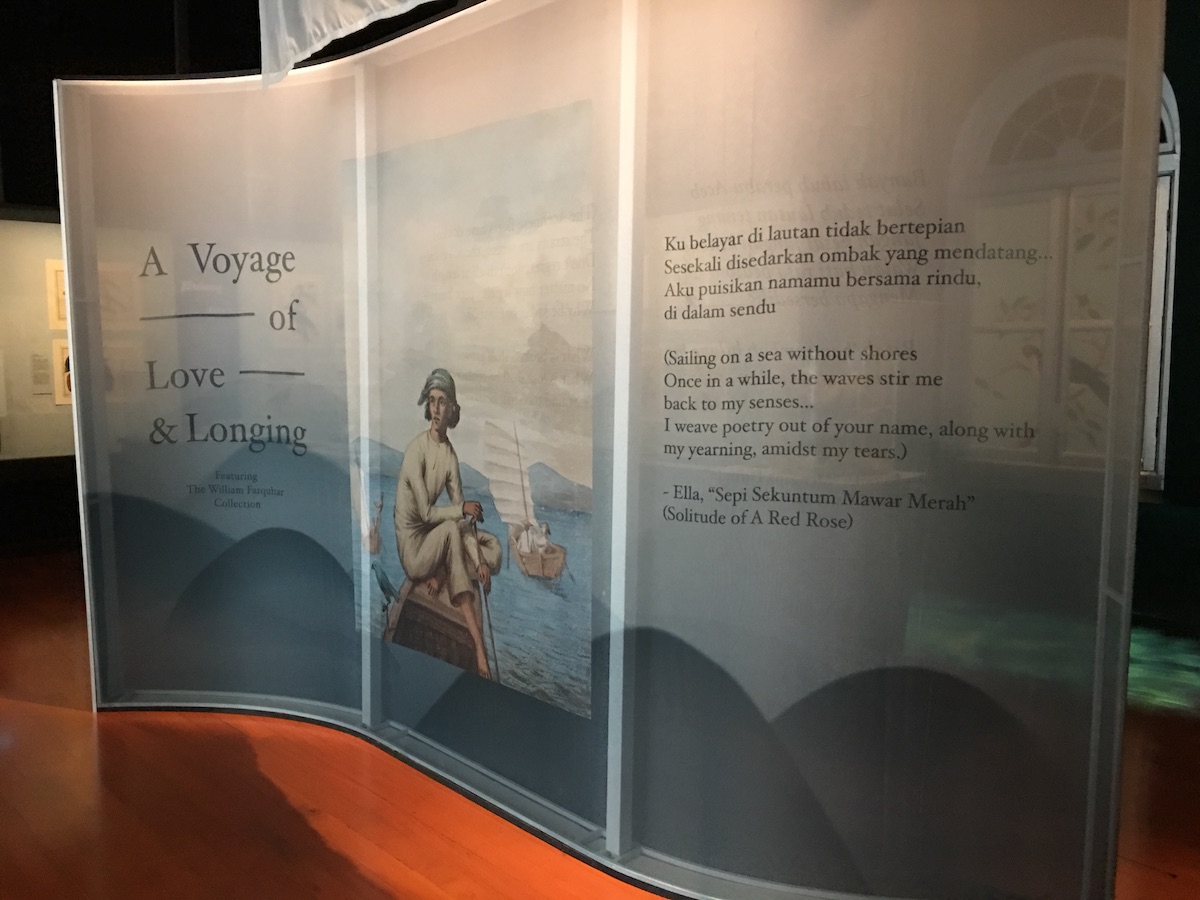
This year, we have a second game for you, titled Embark On Your Own Belayar Journey, made in collaboration with the National Museum of Singapore! Designed to be a interactive companion experience for their A Voyage of Love and Longing exhibit, Embark on Your Own Belayar Journey is a chatbot choose-your-own-adventure game that allows you to voyage through the 19th century Malay Archipelago to get to one of 17 possible endings.
Synopsis: How would you do when out at sea in the 19th century Malay Archipelago, in a boat you sort of made on your own? Would you survive? Where would you end up? And who with? Written for those in love, out of love, or those simply in the mood for adventure, this romance-themed choose-your-own-adventure experience made out of historical fact and historical fiction was created to allow you to take the oars to experience your own historical voyage when you visit the A Voyage of Love and Longing exhibit at the National Museum of Singapore.
You can read more about the game and play it here. Happy travelling!
Jack, who we interviewed about being in Guangzhou during the early days of the COVID-19 epidemic in China, moved to Cambodia during the thick of the COVID-19 pandemic and for the past 6 months has been enjoying its historical sights without being overwhelmed by fellow tourists. With all the travel restrictions and strict criteria presently going on, we had to ask him how he made it happen.
“We were fortunate enough to be offered jobs here in Cambodia.”
Q: Hi Jack, welcome back to LUCK-IT! The last time we spoke with you you were living in China, and now you’re in Cambodia. Why did that happen?
A: My wife and I teach in international schools. We’ve lived in several countries over the past 25 years mostly in Far East Asia with one foray into Africa. China won’t issue work visas to men over 60, and I turned 60 last year, so we had to leave.
What about Cambodia makes you want to live there during COVID-19?
Since we’re teachers, we go to where the next job is. We went to a job fair in Bangkok a year ago just before #COVID19 hit the scene during our Chinese New Year break. We were fortunate enough to be offered jobs here in Cambodia. As soon as we got back to China, though, the #COVID19 news began breaking, and we didn’t return to school until March or April of last year.
How then did you manage to move from China to Cambodia amidst COVID-19 border restrictions? What challenges did you face when doing so and how did you overcome those?
Because of the border and travel restrictions, it was not clear whether we would be able to travel at all. We know many teachers who had taken jobs but were unable to travel to start them.
There were a couple of issues that we faced due to #COVID19: (1) We didn’t have to report to our new jobs until 1 August 2020, but our school in China cancelled our work visas two weeks after the close of school, which meant that we had to depart by that time. Because of #COVID19, they relented and didn’t cancel our visas until we were able to leave. They also allowed us to stay in our apartments until then also. Similarly, the school we were traveling to allowed us to arrive any time before August. They would provide accommodations and arrange for our visas. (2) Many countries had closed their borders, so travel was quite difficult. Flights were irregular and frequently cancelled, so up until May, it wasn’t clear that we would be able to do anything other than return to Canada. For many teachers, this was the only option. Many could not travel on to the jobs they were contracted for. (3) Cambodia was different, though. They had not closed their borders completely. They had strict requirements for entry, though: (a) You had to have a negative #COVID19 test within three days before arrival. (b) You had to pay a $3,000.00 (US) deposit upon arrival to be repaid after completing a two-week quarantine. (c) You had to demonstrate that you had a minimum of $50,000.00 (US) coverage in health insurance. And (d) you had to complete a two-week quarantine. Luckily, you could complete it in your own accommodations as long as no one on your flight had a positive #COVID19 test after their arrival in Cambodia. We are a family of three, so that meant we had to have a $9,000.00 (US) deposit available upon arrival. You could charge it to a credit card, but our school paid our deposit for us.
We are a family of three, so that meant we had to have a $9,000.00 (US) deposit available upon arrival. You could charge it to a credit card, but our school paid our deposit for us.
Which 3 people or objects were most helpful when you were doing the above?
There were many people who were very helpful as we went through making our travel arrangements and arrived in Cambodia. First, there was a travel agent in Guangzhou who made the arrangements for our #COVID19 test certification. They provided a guide to walk us through the process at the only hospital that would provide an English-language certificate. Second, there were the people from the school who met us at the gate and walked us through our arrival and navigating the deposit and having our #COVID19 certificates verified and our insurance verified. And third, there were the unfortunate people who had to give our daughter her #COVID19 test upon our arrival.
Our daughter is autistic, but she is quite high functioning and able to manage most situations. She does have several heightened sensory sensitivities to noise, pain, and busy visual spaces. She wears sound-cancelling headphones any time we’re outside of the house. She doesn’t like being in noisy crowded places and she definitely didn’t like the nasal swab of the #COVID19 test.
In China, they only did a throat swab. In Cambodia, they not only did the nasal swab, but they did both nostrils and the throat. They wouldn’t let us go together as a family, either. We had to go individually. Our daughter is 15 years old, so they thought she would be able to manage, I guess. I went first, and immediately went to find her after completing my test knowing that it would be a trial for her.
By the time I found her, she was standing off to the side by herself refusing to let the testing fellow near her and refusing to cooperate at all. She was weeping and rocking and pacing and vocally insisting that she wasn’t going to do the nasal swabs. I was surprised that she had allowed them to do the throat swab before I got there.
Of course, there wasn’t much space and there was a crowd of curious onlookers gawking, a crowd of testing personal coming to see what the commotion was, and several security personnel, too. My wife and I were able to get her to calm down a bit, and we were able to get the testing fellow to understand that it was going to be difficult to get her to test.
“This is the drawing that my daughter made of her experience getting the #COVID19 test at the airport.”
Regulations were regulations, though, and no one could get in without the tests. Our helpful translators and guides had not been allowed to accompany us into this area. It really looked like we might not be able to enter the country after all. But, the good man there brought out the child-sized swab and showed her how much smaller it was. He got her to try it. She didn’t tolerate it in her nasal cavity for very long. I don’t think he made it to the back of the cavity, either. It was in and out, and he only did one nostril.
I will always be grateful for his understanding and kindness. As we left I looked around at the staff. Some of them were shaken and a bit ashy looking. She made quite a scene.
Which place was most helpful?
Our employer was the most helpful place. The school provided so much support for our transition. They allowed us to arrive early and straight from China. They met us at the airport, and then after our overnight stay at the quarantine hotel where we had to wait for our #COVID19 test results. They provided groceries and information about the city. Really, everything that we would need to feel comfortable and get to know our new home.
What was the COVID-19 situation in China like when you left and what was the situation like in Cambodia when you arrived?
When we left China, it was clear that China had contained the virus and there were fewer cases. They had loosened some of their border restrictions with Hong Kong and for travel within the country and the city of Guangzhou.
As #COVID19 cases subsided in China and community transmission declined, there was a fear of foreigners who were blamed for bringing more infections into China. The problem was that most imported cases came from Chinese nationals returning from foreign travel. There were very few spread by foreigners, but that is a typical response to foreigners around the world.
Cambodia has very few cases and in July when we arrived, there were even fewer. Literally only a few hundred. At one time there were no active cases. There are travellers who have brought infections into the country, though. And, there have been several mini-outbreaks.
One of the worst ones occurred in the fall. The Foreign Minister of Hungary had led a large delegation on a visit. Upon his return to Hungary, he tested positive. They immediately began contact tracing and realized that there were more than 900 possible contacts, so they closed the schools and locked down most of Phnom Penh.
Since then there have been one or two new cases in the country. They close down shopping centers and markets depending on where the infected person had been. They are very thorough in their contact tracing as well.
“Ta Prohm, the temple where Angelina Jolie’s Tomb Raider was filmed near Angkor Wat.”
Recently, they’ve eased restrictions at the school allowing for expanded bubbles of students to increase interactions.
One of my thoughts is that the government realized how vulnerable their healthcare system is and what would happen if they allowed it to be overwhelmed, so they started out very strict a year ago. They were able to prevent too many infections from entering the country over the past year and contained any outbreaks quickly and efficiently to limit or prevent community spread.
What policies are there in Cambodia to keep the spread of COVID-19 down? How does this compare to the COVID-19-related restrictions in China?
I think that the collectivist societies of Far East Asia, in general, have some advantages over the individualist societies of Western Europe and North America. People are more oriented to doing what is necessary to protect the group and will be more cooperative with government instructions.
That said, I think, it also helps that there is still a deep culture of authoritarian government here. Cambodia was ruled by a king for much of its history and then the government was taken over by authoritarian rulers in the ’70’s, ’80’s, and ’90’s. Now, the Prime Minister is almost revered. His word is law. The focus on the press is on Prime Minister Hen Sen. Whatever actions the government takes or recommendations it makes, are reported through him.
Shortly after school started in August, there was a national week-long holiday. It was Khmer new year. They moved it to August because they had cancelled it last March (I think it was in March) to help limit the spread of #COVID19.
“A selfie from a rooftop pool overlooking the Mighty Mekong River on a chilly day in December in Phnom Penh.”
All of these factors combined help make the mitigation efforts very effective.
What did you learn from moving to Cambodia that you didn’t know before?
Cambodia has been a crossroads for much of its history. It has linked the areas that surround it together, so you can see it in the faces of its people. There are physical traits more commonly associated with Malaysia and Indonesia, India and Thailand, China and Viet Nam. And, because of French colonization and the struggle for independence, you can see people with more Western features, too. All people are accepted, though… as far as I can tell.
Also, the generation of the Pol Pot genocide is noticeably limited. The Khmer Rouge era was so traumatic that it seems to have bound the nation together in their effort to recover and overcome the hardships it imposed. Everything from mourning the vast number of dead, to coping with landmines, to redeveloping the cities and economy.
Now, they are struggling to cope with an economy devoid of tourists. One way they do that, though, is by promoting internal native tourism. Cambodians are traveling the country. It is nice to visit Angkor Wat and the areas around Sihanoukville without the overwhelming numbers of tourists.
What advice do you have for those thinking of moving to a new country during this period too?
Do your homework. You’ve got to know the entry regulations for the country you’re visiting and the status of the pandemic there. And, with the new more contagious strains of the virus out there, double mask. Until the world achieves herd immunity, we are all going to be vulnerable to outbreaks of #COVID19. Use an abundance of caution, respect local efforts to mitigate the pandemic, and be careful.
One of the silver linings is that we are traveling much more slowly. With the necessity of a two-week quarantine upon arrival, you either are planning on staying longer, to make your month of quarantine worth it—remember you have two weeks to do upon your return home—and limiting your travel to one country. Or, if you are vacationing within a country, you can spend more time getting to know the place you live.
Lastly, you’re from the USA, so what are your thoughts on the COVID-19 situation there at the moment? Would you be going back to visit any time soon?
I think the situation in the US is absolute madness. That anyone would accept a government that has stood by and allowed over 400,000 of its citizens to die needlessly and painfully is nothing short of madness. It demonstrates the absolute power of cognitive dissonance and motivated reasoning to alter perceptions, cognitions, behaviors and endanger society itself.
Being 60 and not having lived in the US for the last 25 years, I have few ties left. Also, since my wife is Canadian, and since she actually has living family she’s close to, we visit Canada far more than the US. There really is very little reason for me to go back.
Jack is presently learning Khmer from books and online courses. He is also training for a marathon and working on expanding the readership of his blog through improved SEO and networking. You can find out more about him at his blog, The Psy of Life (“a political psychology blog that focuses mostly on the US”), on Twitter, or ask him anything using the comment box below.
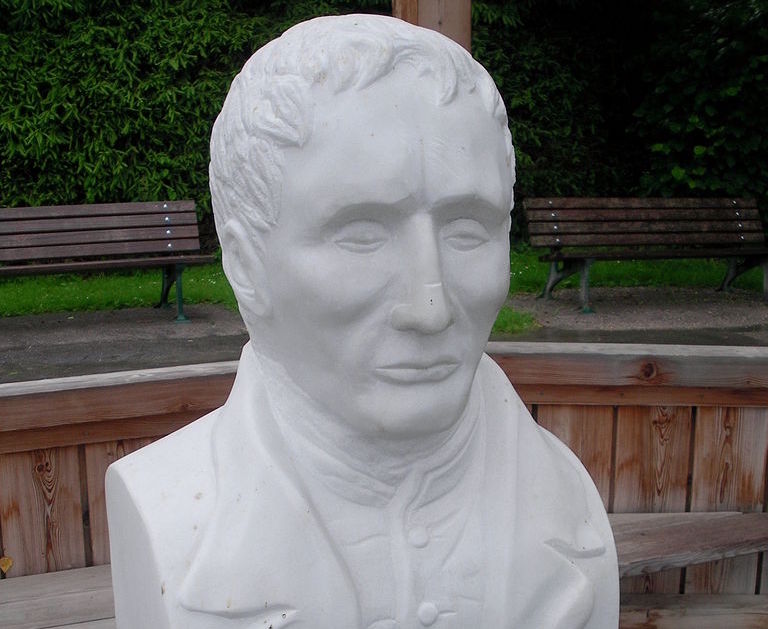
Louis Braille went blind at age 3 and ended up spending most of his life living at a school for blind boys. There, he invented a new way for blind people to read and write with, which came to be used by blind people around the world centuries on. This is the story of the inventor of the Braille writing system.
1809 – Louis Braille is born in a small farming village called Coupvray in France. They are not rich but the family has a cow, chickens, a vegetable garden, fruit trees and a small vineyard. His father is a harness and saddle maker. His mother is a homemaker who looks after the family’s garden. He has older sisters and a brother.
Age 3 – While playing with his father’s tools, Louis accidentally pierces his own eye. As the hospital is too far away, they can only get help from locals. Louis goes blind in one eye. The infection of his first eye spreads to his second eye and he goes blind in that eye too.
Age 4 – His parents give him a cane to use to move around with. His father also teaches him how to make harnesses with his hands and uses nails in the shape of alphabets to teach him the alphabet. A village priest begins to tutor Louis.
Age 7 – The village priest convinces a teacher at the village school to let Louis attend classes. A neighbour walks him to school every day.
Age 9 – The village priest and Louis’ teacher suggest that he go to the only school for blind children in the country. The priest goes to see the lord of Coupvray who writes a letter to the director of the school for the blind asking him to give Louis a scholarship to study there. The school approves their request.
Age 10 – Louis moves to the Royal Institute for Blind Youth in Paris and lives in the dormitory. He meets a new friend, Gabriel Gauthier who would end up as his friend for life. School is 15 hours long every day. Mornings are for academics, afternoons are for learning a trade. The students learn by memorising because there is no way for them to read and write. Louis also joins the school orchestra and the chorus. There are only 14 books for the blind at the school, all made with giant letters.
Age 12 – An officer from the French army introduces a system of reading and writing to Louis’ school called ‘night reading’. He invented it for soldiers to use in the dark in battlefields and thought it would help the blind too. It helps the boys write to each other but it doesn’t help them write to people who don’t know ‘night reading’. The officer doesn’t take the feedback Louis gives him so Louis decides to improve the system on his own. Over the next 3 years, he and his friends will discuss how to make the system better.
Age 14 – Louis is put in charge of the slipper workshop.
Age 15 – He creates the alphabet using six dots that can be read using one hand and shows it to the principal. It works and his method is soon used in the school. Students can now take notes instead of having to memorise everything.
Age 19 – Louis graduates. The principal asks him to stay on as a student teacher. His friend Gabriel is also staying on as a student teacher. Louis agrees and begins teaching geography and grammar. For the first time in his life, Louis gets his own room. In the evening, he works on a paper describing his raised-dot reading system.
Age 20 – The Institute publishes his paper and the principal asks the French government to adopt it for the blind in the country. The government refuses, preferring to stick to the old method of using giant embossed words.
Age 22 – His brother writes to him saying that his father is dangerously ill. His father soon dies. Louis himself develops bad health.
Age 24 – Louis gets promoted to full teacher and begins wearing the teacher’s uniform. He teaches geography, history, grammar, arithmetic and algebra.
Age 25 – The principal of the Institute gets Louis to demonstrate his code at the Paris Exposition of Industry. This exposes his system to many government officials and even the King of France but still, his system goes nowhere.
Age 26 – Louis is diagnosed with tuberculosis.
Age 30 – Louis gets the idea to use 10 dots instead of 6 to improve his writing system so that the blind and sighted can use it together. He calls it the decapoint. He and a former student, Pierre start building a machine to write these dots faster.
Age 31 – The principal of the Institute retires and is replaced by a cold and disagreeable man with different ideas. He changes many things at the Institute and stops the school from using Louis’ writing system, going so far as to punish students for using it. However, the students who have been using it for so long now refuse to stop. When the new principal removes their writing tools, they use forks and nails to keep writing. Older boys even make sure the younger boys know how to use Louis’ writing system. Eventually the new principal’s assistant convinces the principal to just allow the students to use it.
Age 33 – Louis and Pierre’s machine is done. They call it the raphigraphe.
Age 34 – The Institute moves to new premises. At the opening, the new principal’s assistant showcases Louis’ writing system to the general public. They are impressed. Louis however begins to spend more time away from school as his tuberculosis is taking a toll and he needs to rest.
Age 38 – Louis’ health improves and he begins translating books into his writing system.
Age 41 – His health becomes poor again and he decides to retire. The director approves his retirement but asks him to continue living at the Institute.
Age 42 – Louis begins coughing blood towards the end of the year.
Age 43 – Louis dies of tuberculosis. He is buried next to his father and sister at Coupvray cemetery.
2 years after death – The French Government finally decides to use Louis’ writing system as the official system for the blind in France to read and write with. It soon comes to be known as “braille” and is adopted around the world.
100 years after death – Louis is finally recognised and honoured by France for his work. His remains are moved from Coupvray to the Pantheon in Paris—the resting place for French heroes.
Ms Lena Lok was a fresh graduate aged 24 with $80 in her bank account when she first decided to start her own art school business–Amazing Art Shuttle in Singapore. Today, she owns 2 brands, having started her second art school brand–Art Wonderland–at age 31. We asked her for tips on how you can do the same.
“I spend a lot of time in my art studio—I’m almost there everyday including the weekends.”
Q: Hi Lena, thank you so much for coming here to chat with us. To start, could you tell us a little about your art schools, The Amazing Art Shuttle and Art Wonderland? What services do they offer and who are they for?
A: To start off, both The Amazing Art Shuttle and Art Wonderland were founded out of a desire to create quality art education programmes for Singaporeans. Amazing Art Shuttle was started in 2009 as I felt that there was limited art education options available in the heartlands. Amazing Art Shuttle has a literal meaning—we basically shuttle to all corners of Singapore, bringing our art programmes. Today, Amazing Art Shuttle focuses on B2B (business to business) solutions—we count art museums and government institutions as our clients and assist them with the formulation of Art curriculums and programmes. Art Wonderland on the other hand was started in 2017 to focus on our own internal art classes and programmes (B2C). We wanted to create a space that would encourage and invite children to explore new art ideas and techniques. Today, Art Wonderland has branched out into creating immersive and tactile art installations for young children.
Why did you decide to open and run art schools for a living? And how do you feel about that decision now that you’ve been doing this for over a decade?
Back in 2009 (the year Amazing Art Shuttle was formed) there was not much art outreach programmes available. Nowadays you see all sorts of art events everywhere, even in shopping malls. But back then, Singapore was still very new to the ideas of parent-child art bonding programmes and creating community collaborative artworks. I saw that gap and really wanted to use my art knowledge and experience to serve the community and that led me to start AAS. It is important for a business to always innovate and grow and that is also why I still love doing what I am doing; I get to suggest and spearhead many new projects and collaborations. It is a gift to be able to enjoy what you are doing for a living.
What certifications or skills does a person need to run an art school or teach art at your schools? What type of person do you feel is best suited for such a career?
Children are very well educated these days. They can seek out knowledge and information easily through the use of the internet. There are many Art DIY videos and tutorials on YouTube, hence Art Teachers these days need to be able to offer students something more than just creating copies of the same artwork. We tell our teachers that their job here is to teach them to be independent art makers, so they should see themselves as art directors. Thus all our teachers need to be familiar with most art mediums to be able to better guide the students. We require all our art teachers to have a formal art education such as a diploma or degree from an art school. We did make an exception for one of our former teachers as he was skillful in art and passionate about teaching. I feel that passion and responsibility is just as important as certification.
What is your weekly routine like as an art school owner?
I spend a lot of time in my art studio—I’m almost there everyday including the weekends. My time during weekdays are usually spent with my team in brainstorming for art curriculum, creating new marketing strategies and planning new art events/outreach with them. Weekends are spent teaching students and any in between time are used to clear paper work. I do however try to knock off on time everyday so that I can spend time with my family.
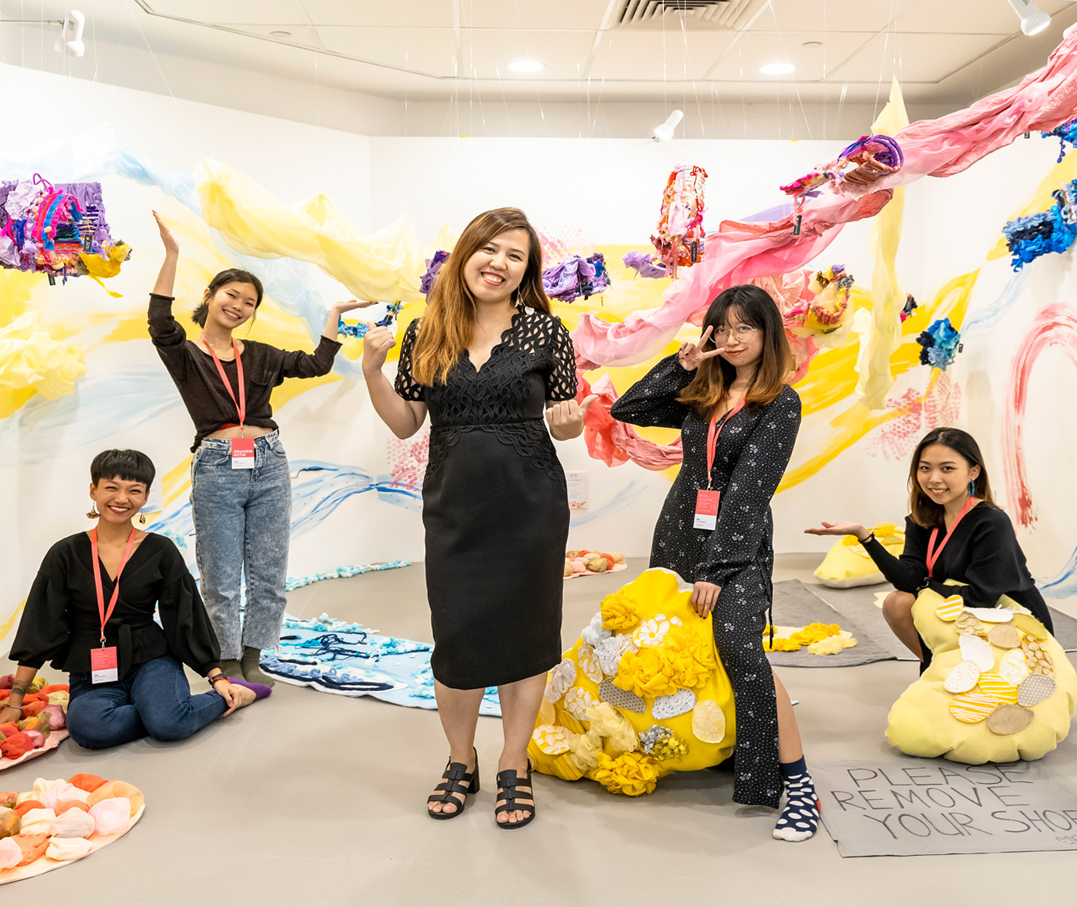
This is Miss Lena Lok.
Which 3 people or things are presently most important to you?
When I was in my twenties and trying to establish the business, I worked very hard and was literally running around all corners of Singapore. Because of that, I almost went into early labour when I was pregnant with my first child. I had to stop all work immediately and went on bed rest for almost 2 months. That whole incident made me realise what really matters the most to me in my life—my family. My husband and two children rank the highest! But my business is like my oldest child and will always be in my mind too.
For your students and their parents, what do they get out of getting involved in art classes? What are the benefits of exposing children to proper art training at an early age?
There are many places teaching children how to draw. But what they do not teach is how they can be observant about their surroundings and to see the world in different perspectives. We encourage our students to spend time discovering the world around them and to notice small little details such as the lines, shapes, colours, textures, smell, sounds around them. Art classes when taught properly can teach children to be more observant and appreciative of the world around them and to form their own thoughts and opinions. The practical benefit of art classes would of course be improved dexterity and motor skills.
What advice do you have for parents hoping for their children to be creative wizards in the future?
Do spend time talking to your children. Possessing critical thinking is just as important as artistic skills for young artists. Spend time doing inquiry-based discussions with them; this will help them form their own thoughts and opinions (traits important for artists).
What advice do you have for kids hoping to be really good at art?
It is more important to have passion and perseverance than to be naturally gifted in art. You need to enjoy doing art to become better in it. Time will hone all skills, but passion is harder to develop.
Lastly, what advice do you have for those hoping to open and run art schools similar to the Amazing Art Shuttle and Art Wonderland too?
Always try to remember what it was like for you as a child learning art; try to look at their world through their eyes. And a question I would pose to would-be art school founders—How can you contribute to Singapore’s art scene with your school and make a difference?
Lena is presently working on expanding her companies so that she will be able to provide quality employment for art school graduates in Singapore (“the sad truth is that there are not much relevant art jobs available for Singaporean art school graduates”). You can find her at the Art Wonderland studio at 37 Middle Road, #03-00 within the Bugis/City Hall region of Singapore, on Facebook and Instagram, or ask her anything using the comment box below.
More interviews with those who’ve created businesses from scratch here.
Photograph copyright of Lena Lok. Interviewer: Sy Want to be featured too? Tell us here. If you found this article useful:
Happy 2021 everybody! I’m Sy, founder of LUCK-IT and as part of tradition, I’m going to get the interview ball rolling by doing a self-interview to show all potential interviewees how safe and not scary it is to be doing so. Since Singapore (where I’m at) announced this year a change in the legal age for smoking (now 21 instead of 20), I’m going to dig up my past this time and share my own experiences with smoking.
“You don’t get fat when you quit smoking.”
Q: How did you end up as a smoker?
A: When clubbing with a schoolmate, she asked me if I would like to try smoking. She had a pack. I said yes without hesitation and we shared a cigarette. Sometime later, I bought myself a pack of cigarettes just to hold and smell and imagine what it would be like to be a proper smoker. I eventually smoked one when having a bad day. And another on another bad day. Then I began smoking only when clubbing. Then it became a regular daily thing. All before I reached the age of 21.
Why do you think you said yes to smoking?
Back then, smoking was something cool, rebellious and emo people did. You saw it a lot in films and pop photography, always glamorously presented. It was also often said to be a good way to lose weight, de-stress and make friends. Because of that, I wanted to be a smoker from the time I was a teenager. Coming from a broken home also contributed in a way. I simply connected better with the types of young adults who would smoke and wanted to belong with them.
What was your routine like as a smoker?
A smoke after meals. A smoke before returning home. Smokes during stressful periods. Many smokes when out for drinks with smoker friends. Smokes when clubbing (back when that was still legal and a thing).
Why did you eventually decide to quit smoking?
The appeal of being a smoker faded as I got older. Eventually I came to view smoking to be not so much a way of looking “cool” but more like an indicator of having poor self-control. I tried to quit smoking 3 times in my life, mostly out of a desire to be healthier and save myself from that dreaded lung cancer everyone was always warning smokers about. The first time, it lasted for a week until I had drinks with a smoker friend and decided to just bum one when I saw how much she was enjoying hers. The second time happened abruptly after I contracted pneumonia and finally understood how wonderful and important having a healthy functioning lung was. That lasted a couple of months but ended when I found myself needing an escape from work stress. The third attempt was successful. It’s now been about 8 years since I last smoked.
How did you quit smoking?
First, I grew older and changed my mind about what I wanted in life. Second, my scary experience with pneumonia made me care a lot more about my precious, very important lungs. Third, I quit my stress-causing job and set myself up in the direction towards a more ideal type of future. On the night of my last day of work at that job, I felt a great weight lifted from my person and was hyper excited about what was coming next. I didn’t smoke before returning home that night because I was no longer feeling distressed and didn’t want to screw up the good things I now had going with something as crappy as lung cancer. I never smoked again after that.
Which 3 objects or people were most useful when you were trying to quit smoking?
1) Having a plan for the future that I was excited to work towards. After leaving my job, I was euphoric and preoccupied for weeks and I think that kept me from feeling any urge to smoke in the immediate aftermath of quitting smoking. 2) A straw cut to the length of a cigarette. At some point, I did miss the act of smoking, especially when at work. Those straws allowed me to partake in the action of smoking without actually having to smoke at all. 3) The change in government policy. When I was younger, you could smoke practically anywhere which made it easy to take smokes. In later years, the government began confining smokers to increasingly smaller and more awkward locations so finding a place you could legally smoke at became a huge PITA.
What setbacks did you have when trying to quit smoking? How did you move past those?
I didn’t have any setbacks after my third attempt because my mindset was that I no longer wanted smoking to be part of my identity. Although I had been seduced by friends and stress the first 2 times, once I got my mindset fixed, I no longer felt the urge to resume smoking even when surrounded by smoker friends or stress.
What’s life like now that you’re no longer smoking? Do you think it’s better or worse?
Better. I feel much healthier, look much healthier and smell better. It’s also nice to not to have to make the effort to go somewhere designated to smoke a couple of times each day, not to have to carry a photo of a dead premature baby, gangrenous hand or bleeding smoker’s lung* in my bag at all times, and not to have to worry about “smoker’s wrinkles”. (*Those were images pasted on every cigarette box in Singapore during my last years of smoking.)
Is there any part of being a smoker that you miss?
The camaraderie of smokers. I made a lot of friends both at school and at the workplace in my time as a smoker and I do feel nostalgic about having somebody or a group of people come up to me out of the blue and, with a tilt of the head, saying, “Let’s go.”
Can you list 3 things you realised only after quitting smoking?
1) Smoke smells really bad. You don’t realise it as a smoker but once your body has detoxed for a while, being near a smoking person is unbearably unpleasant. 2) Smoke lingers on your body and non-smokers can smell it from a mile away, all day long. Again not pleasant for non-smokers. 3) You don’t get fat when you quit smoking. That was my biggest worry as an appearance-conscious 20-something but it never happened.
Lastly, what advice do you have for those thinking of quitting smoking too?
From my own experience, deciding I no longer wanted to be a smoker was the single most important thing that enabled me to quit. From watching my other smoker friends who have also since quit smoking, gradually cutting down the number of sticks a day and replacing the smoking habit with daily routine exercise also helps with stress and the urge to smoke. I don’t recommend vaping or e-cigarettes as I’ve heard they cause more respiratory problems than regular cigarettes. I don’t know anyone who’s tried nicotine patches so I can’t comment on that. Most importantly, I’m not a doctor so do seek some medical advice if you run into health problems while trying to quit smoking on your own. Help for smokers is everywhere these days. If you’re in Singapore, you can find it at places like this.
Sy is presently looking for people to interview and working on developing more games for LUCK-IT’s PLAY-IT segment this year. You can see more of what she’s doing here or chat with her using the comment box below. If you would like to be interviewed for LUCK-IT (and she hopes you would), contact us here.
More interviews with those who’ve quit habits of all sorts here.
We’re taking a short break at the moment but new interviews will continue next year! If you would like to be interviewed or contribute your answers to our yearly compilation questions, do fill in the forms below or on our Be Interviewed page.
Want to be interviewed?
Contribute answers to our 2021 compilation questions:
Merry Christmas one and all and see you next year! 🙂
In our final part of 2020’s The Wisdom of Crowds series and just in time for Christmas, we take a look at the objects this year’s interviewees and interviewers find most useful. What about yours? Which object has helped you the most? Leave your recommendations in the comment box below!
Q: Which is the most useful object you’ve ever owned and why?
Siddharth Mazumdar, 17-year-old inventor: My Philips Beard Trimmer, rather nice to trim the beard rather than shave it all off.
Yip Yew Chong, a muralist: Perception of useful objects change through time, nothing in particular I favour. But if you mean relating to my most recent ventures, the iPad with the Procreate software helped me kick-start my digital drawing adventures in 2018.
Cho Jun Ming, N-Level student and film-maker who lost his father early: My phone. Because with a phone you can do anything you want or that you can realistically think of. For example, with an internet phone you get to use Google, you get to learn things, you get to interact with people, create videos, do all sorts of things so I think a phone is the most useful. To me. Besides money.
Victor Fernando R. Ocampo, speculative fiction author: My phone to survive in modern society, as well as a notebook and a 2B pencil to escape it.
Kauai, 2020 LUCK-IT Interviewer: iPhone! Just can’t get rid of it. It makes life much more convenient.
Desti, adult colouring book designer The laptop is definitely the most useful object; I get lots of use from it, you can do anything from work to communication to leisure on it.
Choo Bin Yong, game designer who runs solo: My desktop computer is probably my most useful object I own. I have been using a computer to do all of my works so it’s something very important to me.
Cedric, child-free by choice: Probably my computer—I make music and browse Reddit on it.
Leanne, popular Instagrammer: Mobile phone. Doesn’t sound like a poetic answer but it is what it is haha! It’s very functional and does almost everything. Or maybe a perfume. Besides improving well-being, it makes the first and the last impression.
Tony, 80-year-old blogger: My smartphone is certainly the most useful object I have ever owned. It’s like science fiction. If I am going to ride my bike, I check the radar on my phone to see that there are no storms coming. I get phone calls on it, send/receive emails, follow the stock market, take pictures. Remember, I was nine years old in 1949. We got the first tv in the neighborhood. It broadcast three hours a day and we had people over every night to see it. That is an amazing contrast to experience in one life.
Joan, a minimalist: Many things I own are useful otherwise I won’t be owning them. However, I must say the 3 most life-changing things I’ve owned are: 1. Menstrual cup: I know they are expensive but in turn, mine has lasted me over 5 years. I have not turned back since. I have super heavy periods and this cup has cut down my waste and expenses on buying disposable pads. 2. Kettlebell: Ever since I was diagnosed with TMD (temporomandibular disorder), I had to cut down on lifting weights to only 5KG in total. My fitness took a real hit. I now own a gym mat, an exercise band and a 6kg kettlebell. These 3 items are really versatile, portable and help me to keep as much muscle as I can afford to build right now. 3. Handheld Glass Massager: Came as a free item from Sephora. However, it really helps to get the pesky knots out of my shoulder and jaw. Haven’t had a locked jaw episode since I added daily self-massages into my routine.
Ms Lena Lok, founder of an art school: I have a Wacom Tablet that has been with me since I was 19 years old! The tablet is now 14 years old and still works very well. It has helped me design and illustrate many things including my two companies’ logos and marketing materials, my wedding invitation card, my book ‘ABCs of Singapore’ (written by my twin sister Lydia Lok) and even a Christmas packaging for Doki Doki- a fruit juice company. If only all electronic products can last as long, haha.
Simon Templar, retired US Marine: A Leatherman tool (made in USA).
Jason Koh, dungeon master: Probably all the notebooks in life. I always have one lying around to scribble fresh ideas in.
Kinge, who quit social media: A mountain bike. I learnt many virtues such as patience and gratitude waiting to own one but most importantly are the fond treasured memories of my parents that I strive to keep alive every day.
Dr Bob Rich, author of 18 books: Little Bob. He is not exactly an object, nor a person, but a sort of a leprechaun that lives inside my head. You can inspect him here.
Norsham Mohd, a former Muslim: Most useful object: A gold pendent given to me by a patient. I was a hospice volunteer nurse with the Singapore Hospice Society. This girl had been under my care from the day she was diagnosed till her last breath. It was a journey I went through with her… from the day she said she was afraid till the day she said, “I am ready to go.” After her death, her brother gave me a pendent. Said it was instructed by his late sister to give the pendent to me as a memory with an inscription at the back: ‘Love from XXXX’.
Sean Munger, a former Atheist: That’s hard to answer because I don’t really think of the world in terms of material possessions. I’ve had the same pair of shoes for 3 years and they haven’t worn out, does that count?
Sy, who runs LUCK-IT: A yearly journal in which I jot down everything I do every day and lessons I learn along the way. Before I began journalling daily, life felt like just a fuzz of days with no solidified destination—you come up with goals, you forget them, you operate on pure instinct. Having goals and progress written down on paper really helps me see the bigger picture of what my life is about, not just now but years down the road, and helps me understand better what I should be doing next to make the most of this life.
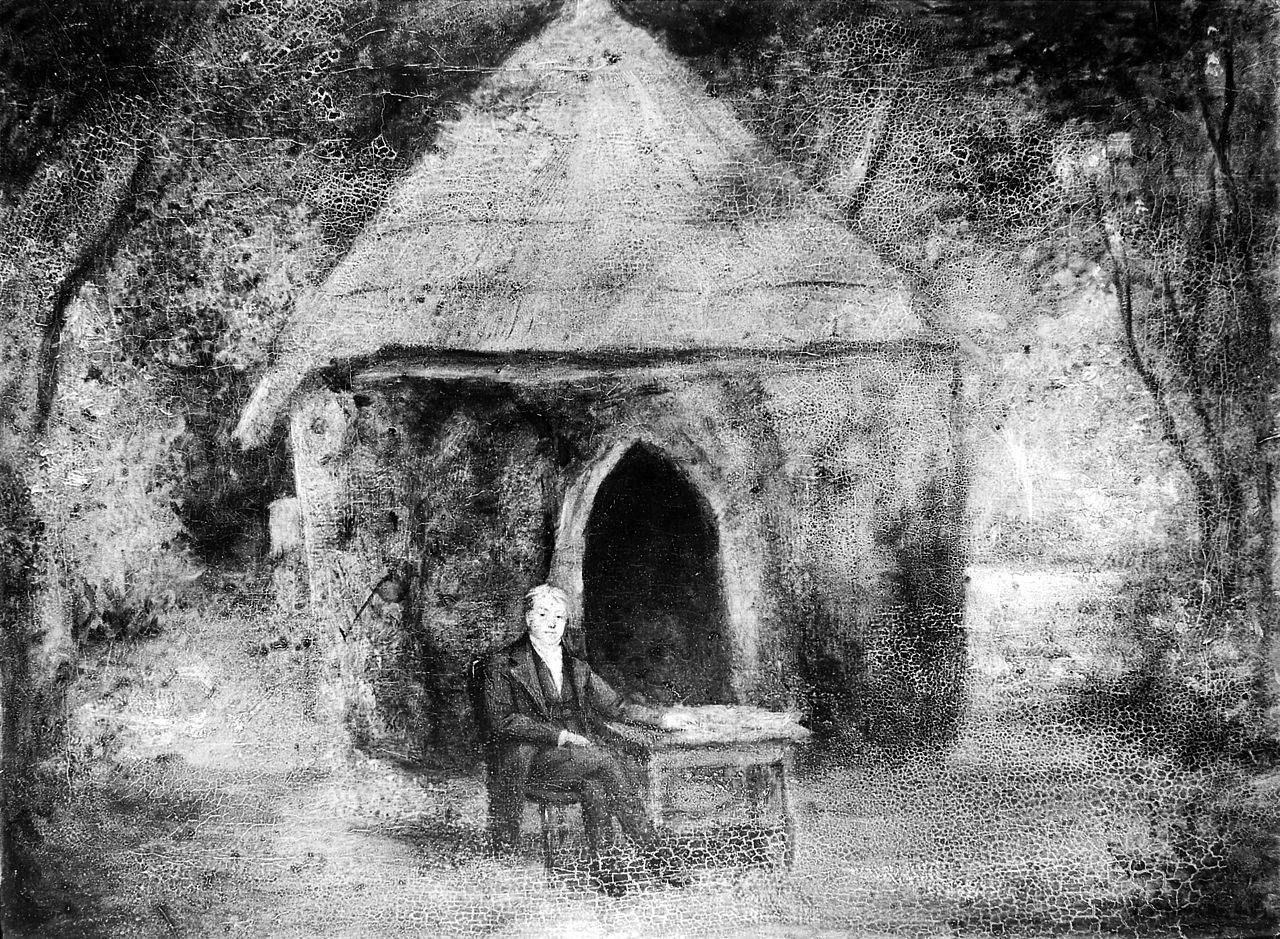
At age 47, country physician Edward Jenner decides to prove the folklore that milkmaids who contract cowpox will never contract small pox. What follows next is the development of the vaccine that will eventually bring about the eradication of small pox. This is the summarised life of the man who made vaccines popular in the Western world.
1749 – Edward Jenner is born in Berkeley, Gloucestershire, England to a clergyman. He has 7 older siblings.
Age 5 – His mother dies during childbirth. His father dies 2 months later. His older brother, also a clergyman, raises him.
Age 13 – After graduating from grammar school, he becomes the apprentice of a nearby surgeon.
Age 19 – Various physicians in England begin to notice that those who’ve had cowpox before never contract smallpox but none of them manage to get widespread recognition for that theory.
Age 21 – Edward completes his apprenticeship and becomes the house pupil of John Hunter, one of the most prominent surgeons in London, who tells him, “Why think? Why not try the experiment?”
Age 24 – Edward finishes his studies in London and returns to Berkeley to be a doctor in his native town. He also joins 2 medical groups to share medical knowledge and writes medical papers. He has an interest in natural science, studies geology and experiments on human blood. He also plays the violin and writes poetry.
Age 29 – Edward experiences a disappointment in love.
Age 35 – After hot air balloons become popular, he builds his own hydrogen balloon.
Age 39 – He marries a woman named Catherine Kingscote and writes a paper on observations of cuckoo birds. He is elected as a fellow of the Royal Society for this work but naturalists dismiss his work as nonsense.
This is Edward Jenner.
Age 40 – His son Edward is born.
Age 44 – His former teacher, John Hunter dies.
Age 45 – His daughter Catherine is born.
Age 47 – He decides to test the local belief that milkmaids who suffer cowpox never contract small pox. He takes matter from the lesions of a milkmaid with cowpox and inoculates an 8-year-old boy with it. The boy becomes ill for 9 days then gets well. Less than 2 months later, Edward inoculates the same boy with smallpox matter and observes that no disease develops. He proceeds to try this again with 22 other people.
Age 48 – His son Robert is born.
Age 49 – He publishes a paper titled ‘An Inquiry into the Causes and Effects of the Variolae Vaccinae’, naming the solution ‘vaccine’ after the Latin word for cow, Vacca. He then goes to London to seek volunteers for vaccination but nobody buys into his theory. To promote his solution, Edward gives the inoculant to other doctors who at first ignore or dismiss it, then try to take credit for coming up with it instead.
Age 51 – His vaccine is now available in most European countries.
Age 53 – The obvious effects of the protection vaccination become obvious and more people start getting vaccinated. Edward is now famous and continues to research and develop his vaccine. Parliament gives him £10,000 for his efforts to promote vaccination. He is elected honorary member of the American Academy of Arts and Sciences.
Age 54 – Vaccinations are now popular in Europe too. He becomes president of the Jennerian Society in London which promotes vaccines to eradicate smallpox.
Age 57 – Parliament gives him another £20,000 for his vaccination efforts.
Age 59 – Edward becomes a director of the National Vaccine Establishment that is funded by the government but soon resigns when he feels dishonoured by the men selected to run it.
Age 61 – His oldest son dies of tuberculosis. His sister, Mary soon follows.
Age 63 – His sister, Anne also dies of tuberculosis.
Age 66 – His wife dies of tuberculosis. He withdraws from public life.
Age 71 – He has a stroke but recovers.
Age 72 – Edward is appointed physician extraordinary to King George IV, and also mayor of Berkeley and Justice of the Peace.
Age 73 – He publishes a paper titled ‘Observations on the Migration of Birds’ then has a massive stroke in his study in the wee hours of the night and is paralysed on one side. The next day, he dies. He is laid to rest near the rest of his family at the Berkeley church.
1840 – 17 years after his death, the British government begins to provide smallpox vaccination made from cowpox free of charge.
1896 – 73 years after his death, a statue of Edward is erected at the Tokyo National Museum to commemorate the centenary of his vaccination discovery.
Edward Jenner statue at the Tokyo National Museum.
1980 – 157 years after his death, the World Health Organisation declares smallpox eradicated.
1985 – 162 years after his death, the house he lived in becomes the Jenner Museum.
Next up in this year’s The Wisdom of Crowds series is a question about goals. Here’s what our 2020 interviewees and interviewers have been living for. What about you? What’s your goal in life?
Q: What is your goal in life?
Oliver Chong, a theatre practitioner who has schizophrenia: To give meaning to this meaningless existence for my time being.
Leanne, popular Instagrammer: To create happy memories with many.
Victor Fernando R. Ocampo, speculative fiction author: I have two main goals: To be remembered and, as far as possible without surrender, to always be kind.
Sy, who runs LUCK-IT: Personally it is to make every second count. Socially it is to provide for the world what other people are not providing.
Choo Bin Yong, game designer who runs solo: My goal is to make a great game or a hit game.
Cho Jun Ming, N-Level student and film-maker who lost his father early: My goal in life is actually to represent Singapore one day in international film festivals. I’d like to let countries outside of Singapore know that the Singapore media industry is not dying and that Singapore media is actually growing to be better by giving an opportunity to talented individuals. One day we can also make high quality films—not just Korea, Taiwan or Hollywood.
Ms Lena Lok, founder of an art school: My goal in life is actually to represent Singapore one day in international I want to continue to serve the community with my art knowledge and skills. My wish is that Singapore’s Art education scene will flourish and become as progressive and developed as Melbourne’s in years to come.
Sean Munger, a former Atheist: To contribute something worthwhile and significant to reversing climate change, which is the world’s biggest and most urgent problem.
Kauai, 2020 LUCK-IT Interviewer: To spend more time practicing painting and learning to appreciate art.
Siddharth Mazumdar, 17-year-old inventor: To never stop learning and growing, while helping people along the way.
Dr Bob Rich, author of 18 books: To be of benefit. That’s why I am a Professional Grandfather, striving for a survivable future and one worth surviving in. One of my gifts in this life is to be able to heal with words, and I am joyful when I can make a difference in someone’s life.
Tony, 80-year-old blogger: My goal is to continue to live a happy healthy life and produce my blog on that same subject, hopefully, helping people to do the same.
Cedric, child-free by choice: To crush my enemies, see them driven before me, and to hear the lamentations of their women. And not have kids.
Norsham Mohd, a former Muslim: To live a productive and meaningful life free from mental and physical slavery. I do not want to die leaving behind debts.
Kinge, who quit social media: To have the truest and fullest human experience that the creator intended me to have when he created me, in the context of I am a spiritual being having a human experience.
Jason Koh, dungeon master: Rather than having one fixed goal far off in the horizon, I believe in having multiple smaller ones, and taking tangible steps to systematically realise them. Right now, it’s creating more opportunities for local creators and designers to showcase their pop-culture themed work to an international audience.
As we come to the end of 2020, it’s time again to collect and share the sentiments of this year’s readers and interviewees in our series, The Wisdom of Crowds. To start, here’s a question about favourite people. Here are our interviewees’ and interviewers’ choices. What about you? Who is your all-time favourite person? Let us know your favourite in the comments box below.
Q: Who is your all-time favourite person and why?
Choo Bin Yong, game designer who runs solo: Hayao Miyazaki. I feel inspired by his passion and drive to keep creating works throughout his life.
Kauai, 2020 LUCK-IT Interviewer: Stephen Chow. He is a legend of 90s comedy. The movies he made were very influential not only because they were entertaining but also because they told the stories of Hongkongers of that era.
Siddharth Mazumdar, 17-year-old inventor: John Locke. He constructed a basis for civil society which ensures the rights we enjoy today, which allow us to be free, and empowers us to help others.
Jason Koh, dungeon master: I’ve always been impressed by the decisiveness, tenacity and vision of Lee Kuan Yew. It wouldn’t be surprising at all to say I’m a bit of a fan.
Kinge, who quit social media: Neville Goddard. In my search for meaning of life, I found myself reading content from many great minds and writers such as Napoleon Hill, Aristotle, Earnest Holmes, Earl Nightingale, James Allen, Jim Rohn, Tesla among others but there is something about Neville’s teachings and writings. They teach you who you are, the real you within, how to use your imagination and observe reality with a new set of eyes leading to self-discovery that changed my life. As Marcel Proust says, “The real voyage of discovery consists not in seeking new landscapes, but in having new eyes.”
Joan, a minimalist: Maynard James Keenan. Many non-TOOL fans would say he’s just a pseudo intellectual, but hey, he makes great music. I also enjoy how all 3 of his bands do represent the 3 broad scopes of the human existence—mind, body, spirit. Overall, I am always very intrigued by individuals who are pretty much unconventional.
Cedric, child-free by choice: My partner, Joan, because she is firmly child-free!
Cho Jun Ming, N-Level student and film-maker who lost his father early: My father. Because he’s a very patient, calm-minded man and whenever he faced any obstacles, he would take it up himself and not let his emotions control him or affect his family. As a kidney dialysis patient who had undergone dialysis for over 20 years, he didn’t mention pain nor did he ever want to give up. He persevered so I really like his resilience, calm and patience.
Victor Fernando R. Ocampo, speculative fiction author: My wife, Patricia who is my sounding board and idea-generator as well as always, my first (and most vicious) editor.
Leanne, popular Instagrammer: My beloved grandpa. He just is.
Norsham Mohd, a former Muslim: I like to say my husband. I still love and adore him after more than 20 years of marriage and 13 years of courtship. He’s been there for me most of the time. There is so much I still need to learn about him.
Sean Munger, a former Atheist: My husband, because I love him.
Ms Lena Lok, founder of an art school: My mother-in-law! She’s an amazing woman who’s still very active for her age. She embraces life by pursuing a variety of activities—hiking, sewing, knitting, cooking, baking, floral arrangements and even volunteers her time with different communities. She’s a great role model for active ageing, haha!
Oliver Chong, a theatre practitioner who has schizophrenia: My dad. He gave me his life.
Dr Bob Rich, author of 18 books: Sylvia Kryz. She is an 84-year-old lady who was born inside my computer, and wrote the novel, “Hit and Run”. I’d really, really love to be like Aunt Sylvia. Why? Read the first chapter, which is on the page I linked to.
Simon Templar, retired US Marine: Jesus Christ. He came to Earth to save.
Sy, who runs LUCK-IT: I actually have a large collection of vastly different favourite people who inspire and educate me in vastly different ways. If I had to single out one helpful one here though, it’d probably be Buddha for his philosophies on inter-relatedness (everything is cause and effect), suffering (stop greed, anger and ignorance to stop suffering) and understanding the nature of things. I’m not even Buddhist (I identify as agnostic) but those simple philosophies have been quite helpful and effective for decision-making purposes enough times throughout my life for me to rather like the guy.
Tony, 80-year-old blogger: I can’t think of a single all time favorite person. I admire anyone of any age who lives an intelligent life and does positive life-oriented acts. As a writer I have favorite authors, but won’t single out just one. I do love Beethoven’s music. I guess I admire him the most.
Joan, who we interviewed earlier about being a minimalist, first decided she never wanted kids at age 14. 15 years later, she met Cedric Chew who, at age 12, had decided not to have children too. Now that they’ve been in a relationship for about 2 years and enjoy living with their fur-kids, we asked them why they made the choice not to have kids and what the outcome of that choice has been like.
“Even as a child I found other kids annoying.”
Q: Hi Joan! Thank you for coming back to talk about a different topic today, and with your partner too! To start, could you tell us a little about yourselves? Who are you and how do you tick?
Joan: Hello. I am Joan, founder of Minimalism in Singapore, mummy to two cats and am in a managerial position in the private education industry.
Cedric: Hi, I’m Cedric, dad to one very spoiled cat and many, many guitars, and I’m a sales manager for a Pro Audio company.
You both identify as wanting to be child-free. Did you both decide on that together or was that what led you both to choosing each other?
Joan: It was pretty much a pre-requisite for me before we started to date, imho haha.
Cedric: Wanting kids is a deal breaker for me when it comes to getting into long term relationships
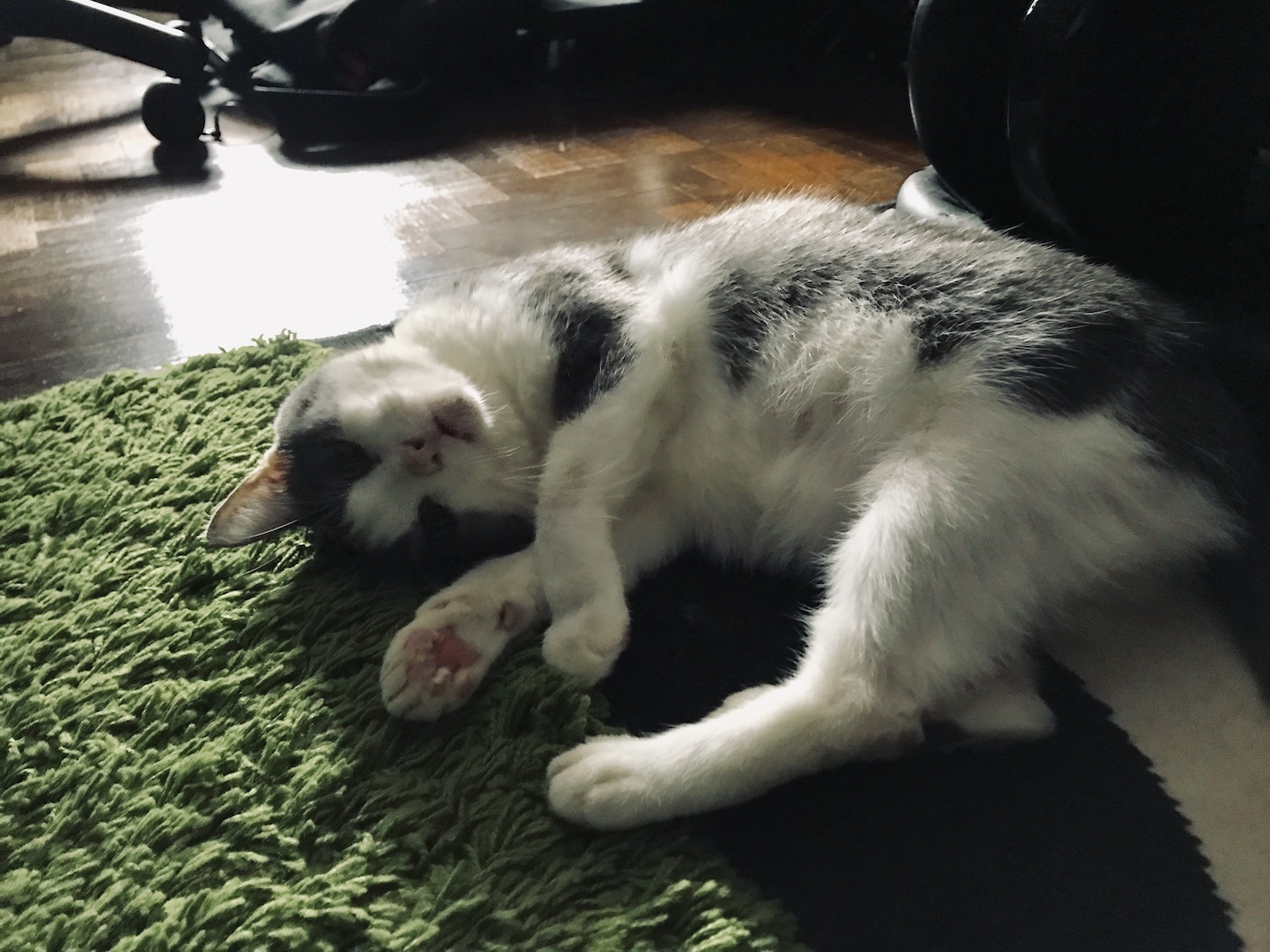
Joan and Cedric’s cat.
What are your individual reasons for wanting to be child-free? What makes you feel that way?
Joan: Being career driven and understanding the repercussions of being a parent to a child that needs almost a 30-year (or more!) commitment is too much of a balancing game to me. I like to plan for the future, and I would prefer to see myself in a relaxed state of mind when I am old and wrinkly.
Cedric: I’ve never liked children or the costs involved in their upkeep. Even as a child I found other kids annoying. Then over the years I realised how much money my parents spent raising me and I thought, “Man if I ever had that money I’m keeping it for myself!”
Why do you think you want to be child-free when many other people feel strongly for the exact opposite? Is it something about your personality, or past, or…?
Joan: Firstly, I hate to fail. To me, being a parent is daunting as managing a young one is not easy and you’d definitely be criticised no matter what you do. Secondly, being an educator, I think I have “parented” enough for a lifetime. I do enjoy watching my students flourish, but I don’t think I can come home to another batch of children and unwind at the same time.
Cedric: I’m an only child, and even during extended family gatherings I never liked playing with most of the other kids my age—I would either be reading or playing Gameboy by myself, or listening to the adults talk.
What’s the best part about being a child-free couple, and what’s the worst?
Joan: Best part: I get to spend my money on relationships, self-care, health care that many put off if they have kids due to financial allocation. I also have less stress should I face a period where I do not have income coming in. The worst would probably be having to face relationship challenges head-on without an external distraction (but it is something I’d prefer than avoid) and missing out on “family nucleus only” financial subsidies from the government.
Cedric: The best part is not having to reshape and plan our entire lives around a child, not just financially, but socially and emotionally. I really can’t think of a downside!
How have the people around you reacted to your decisions to be child-free and how have you dealt with their reactions beyond ignoring them?
Joan: Well, clearly it is not supported by the family. My mother tries to convince me that having a child is equivalent to adopting a puppy. I’d much rather adopt a puppy.
Cedric: My parents don’t really care. I think having seen how I turned out they probably secretly agree that it’s best I don’t breed.
Another one of Joan and Cedric’s cats.
The Singapore government is trying its best to encourage more Singaporean couples to have Singaporean babies. What do you have to say to them?
Joan: Economically speaking, having a growing birth rate would help the country on a macro scale. However, it comes with intangible responsibilities that are not well supported by the government. One area that comes to mind is definitely postpartum depression.
Cedric: No thank you, have you seen the cost of living lately?
What advice do you have for those intending to spend their lives child-free too?
Joan: Don’t get evangelical over it. It is a choice that is outside of the norm. However, do plan well for the future—especially when explaining your choice cordially or to even stave off loneliness when you get older. Personally, I have a bucket list that I consistently strive to check off in different phases of life. I think it’s a pretty fun thing to hone and helps you grow outside your comfort zone.
Cedric: Live the way you want, not how society tells you to. And invest in quality contraceptives or make skilful withdrawals.
Which 3 things or people are most important for those wanting to be child-free?
Joan: Your support system, your plan for the future, to be flexible to change.
Cedric: Your accountant, lawyer, and real estate agent. They’ll be invaluable in helping you spend and manage the money you’ll be saving by being child-free!
Which place is most useful?
Joan: …
Cedric: The place without any children.
More of Joan and Cedric’s cats.
Lastly, what if… just what if… you end up with a child anyway by the hand of fate?
Joan: Abortion is the first route we’ve agreed on. Firstly, it’s not as dangerous as it seems. Secondly, giving the child up for adoption may leave a child traumatised in future anyway.
Cedric: Yes, and the hand of fate will be given a firm slap on the wrist.
Joan plans to work on her career, work on her bucket list and improve relationships with friends and family in the next year. Cedric says he’ll be working on a Death Metal album for children about being child-free—“I’ve already booked a kindergarten to record in.” You can find out more about them on Joan’s website, minimalisminsingapore.wordpress.com.
At the age of 12, Jason Koh’s cousin introduced him to Dungeons and Dragons and he was immediately hooked. By age 15, he was running games after class for friends and soon after, he was playing Dungeons and Dragons with people all around the world through chat rooms and message boards. We asked the now 38-year-old why he’s still playing the game 2 decades on.
“Players love it especially when you remember the little things they do, and then use it to make the story more engaging for them later.”
Q: Hi Jason, welcome to LUCK-IT! Could you tell us a little about yourself? Who are you and how do you tick?
A: I’m the overlord (well, director) of a pop-culture marketing and events agency, the convention producer for one of Singapore’s largest comic art and illustration festivals, a game writer, and game master-for-hire. Basically, I do many things and wear many hats, but they’re all things I do out of love for all things pop-culture related. Lots of people think it’s challenging to make a career out of your hobbies, but here I am. I’m living it.
You are also known as a dungeon master? What’s that and how did you get started doing it?
A dungeon master (DM), or more commonly, a game master (GM) serves as the referee or storyteller for games, but you are an entertainer first and foremost. By telling an engaging story or creating clever scenarios, you can transport players from the familiar and ordinary into a fantastic world where they can slay imaginary dragons, become heroes, and take respite from the mundane, at least for several hours.
I began playing Dungeons & Dragons over two decades ago, and have been a game master for private games and games with friends for almost three quarters of that, but organising and running public games at conventions and hiring out my services as a game master is a fairly recent endeavour. It was a suggestion from a client who enjoyed the spectacle of one of the massive, multi-table adventures we ran at a convention, and since I have the game materials, resources and the know-how, it seemed like a natural next step.
A typical game at Jason’s table includes the use of intricate miniatures, props and set pieces, making the experience a highly engaging and tactile one.
For those who might not know, can you explain what Dungeons & Dragons is and how it works? How do people play it and where do they go to play it?
Dungeons & Dragons (D&D) is a tabletop roleplaying game where players take on the role of heroes (and sometimes villains), and partake in adventures. It’s a very vast, open and collaborative experience where the game master and players work together to tell a story. The game master is like the director, and the players are the stars of the show.
All you need to play D&D are some polyhedral dice, a pen and paper, and your imagination. In the past, hobbyists would play at local game stores and conventions, or meet up at cafes or in someone’s home for a game. Now, many groups have gone digital, and you can play through platforms like Zoom or Discord, or even highly specialised sites designed to facilitate such play like Roll20.net.
As a dungeon master, how do you create the games? Do you have a source of reference or is it all created by you from scratch?
In convention games and community play, we use D&D Adventurers League organised play rules. This system uses worlds and stories produced or endorsed by the publisher of D&D, and it allows players around the world to create persistent characters, record their achievements, and play with whomever they wish. The materials are available online, through the publisher’s website, and through a portal for community-created, crowdsourced content called the DMsGuild.
But it’s not too tough to create your own world or tell your own story if you’re familiar with the tropes of the genre and are willing to do a bit of research. I personally enjoy telling stories that draw on Eastern influences and themes, and crafting elaborate and suspenseful mysteries for my players. In fact, working with your players to develop the story, letting their actions impact the world, and having the world evolve with them is great too.
Cover for one of Jason’s D&D works, which was nominated for an ENnie Award in 2019.
What’s the D&D game you’ve created that you’re proudest of and what is it about? Where can people go to play it?
I’ve published several adventures on DMsGuild for D&D Adventurers League, and one of the titles, “Ooze There?”, was nominated for an ENnie Award in 2019. The ENnies are like the Oscars of the RPG world, and it was a first time an RPG writer in Singapore was nominated, so that was quite the achievement. I have several other projects in the pipeline that will be published on the platform soon, and they will all be available for purchase as a digital download. I’m also currently working on some RPG Kickstarters, including an insect-themed one with a popular digital artist, and a Wuxia-themed project slated for release next year.
As for those who want to dip their feet into D&D, the D&D Adventurers League Singapore Community runs monthly games online, and new players are always welcome to participate. Just check out their Discord at www.bit.ly/discalsg for more details.
What is your monthly routine like as a dungeon master and… do you get paid for being one?
Being a game master is just a small part of what I do in the agency. If it’s a corporate engagement, we might have to devote time to research so we can craft a storyline and scenarios tailored to the client’s team-building needs. If it’s for community building or outreach, we might have to pick suitable adventures following the theme for that month or event. With games taking place remotely right now, it’s inevitable that I have to devote some time to creating visual aids and inputting data into the platforms we use for online play.
We typically charge clients for any corporate team-building projects we run. We also charge a fee for private bookings that take place in our studio.
With the current global health crisis however, games take place strictly online, and are typically run on Discord. We don’t charge players to participate in such online games, but they’re encouraged to tip us on Ko-fi if they had a good time. The tip goes towards keeping the Discord servers we run games on boosted, and the costs of any materials we purchase to facilitate online games.
Which 3 people or things are most useful to your dungeon mastering work?
I’ve found it incredibly helpful to have the rulebooks on hand, not as a reference for myself, but for players who might be newer to the game. They’re a great reference, and it’s even better now that they’ve been fully digitised and are available online. Other than that, I’d say lots of post-its and writing material. You never know when an idea might suddenly strike you, or if you might need to jot down something in a hurry. Players love it especially when you remember the little things they do, and then use it to make the story more engaging for them later.
Which place is most important?
Any place with a large enough table to fit your playgroup, really, or a place with good connectivity if you’re playing games online. That’s the beauty of the game. It takes hardly anything at all to get started.
Can you list 3 things you realised only after becoming a dungeon master?
1) Managing player expectations is easy. It’s managing player egos that is hard.
2) Players who join the game without any preconceived notions of what D&D is can be some of the most fun to play with.
3) Time management, and making sure your games don’t take more than four hours though, can be incredibly tough. Sometimes, you just get so caught up in the story and the roleplaying you simply lose track of the time.
For players, what do they get out of playing Dungeons & Dragons games? How different is Dungeons & Dragons from say video/computer RPGs or life simulators like Second Life?
Playing D&D fosters cohesion, and promotes bonding through shared experience. We’ve also discovered that it’s a great tool for helping people develop communication, problem solving and social skills, heightening concentration, and in some cases, improving confidence.
Unlike a video game, where dialogue and interactions are pre-scripted, and scenarios have predetermined endings, D&D is incredibly open-ended. If you are immersed in the game, you’ll soon realise that the story is shaped not just by the game master, but by the decisions of you and your fellow players. You’re capable of actually making a mark on the world. You’re the hero. You’re the star of the show.
Even in games run on digital platforms, Jason enlivens the experience through the use of detailed custom graphics, visual aids and voice acting to provide an immersive experience.
Can you recommend some good places people can go to play D&D games in Singapore and around the world?
I’d definitely say check out the D&D Adventurers League Singapore Community Discord (http://www.bit.ly/discalsg). You can also download the basic rules for D&D from the official Dungeons & Dragons website to play with friends and family.
Some game stores may run physical games on-site, but we all know how that may not be the best right now with Covid-19, so definitely check for communities that play online near you instead.
Lastly, what advice do you have for those hoping to become dungeon masters too?
Lots of people don’t dare to make the jump to becoming a game master because they think they’re not good enough, or that they don’t know the game rules enough. The truth is, it’s a learning process. If you like writing stories and telling stories, it might not be a bad idea to just give it a try. Take that first step, play with friends you feel comfortable with. Practice, and you’ll definitely be able to make it.
This is Jason. Account director of one-stop pop-culture marketing agency Neo Tokyo Project, the producer of the Doujin Market art festival, the author of several D&D adventures, and a professional game master-for-hire.
Jason is presently pivoting towards producing more content for DMsGuild and through Kickstarter, while also organising monthly games for the community through Discord. He is also planning to launch a D&D stream on Twitch. You can find out more about his updates through his Facebook page (“check out the #dailylivesofntp hashtag”) or ask him anything you need to know using the comment box below.
More interviews with professionals of all sorts here.
Photographs courtesy and copyright of Jason Koh. Interviewer: Sy Want to be featured too? Tell us here. If you found this article useful: