At 51 years of age, Yen-Lu Chow was an entrepreneur and an angel investor… then he lost his son to suicide. Now 61 and on an ongoing journey to heal himself and the world, this social innovator, philanthropist, advisor, mentor, and seeker of Truth shares with LUCK-IT memories of his son, Lawrance, and all the lessons he’s gleaned from grief, suffering, re-calibrating and recovery.
“I had a tough time getting out of the house. I didn’t shave for months.”
Q: Hi Yen-Lu, thank you for agreeing to share your story with us. How did you find out your son had passed away? What were you doing right before that and what did you do right after that?
A: We got a call from Murdoch University in Perth, Australia where our son was attending school—from the Director of International Student Affairs. It was late in the evening—almost 10:30pm. My wife and I had just returned home from tennis (we used to play a lot of tennis together as a family).
How did you feel when you first heard the news? What about at the funeral and in the days after that?
It was a parent’s worst nightmare. After receiving the call from school, and having to take the overnight flight from Singapore to Perth, Australia, it was the longest flight ever. It felt like eternity. We were hoping somehow that the police, the school, God, had made a mistake—hoping that it wasn’t him. We had to go to the police coroner’s office to identify him. We came face to face with our dreaded fate. Our hearts were broken into a million pieces.
The days and weeks and months after were the most difficult times of our lives. We were thrown into the deepest and darkest abyss—worse than hell. We were in purgatory.
Yen-Lu’s son, Lawrance (extreme right), with Murdoch University teammates when they won Gold at the Pan Austria Tennis Competition, in the year he passed away.
You’ve said in other interviews that the days after your son’s death was the darkest time for both you and your wife—can you share how long those dark days lasted? How long did it take you, after his death, to be able to see the littlest bit of light again?
The first 6 months to a year was very, very tough.
What was the turning point/life-changing course of action that helped you see that little bit of light again, you think?
Fairly early on, we realised that perhaps we are not alone—that he was not alone—that there are likely many other young people who have suffered or are suffering from depression or other forms of mental health issues. And we wanted to do something about it. This was that first glimmer of light—it provided a path to move us forward. So rather than focusing on our own grief, pain, sorrow, and suffering, we decided that we would instead try to focus on others’ pain and suffering—and to alleviate their suffering. This was the beginning of our transformation. And this was what our son would have wanted.
What was your routine like during those darkest days?
I had a tough time getting out of the house. I didn’t shave for months. I was wearing my son’s shirts a lot during that time. I still do to some extent.
I also spent a lot of time trying to remember him—all the good things about him and the good times we had as a family, writing a tribute to him with scenic pictures of the family traveling together, a memorial video, etc, also seeking help from friends and healers.
What about now? What is your present routine like?
I spend most of my time these days working on my family foundation—I’ve founded/co-founded a number of nonprofit social initiatives (Akaraka, Over-The-Rainbow, Singapore Creations, YSI SEA, Asia Institute of Mentoring, Made of Brilliance, etc) to help other kids, young people and their families.
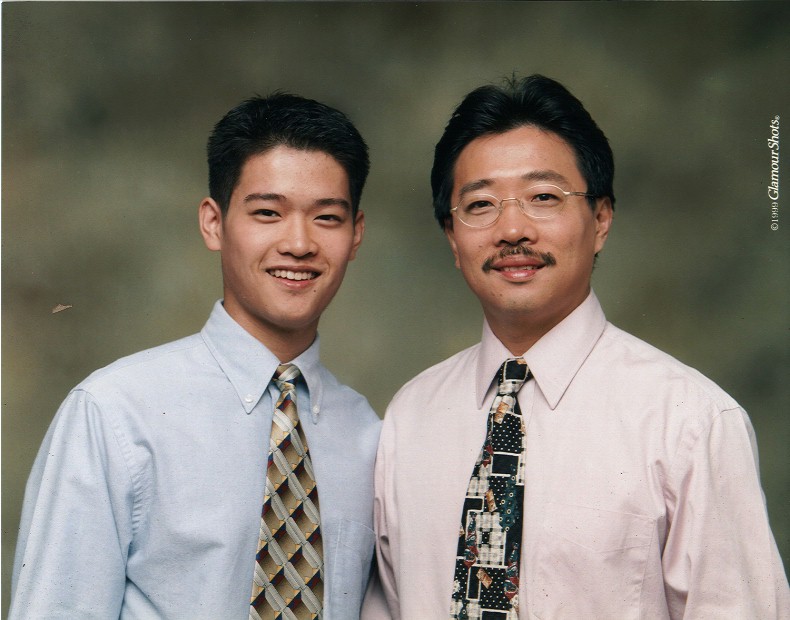
Yen-Lu and son, Lawrance, vacationing in Mexico in 1993.
How do you presently spend your weekends?
I do a lot of reading and spending time with friends. We also hold a lot of our workshops, talks and events on weekends—to bring more well-being and hope to others.
What advice do you have for parents who’ve only just lost their child to suicide?
We came across many and have supported many parents on this journey of grieving and recovery.
They need emotional and social support and we try to be there for them. Letting them know that it’s going to be a long journey back—to take time to grieve—also letting them know that things will get better, that the sun will rise again—but will take time—that they need to take care of themselves and the rest of the family first. More importantly, to know that their child will always be with them. We carry our son in our heart.
Yen-Lu and son at the Singapore Botanical Gardens in 1998.
Can you map out a recommended path to coping for parents who’ve only just lost a child to suicide to follow?
What was crucial for our coping and recovery: Rather than heaping blame on ourselves and on each other—to ponder what should have been and what might have been—how we could have done things differently—regrets—which were easy to do during those dark times—and which would have brought us to an even darker place—we decided to support each other—and to focus our attention to help others. This was key for us to begin the healing process.
It’s also been an ongoing journey to search for new meaning and purpose in life. These days it is manifested largely through the work of our family foundation and many other social initiatives I get involved in—to discover our true self—to connect to our Higher Self—and to find our common humanity.
What key things/people/situations enabled you to get through losing a child to suicide, in your opinion?
Unconditional support of friends and family is crucial. Also see above.
How did seeing all that your son went through and losing him at the end of it all change you as a person? Or did it not change you? Why?
Life is precious—yet fragile. Life is short. We have to be grateful for all the gifts that we’ve been given in life.
If you could go back and replay the time you had with your son all over again, what would you do differently?
I think I would tell him I love him a lot more often.
Yen-Lu and family in Taiwan in 2007.
What was your son like as a child? What about as a teenager and later a young adult? How did he change at every decade? Or did he not change?
When our son was alive (he was ill at the time), he once told us: “Wouldn’t it be nice if we could make a difference in someone’s life?”
His life, his passing, his legacy became our inspiration, and the genesis for our family foundation and Over-The-Rainbow.
He was a shy but a great kid—and as perfect a son as any parent could wish for. He has the most wonderful hobbies, and the most kind and gentle personality.
He was an avid reader starting at a young age; he loved being read to as a young child, especially at bedtime. He loved animals as well. Lawrance was born with music in his veins: he started piano lessons at a tender age of 5 ½ years, and after years of practice—became quite a proficient pianist; he sang in a children’s choir that performed in public during Christmas holidays; as a pre-teen he picked up clarinet, and thru his interest and dedication, he was selected and performed as the first-chair clarinet for the school concert band, at the Singapore American School; in later years, he taught himself acoustic guitar, and was able to play some pops and other selected tunes. He owned two iPods and an iPod Shuffle, and literally took his music with him everywhere. He also loves sharing music with others, and with his guitar.
He also got into sports at a young age: he started learning baseball when he was 4 or 5 years, playing catch with Dad. He grew up with baseball, playing T-ball later on in the little league. He also played basketball, with dad initially, and then participated in the youth basketball leagues. He enjoyed playing American football with Dad. Later on as a teenager, he caught on to tennis and went on to play for the varsity team at SAS, varsity team at Fordham University, and was on the Murdoch University tennis team that won the gold medal at the 2009 Pan-Australia Uni-Game competition. And due to Mom’s strong influence and passion for yoga, he picked up yoga in the last couple of years. He started practicing yoga quite regularly.
Which event in your son’s life set in motion his struggle with depression, you think? Or was that brought about by more than just a single event?
It’s both nature and nurture. I don’t talk about this much—but my Mom had severe depression when she was raising us. It’s just in those days, no one talked about it. She had to live with it her entire life. I also experienced depression as a young man that went well into adulthood.
The stress of growing as a teenager and later academic stress were other triggers.
Which 3 objects/people could you not live without right after losing your son? Why?
Not sure how to answer this question. I look at life very differently these days. Nothing’s permanent—everything’s temporary—life is change.
Yen-Lu with kids of Singapore Creations—which provides young people with a supportive platform where they can be creative and grow as people—of which he is co-founder and chairman, at the non-profit’s inaugural production.
Of all the objects you bought/received when trying to cope with losing your son, which was the most useful? Why?
I rely on my music a lot. I always have.
What is the worst advice you’ve been given, or have heard people giving, with regards to coping with the loss of a child? And what’s the best?
They think you should “get over it”—but no one ever “gets over” the loss of a child. Late Elizabeth Edwards, an American attorney and health care activist shared so beautifully :
” If you know someone who has lost a child and you are afraid to mention them because you might make them sad by reminding them that they died—you’re not reminding them.
They didn’t forget they died.
What you’re reminding them of is that you remembered that they lived, and that is a great gift.“
Yen-Lu with participants at the “Screwed Up Moment” event—which focused on sharing failure, not achievements, jointly organised by Over-The-Rainbow and the Happiness Initiative.
Yen-Lu now spends most of his days working on several social initiatives (Over-The-Rainbow, Singapore Creations, Young Sustainable Impact SEA, Asia Institute of Mentoring, Made of Brilliance, Climate Conversations, etc) to benefit society. You can find him online in a lot of places (“I’m very active in the social space and also in tech circles.”) or drop him a question using the comment box below.
Photographs courtesy and copyright of Yen-Lu Chow. Interviewer: Sy If you found this article useful:
Ten years after graduating from Saint Andrew’s Secondary School, Bryan Yong went back and attended classes again—this time as a relief teacher. He told LUCK-IT how he got the gig and shares what the jobscope and schedule of a relief teacher entails.
“I was recommended by an ex-teacher.”
Q: Hi Bryan! How did you end up as a relief teacher at your alma mater? How did you know they were hiring and why did you want to do the job?
A: I had some spare time after graduating from university and before starting my first full-time job and was looking for something to do in between. I had taken up other part-time jobs before (e.g. car valeting) but was looking for something more fulfilling and better paying.
What does the job of a relief teacher entail? What are your main responsibilities and side responsibilities?
Relief teaching requires you to take charge of a class when the teacher isn’t present due to certain circumstances (sick leave/on course), mainly to ensure all students are present and to keep order. If work is assigned to the class, the relief teacher will carry out the instructions given, usually in the form of readings or worksheets. Basic knowledge of most subjects would be a bonus as you will meet inquisitive students who will need help with their work.
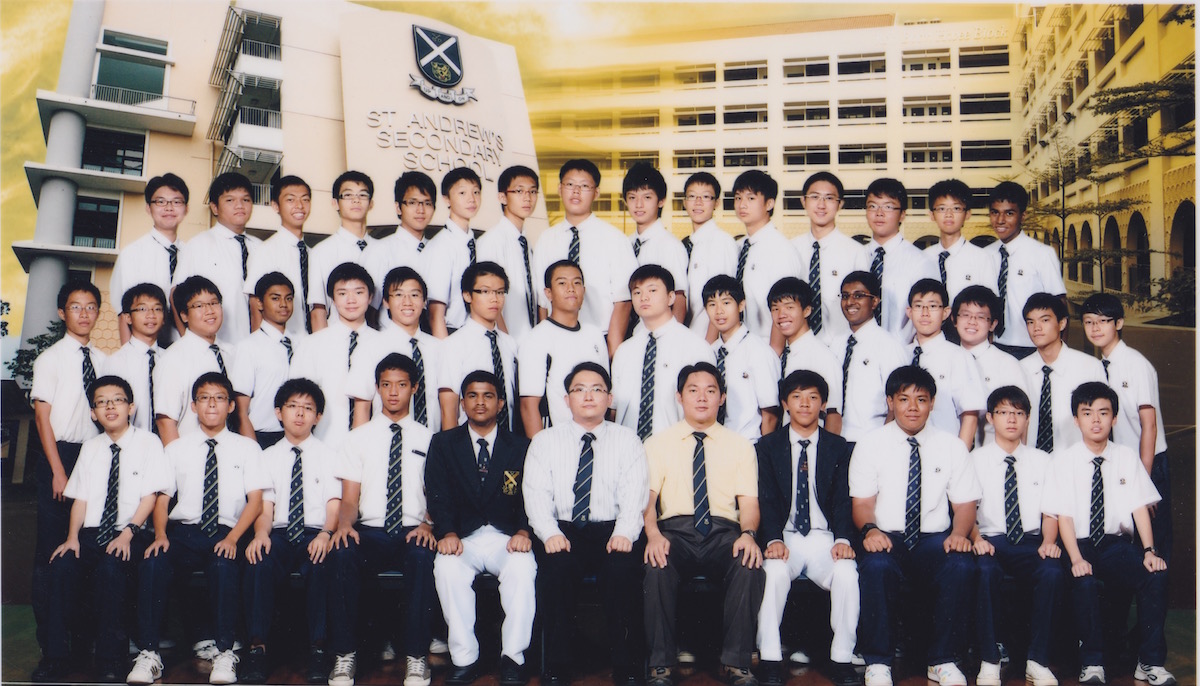
Bryan (front row, middle) in his Sec 3 yearbook photo.
How did you apply for the job? Did you have to do anything special in the process of applying for it?
Application is through a MOE [Ministry of Education, Singapore] portal, where you have to first create an account and thereafter furnish your details for registration. In short, the documents you need at hand are your past education result slips and personal information. Upon registering, MOE will review the documents submitted and decide whether you have the qualifications to become a relief teacher. If approved, the next thing is to make a trip down in person to your desired school to register with the school. (Proximity to the school plays a considerable part in whether the school will accept you or not.)
Applications can be made throughout the year but will only be reviewed in 2 windows, 1 January to 28 February and 1 July to 31 August.
To be eligible as a Relief Teacher, you have to possess either: 1) an on-campus Degree or be an undergraduate pursuing an on-campus degree; 2) have a diploma from a local polytechnic/IB Diploma; 3) with at least 2 GCE ‘A’ Level/H2 and 2 GCE ‘AO’ Level/H1 passes (including General Paper); or 4) 5 GCE ‘O’ level passes (including English and Mathematics) with L1B4 of ≤ 26 points.
More details on application and eligibility can be found in this link. [LUCK-IT disclaimer: This post is not sponsored by MOE. All MOE links are provided purely because of Bryan’s enthusiasm.]
How long did it take for you to go from applying for the job to getting hired for it?
Approval can take roughly 3 weeks to 1.5 months from submission of documents. After which, registering with the desired school can take an hour or 2 depending on the availability of the Head of Departments (HODs) or Principal/Vice-Principals who will interview you to determine your suitability for the school.
Why do you think they hired you for the job?
I met the minimum requirements meted out by MOE, and I was recommended by an ex-teacher from my alma mater (St. Andrew’s Secondary School).
What is the work routine for a relief teacher like?
The school(s) that you’ve registered with successfully will call you in the morning (on the day itself) if they require your assistance. The school that I was registered to would call between 6:45am and 7am if they required me to come in that day. This may differ from school to school. Relief teachers are required to come in by 7:30am to collect the relief schedule for the day. The first period starts at 8am and the last period typically ends at 2pm or 2:30pm. There is no dictated lunch period–teachers normally take the chance to grab a bite or drink during their free periods, whenever that may be.
How do relief teachers spend their weekends?
Unlike full-time teachers, relief teachers do not have to prepare materials for class or bring worksheets/exam papers back to mark. Hence during the weekends we are free to enjoy the time at our own pleasure.
Bryan (middle, with hands on side) in Sec 4.
What advice do you have for someone hoping to become a relief teacher at their alma mater?
If you have teachers who have taught you in the past and are still teaching at the same school, you can reach out to them for advice on how you can go about applying to the school. If you have left a good impression on your teachers upon graduating, they may put in a good word for you with the school’s upper management.
Can you map out a recommended path for people who want to be relief teachers at their alma maters to follow?
As mentioned, apply through MOE and get yourself approved to relief teach first. Then proceed down to your alma mater’s General Office to apply as a relief teacher. Knowing an ex-teacher that you have built a good rapport with in the past is beneficial as they can put a good word in for you with the HODs/Principals who are going to interview you.
What has the experience of being a relief teacher been like for you?
The first few days/weeks will be a bit of a challenge as you have to first discover ways to teach or discipline students. But as time passes, you will pick up skills from your fellow teachers and colleagues on how to deal with more difficult students. As an ‘old boy’, students tend to look up to you as they know that you’ve once been sitting in the very seat they are in now.
Have you changed as a person since becoming a relief teacher? Or learned some things you didn’t know before?
Relief teaching has taught me patience when it comes to educating the younger generation. I have had the chance to see how both the students and the education system has changed since my days as a secondary school student 10 years ago. There are now other schemes for Normal Academic students to through-train into polytechnics without having to take their ‘O’ levels, as well as a major change in the education system to look forward to in the next few years.
The school which educated Bryan and later became his source of temporary income.
If you could go back and replay your time as a relief teacher all over again, what would you do differently?
Wouldn’t change a thing, the students and teachers I’ve met really do bring back memories of those carefree days as a student.
How have you changed since secondary school? Or have you not changed?
My thoughts have definitely matured since. In secondary school you’re kept in this protected environment and things that happen around the world don’t really affect to you. I’m glad to know that the education system has opened up to give students a more worldly perspective.
Do you think your secondary school has had an influence on your personality today? If so, how? If no, why not?
Yes! Saint Andrew’s is an Anglican mission school teaching Christian values, which has definitely made an impression on me even through my young adult years.
Which 3 objects/people in your life can you presently not live without and why?
Friends, good ones. They stick with you through good and bad times and provide valuable perspective on matters to help you better see a situation you’re in.
Of all the objects you bought in the past year, which has most positively impacted your life? Why?
In this technological age it would be my new phone [the iPhone XS]. Eons faster than my previous one and with a better camera, it has made me more productive as I use my phone a lot for work/keeping up with friends.
Which person do you wish LUCK-IT would interview for you to learn from? Why?
Anyone who can give young working adults good advice on saving for the future.
[UPDATE: We have found some answers on saving for the future for Bryan. Click here to read them.]
Bryan now (middle), on the job as a relief teacher.
Bryan starts working at Singapore Airlines as a Cadet Pilot this month but will try his best to answer questions on relief teaching when he has the time if you leave them in the comment box below. Aspiring pilots can also reach out to him via his Facebook page should they need help preparing for airline job interviews (at his discretion).
Photographs courtesy and copyright of Bryan Yong. Interviewer: Sy If you found this article useful:
When HT was 10-years-old, he wanted to be able to shoot webs like Spiderman. There was a lack of high quality, realistic web shooters available for purchase then so he decided to make his own. Today, HT has sold close to 300 self-made web shooters on Etsy under the brand HeroTech, mostly to middle-aged Americans, some of whom buy for their kids. LUCK-IT couldn’t resist asking how he made that happen.
“It’s a lot easier than you think—almost everything I learned to make the web shooter was learned through free online resources.”
Q: Hi! So excited to have you with us today! Tell us about yourself: Who are you and why did you decide to start making your own web shooters?
A: Hi! While I’d rather not share specific details related to who I am, I can tell you that I’m a pretty huge nerd. I’ve always loved engineering and inventing new things, so when I heard about the then-new Spider-Man Homecoming movie coming out, I wanted to make my own web shooters. There’s something pretty magical about bringing things from science fiction to reality, and after 6 months of prototyping I was able to make something satisfactory to me.
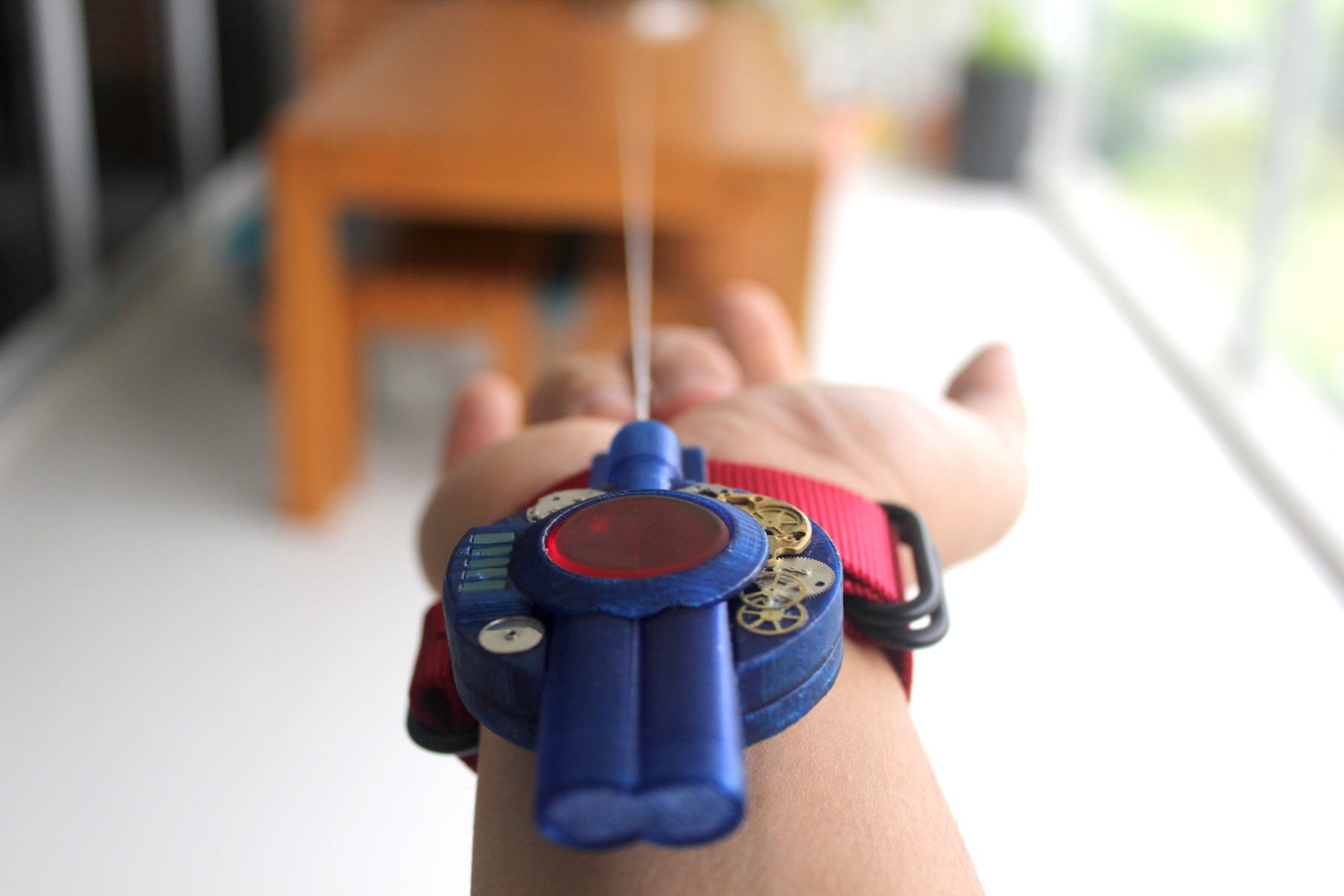
HeroTech’s web shooters in action! Powerful enough to take down music stands! Source: HeroTech’s YouTube channel
How do your web shooters work?
When engineering I try to follow the KISS (Keep It Simple Stupid) method, and that’s the approach I went with this. Basically, inside the web shooter is a block on a spring. The projectile itself also has a spring on it, and when the projectile is loaded into the shooter, the block catches on a latch on the projectile, thus keeping it in place. Fishing line is tied to the block and around the middle finger, so when the fishing line is pulled, the projectile releases.
How is it you know how to create a mechanically functional gadget? Was it something you studied in school or something you picked up on your own?
I took physics in school, so I had some basic knowledge of mechanical principles. However almost every other part of the construction of the web shooter was self-learned through online resources.
How did you find and acquire the parts required to make your web shooters?
Almost all of it was online through sites like AliExpress, eBay, etc.
Can you talk us through the process of creating your web shooters? What did you do first, and next and so on and so forth?
First, I had to define the parameters and goals of the project: what specific capabilities did I want the web shooters to have? From there, I was able to ideate several solutions to the different goals, and then prototype them. Some worked, most didn’t, and I retested the prototyping process until I found systems that worked. From there it was just refining and testing the web shooters to make them reliable and looking good.
Did you succeed the very first time you tried to create a web shooter or did you have any failed prototypes? If so, how many of your early designs failed and why did they fail?
Nothing ever worked the first time—oh my goodness was the prototyping process arduous and frustrating. I lost count of the failed designs somewhere after version 20. Most of the failures were due to unaccounted for variables or stresses in the environment.
How many months did you take in total to figure out how to get your device to work? And how much money did you spend in the process of doing so?
The first working version took about 6 months and $800 SGD to develop.
HeroTech’s workbench: various web shooters in different stages of construction; tools and materials used to make web shooters; packing and shipping materials used to ship web shooter orders.
What was your routine like when you were thick in the midst of creating your web shooter?
As I was studying full-time, I was usually only able to work on the web shooter in my free time. When I was able to squirrel away time to work on it, it was usually late in the night or early early morning.
What about weekends? How did you spend weekends then?
Weekends were spent with friends and family usually, but occasionally I liked to show them the prototypes and get their opinions.
What advice do you have for someone thinking of making their own superhero gadgets too?
My advice is that it’s a lot easier than you think—almost everything I learned to make the web shooter was learned through free online resources, so don’t be too intimidated to try making gadgets of your own.
Can you map out a recommended plan of action for people wanting to create their own superhero gadgets to follow?
The design thinking process is what I’d go for—empathise, define, ideate, prototype and test. These five steps are pretty essential for creating anything of use, and once you find something you want to make, it’s just a matter of following these steps.
What key things/people/situations enabled you to create your web shooters, in your opinion?
In my opinion, me creating the web shooter and the resultant online success of it was mainly enabled by my situation and circumstance. I was lucky enough to have access to a 3D printer via my school, and my parents were supportive of me and what I wanted to create.
How did having successfully created a working web shooter change you as a person? Or did it not change you? And what did you learn from doing it that you didn’t know before?
It changed me because I learned what I can do if I just set my mind to a goal and work consistently towards it.
If you could go back and replay your entire process of engineering web shooters all over again, what would you do differently?
I wouldn’t change a thing actually. The hiccups and failures are the real takeaways for me, and the process as a whole was quite enjoyable—those moments of triumph when something actually worked made it all worth it.
What were you like as a child? What about as a teenager and young adult? How did you change at every decade? Or did you not change?
As a child I was quite carefree and happy—ever since young, I loved to create things. Legos were my favourite toys. As a teenager/young adult, I became quieter and generally more mature. I still love to create things, however instead of Legos, I use CAD modelling and 3D printing now.
Which major event in your life has made you who you are, in your opinion? Why do you think so?
The moment when the first web shooter video hit 1 million views on YouTube was an epiphany moment for me. I realised not only was there a sizeable audience and demand for HeroTech, but that I could tap into it even with the limited experience and knowledge I had. HeroTech has long been a pipe dream of mine, something I envisioned doing on the side while I worked a full-time job. I never imagined that I could do it right now. I’ve never been the kind of person who wanted to change the world or make my mark on history, but that moment truly made me realise the impact and reach even a kid with barely any engineering experience could have on a large community, something that has propelled and driven me ever since.
Two halves of HeroTech’s new WEB-12 web shooter. Prototypes made out of steel.
Which 3 objects/people in your life can you presently not live without and why?
My mom, dad and my friends. (Technically more than 3 but who’s counting 🙂 ) I think friends and family are the most important things in life, and without them I wouldn’t be where I am today.
Of all the objects you bought in the past year, which has been most useful? Why?
3D printer for sure. Specifically the Prusa i3 MK2, shoutout to Prusa Research #pleasesponsorme. It’s allowed me to bring ideas from my mind into physical reality, and is my most invaluable engineering tool.
Which person do you wish LUCK-IT would interview for you to learn from? Why?
Anyone who’s done a lot of good for the community would be awesome to interview.
[LUCK-IT Update: We have interviewed a gentleman who has done just that, right here. And another lady too, right here.]
Editing in progress: A YouTube video for HeroTech’s WEB-12 functional thread shooter.
What’s the worst advice you’ve been given, or have heard people giving? And what’s the best?
Worst advice I’ve ever heard is “get so drunk you forget everything”, and the best I’ve heard is “this too shall pass”.
Lastly, what other superhero gadgets do you intend to create in the future?
Some Iron Man projects are planned, as well as some stuff from the Flash, and of course more web shooters.
HT is presently working on making metal web shooters, a micro flying ornithopter, and some other secret stuff. You will be able to track his progress and see his web shooters in action via HeroTech’s YouTube channel, Instagram page, Facebook page and Twitter account. You may also ask him questions by leaving them in the comment box below.
Interviewer Note: You make me want to go invent gadgets to solve all of life’s problems now. Thanks for helping me realise everything’s doable 🙂
Photographs courtesy and copyright of HeroTech. Interviewer: Sy If you found this article useful:
Juliana had a rash at age 12, for which she was prescribed topical steroids. Over the next eight years, plagued by persistent skin problems, she persisted with using topical steroids all over her body until, when aged 21, she decided to stop. Within a week or two, her skin became completely red and for the next four years after, she was ‘burning’, oozing and shedding from head to toe, to the extent she had to take a year off school. Four years after her ordeal with what the Internet terms ‘Topical Steroid Withdrawal’, Juliana tells LUCK-IT everything she’s learned from the experience and offers coping tips to others going through the same.
“Be reminded that you are stronger than what you believe.”
Q: Hi Juliana! First off, can you tell us what topical steroid withdrawal is and how someone can tell when it’s happening to them?
A: Topical Steroid Withdrawal (TSW) is a cluster of symptoms that happens when you stop using enough topical steroids after using them for prolonged periods of time. Now, just what exactly is ‘prolonged periods of time’? It’s advisable to continuously use topical steroids for not more than 2 weeks, so going by that, anything longer than 2 weeks is too long. Of course, it also depends on the strength of the topical steroids. The stronger you use, the shorter you should use them for. In general, the chances of someone having TSW is greatly increased if they have used it for months on end, and notice their skin worsening despite the usage. It can be hard to tell if it’s happening to yourself because you can never be sure if it’s just your eczema worsening or your skin craving more topical steroids (hence entering TSW unknowingly). I can’t really give a simple answer. The more complete one would require a look into personal history:
1.. Did you use potent topical steroids for more than 1 month continuously? Or weak topical steroids for several months/years? 2.. Has your doctor been prescribing you increasingly potent topical steroids to maintain your skin? 3.. Did you experience worsening of the rash, spreading of the rash, burning, oozing, more dryness than before? 4.. Does your skin worsen the moment you stop applying topical steroids? 5.. Do you feel like you can’t maintain your current skin without the topical steroids?
Actually, as long as your answer for 4 and 5 is a yes, I can say with 90% confidence that your skin is already addicted to topical steroids, and if you’re not applying more frequently, or more potent steroids, you will experience withdrawal symptoms, which is what I lined out in number 3.
Before Juliana went into withdrawal. “21 years old. Taken at a restaurant because why else would I be holding a basket of xiao long bao? This was Crystal Jade at Holland Village (if you really care for the details!) when I was still suppressing my rashes with a lot of steroid creams. It was barely manageable as I remember having a rash underneath my lips that was shedding that day. Still recall the Elomet cream stinging my skin.”
How did you realise you were going through topical steroid withdrawal yourself?
It was after I stopped my 9-day oral steroids treatment. My skin was worsening again and I was shedding, from my body, tiny skin flakes everywhere. My skin was red! My then ex-boyfriend told me I have TSA [Topical Steroid Addiction]. I didn’t believe him because as far as I knew, one can only be addicted to oral steroids, which I had been using very rarely. I googled ‘eczema red skin’ and chanced upon Kelly’s page about red skin syndrome. Her photos were what convinced me I was going through TSW, because we looked the same. Dry, red face. Which is also why I decided to take photos of my skin (even though I really didn’t want to look at them) and post them on my blog!
How did you even start using topical steroids in the first place?
The same as everyone I suppose! A doctor prescribed it to me! It was a general practitioner in the very beginning. I had some rashes, he prescribed it to me. End of story.
How much topical steroids were you using before you ended up with withdrawal, and how regularly were you using it? Were you following your doctor’s instructions when using or did you just use it whenever you felt you needed to?
Let’s just define ‘ended up with withdrawal’ as the point I decided to stop using topical steroids, because I believe my skin already went into withdrawal before I stopped using steroids although I’m not sure when that was exactly! I had been using topical steroids since I was 12? I was 21 when I stopped. Initially, I would only use them on the rashy bits, for a few days until they went away. Then repeat when they came back. During the last 5 years of my usage, I was using them twice a day, all over my body (because I had rashes almost everywhere). It was betamethasone valerate. I still remember it was quarter strength and half strength. My dermatologist prescribed me TUBS of that. Not tubes, but TUBS! Strangely, my doctor didn’t give me much instructions other than to “use them when itchy”. So I did use them every day because I itched every day. Also the rashes never really went away, so I gotta keep applying until they do, right? When I did withdraw from topical steroids, and was crying to a dermatologist at the NSC [National Skin Centre in Singapore] hoping to get them to diagnose my skin as a TSW case, she told me to “use the topical steroids every day until the skin clears up”. self-censored expletive
How long did it take for you to recover from topical steroid withdrawal? Did the condition affect your life in any way? If so, how?
I’ve quit topical steroids for 8 years now. It took me 2 years to heal from the worst flare. And then throughout the other years, I continue to deal with relatively minor flares. I feel like I never truly healed from my eczema, so I’m still working on that!
TSW left me quite debilitated at that time. I went from social butterfly to hermit. I couldn’t function normally as I was exhausted (from not being able to fall asleep at night) and couldn’t perform well at school. I had to take a year off school in fact. I even stopped watching TV in the living room because I didn’t want to leave a pile of skin there. I spent all my time in my room. I lost all self-esteem and confidence, got depressed, but not depressed enough to shut myself out from my friends completely. I also had thoughts of dying but I couldn’t bring myself to do that to my family. I felt like a constant burden to them, but it’s also this thought that makes me want to do anything I can for them right now.
Juliana’s feet, 7 months into withdrawal.“In 2011. 22 years old. Taken at home because I really didn’t wanna be in the outside world anymore. Skin was REALLLLLLY bad. My skin got to the worst stage around month 7. It was a gradual worsening. Imagine how hopeless I was. 7 months in and it was just the beginning.”
How did you finally get over topical steroid withdrawal? What was the turning point/course of action that got you there?
For me, it was Traditional Chinese Medicine (TCM). As I had to return to school after my gap year, I wanted a little help from someone experienced at treating skin conditions. I was really glad it worked for me, as it helped me go from 80% to 99% healed. Of course, I got complacent and stopped treatment 1 year in, and started adopting my previous unhealthy (but very fun) living habits. I guess the saying is true: live fast, die young. Or in this case: live fast, bad skin.
Did the process of going through topical steroid withdrawal heal your eczema too, you think?
Overall, it’s a ‘no’. I still have my underlying eczema that has been unresolved for too many years. It did get a lot better, like almost unnoticeable during my first stint of TCM back in 2013, but apparently the problem’s still not fixed! Especially when I went back to my old ways of partying and drinking.
What was your routine like during your worst phases of topical steroid withdrawal? How did you care for your skin, self and surroundings?
Oh my, the routine is depressing. I’d wake up around 8am, staring at the window as the sky brightened. I’d wish for the night to come faster because I didn’t want the light to show me how bad my skin was. I wanted to sleep my day away so I wouldn’t have to move or see much. When I finally felt too dry from spending too much time immobile in bed, I’d get up for a shower. I still remember I had to mentally prepare myself for the pain I’d experience when the water first hit me. I would spend 20 minutes just having water run over me—the only time I would feel rather normal again because my skin would no longer be dry and tight. But I knew after leaving the shower, I’d have to experience the dryness all over again. It is like going to heaven then going straight to hell, falling double the distance. I’d then sit in front of a fan to dry myself out, apply dollops of vaseline (when my skin could tolerate it. Otherwise I would just slowly let it dry up and turn into Groot? I imagine this is how he feels.) and enjoy the remaining bits of flexibility and elasticity in my skin. I think I spent too much time picking on my skin. I just hated how rough it felt when I ran my hands across my skin. Lots of scratching and rubbing later on to soothe the tingling and itch. I’d eat, drown myself out with TV shows because that was the only thing I could do that didn’t require my hands (as I needed them to scratchy scratch). Nightfall, I’d feel happier then head to bed hoping to fall asleep, but it would always take me a few hours as I would be tingling. When I was oozing, I had to pad those areas with cotton pad to prevent it seeping into my sheets too. I had to sleep in certain positions to limit contact with the bed. Still have no idea how I survived those days, other than the fact that the human body is a lot more resilient than you’d think.
I didn’t really care much for my skin and self back then. I really should have spent the time reading books good for my soul and mental state. Nothing I did seemed to help with the skin anyway, and creams were a big no-no during the worst as it stung so it was really just showering twice (with just water) and trying to keep my surroundings as clean as possible (thank god for my mom as she cleaned my room for me).
Now that you’re much better, what is your routine like? Do you do anything special to keep the topical steroid withdrawal flares or eczema at bay?
I can fall asleep around 11pm and wake up at 6am for work 🙂 I CAN WORK NOW! In fact I can do many things which I used to be able to do before TSW. I only shower once a day now! A HUGE improvement because my skin feels less dry now. I use creams to keep the dryness at bay, I really like Cetaphil Restoraderm cream as it contains a good blend of ceramides and niacinamide which restores the skin barrier and calms it down. It’s not too oily so it doesn’t leave my skin sticky. I’ve also switched to Avene products for facial skin care because they don’t irritate my skin! They keep my skin moisturised and supple most of the time, unless I have another tiny tiny flare (like real tiny, because it’s only 2 rashes on my cheeks) then the skin does its thing and goes through the red/itchy/dry/shedding cycle. Can’t say it prevents a flare from happening because I still have flares, especially before my period!!! But these are the things I find to not sting my skin even when it’s acting up.
How do you presently spend your weekends?
This question makes me guilty, because it’s kinda like how I spent it last time during TSW… at home and in front of my computer. BUT, on top of that, I cook, I do my laundry, I clean my room, I play games with my boyfriend, and occasionally, I go out for a hike or spend it with family. Okay, spelling those out makes me feel like I didn’t really waste my good skin time 🙂
“Take it one day at a time.”
What advice do you have for someone going through topical steroid withdrawal too?
Be mentally prepared for the shitty days you’re about to face, it really tests your sanity. If I can make it through, so can you. If it helps, visit my skin blog for some hope. A lot of readers told me it helps them when they read what I had written in the past. Maybe it’s the photos too? I don’t really know. Secondly, be patient. “Take it one day at a time” should be the tagline for TSW! Be reminded that you are stronger than what you believe. Lastly, if you see a lot of yellowish pustules that resemble pus (they have the milky yellow colour, unlike interstitial fluid that is yellow but a clear fluid), visit the doctor for a possible infection. You’d need antibiotics for that sh*t.
“Month 7 versus month 25. So that’s 22 vs 24 years old. There’s a lot more comparison on my blog. Of course, these are outdated by now. The photo on the right was taken in 2013, when I had great success with my first TCM doctor. Skin has since had several other flares.”
Can you map out a recommended path to healing for people going through topical steroid withdrawal to follow?
Stopping topical steroids is the first step. The rest is just a survival response. Seek support from friends and family. The ITSAN [International Topical Steroid Addiction Network] community can help you in the beginning so make sure to head over there for some moral support. But don’t linger because what else do you expect from a bunch of miserable people who are all suffering? Be patient; the worst is yet to come, but once it does, you know you’re half-way through the battle. It can take months just for it to get that bad. It really depends on your body. I notice the healthier you are, the faster you get worse and from there you’ll truly experience the recovery.
What key things/people/situations enabled you to make it through topical steroid withdrawal, in your opinion?
Hands down, my family!!! It wasn’t even myself, because I wasn’t myself back then. I was staying alive for my family because of their love for me. Some of my skin friends weren’t as lucky—their family didn’t support the idea of TSW, and insisted they go back to treatments. I was also very fortunate to have been able to rest at home for the entire year. I didn’t have the kind of financial burden others have. Nor do I have children of my own to support. I just had to make sure I was still breathing.
How did going through topical steroid withdrawal change you as a person? Or did it not change you?
Did TSW affect my life in any way? F*CK YES! It turned my world around, broke me down, built me up and gave me strength I never could imagine having. I never knew at that moment how I could survive the endless cycles of shedding, oozing, and itching but I made it through somehow. I started to appreciate my very supportive family, because if not for them, I couldn’t have made it. I earned that strength, and I use it as a reminder when I feel down in life. It has also given me the power to be more empathetic towards others. We’re all suffering in some way or another; why did I think I was the only one who had it the worst? I’ve learnt to be more kind towards others. So, even though it sucks to have had a few years of my life taken away from me, I think of it as a mental retreat where I learned how to be a better person, and also how to live in harmony with this world, my mind and my body. Also, it has given me a brand new perspective–now I am more appreciative and thankful of everything in life (I felt this the strongest right after I returned to school though as time goes by, I need reminders to remind myself how good I have it right now). Deprivation is the best spice in life!
If you could go back and replay your whole journey of healing from topical steroid withdrawal all over again, what would you do differently?
I would spend those times more productively. I could have read so many books during those times, learned so much more than I could have done. Books have given me some peace of mind, that I’m not wasting my life away because I am gaining something even though all I can do is read. Maybe pick up how to trade as well, so I could have earned some money on the side while being home-bound? Too bad!!!
How much topical steroids did you use as a child? What about as a teenager and a young adult? Have you noticed any patterns between the condition of your skin and your use of topical steroids?
Not much as a child, because when I was just a kid, I was clearly more wise. I refused to use the creams because I didn’t want to dirty my sheets. As a teenager, I got more vain and wanted to get rid of the rashes so of course I started using it more. As my skin got worse, I used more topical steroids. Sometimes I wonder if my increased use of topical steroids worsened my skin too.
Which major event in your life made you who you are, in your opinion? Why do you think so?
I was really lucky as a kid, I never had any huge problems or issues other than minding my grades at school. So as of right now, going through TSW, it has been humbling, and very educational for me, spiritually and mentally. You really have to fall to the lowest possible level in your life in order for you to evaluate what the most important things in life are. When everything is stripped away from you, you realise those are not essential. And from there, the mental world I build is laid on much stronger foundations. It’s weird because I didn’t want TSW to define who I am, yet it contributed a lot to who I am today.
Juliana now. “This was taken last month at home. 29 years old now. FML. Where did time go?”
(about the photo above, cont’d) “If you zoom all the way in, you can still see my neck is atrophied, and slightly rashy. Skin looked really good after my period and has fluctuated along with my hormones and flared a little since that week. So much has happened in one week! My neck is now recovering from a flare [that started] 6 days ago and it has gone through the same old ‘itch -> red -> dry and shedding -> smooth and fragile -> dry again but less red’ cycle. Same with the area around my lips too. Will it end one day? Yes. It just takes a long while because my skin has definitely atrophied and is even more easily irritated than before. Other than that I think I look spectacular in the photo. Only had some concealer underneath my eyes!”
Which 3 objects/people could you not live without when going through topical steroid withdrawal? Why?
My mother, my brother, and vaseline. My mother and brother are super supportive and helpful, and never once complained about my skin and its inconveniences. My mom worked, and had to cook for me and clean my room for me. She did so much for me. As for vaseline, it helped me retain a little elasticity in my skin moments after showering, giving me the ability to move without as much pain and skin tearing.
Of all the objects you bought for coping with the symptoms of topical steroid withdrawal, which has been most useful? Why?
Probably vaseline too, because it’s inexpensive, didn’t irritate (when my skin was better), and gave me some level of relief to function.
Which person do you wish LUCK-IT would interview for you to learn from? Why?
The Dalai Lama, because he contains so much wisdom and joy, I want to learn how to cultivate that too! Especially when life is filled with difficulties and hardship.
What is the worst advice you’ve been given, or have heard people giving, with regards to skin care? And what’s the best?
The worst would be the dermatologist who asked me to apply topical steroids DAILY, ALL OVER MY SKIN. No thanks.
The best would be to leave it alone as much as possible! If it’s not broken, don’t try to fix it.
Juliana is presently a sales and operations executive, working 9-6 for a brand she loves. She works on herself when not at work and of late has been figuring out and dealing with emotional issues. You can read more about her experience with TSW on her blog (although she hasn’t been updating because life has gotten in the way) or ask her to tell you more about it by leaving your questions in the comment box below.
Interviewer’s Note: A couple of years ago, a series of spreading rashes all over my body made me consult three different doctors over five months. All three—one of whom was even a skin specialist—diagnosed and prescribed the same thing: eczema of unknown origin and tubes of increasingly potent topical steroids (the final batch being Clobetasol, the most potent topical steroid of them all). The response of my skin was always the same: better with topical steroid application but way worse the second I stopped applying the creams. It took me many cycles of this to put two and two together but I eventually concluded my worsening skin condition might ironically be linked to the creams the doctors were telling me to apply. I figured I might be allergic to the creams so I stopped all at once and right away ended up house-bound for months when all of my skin immediately erupted in crazy itchy oozing sores that would grow dramatically in size and thickness before crusting over and flaking like snow over time. I was ghastly disfigured, scratching all the time, had insomnia and strange zapping sensations every single night, and I truly believed I was suffering a disease doctors didn’t yet know about. It was then I found Juliana’s blog on the internet, and more from others who looked just like her and myself, and finally realised what might really be going on. I told my doctor (the skin specialist) about what I found but he refused to acknowledge the link between the creams he’d prescribed and my skin condition. In the end, I had only Juliana’s blog and that of others like her to rely on for tips on what to do to feel better and function better. My skin is now back to normal and all I did to get it back was—not consult more doctors but, like Juliana and others said—wait it out and let my body heal itself. And for that information, I am forever grateful.
Photographs courtesy and copyright of Juliana. Interviewer: Sy If you found this article useful:
After taking her GCE O-Levels in Singapore, 17-year-old Christine Yong had the option to either enrol in a Polytechnic, work towards the GCE A-Level examinations or pursue a International Baccalaureate (IB) diploma. After careful introspection, she chose to take the IB at Anglo-Chinese School (Independent) and two years later, graduated with the best possible score an IB student can attain—which gave her a better chance at getting into top universities around the world and winning scholarships. LUCK-IT had a chat with the now 24-year-old about her study techniques and snagged some tips for present and future IB students hoping to achieve the same.
“I don’t have a specific system other than placing importance on practice and repetition.”
Q: Hello Christine! First off, can you tell us why you chose to take the IB instead of the alternatives? And what subjects did you take and why?
A: The most crucial constraint on my choices was that I did not take Higher Chinese in secondary school. With my L1R5 of 6-2=4, Raffles Institution (RI) and Hwa Chong Institution (Hwach) were out of my reach. I decided to pursue the IB programme at Anglo-Chinese School (Independent). Even if I had qualified for RI or Hwach, I would not have chosen to go to either. First, I felt it was too early for me to specialise in either the arts or sciences. As someone who was inclined towards both disciplines, I thought the holistic curriculum of the IB was more suited to my interests. Not only did it have a better breadth-depth trade-off for me, it also trains a more comprehensive set of skills. For example, in languages and literature, students are assessed via both written and oral examinations. For the sciences, independent research projects are part of the compulsory assessment. In retrospect, these were incredibly valuable for training my presentation and research skills. Secondly, I much preferred the continuous assessment format of IB over the one-shot style of the A-Level [Singapore-Cambridge General Certificate of Education Advanced Level] examinations. I felt that this type of assessment was not only less stressful but more fair—based on aptitude, rather than ability to memorise.
I took HL [Higher Level] Chemistry, Biology and Geography with SL [Standard Level] Mathematics, English Literature, Chinese B (the subject for Chinese as a second language, since English is my first), Extended Essay (compulsory research paper) and Theory of Knowledge (also compulsory). The principle was to first take what I loved—Biology, Geography and Literature—then take what I felt was practical or necessary for my university applications/career—Chemistry, Mathematics and Chinese. Finally, this was rounded out by the required subjects: Extended Essay and Theory of Knowledge. I would recommend taking Mathematics HL if you are unsure about your future career path—at once, it helps open up engineering, science, and medicine as career options. I ended up pursuing a Biology degree where Maths HL would have been immensely useful.
Christine (far left, in black) at Anglo-Chinese School (Independent)’s Prom Night in 2013.
What grades were you aiming for and what grades did you think you’d get?
I didn’t have any particular aims other than at least my school average (I believe around 41 at the time I took the IB in 2013) and 7-7-6/7-7-7 for HLs (a requirement for my top target universities).
When did you start properly studying for the IB final exam or working towards getting those grades? How much time do you think you spent preparing for the final exam in total?
The IB involves lots of continuous assessments, so the effort was continuous. In terms of final examination preparation, I began studying intensively about 2 months before the first examination.
How do you study, really? Do you have a system you use? If so, where did you learn that system from?
I don’t have a specific system other than placing importance on practice and repetition. For Chinese, I simply followed the assignments and classes, and practiced on past exam papers. For the sciences, maths and Geography, in addition to ensuring I did all the regular assignments, I would go over all of the content of my subjects at least once prior to my examinations. In this first pass, I would make summary notes of all content as this helps to solidify the concepts, facts, and statistics in my memory. In the process, I would read around concepts or topics that I find particularly interesting (usually on Wikipedia or journal articles) and embed these insights into my notes. I would also identify the sections in which I have poorer understanding for further rounds of revision (this entailed reading over notes/making new notes depending on how confident I feel about the subject). For each round of revision, I would check my understanding either on a per-topic basis or through past examination papers, depending on my confidence level and what resources were available to me. For Literature, we broke up each text into parts and worked in a group to analyse the sections we thought were more likely to be significant. For the oral examination, we practiced answering questions with each other.
Can you share your study routine? How did your week look when you were preparing for the IB final exams?
For the 2 months I spent preparing for the final exams, I spent every day except Sunday studying for about 8-10 hours each day. I would usually allocate 2 subjects to 1 day and alternate between reading/memorisation and practice, to reduce the monotony. Sundays and mealtimes were essential breaks that ensured I was fresh for my other study sessions. I spent some days studying together with friends, where we would talk about the subject, quiz each other, and take some well-earned breaks.
How did your week look when you weren’t close to any exams?
I would usually be dedicating around 12 hours per week to completing assignments, reading, and whatever continuous assessment was ongoing at the time. 4 hours went to extracurriculars. The rest was free time spent with friends, at home, and/or pursuing hobbies.
How did you spend your weekends then?
Some mix of work and chilling, according to the weekly schedule above.
Christine (middle, in boots) with her closest friends from Junior College.
Did your parents do anything special to prepare you for the final IB exams?
Nag at me when I appeared too relaxed i.e. whenever I was not studying, and not disturbing me when they saw me studying!
What advice do you have for someone thinking of getting 45 for the IB?
Choose subjects you love, pace yourself well for the 2-year grind (marathon, not a sprint!), and don’t forget to set aside time for your family, friends and hobbies.
Can you map out a recommended path for students who want to get 45 at IB to follow?
The IB offers lots of flexibility, so it’s difficult to recommend a path. But I would say choose the right school, with teachers who care for you as an individual, and who have a good grasp of the IB assessment rubric.
What are the key things/people/situations that enabled you to get 45, in your opinion? Who/What do you believe you never would have done it without?
As I mentioned above, I felt very blessed to have teachers who cared about my personal growth and learning, and who were experienced in the IB. In comparison with friends and family from other schools or countries who did the IB, I feel that ACS(I) [Anglo-Chinese School (Independent)] provides one of the best environments for doing well in the IB.
How did getting 45 change you as a person? Or did it not change you?
It didn’t change me very much, other than helping me get into the university and course I wanted. Personally, I don’t think there is a significant difference in ability between people who scored within the range of 42-45 (this is also reflected in universities’ IB cut-offs).
If you could go back and replay your entire education process all over again, what would you do differently?
Now that I am on the verge of starting my career, I feel that I should have taken the more difficult Mathematics HL, taken a philosophy or sociology subject at an earlier age (though this was not possible for my O-Levels [Singapore-Cambridge General Certificate of Education Ordinary Level]) and worked harder to express myself in Mandarin Chinese, dialects, and other languages. These are skills that I see as very important not only in the current global job market, but in defining my personal identity.
What were you like as a child? What about as a teenager and young adult? How did you change at every decade? Or did you not change?
I was as interested in a wide range of academic subjects as I was in things society didn’t seem to value as much—writing, design, baking, cooking, and gaming. I did begin to realise that others did not consider these latter pursuits potential career paths, so I became less invested in these areas (to my great disappointment) and more in academic science. However, these all continue to be a part of my life in some way today.
Which major event in your life has made you who you are, in your opinion? Why do you think so?
I can’t identify a single major event!
Which 3 objects/people in your life could you not live without when studying for the IB final exams and why?
My IB friends, my family, and my Wah Chee teh bing and butter chicken.
What Christine calls ‘The best Teh Bing in Singapore’, located within walking distance from Anglo-Chinese School (Independent).
Of all the objects you bought when preparing for IB, which was most helpful? Why?
My laptop, where all of my notes and assignments live.
Which person do you wish LUCK-IT would interview for you to learn from? Why?
I’d like to learn from entrepreneurs and artists in Singapore about their struggle to change or adapt to Singaporeans’ behaviour—whether as consumers or as individuals in society.
What’s the worst advice you’ve been given, or have heard people giving, with regards to studying? And what’s the best?
The worst: to study everything. Sometimes spotting is necessary for efficient studying. The best: to use mnemonics when you need to memorise something that is organised or named in an effectively senseless way.
Christine is presently a graduate student studying the fields of science and tech policy. She also works part-time in a Japanese startup in the field of computer vision within the mobility sector and keeps a portfolio of her thoughts and work on her website. If you wish to get her advice on studying and taking the IB, you may drop her your question in the comment box below.
Back in 2015, 19-year-old Jeshua made the decision to rent out his personal collection of camera gear and started a Facebook page titled ‘J Rental Centre’ to do so. Today, J Rental Centre has a website, an office, staff and three collection points all around Singapore. LUCK-IT asked the now 24-year-old entrepreneur/film-maker how he did it.
“I would say the reason we’re still here and still focussed on the same vision of connecting people is because of the community impact we have seen.”
Q: Why did you decide to start an equipment rental business? And how is it you could start it with almost $0?
A: We’re not exactly an equipment rental business but a peer-to-peer platform, something like Airbnb/Grab, that connects owners and renters of camera gears, event logistics and creative spaces with each other. I began JRC.sg in early 2015 as I saw that the existing rental houses were expensive and rigid, especially for students and smaller productions. We wanted to provide a rental service that is both affordable and convenient, while focussing on the people element, not just the hardware or spaces. There is nothing like getting tips directly from a professional owner and a few minutes chat can prove more useful than 2 hours of manual-reading or YouTube-watching.
The business was started not as a business but as a means of cost reduction and better utilising resources which I already had. There wasn’t capital investment that could be measured in $ but certainly a lot of time and energy in formulating the policies, writing agreements, developing the website, marketing, and the list goes on.
What was your first year of business like? How did you get customers and what did you learn along the way?
JRC began as a Facebook page with a list of stuff that I personally already owned. Shortly after, some friends also wanted to rent out their equipments and we grew the list, then created a blog-site. The first few customers came from people whom I had known through school and work and word slowly spread through word of mouth as well as our digital marketing efforts.
J Rental Centre’s first Facebook list of gear for rent.
How did you start expanding your business? Was it something you planned for at the start or something that occurred organically?
In 2016, we launched the first version of JRC.sg which listed camera equipment like DSLR, lenses, lighting, sound and support gear from 16 different owners all over Singapore. It was a huge step up from the Facebook page or blog-site but still largely manual in the way we cleared inquiries, created invoices and collected payments. More partners came on board—some customers and some who just had a spare set of kit they didn’t want collecting dust at home. Today, we have over 100 owner partners and are on our second version of the site which features two new verticals (event logistics and creative spaces), e-payments, user accounts, online ID verification as well as a host of other bells and whistles. We are always thinking of ways to add value and connect more people as we know that there is still a sizeable portion of the media and events industry that are more used to just walking into a shop to get what they need.
How long did it take you to get to the point where you felt like your business would be sustainable in the long run? Was there a significant turning point/course of action that got you feeling that way?
I don’t think that we have even reached this point today, despite being around for over 4 years. Reaching critical mass and achieving a network effect that is win-win for all parties is not easy, and even companies like Grab are not profitable yet. I think a better question would be at which point did I start taking this Facebook page that I created more seriously and try to scale up what we were doing, and that would have to be in 2016, when I saw that having a site which organises the listing information was going to be very important if we wanted to connect more people. So, I hired a developer to code the first version and started taking in some interns to assist with marketing as well as thinking of new ways to grow the platform.
J Rental Centre’s present website.
Did you have any setbacks or wins along the way while in the process of doing the above?
Our setbacks include lengthy development time, especially on the current site, as I was properly trained in film-making and not as a tech-geek, some mis-steps in terms of trying to penetrate the clothes rental market sometime in 2017 and a bunch of poor hiring decisions. I would say the reason we’re still here and still focussed on the same vision of connecting people is because of the community impact we have seen. The power of team cannot be underestimated, especially in a small industry like media. It is always good to know more people and the transactional value of renting out a piece of kit is actually far lower if this transaction actually leads to a friendship or even becoming acquaintances with each other.
What was your routine like when trying to expand J Rental Centre?
Routine would be the last word I’d use to describe a lot of things that I do but we’re really goal-oriented and try many different things to fulfil the goals that we have set out. A lot of focus would be on balancing the chicken and egg problem which would bug most platforms–having too many ‘suppliers’ would mean that each person has less transactions, while having too many ‘buyers’ would mean that each buyer has insufficient choice. So it is a balancing act and we are always trying to court both sides to tell them about why they should use the platform or how we can help them to achieve their goals (be it to save costs, learn more, increase revenues or worry less about safety and procedures).
J Rental Centre’s City Hall Collection Point.
What about now? What is your present routine like?
I now spend a good amount of time working remotely, travelling back and forth from Myanmar where I have started Crossworks since 2018. The company was started to help local Singaporean companies (such as my own) hire remote talent from Myanmar/Yangon to fulfil their manpower needs as well as lower their manpower costs, while stopping the brain drain out of Myanmar.
How do you presently spend your weekends?
If I’m in Singapore, I’d either be busy with productions, accounting, emails, or in church where I serve in the live production team as well. If I’m in Myanmar, I could be on a boat, up in the hills, by the beach or in a city–that’s really much less predictable.
What advice do you have for someone hoping to start their business at age 19, or with $0?
It’s not going to cost $0. Take into account the time and attention that will be the investment in whatever you’re doing but also don’t stop at ‘hoping’ and ‘dreaming’—the realistic chances of success are slim (statistically speaking) but I think that if you’re like me and don’t take it too seriously and are doing something that you like, it’s always worth trying and learning along the way.
Can you map out a recommended path for people wanting to start their business at 19, with $0, to follow?
I don’t have one and I don’t think one exists. I would suggest as above but if you have a clearer idea of the kind of business you’d like to setup, talk to some potential customers/partners and see if that is something that they would need. Don’t be surprised if there is hesitation or if they don’t sound supportive but take those initial observations in and remember why you started always.
This is Jeshua.
Which key things/people/situations enabled you to keep and grow the business you started at age 19, in your opinion?
The business began after a few other platform businesses like Airbnb, Uber/Grab, etc, started, and people became more open to the idea of resources being shared instead of just owned. The gig economy was also and is still continuing to expand such that people do not need to keep all the resources in-house and have them be less than optimally utilised but are able to ‘plug and play’ resources as and when needed.
How did starting your own business at 19 change you as a person? Or did it not change you?
It gave me the opportunity to interact with much more people and hence I would say that it has changed me for the better.
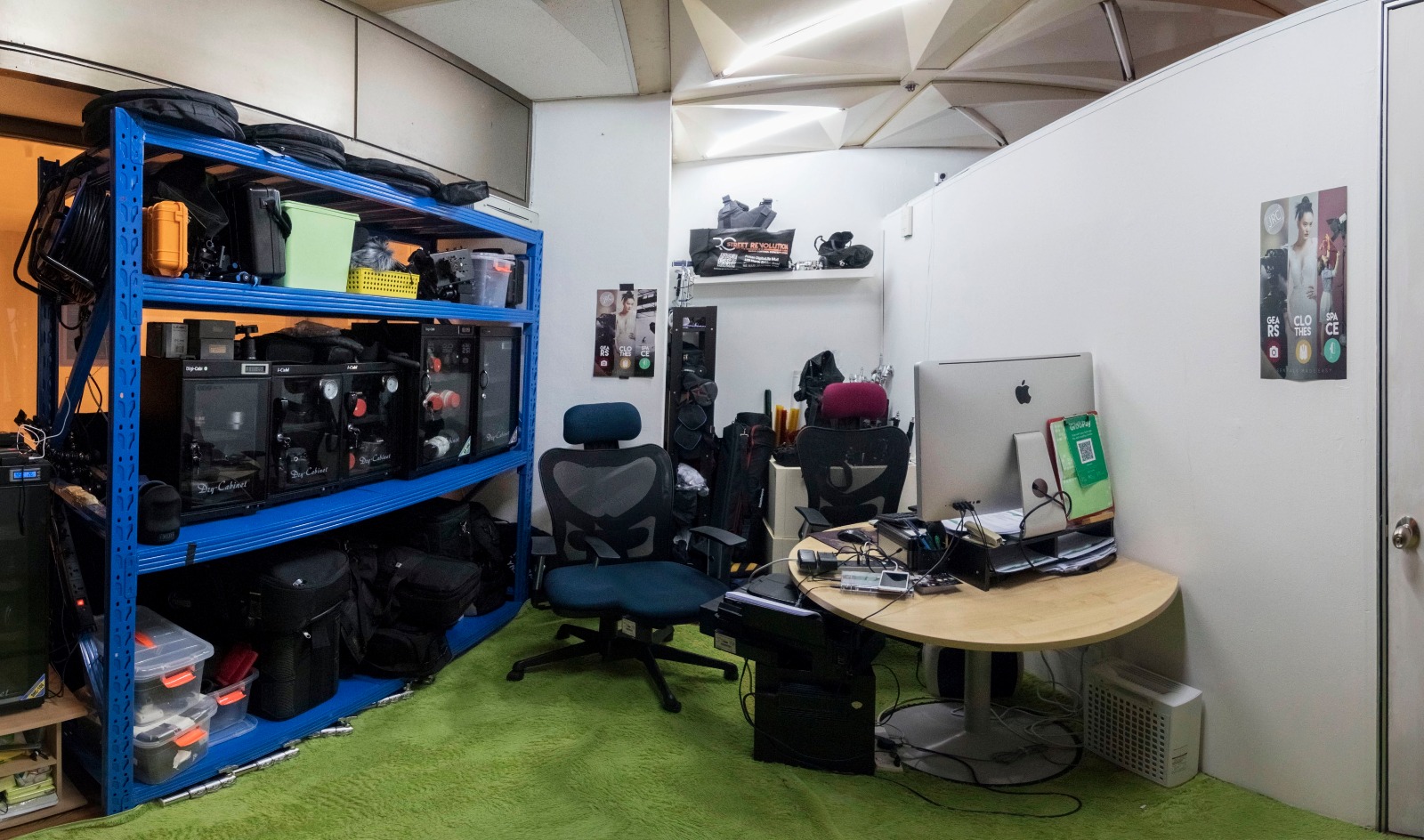
Jeshua’s present office in Tai Seng, Singapore.
If you could go back and replay the adventure of starting and running J Rental Centre all over again, what would you do differently?
I would focus on what I can do at this present moment.
What were you like as a child? What about as a teenager and young adult? How did you change at every decade? Or did you not change?
I never liked being bored. I don’t think that has changed but I have learned to value quiet and slow moments, grown in patience as well as increasingly seen the value in some routines.
Which major event in your life has made you who you are, in your opinion? Why do you think so?
Not one event per se but in general not having examinations being a huge part of my life at any point made me realise that there are more important priorities. Learning became a joy and something I still constantly try and do. With grades and accolades being something that many people in our society get caught up with, I think it gives me a different perspective when looking at issues or making decisions.
Which 3 objects/people in your life can you presently not live without and why?
Objects are easier. A laptop, phone and my passport. I use these to get work done and get around.
Of all the objects you’ve ever bought/received for the purpose of expanding or sustaining J Rental Centre, which has been most useful? Why?
We’re not really a brick and mortar store so I guess our website itself is our biggest asset to help connect people.
Jeshua’s studio at Tai Seng, Singapore.
Which person do you wish LUCK-IT would interview for you to learn from? Why?
Jony Ive—his design has had a huge impact on the world we live in today.
What’s the worst advice you’ve been given, or have heard people giving? And what’s the best?
I have forgotten most of the worst advice. Some of the best would be to take care of yourself physically and not neglect health while focussing on your other priorities.
Jeshua presently runs his two other businesses—Crossworks and Startupmedia—on top of running J Rental Centre. You can connect with him at those websites or his LinkedIn page, or drop him in a question in the comment box below.
At 21 years of age, when just a student in polytechnic, Jasmine Chen received an unexpected call that changed her life forever. Her mum had passed away. Abruptly too. Nine years later, she shares her story of getting through grief at a young age and tells us how it honestly feels to have to continue on without a mum in the years afterward.
“You know, you will never get over it but, you know, you will definitely learn to cope with it.”
Q: How did you find out your mum had passed away? What were you doing right before that and what did you do right after that?
A: I was at the salon cutting hair and I received a call from my brother. I rushed home after that.
Jasmine as a child, with her mum.
What did it feel like when you first heard the news? What about at the funeral and in the days after?
I don’t know. It’s like I didn’t believe it at first. I wasn’t crying when I was on the way home. So many things were running through my mind. Like thinking if it’s all real. But right after I reached home, I saw my family crying… and then it really hit me. I broke down after that.
During the funeral, it still felt like the fact that she’s gone hadn’t really set in yet. We were busy with the funeral, friends and family came, but once it was over, I would just cry and ask why.
How long did it take you to get over the grief of losing your mother? Was that longer or shorter than you expected, or are you still somewhat sad?
I can’t remember how long I took to get over the grief. I don’t think you really ‘get over’? As days go by, you just learn how to cope better. Of course, I will still think of her every now and then and I miss her. Sometimes, I will just think how great if we could do this or do that together. But hey, it’s okay, she will always be in my heart.
Have you gotten over your mum’s death? If yes, what was the turning point that helped you get over her? If no, why not?
It has been a while. Yes, I’ve gotten over it. There’s no specific turning point. I just look forward. Happy or sad, life goes on. Why not live every day happily, right? Friends’ support is important too. I’m really thankful to friends who stick around and gave their support.
Teenage Jasmine and mum.
What advice do you have for someone who’s just lost a mum?
“Remember that she wants you to be happy too.”
It’s sad. Very, very sad. And it takes time to get better. How? You know, you will never get over it but, you know, you will definitely learn to cope with it. Why do I say that you will never get over it? Because you know that she will always be in your heart. Just remember that she wants you to be happy too. So take your time to look forward and be happy.
Can you map out a recommended path to healing for people who’ve only just lost their mums to follow?
There’s no recommended path. This is what I did: Surround yourself with people you love and keep yourself busy doing things you like. Or do whatever that can make you feel better. It’s hard but you will get better.
How did losing your mum change you as a person? Or did it not change you?
I mean, it didn’t really change me. I had no choice but to learn how to be an adult. I was in a single parent family, living with my grandparents. I was only 21-years-old. I had to learn how to pay bills and how to take care of my younger brother, who is 6 years younger, and my grandparents. So I guess I had to ‘grow up’ faster than I had to be?
If you could go back and replay the time you had with your mum all over again, what would you do differently?
I would probably spend more time with her. Like travelling together?
A tattoo Jasmine got an artist to design for her, concept being her and her mother going on an adventure around the world.
Which major event in your life has made you who you are, in your opinion? Why do you think so?
There’s no major event… you just learn and grow with whatever you’ve been through. Good or bad.
Which 3 objects/people in your life can you presently not live without and why?
My grandmother! She has been the one taking care of us since young.
Jasmine now, grown up but forever 21.
Jasmine is presently a Producer/Director who insists she will never stop being 21-years-old. She is presently working on setting up an e-commerce site and will give us the link when she launches it in the coming two or three months.
Photographs courtesy and copyright of Jasmine Chen. Interviewer: Sy If you found this article useful:
Kamil Haque was just 24 when he got himself employed as an acting instructor at the Lee Strasberg Theatre and Film Institute in Los Angeles—the school which trained actors like Paul Newman, James Dean, Marilyn Monroe, Lady Gaga, Al Pacino, Claire Danes and Robert De Niro—and 30 when he started Haque Centre of Acting & Creativity (HCAC) in Singapore—the self-funded, diverse acting school which coached Henry Golding before he got the role in ‘Crazy Rich Asians’. Six years on, Kamil tells LUCK-IT all about getting employed in Hollywood right out of school and everything a person needs to do to become an acting instructor anywhere.
“If I told you I got employed by refusing to leave the administrative office until they promised to hire me, would you believe me? Well, that’s exactly how I got the job.”
Q: First off, can you tell us about the Lee Strasberg Theatre and Film Institute? What is it, where is it and how prestigious is it, really?
A: It was and is a school started by Lee Strasberg in 1969 to teach what Lee had become famous/notorious for which is the heavily misunderstood concept of method acting. Lee’s method had been shaped through over 30+ years of refinement in various capacities and for the first time in a major way, his work was made available to the masses in a consistent way via his two schools, one in L.A. and one in N.Y.C.
What makes a school ‘prestigious’? Is it the facilities? The location? The staff? The process to gain admission? The alumni? I’d say for the first four criteria there is hardly anything that would make it stand out to the casual observer. Where the Institute has really cemented its name is in the strength and sustained success of its alumni and the association Lee Strasberg had directly or indirectly in training some of the world’s greatest actors which in no particular order include Paul Newman, James Dean, Christoph Waltz, Marilyn Monroe, Lady Gaga, Al Pacino, Claire Danes, Steve Buscemi, Robert De Niro, and the list goes on.
What about your acting school? What is it all about, where is it and why did you start it?
My acting school, Haque Centre of Acting & Creativity (HCAC) was founded in 2013 as the culmination of a 20+ year childhood dream to have my own school that is in many ways modelled after the Strasberg Institute and also other acting schools and private acting associations I have been a part of over the years. HCAC is the first professional acting studio in Singapore. The school doesn’t subscribe to only one method of acting and has workshops that span across various modalities of performing arts. The school caters not just to actors but also to a significant group in Singapore I called Creative Double-Lifers—people who are in some sort of parent-approved profession from 9-6 but are in need of an outlet or who want to maintain a second parallel path in the creative arts that their personal or professional life does not provide them. Perhaps they even have no ambition at all to perform but they believe there are essential skills from the arts that might benefit their personal or professional lives. My studio is located in a shophouse in the heart of Little India at 89A Desker Road. I started the school as a place for artists to refine their craft in a professional environment, a place for people to figure out what stories they want to tell and to have my teachers provide them with the tools and skills on how to tell them better and lastly as a place where self-expression has a safe space to flourish in a country that perhaps doesn’t value it as much as it could.
Kamil (left) with one of his students at the Strasberg Institute in Los Angeles.
How did you even get employed as an acting instructor by the Lee Strasberg Institute anyway? How does one qualify to be an acting instructor anywhere?
If I told you I got employed by refusing to leave the administrative office until they promised to hire me, would you believe me? Well, that’s exactly how I got the job. I remember, the very first day I arrived in L.A. to register for classes at the theatre school as a student, I told the administrative head I wanted to teach there instead. She laughed and said I couldn’t simply because I didn’t know what they taught. I was really stubborn and I insisted we come to compromise. We agreed that if I could finish the 2-year programme (and many people don’t for various reasons) then I could possibly teach. Challenge accepted. Within the first 9 months, I identified my mentor and made my intentions known to her and she was generous enough to teach me acting as well as how to teach acting. With each lesson she would slowly let me teach parts of it in increasing increments eventually working my way towards being a substitute for her when she was unwell. Literally, the day after I graduated, I told them “I’m done with the program, I want to teach.” They saw that throughout the two years, I was willing to work hard, to grow, to learn and I was also helping people who were new to Los Angeles, the school and to the work. Because I had also established myself as a capable teacher and substitute, the transition to full-fledged teacher was easy. They saw the passion so they fulfilled my wish.
To be an acting instructor anywhere I think you first have to have a love for teaching. To be a teacher you have to be an activist and love to serve. Beyond that, as an acting instructor specifically, you have to have a keen eye for the human condition and be equal parts intellectual and instinctive in elevating your students and giving them ample opportunities to have lightbulb moments. Beyond that, of course as with any profession, having the appropriate credentials certainly helps.
I’m very sorry if this comes across as rude, but… why not just be an actor? Why be an acting instructor?
It’s not that I don’t love acting. Acting will always be my first love. Over time, I have realised while I love acting, it is something that feeds my ego. Teaching on the other hand is something that feeds my soul. I can’t imagine doing one without the other. After all, what is an ego without a soul and vice versa?
What do you presently teach at your acting school and how did you come up with the syllabus?
“Since the bulk of acting pedagogy comes from Lee Strasberg and I’m the only teacher in Asia who has credible experience teaching his work, I specialise in teaching all aspects of Strasberg’s work.”
Since the bulk of acting pedagogy comes from Lee Strasberg and I’m the only teacher in Asia who has credible experience teaching his work, I specialise in teaching all aspects of Strasberg’s work and by extension workshop-productions for all students to practice what they’ve learnt to test it outside the echo chamber of a classroom.
My syllabus and how I shape the syllabus for the other workshops not taught by me is really to ensure there is an egalitarian approach to actor training. I must stress again that HCAC doesn’t subscribe to just one methodology of acting and that all methods are welcome here and when taught, they are taught by specialists so students are exposed to the breadth and depth of acting so they can make informed and empowered decisions on how to create a method that works for them.
Kamil (foreground) facilitating a workshop-production at the Strasberg Institute.
Can you share what your schedule and weekly routine was like when you were an acting instructor at the Lee Strasberg Institute?
The schedule varied depending on the semester and the demand for workshops depending on the size of the student population. At its peak, I might have taught up to 12 hours a day but never more than 2-3 days a week.
What about now, what’s your present routine like now that you’re also a businessman on top of being an acting instructor?
I typically start my day around 10:30am. At home, I answer emails from potential students, corporate training enquiries and even production houses that need assistance with casting actors for their projects. My arrival at the studio usually coincides with a lunch meeting for upcoming projects or rehearsals. I might bookmark that conversation for the moment to welcome private clients who need coaching. Some are prepping for a role; others need a sounding board if they have already been cast. But the majority of my students are Creative Double-Lifers who need coaching on public speaking and presentations. If I’m not in the studio, I might be found at a bank teaching improvisation at the workplace or some such form of corporate training that incorporates acting.
When the afternoon flurry is done, there might be a lull to attend to emails for a couple of hours before it picks up again from 7pm when my teachers and I begin our acting workshops. Classes officially end about 11pm and unofficially, much later. When I’m finally done, usually around midnight or so, I stick around to answer questions from students and answer more Whatsapp messages or emails that have appeared in my Inbox That Never Empties™. I finally make it back home by about 1:20am or so and allow myself to binge on Netflix or football news (Go Manchester United!) to decompress before drifting off to sleep around 3am to start the cycle all over again. The work is taxing and I’m usually at my studio 6-7 days a week. I hardly see my own family and barely have time for a social life. I’m slowly learning to be better at that last bit with some amazing people in my life who balance me out.
How do you presently spend your weekends?
If I don’t have to be at work, I avoid it! Instead, I might watch a play or movie or binge on Netflix (I’m not ashamed to say I watch a lot of crap because most other times, it’s still like I’m working because I’m subconsciously analysing what I’m watching). Ideally, I’ll be with my partner and we’ll relax over good food, home-cooking, drinks with friends or decompressing from the week by relaxing at her home.
Haque Centre of Acting & Creativity (HCAC) is located in the heart of Little India at 89A Desker Road.
What advice do you have for someone hoping to become an acting instructor? What about for someone who hopes to open their own acting school one day?
Do it because you love it. Not because it’s a cash grab (because there isn’t much to grab!) or because you aren’t getting much work as an actor. The last thing the industry needs is a cynical ex-actor who is jaded and jealous of their students. If someone has hopes of opening their acting school one day, come talk to me. Maybe you can teach me something!
Can you map out a recommended path for people who want to be acting instructors to follow? What about for people who want to open their own acting schools?
Get solid training with specialists. Learn the breadth and depth of methodologies that inspire you. Find a mentor who is a said specialist. Learn how to teach from them. Learn how to create your own way of teaching. Get as many teaching hours in. Whilst doing so, get out there and act. Learn what it’s like by being an actual practitioner too so you understand what your students go through. If you approach such a hands on craft from pure academics and intellectualisation then you are not really doing justice to what you teach. If you want to open your own acting school, go work in one for several years first. Figure out what works and what doesn’t before you embark on your own initiative.
What are the key things/people/situations that have enabled you to be an acting instructor, then to set up and run your own acting school, in your opinion? Who/What was/is indispensable?
In my life, whether by my own doing or by mysterious forces I am not privy to, I’ve had the good fortune of always having mentors and guides to nudge me along, believe in me and call me out on my BS. To set up and run my own acting school, truthfully, six years in, I’m still learning how to do that. Come back and ask me again in 44 years time.
How did becoming an acting instructor and owner of an acting school change you as a person? Or did it not change you?
It made me more responsible because for my employees, their livelihoods are in my hands. For my students, their careers are in my hands. My own future and what I want to see happen in it is in my hands.
If you could go back and replay the whole process of becoming an acting instructor and starting your own school all over again, what would you do differently?
Had I more insight into the world of business, perhaps I would have done more research into the business climate of the arts in Asia and I would have ascertained how I could have gotten more business managerial support and other means of funding to scale the school up faster.
Kamil (with card on head) conducting ice-breaker games at an Improv & Think Fast Workshop with corporate clients.
What were you like as a child? What about as a teenager and young adult? How did you change at every decade? Or did you not change?
I was a pain in the ass. I was loud (I still am at times) but that was mainly from a constant desire to impress, or fit in or to shape shift without having a voice of my own. As I got older and certainly from my time in L.A., I discovered my own voice, my own body, my own mind and I had actual infrastructure to bring my childhood dreams to life.
Which major event in your life has made you who you are, in your opinion? Why do you think so?
I first got involved in acting in kindergarten in my stage debut of ‘The Bear Went Over The Mountain’ but it was in my primary one performance as the dog in ‘Old MacDonald’ that I caught the acting bug. My parents would also often take me to movies as a kid and I remember that it was after watching ‘Dead Poets Society’ that I knew acting (and eventually teaching) was what I wanted to do. I distinctly remember on the car ride home from the old Orchard Cinema (what is now Orchard Cineleisure), I was sitting in the backseat expressing my thoughts and opinions on the movie, specific events in the movie and their significance and what the movie meant to me. To that, my parents turned back to look at me and asked how I was able to have such thoughts that were apparently well beyond my years. Shortly after that, they also enrolled me into acting school with Julia Gabriel (who I remain eternally thankful to) and the rest they say is history.
Which 3 objects/people in your life can you presently not live without and why?
My parents (I collectively count them as one because they are divorced and I speak to them exclusively on separate matters so together they form one super human). My girlfriend who is my cheerleader, my rock and my biggest bullshit alarm. She helps me keep it real. Sambal belacan/chilli to spice up my food because I live for that pleasure from pain!
Of all the objects you bought in the past year, which has most positively impacted your life? Why?
A engraved bracelet I always wear around my right wrist that says ‘Know Thyself’ because it’s a constant reminder for me to be self-aware, sensitive to my own needs and boundaries and also because I’m too much of a coward to get a tattoo with the same phrase.
Which person do you wish LUCK-IT would interview for you to learn from? Why?
My parents because I don’t know enough about them and I doubt they would actually tell me if I sat them down to ask.
Kamil (in blue) on a set directing camera crew and actors.
What’s the worst advice you’ve been given, or have heard people giving, with regards to acting? And what’s the best?
Worst Advice: Don’t waste your time with acting. Get a real job.
Best Advice: Genius is inspiring. Smart and hard work gets results.
Kamil is presently working on HCAC’s current set of workshops, planning for the rest of 2019, developing the Haque System of acting, setting in motion the HCAC ensemble, doing more corporate training, figuring out how scale up his business and inviting investors and business angels to take a plunge with him—more details available on his website, www.methodactingasia.com. When he has the time, he will also answer queries about acting, teaching and starting acting schools so if you have any questions on those, drop them in the comment box below.
Photographs courtesy and copyright of Kamil Haque. Interviewer: Sy If you found this article useful:
Having ministered to prisoners at Changi Prison and ex-prisoners at halfway houses for the past seven years, Daphne Chua, a Christian, tells LUCK-IT all about the difficulties and rewards of being a prison minister in Singapore.
“It is a roller coaster ride for most.”
Q: How did you start ministering to prisoners? What made you want to do it?
A: I started ministering in Changi Prison five years ago. Prior to that, I spent two years ministering to ex-prisoners at halfway houses. I have always been encouraged by newspaper articles I read about life transformation in prisons and I told myself I would want to do that some day. The call of Jesus to visit those in prison after I became a Christian was the final call for me to step out.
Can you share how you minister to prisoners? Take us through the process?
Each session is two hours long. Starts with worship, then prayer, followed by the Alpha session [an evangelistic course used around the world by various Christian denominations which explores a different aspect of the Christian faith each week], then the session closes with prayer.
How receptive are prisoners when you minister to them? How can you tell when you’ve succeeded/failed in your efforts to get the message across to them?
They are mostly receptive. Some may be apprehensive at the start but after a few sessions, they mostly warm up to our coming. When the inmates look forward to our coming, their warm handshakes and sharing of their struggles tell us we have succeeded in gaining their trust.
How long does it take for you to get a prisoner to accept what you’re telling them and truly believe in it themselves?
It is a roller coaster ride for most. Usually after a few weeks, they see the hope but again, there will be setbacks that cause them to lose confidence from time to time.
What’s your worst experience when ministering to prisoners? And what’s the best?
Worst: We go in without expectations so nothing can be bad when you do not expect anything good.
Best: When you know the inmates trust you and when they look for you when they are discharged.
Are there any traits/personal experiences that make a prisoner more likely to accept your ministry, from your experience?
Being genuine is the most important trait to receive acceptance.
Conversely, are there any traits/personal experiences that make a prisoner less likely to accept your ministry, from your experience?
When one talks down on them… or shows that we are more superior.
Daphne hosting fellow volunteers and prisoners she’s ministered to at a BBQ get-together at her house.
What’s the single most effective method of getting a prisoner to accept your ministry, in your opinion?
Using the word of God in a non-threatening, yet firm and loving manner.
What advice do you have for someone hoping to minister to prisoners?
Genuine love and concern for the least in the society.
Can you map out a recommended path for people who want to minister to prisoners to follow?
Be a disciple of Christ.
What are the key things/people/situations that contributed to your ability to be effective as a prison minister, in your opinion?
Fellow volunteers of the same mind, with the same care and concern for the those in incarceration.
How did the experience of prison ministry change you as a person? Or did it not change you?
It humbles me and makes me more thankful that God has taken care of me and that I have been blessed to be watched over and protected by Him.
If you could go back and replay your prison ministry journey all over again, what would you do differently?
Of all the objects you bought in your journey of doing prison ministry, which has been the most useful, in your opinion? Why?
God’s words i.e. the bible and the materials we use to share with the inmates.
What is the worst advice you’ve been given, or have heard people giving, with regards to dealing with prisoners? And what’s the best?
Best advice: Not go for the number. It doesn’t matter if anyone is transformed in the process of being ministered to. Just do as love compels you to do.
Worst advice: They are crooks, never to trust them. But in a way, it creates the awareness of being discerning and helps me be on my guard against people who are out to exploit your kindness.
Daphne is presently a realtor, busy with real estate work and prison ministry, which she has no plans to stop in the near future. She’s open to answering questions about the above topic so if you have any, drop them in the comment box below.
When Liew Tong Leng was 23-years-old, he took part in his very first photography competition and won a prize. In the three decades that followed, he participated in more than 300 photo competitions and won more prizes in at least 200 of them—including $30,000 worth of cash and camera equipment on local reality TV competition ‘The Big Shot‘, $10,000 in a Great Eastern photo competition and another $10,000 in a Konota photo contest. He tells LUCK-IT all about his keys to winning and lets us in on what made him the man he is today.
“It’s the process of taking part in competitions that moulded me to be what I am today. There is no short cut.”
Q: How did you start taking part in photography competitions? Which was the first one you participated in and did you win that?
A: I started taking part in photography competitions in 1992 through the influence of friends. I happen to know many photography friends who take part in competitions and I joined them to benchmark myself and also to improve my skills.
How many photo competitions did you lose before you finally won a prize in one?
The first time I took part in a photo competition is also the first time I won a prize.
The last photograph Liew won a competition with — at the SAFRA members’ annual photo competition. (As of Apr 2019)
Which was the first photo competition you won first prize in?
I really can’t remember when I first won a first prize because it was a long time ago and it was still in the film era.
Now that you’ve won many competitions, what, in your opinion, are the key elements that make a winning photograph? And what are the skills a photographer must have in order to achieve that photograph?
I think a winning photo must contain three elements: good lighting, good composition and a good moment. The most important being a good moment. In order to capture a great moment, you have to anticipate and be ready.
How frequently do you take part in photography competitions? Is there a routine you have to keep track of all the competitions going on and if so, what is it?
I take part in photography competitions almost every month. I have a way of archiving all my potential winning photos and categorising them.
How often do you pick up a camera when not participating in photography competitions? What do you usually do with the camera then?
I shoot almost every weekend when I’m free. I don’t wait for a competition to be available to go and shoot. It’s the other way round—I shoot first, categorise them and then select the suitable photos for the theme of different competitions.
Liew’s entry for the Perspectives, Capture The Moment Photography Competition.
How do you presently spend your weekends?
Shooting.
What advice do you have for someone hoping to win not just one but many photography competitions?
Study competition photos. Learn the elements required in a winning photo and keep shooting different genres.
Can you map out a recommended path for people who want to win many photography competitions to follow?
As above.
What key things/people/situations enabled you to win so many photo competitions, in your opinion? Who/What do you believe you never would have succeeded without?
Passion and hard work. Again spending time and being hardworking is my key to winning.
How did winning many photography competitions change you as a person? Or did it not change you?
I always strive to be creative and shoot differently in order to win. Since 1992 when I started photography, I had that passion and till now I’m still burning with that passion to take great photos, but through the years, in terms of photography I see things differently now.
Liew’s entry for the 4th Great Eastern “Life is Great” Photo Competition.
If you could go back and replay all the competitions you’ve ever taken part in all over again, what would you do differently?
No, I think it’s the process of taking part in competitions that moulded me to be what I am today. There is no short cut.
What were you like as a child? What about as a teenager and young adult? How did you change at every decade? Or did you not change?
As a child I was quite an introvert. As I grew and started to win photo competitions, I was known and became more confident of myself.
Which major event in your life has made you who you are, in your opinion? Why do you think so?
Winning the first prize in the TV reality show, ‘The Big Shot‘. The photography competition was quite a major event in my life. I was on national TV and the attention increased. I had to learn to be humble and yet confident in what I do.
Liew’s photography gear.
Which 3 objects/people in your life can you presently not live without and why?
Camera equipment. Without it, I can’t shoot.
Of all the objects you bought for photography in the past year, which has most positively impacted your life? Why?
Photography equipment is just a tool to take great photos. It doesn’t really impact my life.
What’s the worst advice you’ve been given, or have heard people giving, with regards to photography? And what’s the best?
The worst advice I heard was to fix certain settings while taking a photo. I think the best advice was to explain the reason I do certain things instead of just telling others what to do.
Liew is presently an Airworthiness Manager with CAAS (Civil Aviation Authority of Singapore) and regularly posts his photographic creations on his Facebook and Instagram pages. He is also happy to answer questions on photography so if you have a burning question about photography techniques or competitions for him, drop them in the comment box below.
Photographs courtesy and copyright of Liew Tong Leng. Interviewer: Sy If you found this article useful:
Bank Relationship Manager, Qiu Ruozhi was 28 when she first began running half marathons—a 21km run across varying routes. Having completed ten of them since, she tells LUCK-IT why she continues to do half marathons almost a decade on and lets us in on her preparation routines.
“With training, I believe that anyone can run a half marathon. It sounds like a really long distance but it really isn’t that bad.”
Q: How did you start running half marathons? Why did you do it?
A: I was taking part in 10km runs as a social activity with my friends and I decided to challenge myself to go for a run that is longer than the usual.
How did you train for your very first half marathon?
I searched online for a training schedule for a 21km run.
Did you think running it would be a breeze or did you have no idea what to expect?
I enjoyed running so it made it easier.
How long did it take you to prepare for your very first half marathon?
It took me about 6 weeks to prepare for it.
And how long does it take you to prepare for a half marathon now?
I am running/working out regularly, so I guess about 3 weeks would be sufficient.
How do you feel before, during and after a half marathon?
I always take part in the half marathons with friends so it is usually an enjoyable run. I would look forward to it and enjoy the run. After a half marathon, all I want to do is eat and lie down.
Ruozhi with her marathon essentials at The Straits Times Run 2016.
Can you describe your training/preparation routine for a half marathon in more detail? What do you do every week and how do you increase the intensity?
It is a 6-days-a-week training. It starts off Monday-Thursday with alternate running distances, i.e. 4.8km, 6.4km, 4.8km, 6.4km. Friday is a sport of your own choice. Saturday would be 9.6km. Every week, the distance increases by 1.6km for all the days. Ultimately, by the last Saturday, you will need to clock 19.2km. There should be 3-4 days where you rest and finally run the 21km race.
Now that you’re more experienced, how does your training routine differ?
I would run four times a week. Twice would be 6-8km, a 10km and one incremental distance, i.e. 12,15,18km.
How do you spend your weekends when you are preparing for a half marathon?
I would ensure I get at least 8-10 hours of sleep before I train, so that I am well rested. I will go running first thing before I go about my day.
And how do you spend your weekends when you are not preparing for a half marathon?
These days I will go to the gym, catch up with friends and family.
What advice do you have for someone thinking of doing a half marathon?
With training, I believe that anyone can run a half marathon. It sounds like a really long distance (given that we do not really walk anywhere these days) but it really isn’t that bad.
Can you map out a recommended path for people who want to complete a half marathon to follow?
There are many training schedules online available depending on fitness level and time available to train.
What, in your opinion, are the key things/people/situations that enable you to complete half marathons painlessly?
I was encouraged to run a half marathon by a friend who is a triathlete. She was the one who trained with me and forced me to chat while running. Running became an activity amongst a couple of us and we would use that time to chat and catch up. It probably made me enjoy running even more because I didn’t have to give up my social life entirely. I think having people around to exercise with makes it difficult to procrastinate.
Ruozhi trains in the gym on a regular basis, even when not preparing for a run.
Who/What can you not do without?
Apart from my dear friends and family, I cannot go through a week without exercising and coffee every morning is a must.
How has having completed numerous half marathons changed you as a person? Or has it not changed you?
“Perseverance is important in whatever we do. Running is a test of this because we have the choice to stop and give up whenever we want and not go anywhere.”
It has taught me that perseverance is important in whatever we do. Running is a test of this because we have the choice to stop and give up whenever we want and not go anywhere. I think this can be applied to almost every aspect in life. It has taught me how to self-motivate and keep going even when situations seem bleak.
If you could go back and replay your preparation for your first marathon all over again, what would you do differently?
I was actually pretty pleased with my preparation. I don’t think I would want to change anything about it.
What were you like as a child?
One trait that my parents still like to remind me of till this day is that I refused to ask anyone for help. I would do everything myself. Even if I didn’t know how to, I would try and figure it out on my own.
I was always the favoured child. My nanny doted on me more than her own grandchild. As I am the firstborn, my parents showered me with presents and let me do anything that pleased me.
It was a difficult time when I had to go to primary school because I was on holiday most of the time during my kindergarten years. I still remember crying every day and begging my parents to allow me to stay home.
What about as a teenager and young adult?
Ruozhi heading for fitness classes at the gym she frequents.
As I grew a little older, fitting in became really important to me. It was [the era of] the Baby-G fad and it was the first time I got rejected by my mother when I requested for it. She said it was ugly and refused to buy it for me. It felt like the end of the world for me.
Apart from being FOMO and wanting to always be hanging out with my friends, I would say that I was fiercely loyal to them. I valued my friendships and people who were close to me and I would drop what I was doing if they needed help or just wanted a listening ear. The friends that I have who were there during my formative years are the friends that I know for sure would be friends for life. However, I never much cared about what other people thought of me, I guess this trait has followed me all the way up till this day.
How did you change at every decade? Or did you not change?
I think it’s a constant learning journey. As I age, I control my temper more and I will ask myself if what is troubling me is very important to me. I realised that there are many trivial things that are not worth getting angry or upset about. I have also learnt not to be consumed by things that I cannot control and focus my energies on things that I can change.
I have also started being more appreciative of what I have and not comparing myself with others.
I have also realised that I am making life difficult for myself if I do not ask for help. I can’t know everything in this world and asking for help does not mean you are less of a person. It just makes life easier and more efficient.
Which major event in your life has made you who you are, in your opinion? Why do you think so?
I think that was the time when I first started working. I realised that I had been living in a bubble with idealistic thoughts that after graduating with a degree, I had all the answers to life. Obviously, I was wrong.
I had to learn how to communicate effectively with people and communication isn’t just about forming words. The difficult part is getting others to see your point. This requires you to speak their language and put yourself in their shoes. It was truly a steep learning curve for me and I went to my friends for advice. When that was not enough, I even went to buy books on communication to help me understand more.
It was then that I was truly enlightened. I may have education but having people skills is equally important. There is no point in having brilliant ideas when no one buys into your ideas.
Which 3 objects/people in your life can you presently not live without and why?
My iPhone, iPad and, recently, Kindle. My phone is basically required for work and to catch up with friends. My iPad is also needed for work, and for me to catch up on Netflix. My Kindle is for me to read whenever I have free time.
A route Ruozhi takes when exercising at MacRitchie Reservoir.
Of all the objects you’ve ever bought for half marathon preparation, which has been most helpful? Why?
My running shoes are the most important item as of far. When I first started running, I was buying the designs that I liked best across all brands or the ones my friends were recommending. I was throwing them away because they didn’t fit me. I would suggest to find a brand of shoes that fit your feet before you start running, as comfort is key. Ill-fitting shoes will make training difficult.
Which person do you wish Luck-it would interview for you to learn from? Why?
A monk because they live a completely different life from me.
What’s the worst advice you’ve been given, or have heard people giving, with regards to half marathon preparation? And what’s the best?
I’m not sure if this is a bad idea but during half marathons they usually give out bananas/energy bars. I have no clue how people eat while running. I certainly cannot eat before or during a run. The best advice I had was to sip water and not drink the entire cup at water points. That would give you a stitch.
Ruozhi is presently working on becoming more toned by adding body combat and yoga classes to her routine. You can find her in a gym or on Instagram @ruozhiq.
Photographs courtesy and copyright of Qiu Ruozhi. Interviewer: Sy If you found this article useful:
Sean Cheong, a TV director/writer/producer/lecturer/course developer, was 17 when he began freelancing in the media industry on a part-time basis and 29 when freelancing became his primary occupation. Now with seven years of full-time freelancing under his belt, he tells LUCK-IT how freelancing in the TV/advertising/radio industries of Singapore really works.
“Always have a back-up plan, or a diversification in your industry. ”
Q: How did you end up freelancing in the media industry? Why didn’t you get a full-time job instead?
A: It was not really a conscious choice. I think it is the nature of the industry. Most of the work is freelance and full-time jobs are limited. So I started to freelance and then one thing led to another and it just happened naturally. So now I’m full-time freelance and have been for the last ten years.
What were the early days of you being a freelancer like? How did you get jobs? Did you think you would succeed or fail? Or did you have no idea what to expect?
The main thing it taught me was to treat every job that I do as if it is my last job, because sometimes it literally is. You won’t know where or when your next job will come. So this means that:
a) I do the best I can. b) I service the project/client the best that I can. c) I have to be frugal with every cheque that I get. d) You have to rely only on yourself. It’s up to yourself to hustle to find the next job, etc. Don’t expect it to come to you so simply.
Sean (with cap) directing TV drama, 2025.
How long did it take for you to end up with a sustainable income from freelancing? Did you have any setbacks or wins along the way?
If by sustainable, you mean stable, then it’s still not. It never was and I wonder if it ever will be.
What was your daily routine like in the early days?
It’s been so long ago, but if I remember it correctly, it was a lot of getting myself out there to try to find a new gig to do if I was not already on one.
What about now? What’s your current daily routine like?
Sean with actress, Huang Biren, when directing a Milo TV commercial.
Mostly hanging out with my wife and baby. I don’t see the need to be enthusiastically getting myself out there to try to find a new gig. On that front, I think I’ve reached a point where either people know me enough to know where to find me or they don’t know me/are not interested to, and as such, that won’t change very much.
How do you presently spend your weekends?
Again, hanging out with my wife and baby.
What advice do you have for someone thinking of becoming a media freelancer in Singapore?
1) Always have a back-up plan, or a diversification in your industry. I’m glad to currently have two other diversifications while still doing media.
2) Find a way to make your money work for you through investment or dividend revenue instruments. As it is, we work hard for our money, harder than perceived sometimes. It will be a waste not to make it work hard back for us.
Can you map out a recommended path for people who want to be media industry freelancers in Singapore to follow?
There is no such thing as starting out at the top from the start. Start from the bottom, do everything, do anything. If you move higher to the top, that’s good on you and that’s a bonus.
What are the key things/people/situations that enabled you to become a media industry freelancer, in your opinion?
I honestly don’t know because I am still finding it. But if I were to guess, I would say being reliable and positive is important. I have, at no point, let any project down (in terms of delivery schedule) or given up, no matter how tight or poor the conditions are.
If you could go back and replay your entire career all over again, what would you do differently?
I would have made some better decisions on some of my jobs. People have longer memories than we expect.
What were you like as a child? What about as a teenager and young adult? How did you change at every decade? Or did you not change
I don’t know about changes. I always wanted to work in television. I just grew up into a young adult and am doing it so, I lived the dream somewhat (and still am).
Sean (pointing) on another one of his many projects, in 2013.
Which major event in your life has made you who you are, in your opinion? Why do you think so?
Getting let go from a dream job (it happens) which I was convinced I could do until I was in my sixties, for reasons that is not related to my skill and competencies in the media. Other than the shattering of a dream, it made me realise the only reliability is me, myself and I.
Which 3 objects/people in your life can you presently not live without and why?
Of all the objects you bought in the past year, which has most positively impacted your life? Why?
I have not bought anything in 2018, unless it’s for my daughter so…
Sean (with cap) on the set of 2025 with cast—Nicholas Lee, Gerald Chew, Edward Choy, Melissa Yeo, Eunice Annabel Lim, Amy Cheng, Scoot Hillyard and Amesh Kumar.
Which person do you wish Luck-it would interview for you to learn from? Why?
A stock day trader. It’s something I would be interested to know more about. It’s also a skill that I am currently learning, that I wish to improve on.
What’s the worst career advice you’ve been given, or have heard people giving? And what’s the best?
Worst: (It was not given to me, but it is done and I have heard of people doing it.) “As long as you participated in it, just put it in your C.V., write ‘you directed/shot it’. You are not lying. You did participate in it.” As a means to make your C.V. look better. It has also been done to me when an intern on one of my productions said they directed a particular production when applying for the job. There are ways and things you may need to do to get ahead, especially in the early days when you are starting out fresh, but this is not the way. It’s actually stupid.
Best: “You can’t control what others think, but what’s within your control is to keep your nose clean.” I do that all the time.
Sean is presently still a full-time freelancer and TV director, busy with his 11-month-old daughter, managing his stocks portfolio on NASDAQ and the SGX and running two other businesses on the side. You may read more about him on his website or ask him questions about becoming a media freelancer by dropping them into the comment box below.