Cho Jun Ming failed his N-Levels on his first try at age 16, which meant he was left with extremely limited options for higher education. We asked him how he picked himself up and found out he found inspiration and support in the most unexpected places.
“I locked myself in my room and I skipped going out. I just cried.”
Q: Hi Jun Ming, thank you for coming back on to share your story. Can you tell us what it felt like when you first found out that you had failed your N-Levels? What did you do that very day and in the weeks after?
A: When I first received my N-Level results, I fainted. My best friend helped me up. And what did I do next? I locked myself in my room and I skipped going out. I just cried.
Why do you think you failed your N-Level exams? Was it simply lack of preparation for the examination or something else much bigger?
It was because I didn’t really study. I hated studying and I mixed with a company of friends who also didn’t study. Every day we would just hang outside and create troubles.
How then did you figure out your next steps after failing the exam? How long did it take you to figure that out and who or what helped you get over it?
My teacher proposed, after I failed, that I either go to ITE [Institute of Technical Education] or, since I don’t like to study, I just don’t study. I chose ITE. And ITE [which has some stigma for having the worst students in Singapore and was said to stand for “It’s The End” in a local film] is actually not the end. Around 1 year into ITE, it was my supportive classmates who helped me achieve my dreams in film-making.
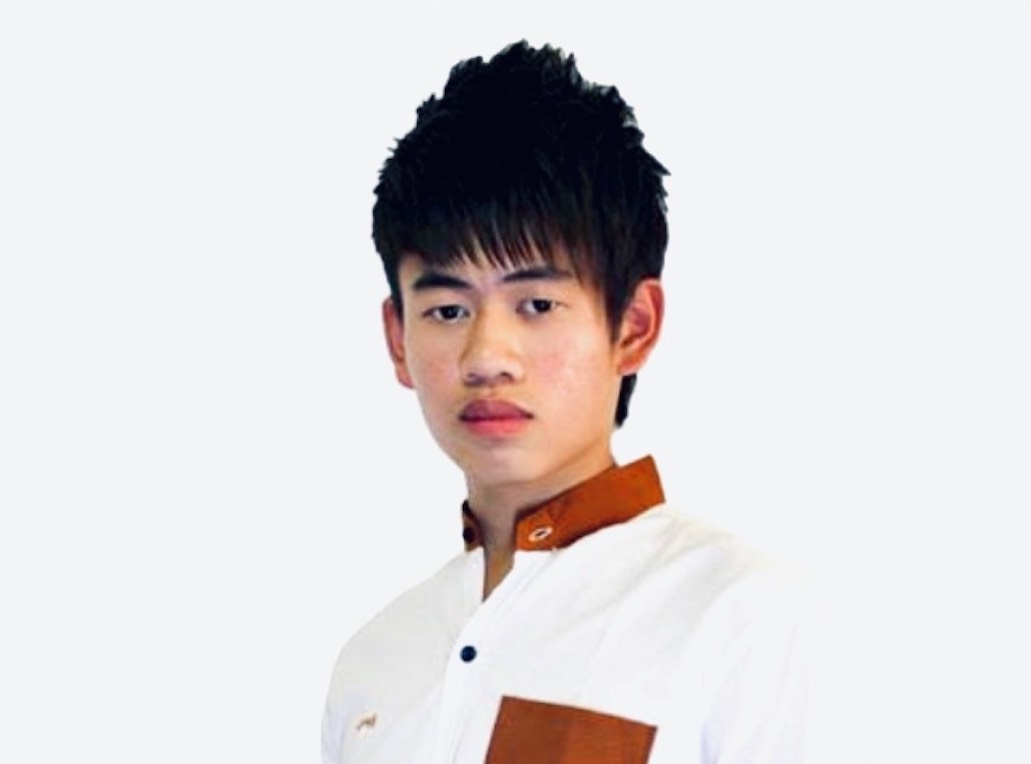
Jun Ming during his N-Level examinations.
What was your routine like when you were trying to get back on your feet again? What did you do on weekdays and what did you do on weekends?
I started watching film tutorials on YouTube and on my free days I would go do some part-time acting and when even more free, I would go to the gym and build my physical body to be a person with a healthy lifestyle.
Did you have any further setbacks during that period? If so, how did you move past those?
Yes. Because I don’t come from a film school, not many people wanted to support me in terms of lending me their equipment or giving me funding. I just used my own pocket money and didn’t eat and used it to pay my cast. For equipment, I just borrowed it from ITE.
Which 3 objects or people were most useful to you during the above time period, when you were trying to get back on your feet?
It’s more people. 1) My classmates. 2) My lecturers. 3) My dad—my dad often talked to me during that time.
What did you learn from failing your N-Levels that you didn’t know before? How have you changed as a person?
I think learning how to be like my friends and studying hard, because academics is very important. Because I never studied and I failed, this is the thing I didn’t know. Or rather I knew but didn’t care. How did I change as a person? I understood I wasn’t good in academics, so right now I am pursuing my passion.
If you could go back and replay your time with the N-Levels all over again, what would you do differently?
Definitely study in the library with classmates who will not hang out with friends and create troubles outside.
What advice do you have for those who are presently coping with the failure to pass their N-Levels too?
Yes, academics are very important and you should be sad, you should be depressed, because all these emotions will make you learn and make you become a stronger person in the future. So you cannot avoid that. Move on and be positive, find the thing that you love and do the thing that you love. And one day, people will eventually give you their support.
What’s the worst advice you’ve been given, or have heard people giving? And what’s the best?
Worst advice was when I wanted to make a film and was told to face the reality and go home, and I was told that making films doesn’t earn much and that I have no talent. Best are any of the responses I’ve gotten from my films, positive ones that tell me it’s shaped their lives and changed their children’s lives, asking me to carry on and chase for my dreams and create positive change.
Jun Ming winning a film-making award.
Lastly, what are your present goals now and who can we interview to help you achieve those?
My goals right now are to represent Singapore in international film festivals. And who you can interview I think would be those industry professional movie directors, Boo Junfeng, Anthony Chen, Jack Neo, people like them because they’ve been through it and have more experience and they can advise.
A close-up of one of the film-making awards Jun Ming has since won.
Jun Ming is presently working on a film about Chinese Fengshui and hopes to be able to send it to international film festivals eventually. You can find out about his films at his Facebook page or ask him about failing N-Levels using the comment box below.
At age 17, when most of his classmates were gearing up for the big A-Level examinations, Jeshua Soh chose to drop out of school. Because he had been enrolled in Hwa Chong Institution’s Integrated Programme—a six-year course which skips the O/N-Level examinations to prepare students directly for the A-Levels—he had only the PSLE certificate he had gotten at age 12 to his name. We sat him down to find out what happened next.
“I believe that it has helped me, ironically, to see the importance of learning.”
Q: Hi again, Jeshua! Can you introduce yourself to those who haven’t read you before—share where you’re from and why you wanted to drop out of school?
A: I’m a filmmaker by training and an accidental entrepreneur who has started 3 companies and 1 Facebook channel to date. Examinations have never been a big focus for me, having entered Hwa Chong Institution’s (HCI) Integrated Programme (IP) through the Direct School Admission route after primary school, and skipping O/N-Levels as a result. At the age of 17, I chose to drop out of Year 5 in HCI to read Film, Sound & Video in Ngee Ann Polytechnic’s School of Film and Media Studies. At Ngee Ann Polytechnic, we were assessed based on project work and not examinations, owing to the nature of our course being practical and team-based.
A photo Jeshua created before he decided to drop out of school.
How does Singapore, your home country, view school dropouts? What were you taught to think of it as a child, and how did you feel about it then?
Dropouts are one of many kinds of people who break from the conventional ‘path’. In my case, it was a voluntary action, and I appreciate that I had done so having weighed both options (of completing IP and of studying film). I feel that many people in Singapore are conditioned through their growing up environment and societal structures to stick to a well-trodden path, and hence dropouts may be viewed as unconventional at best, or crazy, at worst.
How then did you manage to drop out of school? Can you share your entire process and also how you figured that process out?
Dropping out of HCI was actually pretty simple: I just had to walk into the general office and meet the vice principal, sign a form, pay the remaining school fees and I was out. As for securing a place in Ngee Ann Polytechnic without an O-Level certificate, I needed to apply under a direct admission exercise and sit for an interview before being offered a place.
What did your parents think of your decision? What about your teachers and classmates?
Initially, there was the usual and warranted concern, but I am glad that my parents became supportive of my decision to pursue an education and career in media/entrepreneurship as time went along. The teachers and classmates who I’ve kept in contact with are also happy for me, and I hope that those who I’ve not spoken to in years will feel the same way 😛
What was your routine like before you dropped out of school? What did you do on weekdays and what did you do on weekends?
I was going to school/CCA [co-curricular activities] and church on weekends. It was actually at the age of 9 that I started volunteering in my church’s media team and gaining exposure to different aspects of audio/video/live production. I joined the media club during secondary school and a lot of CCA’s during my 3-month stint in JC [Junior College; the later segment of HCI’s Integrated Programme] (as I was already quite sure I wasn’t staying for long).
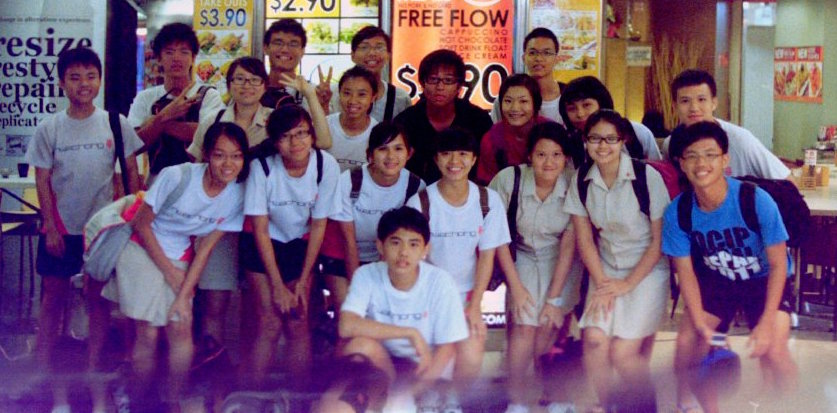
Jeshua (first row, middle) around the time he decided to drop out of school.
What about after you dropped out of school? How did your routine change?
There was no longer a big A-Level examination to look forward to, and classes in polytechnic were much shorter, though much more time and emphasis would be spent on project work/assignments. I had the opportunity to go overseas 6 times as part of my 3-year curriculum and couldn’t have asked for a better course to study in (not sponsored by NP to say this!) because of the teachers, curriculum and amazing people whom I met along the way.
Which 3 objects or people were most useful to you right after you dropped out of school?
Camera, Laptop & EZ-Link card? I didn’t start using a smartphone until late 2015, when I enlisted into NS [National Service], so my MacBook Pro was what got me around the assignments/projects that we had to do. My camera was useful as I took on freelance jobs doing corporate videos, weddings and also joined the photography club in NP [Ngee Ann Polytechnic]. Lastly, the EZ-Link card was a good way to get around Singapore in pre-Grab/Uber days!
Which place in Singapore was most useful?
School and ‘virtual school’ (i.e. the internet) was and still is useful for learning and picking up many interesting skills and knowledge. Post dropping out, I was still immensely interested in current affairs, economics and philosophy, and decided to continue pursuing some of these interests outside of my polytechnic. I would also remember what one lecturer advised me: about how film is just a medium and knowing more about the world we live in is key to the stories that we can tell through this medium—hence continual learning from different sources is something that I believe has played a big role in making me who I am today.
What were the biggest obstacles you faced when trying to drop out of school in Singapore, and after you dropped out of school, and how did you overcome them?
I believe the biggest obstacle was perceived risk—this was contributed by society, family and myself, that I had come so far only to drop out with just a PSLE [Primary School Leaving Examination] certificate, and if I didn’t do well for polytechnic—where would I go/what will I do? Perhaps this is also the reason why I often argue that people see that they have too much to lose, instead of too much to give. When we change our frame of mind/perspective, to question the possible outcomes of giving our best shot at something, instead of remaining in a worried/paranoid state of mind, I believe that one opens him/herself to much more opportunities!
A photo Jeshua created shortly after he dropped out of school.
Now that you’ve done it, would you recommend dropping out of school in Singapore?
Don’t drop out of school for the sake of doing so. But if you’re able to learn outside of the structured environment, and are looking to take advantage of a unique opportunity that may not present itself to you again, consider it carefully. Talk to some friends and family, perhaps even folks from the area that you’re looking to step into, but don’t be overly swayed by any group because as I mentioned earlier, chances are that you will be called unconventional, or even crazy. There is certainly a risk/opportunity cost in every decision you have to make.
What have you learned from having dropped out of school that you didn’t know before? How have you changed as a person since?
I didn’t know that people would one day be asking me this question. I guess I didn’t really think that it was any big achievement/something to be proud of 9 years back, but today I believe that it has helped me, ironically, to see the importance of learning—whether in or out of the education system. In my work overseas in Myanmar, I constantly advocate a mindset of continuous learning and discovery and for students to give their best in the environment they are currently in.
What advice do you have for those who hope to drop out of school too?
If you’ve already carefully considered this decision and consulted your various circles of friends/families as recommended above, the advice I would have is to own the decision (if you had a choice) and make the best use of your time, energy and resources in the new path you’re choosing to take without looking back. If you don’t have a choice, work hard and smart during your next phase in life (be it another educational institution/working life) so that you may have more choices and opportunities in time to come.
What’s the worst advice you’ve been given, or have heard people giving, with regards to dropping out of school? And what’s the best?
The worst advice someone has given me is that without a university degree, you can’t do much in Singapore. I must admit that that is true for certain professions such as doctors/lawyers, but, at least for what I’m doing, I don’t feel like I’ve been hindered by not having that piece of paper.
Jeshua (seated) with a person and the objects that really helped him after he dropped out of school.
What other bold things would you try to do next and who can LUCK-IT interview to give you some tips on how you can achieve those?
I will like to cycle from Singapore to Thailand perhaps? Probably only hard work and training can help in achieving that… but perhaps someone who has done so before and can share his/her experience of doing so and the possible pitfalls to avoid, or nuggets of wisdom [attained] while attempting such a long ride.
Lastly, what would you be teaching your kids, or the kids around you, about school and academic qualifications?
Academic qualifications are important to some but not all, and school should be taken seriously because not everyone has an opportunity to go to school. At the end of the day though, neither should be worshipped as they are a means to an end—learning and a never-say-die attitude is more important.
Jeshua is presently a 24-year-old entrepreneur/film-maker who’s been going around the world to introduce the services of his businesses while continuing his own learning journey. He does not have a bucket list but believes that the world is his classroom and Singapore, his homeland. You can spot him at JRC.sg‘s City Hall collection point in Singapore or the Crossworks office in Bahan Township in Myanmar, or just get his advice on quitting school through the comment box below.
He also wants to say: “I have recently taken an interest in flood prevention in Myanmar and released two videos (here and here) thus far, concerning the problem and causes of the yearly floods. This year along, over 200,000 people have been displaced and if you would like to contribute in some way/shape/form, please comment on the second video and share it as well!”
Interviewer Note: Like Jeshua, I too dropped out of school at about 19, except, unlike him, I was in university, didn’t have any idea what I wanted to do with myself next, didn’t consult anyone before making the decision, and was eventually made to feel a lot of shame for having done that.
Fast forward almost two decades, I can now tell you, I do not regret dropping out, nor have I ever felt much of a pinch for being a school dropout. In fact, rather than destroy me, dropping out opened new opportunities, experiences and conversations I never would have had had I stayed on the route I had been on.
It’s not that I recommend dropping out: dropping out is not a walk in the woods and comes with emotional and financial challenges the dropout will need to be ready to deal with at short notice; plus like Jeshua said, nobody wants to be operated on by a surgeon with no certificate so if that is what you want, hell yes, get that certificate. But all the same, I do think those kids who have dropped out or are thinking of dropping out should know that quitting school is hardly the end of the world.
Life options don’t just freeze after you end school. You have till your dying day to go back to school. There is always a new day, a new chance to try and attain success in your own way (like Hui Ling, the Young Artist Award winner we interviewed earlier did).
More importantly, as another school dropout, Steve Jobs, once said, “Your work is going to fill a large part of your life, and the only way to be truly satisfied is to do what you believe is great work. And the only way to do great work is to love what you do.” So that is what you really should be figuring out, not just how to attain better certificates. 😉
Photographs courtesy and copyright of Jeshua Soh. Interviewer: Sy If you found this article useful:
Growing up in poverty, Dr. Y from Balestier Hill Primary School was a less than spectacular student who could only qualify for a ‘last choice secondary school’ (his words), Whitley Secondary School, before failing to qualify for Junior College as well. At age 24 however, he graduated from university with a degree in Dentistry and by age 28, was able to set up his own dental clinic in Singapore. We asked the now 60-year-old how he found a way past his childhood limitations and acquired a bunch of tips for those growing up in challenging circumstances.
“Build character first. With character build perseverance. Set realistic targets and set it higher slowly. Enjoy the journey.”
Q: Hi! Welcome to LUCK-IT! Thanks for coming on to share your story with us. To start, tell us a little about yourself when you were a kid? You call yourself a ‘late developer’, so how ‘undeveloped’ were you when you were young? How lousy were you academically and what were all the things you failed at?
A: I was in the top class of my primary school but was weak in both the languages and average in mathematics. But I was very good in science.
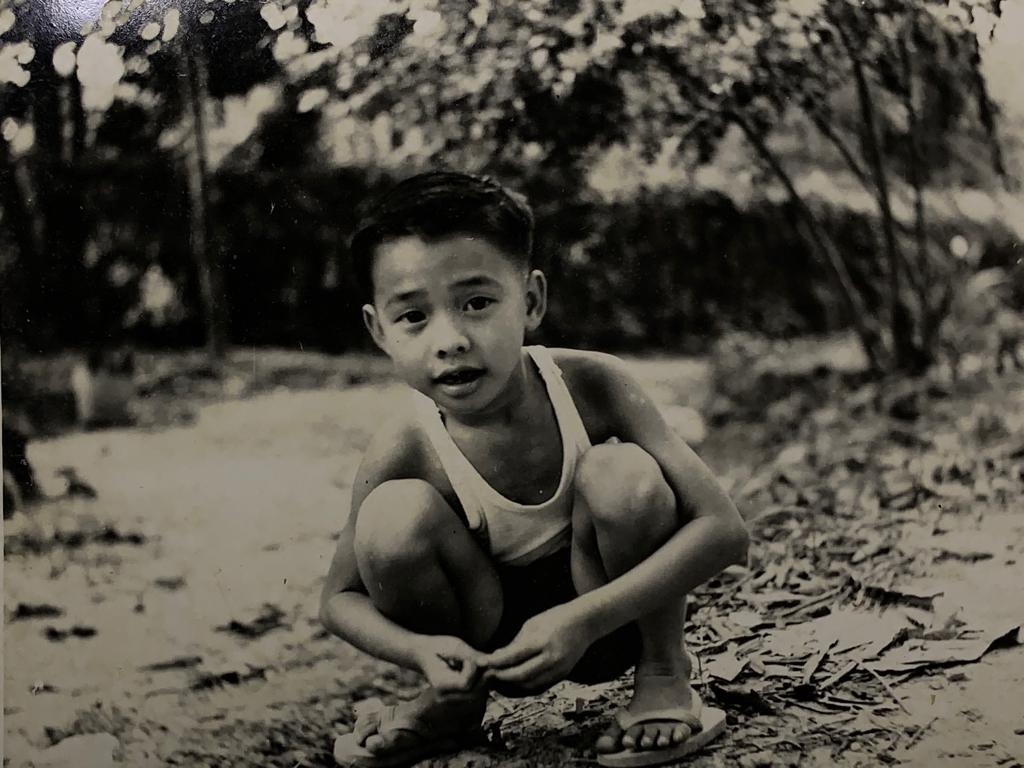
Dr. Y when still a kampung boy, with his pet hen.
When did you start achieving more success in life? How old were you when that happened and what was the turning point or turning points that led you to success?
I failed mathematics at my mid-year exams in secondary 2 and in that exam, my good friend in class scored 95 marks. I learned, from him, that he already read the examples in the textbook before the teacher taught the topic and did all the simple exercises in the textbook, and after the lesson, did all the difficult optional exercises.
What were all the things you figured out how to do that led to you achieving success that you didn’t know how to do when you were younger?
To do well is not just to do your homework. It’s to do your homework, study and memorise your homework and then expand your knowledge by reading widely and doing more than is required by the school.
Do you think there might be some circumstances people get born into that might naturally put them at a disadvantage when competing within the education or employment systems in Singapore? For example, not speaking English at home which makes it slightly more difficult for the kid to grasp schoolwork earlier on in life, maybe? What have you noticed around you and through your own struggles?
The home environment may not be conducive for the child to be challenged to do better. Parents may demand good results but may not be lovingly beside the child to encourage him or her in their weak subjects. Some parents farm their educational responsibilities to others and are also too ‘busy’ to impart life skills and help the child cope with failures and disappointments. Others are struggling to make ends meet and are not able to provide any form of guidance. Some parents are not aware of various organisations that can provide free help for their children.
What do you think those born into circumstances that make it more difficult to succeed within the system can do to overcome their situational disadvantages?
Increase their exposure to community-based activities. This will include various camps and group participation in projects and sports, moral education in religious settings, uniformed groups in school, playing a musical instrument, social activities with their age group peers outside of school friends.
Dr. Y in recent years, teaching oral hygiene to a class of children in a remote village located at a no man’s land between Thailand and Myanmar.
To date, what are all the things you’re proud of having achieved?
To have been able to overcome educational disadvantages in spite of a financially-challenged childhood. And to have been able to obtain a fully government-funded university education. Also to have been able to pay back and pay forward to our society here and overseas.
Are the people who knew you when you were younger surprised by how you turned out? What did they think would become of you back then and what do they think of you now?
Some are surprised I am able to become a professional, since I had come from a less common educational pathway. I cannot answer for what they think about me, but coming from a humble background, I am still a kampung boy at heart.
What was your routine when you were turning your life around, in the months leading up to your first success? How did it differ from your routine before, when you were still getting average results?
Previously, it was play hard. I was a school band drum major and a qualified marching drill instructor. After that, it was both play hard and work hard.
What is your routine like now?
Still working more hours than others. Mostly in my daily work, in helping and ministering to others, and working overseas.
Dr. Y working as a dentist in Myanmar.
How do you presently spend your weekends?
In church, with friends, and family. Sunday dinner is an important family get together. I go to prison once a month on Sundays to minister to prisoners in the prison Chapel service.
What advice do you have for kids and adults who are struggling with having had only unspectacular results and achievements thus far?
Build character first. With character build perseverance. Set realistic targets and set it higher slowly. Enjoy the journey. Get like-minded friends to walk the journey. Have a group of very good friends that are always dependable in good times and bad.
Can you map out a recommended plan of action for people wanting to break out of their mediocrity to follow?
Nothing can be achieved without hard work. Set milestones in targets and labour to accomplish it. Learn from failures, re-energise and get ready to fight another day. In success, be humble and help those in need of help.
What key things/people/situations enabled you to achieve success later in life, in your opinion? Who/What really helped?
After secondary 2, I made a bargain with God—that I knew existed, but didn’t know which—that if I work hard and He will take care of me, I will serve him in whatever and wherever he calls me to. Even when my application to Junior College was rejected and I ended up attending a pre-university center, I knew that he would be my hope and I never lost hope.
Dr. Y with the residents of Chiang Rai, Thailand.
How did breaking through your own childhood limitations to become a successful adult change you as a person? Or did it not change you? What did you learn from doing so that you didn’t know before?
As mentioned earlier, I am still a kampung boy at heart. People and Family are more important than monetary and material pursuits.
If you could go back and replay your entire life all over again, what would you do differently?
I would have loved to be more active socially. The poor background made me an introvert as we did not have TV or a telephone and I was embarrassed to let friends know we were living in challenging circumstances. But I am glad to have had classmates from all walks of life. I learned respect for all, regardless of social standing, and empathy.
Dr. Y outside a house with a roof made of leaves in Sangkhlaburi, Thailand, next to a school he taught oral hygiene at.
What was your personality like when you were a child? What about when you were a teenager and young adult? How did your personality change at every decade? Or did it not change?
My personality has transformed from a very shy boy to one who can stand in front of a crowd and give talks. Now, I am enjoying the fruits of my hard work over the years and am happy to see our children doing well.
Which major event in your life has made you who you are, in your opinion? Why do you think so?
The day that I transacted with God. He has never failed me, even in times of failures—when I had to give up my non-performing clinic and through my previous partnership failure. And serving God has given me so many friends all over the world.
Which 3 objects/people in your life can you presently not live without and why?
Family, church friends, mission friends.
Of all the objects you bought in the past year, which has been most useful? Why?
My utility car. It’s a people and goods mover and COE is at an all-time low.
Which place in Singapore is your favourite? Why?
Toa Payoh Lorong 8 hawker center. A dinner and supper place with great food at a reasonable price.
Dr. Y and fellow dentist-volunteers at the Thailand-Myanmar border.
Which person do you wish LUCK-IT would interview for you to learn from? Why?
People who have given up their careers to serve the world’s most vulnerable children.
Lastly, what’s the worst advice you’ve been given, or have heard people giving? And what’s the best?
Any advice given when people are in the middle of a very difficult time in their life [is the worst]. The best advice: Look upwards, there is a Creator who cares for you and for me.
Dr. Y running with family and ex-prisoners at the annual Yellow Ribbon Run in Singapore.
Dr. Y is presently still a dentist, busy with overseas missions, mentoring, prison ministry and skills training for denture technicians. You will be able to chat with him if you join him for overseas missions via his Medical/dental missions Facebook page or if you drop him a note using the comment box below.
The above interview is sponsored by:
Photographs courtesy and copyright of Dr. Y. Interviewer: Sy If you found this article useful:
When HT was 10-years-old, he wanted to be able to shoot webs like Spiderman. There was a lack of high quality, realistic web shooters available for purchase then so he decided to make his own. Today, HT has sold close to 300 self-made web shooters on Etsy under the brand HeroTech, mostly to middle-aged Americans, some of whom buy for their kids. LUCK-IT couldn’t resist asking how he made that happen.
“It’s a lot easier than you think—almost everything I learned to make the web shooter was learned through free online resources.”
Q: Hi! So excited to have you with us today! Tell us about yourself: Who are you and why did you decide to start making your own web shooters?
A: Hi! While I’d rather not share specific details related to who I am, I can tell you that I’m a pretty huge nerd. I’ve always loved engineering and inventing new things, so when I heard about the then-new Spider-Man Homecoming movie coming out, I wanted to make my own web shooters. There’s something pretty magical about bringing things from science fiction to reality, and after 6 months of prototyping I was able to make something satisfactory to me.
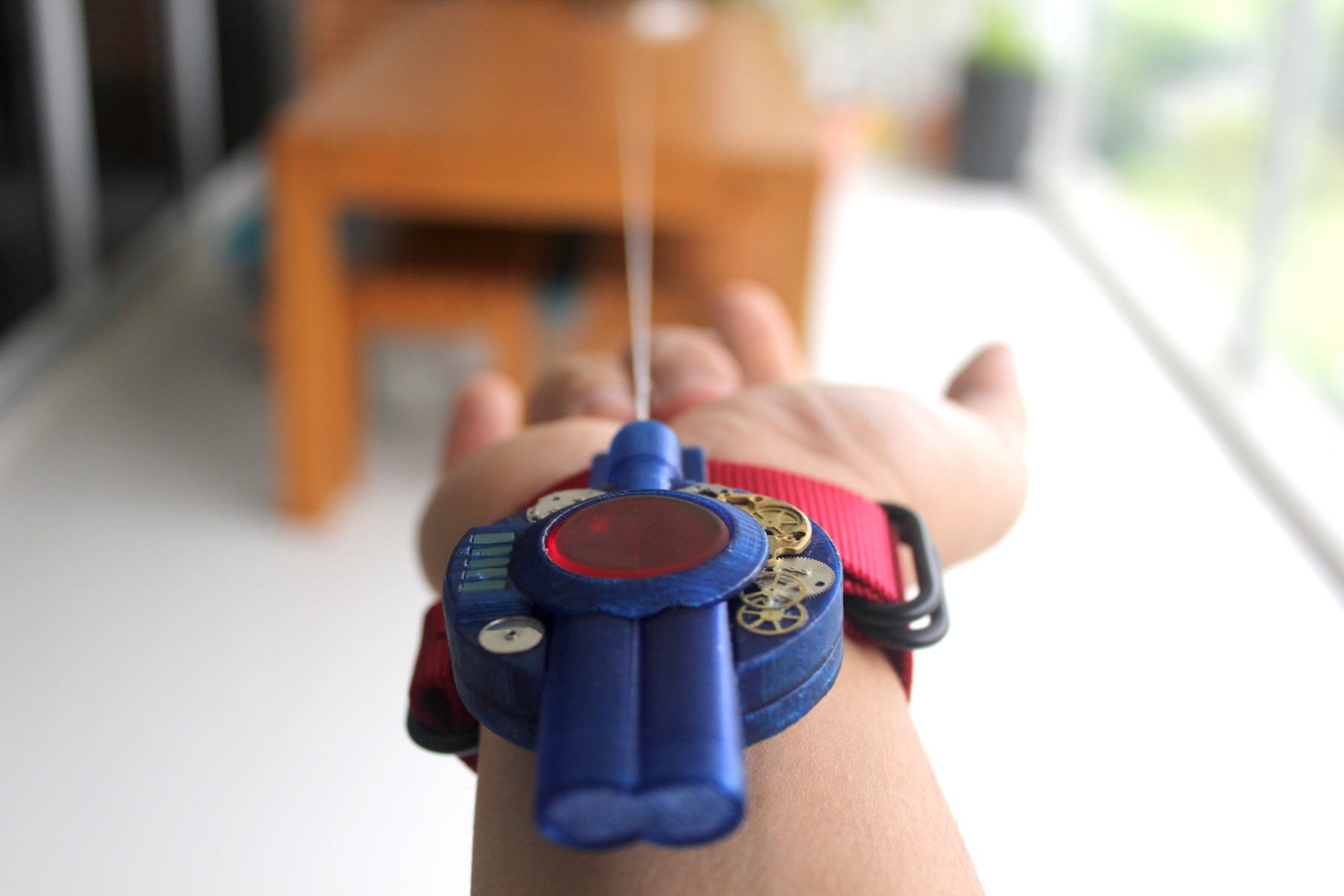
HeroTech’s web shooters in action! Powerful enough to take down music stands! Source: HeroTech’s YouTube channel
How do your web shooters work?
When engineering I try to follow the KISS (Keep It Simple Stupid) method, and that’s the approach I went with this. Basically, inside the web shooter is a block on a spring. The projectile itself also has a spring on it, and when the projectile is loaded into the shooter, the block catches on a latch on the projectile, thus keeping it in place. Fishing line is tied to the block and around the middle finger, so when the fishing line is pulled, the projectile releases.
How is it you know how to create a mechanically functional gadget? Was it something you studied in school or something you picked up on your own?
I took physics in school, so I had some basic knowledge of mechanical principles. However almost every other part of the construction of the web shooter was self-learned through online resources.
How did you find and acquire the parts required to make your web shooters?
Almost all of it was online through sites like AliExpress, eBay, etc.
Can you talk us through the process of creating your web shooters? What did you do first, and next and so on and so forth?
First, I had to define the parameters and goals of the project: what specific capabilities did I want the web shooters to have? From there, I was able to ideate several solutions to the different goals, and then prototype them. Some worked, most didn’t, and I retested the prototyping process until I found systems that worked. From there it was just refining and testing the web shooters to make them reliable and looking good.
Did you succeed the very first time you tried to create a web shooter or did you have any failed prototypes? If so, how many of your early designs failed and why did they fail?
Nothing ever worked the first time—oh my goodness was the prototyping process arduous and frustrating. I lost count of the failed designs somewhere after version 20. Most of the failures were due to unaccounted for variables or stresses in the environment.
How many months did you take in total to figure out how to get your device to work? And how much money did you spend in the process of doing so?
The first working version took about 6 months and $800 SGD to develop.
HeroTech’s workbench: various web shooters in different stages of construction; tools and materials used to make web shooters; packing and shipping materials used to ship web shooter orders.
What was your routine like when you were thick in the midst of creating your web shooter?
As I was studying full-time, I was usually only able to work on the web shooter in my free time. When I was able to squirrel away time to work on it, it was usually late in the night or early early morning.
What about weekends? How did you spend weekends then?
Weekends were spent with friends and family usually, but occasionally I liked to show them the prototypes and get their opinions.
What advice do you have for someone thinking of making their own superhero gadgets too?
My advice is that it’s a lot easier than you think—almost everything I learned to make the web shooter was learned through free online resources, so don’t be too intimidated to try making gadgets of your own.
Can you map out a recommended plan of action for people wanting to create their own superhero gadgets to follow?
The design thinking process is what I’d go for—empathise, define, ideate, prototype and test. These five steps are pretty essential for creating anything of use, and once you find something you want to make, it’s just a matter of following these steps.
What key things/people/situations enabled you to create your web shooters, in your opinion?
In my opinion, me creating the web shooter and the resultant online success of it was mainly enabled by my situation and circumstance. I was lucky enough to have access to a 3D printer via my school, and my parents were supportive of me and what I wanted to create.
How did having successfully created a working web shooter change you as a person? Or did it not change you? And what did you learn from doing it that you didn’t know before?
It changed me because I learned what I can do if I just set my mind to a goal and work consistently towards it.
If you could go back and replay your entire process of engineering web shooters all over again, what would you do differently?
I wouldn’t change a thing actually. The hiccups and failures are the real takeaways for me, and the process as a whole was quite enjoyable—those moments of triumph when something actually worked made it all worth it.
What were you like as a child? What about as a teenager and young adult? How did you change at every decade? Or did you not change?
As a child I was quite carefree and happy—ever since young, I loved to create things. Legos were my favourite toys. As a teenager/young adult, I became quieter and generally more mature. I still love to create things, however instead of Legos, I use CAD modelling and 3D printing now.
Which major event in your life has made you who you are, in your opinion? Why do you think so?
The moment when the first web shooter video hit 1 million views on YouTube was an epiphany moment for me. I realised not only was there a sizeable audience and demand for HeroTech, but that I could tap into it even with the limited experience and knowledge I had. HeroTech has long been a pipe dream of mine, something I envisioned doing on the side while I worked a full-time job. I never imagined that I could do it right now. I’ve never been the kind of person who wanted to change the world or make my mark on history, but that moment truly made me realise the impact and reach even a kid with barely any engineering experience could have on a large community, something that has propelled and driven me ever since.
Two halves of HeroTech’s new WEB-12 web shooter. Prototypes made out of steel.
Which 3 objects/people in your life can you presently not live without and why?
My mom, dad and my friends. (Technically more than 3 but who’s counting 🙂 ) I think friends and family are the most important things in life, and without them I wouldn’t be where I am today.
Of all the objects you bought in the past year, which has been most useful? Why?
3D printer for sure. Specifically the Prusa i3 MK2, shoutout to Prusa Research #pleasesponsorme. It’s allowed me to bring ideas from my mind into physical reality, and is my most invaluable engineering tool.
Which person do you wish LUCK-IT would interview for you to learn from? Why?
Anyone who’s done a lot of good for the community would be awesome to interview.
[LUCK-IT Update: We have interviewed a gentleman who has done just that, right here. And another lady too, right here.]
Editing in progress: A YouTube video for HeroTech’s WEB-12 functional thread shooter.
What’s the worst advice you’ve been given, or have heard people giving? And what’s the best?
Worst advice I’ve ever heard is “get so drunk you forget everything”, and the best I’ve heard is “this too shall pass”.
Lastly, what other superhero gadgets do you intend to create in the future?
Some Iron Man projects are planned, as well as some stuff from the Flash, and of course more web shooters.
HT is presently working on making metal web shooters, a micro flying ornithopter, and some other secret stuff. You will be able to track his progress and see his web shooters in action via HeroTech’s YouTube channel, Instagram page, Facebook page and Twitter account. You may also ask him questions by leaving them in the comment box below.
Interviewer Note: You make me want to go invent gadgets to solve all of life’s problems now. Thanks for helping me realise everything’s doable 🙂
Photographs courtesy and copyright of HeroTech. Interviewer: Sy If you found this article useful:
After taking her GCE O-Levels in Singapore, 17-year-old Christine Yong had the option to either enrol in a Polytechnic, work towards the GCE A-Level examinations or pursue a International Baccalaureate (IB) diploma. After careful introspection, she chose to take the IB at Anglo-Chinese School (Independent) and two years later, graduated with the best possible score an IB student can attain—which gave her a better chance at getting into top universities around the world and winning scholarships. LUCK-IT had a chat with the now 24-year-old about her study techniques and snagged some tips for present and future IB students hoping to achieve the same.
“I don’t have a specific system other than placing importance on practice and repetition.”
Q: Hello Christine! First off, can you tell us why you chose to take the IB instead of the alternatives? And what subjects did you take and why?
A: The most crucial constraint on my choices was that I did not take Higher Chinese in secondary school. With my L1R5 of 6-2=4, Raffles Institution (RI) and Hwa Chong Institution (Hwach) were out of my reach. I decided to pursue the IB programme at Anglo-Chinese School (Independent). Even if I had qualified for RI or Hwach, I would not have chosen to go to either. First, I felt it was too early for me to specialise in either the arts or sciences. As someone who was inclined towards both disciplines, I thought the holistic curriculum of the IB was more suited to my interests. Not only did it have a better breadth-depth trade-off for me, it also trains a more comprehensive set of skills. For example, in languages and literature, students are assessed via both written and oral examinations. For the sciences, independent research projects are part of the compulsory assessment. In retrospect, these were incredibly valuable for training my presentation and research skills. Secondly, I much preferred the continuous assessment format of IB over the one-shot style of the A-Level [Singapore-Cambridge General Certificate of Education Advanced Level] examinations. I felt that this type of assessment was not only less stressful but more fair—based on aptitude, rather than ability to memorise.
I took HL [Higher Level] Chemistry, Biology and Geography with SL [Standard Level] Mathematics, English Literature, Chinese B (the subject for Chinese as a second language, since English is my first), Extended Essay (compulsory research paper) and Theory of Knowledge (also compulsory). The principle was to first take what I loved—Biology, Geography and Literature—then take what I felt was practical or necessary for my university applications/career—Chemistry, Mathematics and Chinese. Finally, this was rounded out by the required subjects: Extended Essay and Theory of Knowledge. I would recommend taking Mathematics HL if you are unsure about your future career path—at once, it helps open up engineering, science, and medicine as career options. I ended up pursuing a Biology degree where Maths HL would have been immensely useful.
Christine (far left, in black) at Anglo-Chinese School (Independent)’s Prom Night in 2013.
What grades were you aiming for and what grades did you think you’d get?
I didn’t have any particular aims other than at least my school average (I believe around 41 at the time I took the IB in 2013) and 7-7-6/7-7-7 for HLs (a requirement for my top target universities).
When did you start properly studying for the IB final exam or working towards getting those grades? How much time do you think you spent preparing for the final exam in total?
The IB involves lots of continuous assessments, so the effort was continuous. In terms of final examination preparation, I began studying intensively about 2 months before the first examination.
How do you study, really? Do you have a system you use? If so, where did you learn that system from?
I don’t have a specific system other than placing importance on practice and repetition. For Chinese, I simply followed the assignments and classes, and practiced on past exam papers. For the sciences, maths and Geography, in addition to ensuring I did all the regular assignments, I would go over all of the content of my subjects at least once prior to my examinations. In this first pass, I would make summary notes of all content as this helps to solidify the concepts, facts, and statistics in my memory. In the process, I would read around concepts or topics that I find particularly interesting (usually on Wikipedia or journal articles) and embed these insights into my notes. I would also identify the sections in which I have poorer understanding for further rounds of revision (this entailed reading over notes/making new notes depending on how confident I feel about the subject). For each round of revision, I would check my understanding either on a per-topic basis or through past examination papers, depending on my confidence level and what resources were available to me. For Literature, we broke up each text into parts and worked in a group to analyse the sections we thought were more likely to be significant. For the oral examination, we practiced answering questions with each other.
Can you share your study routine? How did your week look when you were preparing for the IB final exams?
For the 2 months I spent preparing for the final exams, I spent every day except Sunday studying for about 8-10 hours each day. I would usually allocate 2 subjects to 1 day and alternate between reading/memorisation and practice, to reduce the monotony. Sundays and mealtimes were essential breaks that ensured I was fresh for my other study sessions. I spent some days studying together with friends, where we would talk about the subject, quiz each other, and take some well-earned breaks.
How did your week look when you weren’t close to any exams?
I would usually be dedicating around 12 hours per week to completing assignments, reading, and whatever continuous assessment was ongoing at the time. 4 hours went to extracurriculars. The rest was free time spent with friends, at home, and/or pursuing hobbies.
How did you spend your weekends then?
Some mix of work and chilling, according to the weekly schedule above.
Christine (middle, in boots) with her closest friends from Junior College.
Did your parents do anything special to prepare you for the final IB exams?
Nag at me when I appeared too relaxed i.e. whenever I was not studying, and not disturbing me when they saw me studying!
What advice do you have for someone thinking of getting 45 for the IB?
Choose subjects you love, pace yourself well for the 2-year grind (marathon, not a sprint!), and don’t forget to set aside time for your family, friends and hobbies.
Can you map out a recommended path for students who want to get 45 at IB to follow?
The IB offers lots of flexibility, so it’s difficult to recommend a path. But I would say choose the right school, with teachers who care for you as an individual, and who have a good grasp of the IB assessment rubric.
What are the key things/people/situations that enabled you to get 45, in your opinion? Who/What do you believe you never would have done it without?
As I mentioned above, I felt very blessed to have teachers who cared about my personal growth and learning, and who were experienced in the IB. In comparison with friends and family from other schools or countries who did the IB, I feel that ACS(I) [Anglo-Chinese School (Independent)] provides one of the best environments for doing well in the IB.
How did getting 45 change you as a person? Or did it not change you?
It didn’t change me very much, other than helping me get into the university and course I wanted. Personally, I don’t think there is a significant difference in ability between people who scored within the range of 42-45 (this is also reflected in universities’ IB cut-offs).
If you could go back and replay your entire education process all over again, what would you do differently?
Now that I am on the verge of starting my career, I feel that I should have taken the more difficult Mathematics HL, taken a philosophy or sociology subject at an earlier age (though this was not possible for my O-Levels [Singapore-Cambridge General Certificate of Education Ordinary Level]) and worked harder to express myself in Mandarin Chinese, dialects, and other languages. These are skills that I see as very important not only in the current global job market, but in defining my personal identity.
What were you like as a child? What about as a teenager and young adult? How did you change at every decade? Or did you not change?
I was as interested in a wide range of academic subjects as I was in things society didn’t seem to value as much—writing, design, baking, cooking, and gaming. I did begin to realise that others did not consider these latter pursuits potential career paths, so I became less invested in these areas (to my great disappointment) and more in academic science. However, these all continue to be a part of my life in some way today.
Which major event in your life has made you who you are, in your opinion? Why do you think so?
I can’t identify a single major event!
Which 3 objects/people in your life could you not live without when studying for the IB final exams and why?
My IB friends, my family, and my Wah Chee teh bing and butter chicken.
What Christine calls ‘The best Teh Bing in Singapore’, located within walking distance from Anglo-Chinese School (Independent).
Of all the objects you bought when preparing for IB, which was most helpful? Why?
My laptop, where all of my notes and assignments live.
Which person do you wish LUCK-IT would interview for you to learn from? Why?
I’d like to learn from entrepreneurs and artists in Singapore about their struggle to change or adapt to Singaporeans’ behaviour—whether as consumers or as individuals in society.
What’s the worst advice you’ve been given, or have heard people giving, with regards to studying? And what’s the best?
The worst: to study everything. Sometimes spotting is necessary for efficient studying. The best: to use mnemonics when you need to memorise something that is organised or named in an effectively senseless way.
Christine is presently a graduate student studying the fields of science and tech policy. She also works part-time in a Japanese startup in the field of computer vision within the mobility sector and keeps a portfolio of her thoughts and work on her website. If you wish to get her advice on studying and taking the IB, you may drop her your question in the comment box below.
This is a self-interview done by LUCK-IT creator, Sy, to test the experience of answering questions for LUCK-IT and also to get the spirit of sharing going. This interview is also the first ever posted on LUCK-IT, and the one that got the ball rolling, so to speak.
“I always wished for a textbook or encyclopaedia of case studies that would explain how to deal with all sorts of life matters and since I never found one, I guess it’s up to me to create one for myself, and everybody else.”
Q: So why did you start it?
A: I had a complicated childhood, grew up without a mum or much guidance, so I spent a lot of my life confused about how I was supposed to behave as a woman and what I should be doing with myself as a person. After many decades of blindly trying to figure life out on my own, I eventually came to understand how helpful having knowledge of other people’s experiences was for decision-making and problem-solving purposes. I always wished for a textbook or encyclopaedia of case studies that would explain how to deal with all sorts of life matters and since I never found one, I guess it’s up to me to create one for myself and everybody else.
What were the early days of LUCK-IT like?
It was an affordable art store! I was a few months short of 30 when I felt compelled to go into business on my own and I frankly didn’t have the slightest clue as to what I was really doing. All I knew for certain was that there’d be a huge learning curve and since that was unavoidable, it was best to just jump right into it and get those 10,000 hours down.
LUCK-IT’s shop banner, circa 2015.
Why affordable art first and not a resource of answers from the get-go?
Simple—I didn’t think of it till much later on. Affordable art was the most doable ‘product’ idea I could think of back in 2013. It suited my personality then. Six years on however, I had acquired more work and business experience, met more people, travelled more, witnessed more births and deaths, become a minimalist and rediscovered the joys of acquiring wisdom through reading. I was racking my brain to think of how to make my art business more useful to more people while vacuuming one day when the idea for a resource of answers appeared in my head. It stayed there for months and wouldn’t go away so I just had to do something about it.
What was your routine in the months that led to you starting LUCK-IT?
In 2013, I had a full-time job as a TV producer so I had to wake before 7am to work on the business for an hour and a half before going to work, then continue after work and on weekends. I have to say it was hard to focus on either job, especially since TV production is time-consuming, mentally and physically stressful and subject to sudden overtime any time.
I was able to grow my art business much faster after I quit that job but that growth stalled again when I gave in to curiosity and took on a digital journalist job a former colleague offered me less than a year later.
It was through my years as a digital journalist however, that I learned many of the skills I would need to set up and run LUCK-IT as a resource of answers. When the time to do so came in late 2018, it was just a matter of setting aside half a day every work day to put together what I already knew could be done. I was really chill and open-minded the second time around because I knew what to expect and what I needed to do. Those hours put in really helped! Still, I’m not experienced enough to say if this version of LUCK-IT will succeed so I guess you’ll just have to check back every few months to find out how it turns out.
What is your current work routine like?
I am presently 100% dedicated to doing business and working out a sustainable lifestyle for myself because I have experienced the inefficiency of burnout, followed by a year-long illness from being careless with my body. So I start my day by feeding all the living things living with me, go for a 5-minute jog to get my brain awake then jump right into coffee and deep work the second that is done. I break at lunch, during which I’ll do some toning exercises while waiting for food to cook, then it’s collaborative work all the way till dinner. In the evening, there will be a walk, chores and time with loved ones and books till bedtime.
How do you spend weekends?
On leisurely activities only, unless I’m really excited about getting some work thing done faster. I’m a big believer of sustainability and improving productivity with rest so I schedule rest into my week and stick with it religiously until excitement tells me otherwise.
Why is LUCK-IT called LUCK-IT?
It’s a kit you can use for luck. Get it? Kit you can use to make your own luck? Luck-kit? 🙂
My ‘view’ now on a regular day at work.
If you could go back and live your life all over again, what would you do differently?
Lots. I think I was really dumb and ignorant all the way up to age 35 and if I could go back and redo everything, I would certainly make wiser and kinder choices.
What advice do you have for the users of LUCK-IT? What is the best way to use your site for maximum benefit?
Read everything available before deciding on the best course of action for yourself. Remember that timing matters and micro-differences can affect outcomes. Treat LUCK-IT more like a 10-year-series rather than as the answer booklet to the exam you’re going to take. LUCK-IT may not give you the exact answers to the exam questions you get but you will certainly be more likely to know how to guess the correct answers after reading it.
Can a person succeed by simply following the recommended paths provided by LUCK-IT interviewees from start to end?
Every circumstance is different in minutely different ways so it is hard to say if entirely different people can get the same result by doing the exact same thing at different times. However, if you don’t know where to start at all, or if you’re hoping for some help and advice, LUCK-IT will certainly be able to provide you with clues, direction and a channel of communication with people who’ve been in the same boat, who may be able to answer the questions you have.
Which major event in your life made you who you are, in your opinion? Why do you think so?
My parents’ ugly divorce. What happened all those decades ago set in motion a series of consequences that, in hindsight, influenced my perception of life, methods of function and every last one of the major choices I’ve made. I’m very certain I wouldn’t be the person I am now if their divorce had been more amicable, though I can’t say if the difference would be for better or worse.
What were you like as a child? And how did you change at every decade? Or did you not change?
As a child, I was shy, imaginative and scared of everything. In my teenage years, I was sullen and desperate to rebel, though mostly compliant on the surface. In my twenties, I was into trying everything and anything and staying out for as long as I could. In my thirties, I finally understood who I was and what I wanted from life, learned to say ‘no’ and settled into a domesticated routine. I am still in my thirties.
Which 3 objects/people in your life can you not live without, and why?
Loved ones, text-input device and charger or pen and paper. Because I find love, in-depth observation and creative expression most meaningful and rewarding.
Of all the objects you bought in the past year, which has most positively impacted your life? Why?
The BOOX Note by Onyx—an e-ink tablet running on Android which I use to type large volumes of text on (with a Bluetooth keyboard) and read documents and books off. Before owning it, I had to grapple with printing and dealing with large volumes of paper or tedious transferring of e-book files to my Kobo (an older e-ink reader) if I wanted to save my eyes from the glare of digital screens. Now, I just do all my reading, writing and text vetting directly on my Note and no longer have tired eyes at the end of the process.
Which person do you wish LUCK-IT would interview for you to learn from? Why?
All sorts of people. All ages, races, nationalities, genders, orientations, religions, walks of life, especially those who seldom get to speak their minds. I believe every single person has something he/she can teach everybody else about. Maybe after a thousand interviews, we might end up noticing some patterns? See something we don’t yet know now? This is my quest and you can help out by telling me yours.
What’s the worst advice you’ve been given, or have heard people giving? And what’s the best?
Worst advice: “Just do as he/she/they say(s).” Unless you’re a complete noob on your first day, I don’t think anybody should simply do as another person says in the long run without first processing the said words with his/her own conscience or intellect. The Holocaust happened because many people did as they were told; during 9/11, right after the first WTC tower got hit, building authorities told people in the twin tower next door to stay in because it was safer than going outside. Other people don’t necessarily know or want better, I think.
Best advice: “In life, you get what you put in. Want love? Give love. Want friends? Be friendly. Want money? Show value. Want to be miserable? Cause misery.”
You can link up with Sy on Twitter, Instagram and LinkedIn. She almost always follows back on those platforms.
Photographs courtesy and copyright of Sy. If you found this article useful: