Avoiding GMOs? Meditation? Phone detox? What do our interviewees do to keep their bodies and minds up and moving in tip top shape? We asked them.
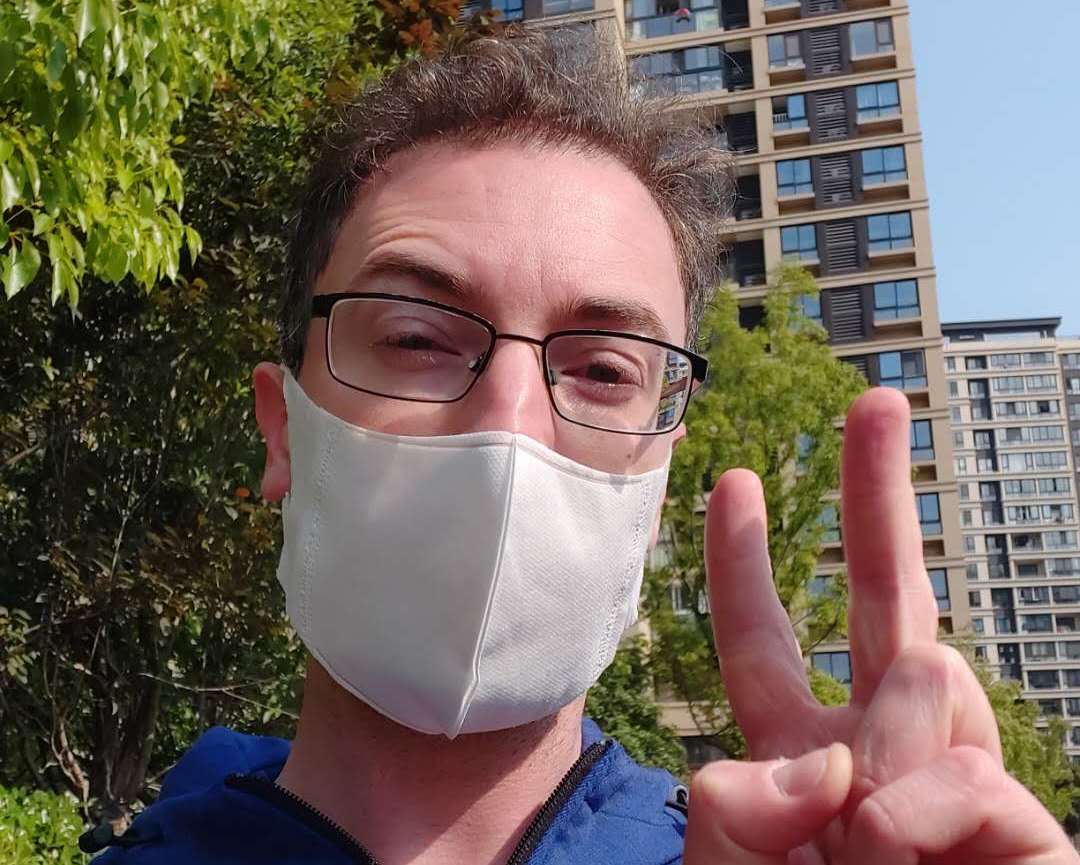
Jack, who moved from China to Cambodia in the thick of the COVID-19 pandemic: Since lockdown last February, I’ve lost 50 pounds mostly by avoiding carbs and sugars. My blood pressure is better and I’m eating a more plant-based diet. I’m hoping to run a marathon this year—I know, hope isn’t going to do it—so I’ve started a training regime.
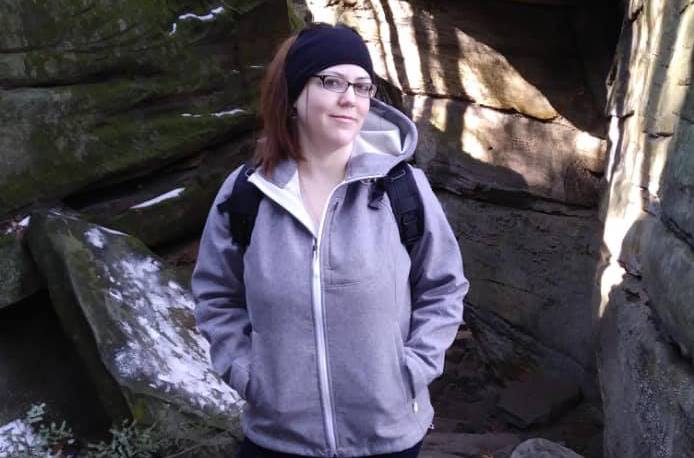
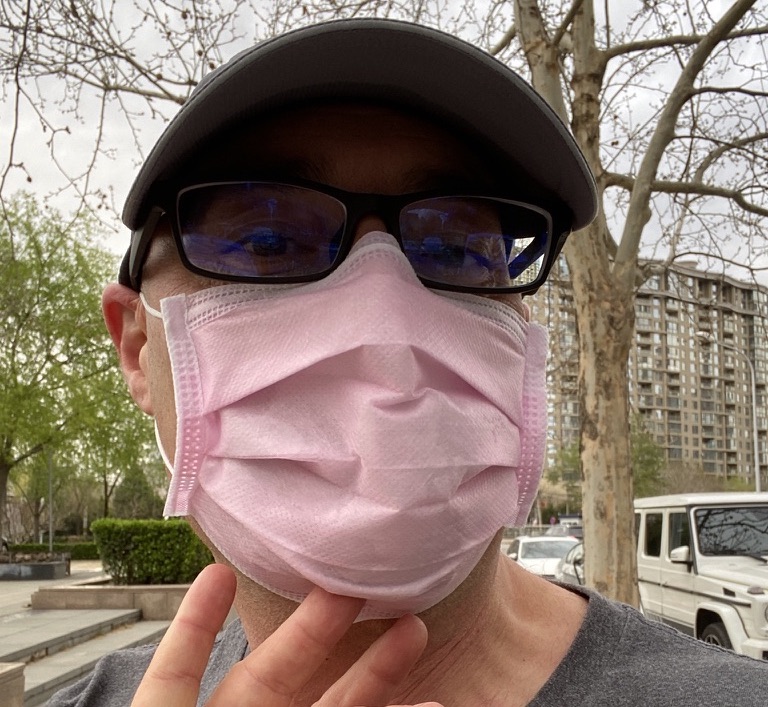
Pamela Ellis, who survived an ectopic pregnancy: I’ve changed my diet to include more healthy options and started my exercise routine back up. I wear a mask as recommended if I do go out and I avoid crowds. Hand sanitizer is my new best friend. I’m also taking more time for my mental and emotional health. Increasing self-care and self-love practices.
Caren Robinson, who survived a major traffic accident: I eat as naturally as I am able to. I focus on foods that are non-GMO. I utilize supplements, Homeopathics, Medical Acupuncture, and self-pacing to take care of myself. I don’t drink anything with artificial sweeteners or caffeine. I don’t use illegal substances or opioids. I say “no” more often and set healthy boundaries for my social involvement (even the time with my family). I embrace things that help me control myself better (aromatherapy, meditation, pool therapy, moist heat, listen to music, etc). I use an electric cart at the store on bad days and walk on good days. I make a habit of going to places that I know where the bathroom is, where groups are smaller, and have seating that is comfortable for me.
Tiffani “Oling” Lim, esports professional: I’ve picked up yoga last year, that’s the only way I’ve been able to maintain a minimal form of exercise since the beginning of 2020. And I believe that having a balanced diet is key.
Jessica, who has Crohn’s Disease: I am on 3 strict diets, I am in a weight loss program, I use a meditation app called Insight Timer daily, I make sure to still stay connected to family and friends.
Dr Bob Rich, author of many books: Last September, I had my 12th opportunity to die (if you like a laugh, you can read the story here), so had to build up again. I went for a bike ride this morning, and am still puffing from it. This is around a 3.8 km circuit. I can do 1 lap far faster than previously, and 6 laps 3 minutes faster. Today, I did 7 laps, 5 minutes slower than my previous best, when I used to do 8, so still need to increase endurance. I also do power exercises, and with all but two, have improved on last year. Small steps take you a long way.
The second thing is meditation every day. It feels good, tunes up the immune and digestive systems, and helps to heal injury or illness.
The third thing is what they say about computers: “Garbage in, garbage out.” So, I do my best to avoid eating garbage. That’s easy because I am married to a champion cook who LOVES to produce things of beauty on a plate.
Choo Bin Yong, game designer who runs solo: I do some regular short jogs once a week with some home exercises. Also been staying away from using my phone too much.
Joan, a minimalist: I make sure I have my 2-3 servings of fruit and veg daily. I also do a short work out in the mornings to get my blood pumping before my mind wakes up. To end the day, I have a “shut down” routine to keep work out of my personal life.
Sy, founder of LUCK-IT: I have a weekly routine that gets me slightly more than the recommended amount of exercise, sunlight and sleep. I also eat unprocessed vegetarian meals whenever possible.
The Amateur Trader, self-employed occasional trader: Nothing special actually.
What about you? What do you do to keep healthy? Tell us in the comment box below and we’ll add it to the list. More questions for you to answer in The Wisdom of Crowds series here.
Want to be featured too? Say hi in the comment box below or tell us here. If you found this article useful:
Jessica was 11 when the persistent pain in her stomach led her to be diagnosed with Crohn’s disease. She told us how Crohn’s changed her life and what living with it for 17 years has been like.
“Pain changes you as a person.”
Q: Hi Jessica, welcome to LUCK-IT! To start, could you tell us a little about yourself?
A: Thank you! I am excited to do this interview with you. My name is Jessica, I am currently 38, living in Ohio with my cat, Tuna and my husband.
How did you find out you had Crohn’s disease? What were the signs that led you to discovering so?
I was 11 years old at the time having severe stomach pains, really gassy and bloated. It was so painful to eat anything and I was living in the bathroom. One night I was at the dinner table trying to eat and I doubled over in pain and my dad rushed me to the hospital.
For the benefit of those who don’t know, could you explain what Crohn’s Disease is?
Crohn’s Disease is a chronic inflammatory bowel disease that affects the body. It can affect anywhere from your mouth all the way through your body. It’s an Autoimmune Disease where your body attacks itself. Crohn’s disease can sometimes cause life-threatening complications. Treatment can help, but this condition can’t be cured. Crohn’s disease can cause abdominal pain, diarrhea, weight loss, anemia, and fatigue, with much more. Some people can go into remission, while others can have severe chronic symptoms that never go away.
What treatments did you receive right after diagnosis and how did those help you?
It took the hospitals a full year of testing before they could fully diagnose me. They did bloodwork, Cat Scans, M.R.I.’S, Colonoscopies, Endoscopy, and started me on a steroid called Prednisone. The steroid at the time was the only drug that was slowing down the bleeding going on in my insides.
“Taken in 2010, right before my first major Crohn’s surgery where they took out my whole colon and large intestines.”
What other symptoms remained after your initial treatments and how have you been dealing with those?
Once you are diagnosed your symptoms remain unless the medication your on works or you go into remission. I still have stomach pains, nausea, pain after eating, nights where I am up all night in the bathroom. It’s very exhausting to deal with. Music has been a huge help in dealing with the stress of it all.
From your experience what types of diets and lifestyles work best for someone with Crohn’s? And which ones are the worst?
Everyone with Crohn’s is different, but in my experience I have to have a strict diet of nothing spicy, no raw vegetables, no harsh meats like ribs. A soft food based diet works best for me. The worst is popcorn, nuts, and anything spicy.
Which 3 objects or people are most useful for you when dealing with Crohn’s flare ups?
I can not stress this enough, a heating pad and any kind of heating pad is a life saver! Hot showers, and lots of bed rest. The less stress you have in your life is better cause stress causes flare ups.
Which place was most useful?
Any place that relaxes you is your most useful.
Do you think you will ever be able to eliminate Crohn’s disease from your life? Why or why not?
You can do your best to maintain your symptoms and try to go into remission but Crohn’s disease can always come back. I went into remission for 9 years after a j-pouch surgery. Now the disease has come back and it’s started all over again.
“Me during remission in 2015.”
What did you learn from having Crohn’s that you didn’t know before? How did you change as a person?
Getting it at such a young age I had to grow up before my time, I felt my teenage years were stolen from me so to speak living in the hospital. I learned compassion for others who go through sickness and pain changes you as a person.
If you could go back and replay your time before developing Crohn’s all over again, what would you do differently?
I wouldn’t have changed a thing. I was 11, on a softball team, was able to go to school, was able to play outside and be a kid. Getting Crohn’s I had to quit it all and go on homeschooling.
What advice do you have for those who are presently coping with Crohn’s disease too? And what advice do you have for their family and friends?
You will get through it even when you feel like you won’t. It’s okay to feel mad and cry and have sick days and it’s not your fault. For friends and family, please don’t push, we know our bodies, just be our support.
Lastly, how are you doing these days?
Thank you so much for asking! Since getting Crohn’s, the disease has caused 6 other illnesses, and I have beat colon cancer. I am doing okay.
Jessica hopes to lose 60lbs this year and has joined a weight loss program for that. You can connect with her on Facebook, Instagram, Twitter or tell her your own stories using the comment box below.
More interviews with people who’ve been through life’s challenges here.
Photograph copyright of Jessica. Interviewer: Sy Want to be featured too? Tell us here. If you found this article useful:
7 years ago, Caren Robinson got into a car to pick her daughters up from a sleepover and soon after got into an accident that left her with polytrauma and traumatic brain injury. We asked her how she recovered and what the process was like.
“I have learned what it means to be disabled and to live with disabilities; how the world is not fully prepared to accommodate or understand people with certain disabilities.”
Q: Hi Caren, thanks for being here to share your experience with us today! To start, could you tell us a little about yourself and how you ended up in that traffic accident that changed your life?
A: Thank you, Sara, for having me here. I am a Certified Holistic Life Career and Executive Coach; a co-host on a Brain Injury Radio show, and I am the founder of an educational website bringing awareness to Polytrauma and Brain Injury for the HOPE’sters of the world.
I really appreciate you reaching out to me about my story. This story is regarding an event that changed the trajectory of my life without warning. That question about how I ended up in the traffic accident remains a mystery to some degree as I have no recollection of the wreck at all. That used to bother me the first few years… trying to piece everything back together; trying to remember how I ended up in a head on collision; why my
seatbelt failed, and I was ejected; how and why I survived such a
catastrophic event, and why I couldn’t remember anything about any of it. It seemed like a complete dream, but the pain was very real.
What injuries did you sustain as a result of your accident and how did it change your body hence on?
I had a plethora of injuries. I sustained a Polytrauma (injuries that affect more than one system of the body) and a Traumatic Brain Injury. The Polytrauma consisted of multiple soft tissue injuries, multiple Orthopedic fractures in my R wrist, R ribs, pelvis, spine, a shattered scapula and a bum left knee. The brain injury resulted in neuroendocrine changes, short and long term memory loss, cognitive changes, hypersomnia, insomnia… well changes to my sleep overall; and a neurogenic bladder among a laundry list of other things which still continue to reveal themselves as time goes on.
Everything about my body was different. Literally everything changed.
What were your thoughts when you first came to at the hospital? How did you think it would affect your life?
The first memory I have at the hospital is waking up to a silver metal Triangle hanging above me. The events I describe remembering, my family has told me was about a week after I had already been in the hospital. I didn’t know where I was at or why. None of it made sense. I was in so much pain and apparently the medical staff was unable to get my pain under control… even with an epidural and being heavily medicated.
I don’t think I had a concept of how it would affect my life at that point because I still didn’t have a full understanding about what had happened to me.
Caren’s back after the accident.
How did the accident really affect your life in the end? How long did it take you to recover from your injuries and what did you have to do to get better?
Wow, that first question is a tough one. I could easily get lost in dark thoughts on that one; that is something I fight against continually… that rabbit hole that rears its head and tries to pull me down into that dark vortex about how much I have lost.
However, I guess I would have to say that this experience has afforded me the blessing of believing in miracles and the wonder of humanity; it has provided me opportunities I would not
have been able to experience had it not been for the recovery process itself; it has helped me to look at gratitude for life in a deeper personal way than I did before; advocate for myself in different ways than before; meet amazing people; experience medical miracles, medical injustices, and still hold onto HOPE as my distinct path to my lifeline.
There are some injuries that will be lifelong. I still have a nonunion fracture at T6 in my spine that the specialists have told me cannot be repaired. I also have some herniations, bulges, and stenosis I deal with. Chronic pain and I have an intimate relationship and I don’t get around as well as I used to. However, I am grateful to still be able to do things independently again.
To get better I had to believe in myself and what I knew about myself and not get caught up in ignorance from those who were not actually in my body. I had to be committed to the recovery process with physical, occupational, recreational, speech, and pool therapies.
I have benefited from counseling that involved CBT and Mindfulness focused care with someone that was experienced with dealing with complex medical traumas and PTSD. I have had to research my injuries and seek out qualified medical care to address a multitude of treatments, tests, and be willing to explore unconventional and alternative treatment plans as well. I have had to stay loyal to the strategies that I learned from my speech therapists, and advocate fiercely for myself, and continue to educate myself.
I have maintained a Blog about my experiences and sought to help others tell their stories as well. I essentially began a trek to reinvent myself with HOPE and Faith being the driving factors, along with my stubborn desire to LIVE and never give up.
Caren after surgery after the accident.
What was your routine while you were trying to heal from your injuries and what is your routine like today?
Apparently, initially my routine included asking the same questions over and over about what happened to me and where I was. Each time I woke up I asked the same questions for a few weeks. It involved 3 months in a Level 1 Trauma Center, then Neuro-Rehab Center, and massive amounts of therapy, and insurmountable pain. I slept a LOT. I could hardly stay awake. That later would turn to insomnia and then become a crazy mix of the two. I had to learn everything again: walking, bathing, self-care, toileting, eating, and managing my pain. The routine involved lots of medications, mostly for pain, uncontrollable muscle spasms, and being bedridden. It involved multiple reconstructive surgeries, of my ribs, R shoulder and several broken teeth repairs. My routine was to heal and accept that I had to let others care for my body because I wasn’t able to at the time.
The routine today involves managing my spoons. If you get the chance… Google “The Spoon Theory”. This was the best way I could describe how I felt to my family and friends about my new lack of energy and how I had to manage it. I am still involved with counseling, though have plateaued a bit on all the different specialists needed. My routine involves a lot less medications, a mindset to accomplish as much as possible with the spoons I have for the day. It involves being more independent than the year before, learning new things, keeping up on medical discoveries around my injuries, being the best mom that I can to my kids, cherishing the relationship I have with my husband, and finding a way to add value to the world despite the limitations of my physical body while pacing myself.
How long did it take you to get over the shock of sustaining traumatic brain injury and polytrauma? What helped you get over it?
I don’t think that this is something you ever “get over the shock of”. The shock comes in waves and becomes less constant as time goes on, yet still remains in the shadows. You just learn to adapt and radically accept the new normal and learn to focus your energy on moving forward with your life.
Healing continues. I still deal with emotional upheavals and endocrine challenges. Cognitively, I truly believe new neuropathways are still forming. I see this in the way I am able to perform with what I am able to accomplish in some things I wasn’t able to do, even 3 years ago. This keeps me hopeful. Yet there are challenges and hurdles that are still there to keep me humble and mindful of the realities I now embrace as a part of this new life. My memory and processing speed is still a challenge to keep on top of, yet I have enough tools to help me keep this mostly managed.
I don’t think I am “over it” as much as I continue to adapt to it. I get whispers of normalcy some days and other days I just can’t seem to get out of bed. Most days I end up pushing myself to accomplish because I have a life to live, responsibilities, and goals for myself. Other times I get overwhelmed and flooded and combating with the fatigue can feel like digging a hold in water. It helps to take baby steps. Baby steps lead to baby steps, which lead to having a purpose. Having a focus, a purpose, a calling is imperative to being able to get from day to day and moment to moment.
Which 3 objects or people were most useful when you were trying to recover from your injuries?
My family would have to count as one because it was truly a team effort between my husband, my mom, my nephew, and my kids.
The second item or object would have to be a purple blanket my brother got me while I was in the hospital. I kind of see it as my good luck charm. I have taken it with me to literally every surgery or major medical appointment; I have had and use it on road trips still to this day to make me feel safe and help keep me calm.
The final thing is an object – the word HOPE. Fixating on HOPE has gotten me through, and still remains a focus of importance for me.
Caren during Neuro-Rehab.
Which place was most useful?
Being able to be home was the most useful. Even though I was in a hospital bed at home, I had 24-hour care from people who really loved me and helped me stay focused on the end result, with time to heal. They bathed me, dressed me, cared for me in literally every way. It is the place I feel the safest.
What setbacks did you have along your journey of recovery and how did you move past those?
Wow. Too many setbacks to count. I know there were many that happened while I was inpatient that I don’t even remember. My family tells me about those. I almost died more than once. A lot of touch and go. The parts I do remember though as the biggest setbacks, was fighting with insurance and dealing with dishonest insurance agents who misrepresented the facts, options, and what our rights were.
Other setbacks included whack healthcare providers with tunnel vision, lack of proper follow through on my injuries, missing diagnosing injuries properly, not having the knowledge to help me with my particular injuries, and delayed treatment.
I moved past these setbacks with sheer determination, lots of emotional meltdowns, immense pain and physical decompensation, loss of body functions, and determination to not accept no as an answer to getting fixed. Finding providers who actually listened and believed me.
We were persistent with educating ourselves about the no-fault laws and our rights; advocating for myself, researching my injuries and getting in contact with amazing healthcare providers and amazing surgeons who actually cared about their patients. I learned to use my voice and speak up for myself. I learned to trust my body and what it was telling me. My family and I took copious notes and kept track of everything since I couldn’t completely depend on my memory. Eventually we ended up having to utilize the services of an Attorney and a Medical Case Manager (that we picked out) – which I highly recommend by the way.
There were so many people that have helped me move past the hardest parts. My counselors, Primary Care Physicians willing to advocate for me; a strong medical support team; and the love of my family and sacrifice of their time for sure.
The turning point of a lot of my physical recovery processes were when I got my ribs plated with Titanium and 40 locking screws in 2014 (10 months after the wreck) at Spectrum Health in Michigan.
Then, after much delay we met Dr. Peter Cole with Regions Hospital in MN. Dr. Cole did 3 of my reconstructive surgeries in 2016 utilizing stainless steel plates, screws, and cadaver compound – a truly fascinating process. I had gone 2 years with a shattered scapula and losing function in my right arm. I also ended up having a fractured Acromion plated as well. He gifted me back the use of my right shoulder and arm with his skills. I will be forever grateful to him and his trauma team. I would also like to add that he had an amazing bedside manner as well… as did his whole team.
Another turning point was with vision therapy and prism glasses from a Neuro-Ophthalmologist. This was a game changer for sure for the lack of balance, nausea, cognitive fatigue, and headaches. Then again, getting the root canals and crowns done helped resolve a lot of physical pain in that region of my body too. Again, having good knowledgeable providers really makes a difference.
What did you learn from this life-changing accident that you didn’t know before?
I didn’t know I was capable of taking and tolerating the level of pain that I have endured for so long. I have learned what it means to be disabled and to live with disabilities; how the world is not fully prepared to accommodate or understand people with certain disabilities.
If you could go back and replay everything you did to heal from your injuries all over again, what would you do differently?
I would have stayed in the hospital longer and my family would have demanded more aggressive treatment of my injuries before releasing me to Neuro-Rehab. We would have gotten vision testing from a Neuro-Ophthalmologist, audiology testing, and reconstructive surgeries, and oral care without waiting on insurance. Educated ourselves about our rights and the laws while still in hospital. I would want my family to take more pictures so I could piece more together. Gotten support for my family so they weren’t doing everything themselves.
This is Caren Robinson.
What advice do you have for those who are presently coping with traumatic brain injury and polytrauma too? And what advice do you have for their family and friends?
The advice I would offer is that healing takes time. Be patient with yourself. Find your voice with your providers, with your family, and with your friends. Find a way to tell your story. Trust what you know about your own body. Ask for help. Work with a Speech Therapist. Find a Neuro-Ophthalmologist; see an Audiologist; Get Lab work to check Hormones and a thorough Thyroid Panel. Consider using a weighted blanket, blindfold, ear plugs and sunglasses to help with Brain Injury symptoms. If it is possible, acquire a SPECT CT scan from Cerescan or a similar organization. Join the Brain Injury Association group in your State or Country. Find a support group either online, face to face, or both. Ask questions. Use a notebook to write things down. Speak out loud about your symptoms. Don’t keep them to yourself. Pace yourself.
Develop a routine with the patient. Be patient with repeated questions and lack of memory. Take them seriously and do not pre-judge them and assume you know how they are feeling… ask. Accept that just because you may not be able to see an injury doesn’t mean they don’t have one. Establish a routine that allows you to take care of yourself. Acquire a Medical Case Manager. Help them keep track of medications. Don’t take their mood changes personally. Don’t take personality changes personally. Recognize that their effort may be inconsistent based on how they are feeling from moment to moment or day to day. Be willing to advocate for them or speak for them when they can’t speak for themselves. Get to know their patient rights with the facility they are in or involved with.
Lastly, how are you doing these days?
These days I am feeling blessed and interested in continuing the process of bettering myself. I am feeling fortunate that neither myself or my family members have ended up with COVID-19 yet or suffered to the extent that other families have during this Pandemic. I am fortunate enough to be alive and able to think for myself, dress myself, do my own toileting, and have a different quality of life… but a life worth living.
I am committed to bringing awareness to Polytrauma and Brain Injury. I am focused on building my Coaching business. I am also still grateful for the pain I feel still because it keeps me fresh, aware, and thankful that I am still present and able to feel my body still.
I still struggle. Some days are easier than others. Some days are harder than the day before. Every day is a new opportunity to better myself and develop healthy habits. I like to say, “any day above ground is a good day”. Keeping my attitude and mentality focused on positivity, possibility, and creating a culture of compassion and awareness is a way I hope to pay it forward to the Universe and the Global Community. Here I am, never giving up. Never giving up HOPE.
Caren is working on managing her weight and getting off the cardiac meds she is on this year. Her goal is to make it to the end of 2021 without COVID and without dying; to build her business and accomplish some educational milestones. You can follow her journey through this on her websites www.hopetbi.com and www.vitalability.com, or ask her anything you would like to know about polytrauma and brain injury using the comment box below.
Jack was in his early 50s when he discovered pathological demand avoidance and realised it might be the cause of all his difficulties with getting things done. For World Autism Awareness Day (April 2) and Autism Awareness Week, he told us how the condition has affected his life and what understanding it did for him.
“I realized that PDA had cost me jobs and my first marriage.”
Q: Hi Jack, welcome back yet again. Let’s talk today about pathological demand avoidance. For those who don’t yet know what it is, could you first explain what it is?
A: Pathological Demand Avoidance (PDA) is a type of autism-spectrum disorder first described by British psychologist, Elizabeth Newson, in the 1980’s. It describes a subset of people with high-functioning autism-spectrum disorder and is characterized by an extreme resistance to completing everyday tasks or anything perceived as a requirement. As such, it can be quite debilitating since it makes even the simplest and most routine tasks nearly impossible at times.
How does pathological demand avoidance present in your life and how often do you encounter it as a school teacher?
I am now in my early 60’s and didn’t realize that I had PDA until I was in my early 50’s or about ten years ago. At the time we had just discovered that my young daughter was on the autism spectrum. After reading the symptoms of autism, I realized that not only was I on the spectrum, but my sister, mother, and two nieces were, too.
While we were exploring treatments for my daughter, I came across a PDA symptoms checklist and realized that it fit my daughter, sister, and one of my nieces as well.
Once you have a diagnosis or suspected diagnosis like this as an adult, you immediately cast back across your life to re-interpret events. I realized that PDA had cost me jobs and my first marriage.
I realized that I had extreme difficulty managing money as a young adult. When I was living by myself, I would on a somewhat regular basis allow the electricity to be cut off in my house. I would receive the bill and just be incapable of paying it even though I had the money to do so. The steps to doing so would just feel overwhelming. I would be paralyzed with anxiety at the prospect of paying the bill. So, eventually, the electricity would be shut off. I’d usually wait a day in the dark before going down and paying the bill and late fee and wait another day for it to be turned back on. That is probably the best example of PDA. The ridiculousness of the situation exemplifies just how perplexing the whole thing is.
I remember sitting on the couch with my first wife near the end of our marriage with her demanding that I write the check to pay a bill. I just couldn’t do it. Fed up with my inexplicable refusal, she wrote the check and mailed it. She left me a few months after that.
Another example was occurred during a staff meeting at a treatment center. A co-worker’s father had died, and we were passing around card to sign. When it came my turn, I couldn’t do it. I just couldn’t. I sat horrified by my own inability knowing that I should, but I couldn’t. Of course, I immediately alienated everyone there.
One of the things about autism-spectrum disorder including PDA is that it is a developmental delay, meaning that your brain is maturing more slowly than those of your peers. You may not gain all of the skills that your peers come to naturally, but some of them will develop more slowly. As I’ve gotten older, I have been able to manage my PDA better in part because my brain became more mature.
A neurotypical brain reaches its full maturity by about age 25. Mine didn’t until I was about 35 and even then, I needed to work hard on managing the anxiety that drives PDA.
While it makes many of the routine tasks of teaching difficult, it helps, too. I understand and am sympathetic to any student who has a mental health disorder or any difference from her age group, especially those with PDA. I have advocated for such students in staff meetings and with their parents convincing the parents to seek testing in order to instigate an IEP or educational support program for their child within the school. I have also encouraged faculty members to adapt their classroom requirements helping them to better understand the baffling reactions of some of their students.
Out of a class of 20, I have at least one student with autism-spectrum disorder in every grade level I’ve taught. Sometimes more than one. Every year, I have at least one new student with PDA out of the five or six classes that I teach.
What changed in your life after you realised such a condition existed? Did you have to go through anything special after being diagnosed with it?
My inexplicable behaviors became more understandable. That was the biggest effect. Even today, I’ll recall a memory that included me being frozen by anxiety unable to perform some routine task, either at a job or in a social situation, and realize that it was yet another example of PDA afflicting my life.
Nowadays, I realize that if I don’t get started with certain tasks straight away, I won’t ever do them. That really helps with doing the routine tasks like housekeeping chores. Since moving to Cambodia, I am our housekeeper since I am not working this year, I have had to do everything with a minimum of procrastination. It has helped for me to just say to myself, “If I don’t do this right now, I’m not ever going to do it.”
The biggest thing that has changed, though, is that I’m more accepting and understanding of myself, especially, when I am having a difficult time getting started with doing something.
What strategies do you use to cope with pathological demand avoidance these days? What works best and what does not work at all?
I realized that when I am given a task, I will unconsciously tag it as something that I’ll never be able to do. Before my “diagnosis”, I would rarely realize it, but, now with my new understanding, I more frequently catch myself thinking about it. For example, my daughter wanted modeling clay for a Christmas present this year. Buying gifts in general has been a non-starter in my life. It is something that I just can’t do and because of it, I have abandoned significant relationships. It caused me to distance myself from my mother and sister, for example. I felt like I was letting them down since they never failed to get me birthday and Christmas presents, but I struggled so mightily to reciprocate. I felt like they would resent it and be angry with me.
Getting something like modeling clay in a developing country like Cambodia could be a very difficult task, especially in the time of #COVID19. You have to reach out to people to ask where it might be found; you have to call ahead and overcome whatever communication barriers might be there; you have to go to the store and negotiate the purchase. Going to the store is not as easy as it sounds, though. Addresses often aren’t reliable. Phone numbers don’t always work, but that doesn’t mean the store is not open. I still haven’t gotten the modeling clay. I probably won’t get it for her upcoming birthday, either, even though I really really want to. It is maddening. But the anxiety and uncertainty are nearly impossible to overcome. It really assaults your self-esteem. After a lifetime of it, it really grinds you down. Honestly, I am ashamed of myself for failing to do something like this.
Learning to relax, focusing on getting started, and breaking things into more manageable steps all help, but as the modeling clay example shows, it doesn’t overcome everything.
Which 3 objects or people are helpful for a person with pathological demand avoidance?
I can’t say that there have been any people that have been explicitly helpful to me. There certainly haven’t been any objects. There have been some techniques, though.
One of things I’ve begun doing that seems to help a lot is thinking through the things I need to do the next day as I lay in bed before going to sleep. I will imagine the sequence of events of the next day in exquisite detail: getting up at a specific time (I usually get up at 5:00 AM without an alarm), making lunches and breakfasts for my wife and daughter, doing the dishes afterward, starting the laundry, getting my daughter started on her school work (we’ve pulled her out of school because it has proven to be overwhelming for her), and so on.
Avoiding procrastination. My best semesters at school were those in which I took 18 semester hours. The average semester course load was twelve. My worst semesters were those in which I had dropped from twelve to nine or six. The difference was procrastination. With 18 hours, I had no time to procrastinate. I either did the assignments right then and there, or I was sunk. With nine or six hours, there was plenty of time to do it later. Getting started is more than half of the battle.
In that sense, routine helps. I’ve found it difficult to maintain a schedule for most of my adult life. The only thing I’ve done routinely ever is walk my dogs twice a day for obvious reasons. I like teaching because of the routine and predictability. My sister retired from the US military. She stayed with it because of the routine and predictability.
And, identifying emotions. One of the sources of anxiety, confusion, and refusal is the cacophony of emotional reactions when a demand is placed upon me. It’s like every emotion is triggered at once and overwhelms me, which causes the anxious paralysis. Our emotions exist to help us navigate and cope with our environment. If you can’t accurately identify your emotional response to an event, then you cannot react to it properly. Your best course of action then is to do nothing until your emotions get sorted out. By focusing on that emotional response, I can determine which emotions predominate. I can engage in some soothing self-talk and reduce my anxiety.
Some things clearly don’t work. Rewards and punishments don’t work with people with PDA. Logical explanations do, but you often have to have time for those explanations to percolate. If you put too much pressure on someone with PDA and start limiting choices and options, you’ll get an emotional meltdown. These can be pretty ugly and include real violence, lots of swearing, hysterical crying, and other histrionics.
Surprises are usually bad. Don’t surprise people with PDA, especially with requirements. Instead of saying, you’ve got to do this assignment right now, you should ask them when do they want to do the assignment, in half an hour or an hour?
Trying to get someone with PDA to do something can feel ridiculous. With my daughter, I have reached a point of thinking, “If you’d only do this one simple task that millions of people have done in the history of human kind on the planet, everything would be so much easier.” When you’re reaching that point, you know you’re coming up to a meltdown. It is past time to back off and give everyone space.
The problem, especially with school work, is that she does everything slowly and definitely does not meet deadlines.
Which place is most useful?
For me, there aren’t any real places that are useful. Much of the literature recommends establishing a safe place for someone with PDA to retreat to when life becomes overwhelming, but for me that never really appealed. Being left alone until I was ready to do whatever is about the only thing that worked.
What is the hardest part about having pathological demand avoidance and how do you move past that?
The hardest part of PDA is knowing that you’ve disappointed people with your inability to achieve simple tasks and requirements. I carry a lot of shame because of it. I have a lot of intrusive anxiety provoking memories. By now, I have one for almost every situation I find myself in, which is hard because no matter what I’m doing, I can trigger an anxiety provoking memory to disrupt my thinking and emotional state. If I’m focused on doing something, it isn’t as bad. When I’m doing tasks that don’t take as much focus or that aren’t as distracting, then I can be flooded with anxiety for no apparent reason.
What advice do you have for people with pathological demand avoidance in their lives too?
Seek routine. Develop healthy self-talk so you’re not blaming yourself for all of your failures to achieve, which there will be many over your lifetime. Understand what triggers absolute refusal and try to get those in your life to avoid triggering you.
What advice do you have for people in general when in the company of an individual with pathological demand avoidance?
Avoid making demands. Offer choices. Understand that somethings are just going to be impossible for that person to do and figure out a way that they aren’t hurt too badly by them.
Lastly, what has your pathological demand avoidance diagnosis taught you that you never knew before?
People are not lazy. People who aren’t performing to expectations or meeting expectations aren’t doing it because they don’t want to but because they can’t. No one sets out to fail. When failure happens, it is because there are other forces at work besides being lazy. Everyone is motivated to do something and everyone achieves something with that motivation.
Jack hopes to run a marathon before August (“but #COVID19 and my PDA are making that difficult”). You can read more of his thoughts at his website, The Psy of Life, or chat with him using the comment box below.
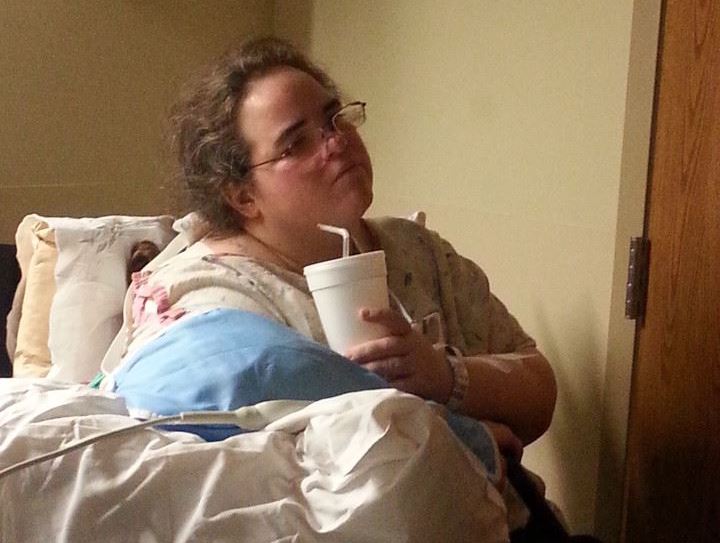
Pamela Ellis was having a regular day, feeling great, when all of a sudden she began feeling extremely sick. Everything went downhill from there and she soon found herself needing emergency surgery for an ectopic pregnancy. She told us what that and the 6 months that followed was like.
“I cried every day for 6 months.”
Q: Hi Pam, welcome to LUCK-IT! To start, could you tell us a little about yourself?
A: Sure! I’m a 39-year-old stay-at-home mom to 3 beautiful children and wife to an amazing husband. I spend most of my time reading, meditating, studying spirituality, mythology, and folklore, hiking through the woods, helping my husband with his race car, and writing my blog.
How did you find out about your ectopic pregnancy? What were the signs that led you to discovering so?
I learned about it at the emergency room. I had no idea I was even pregnant, or that it was ectopic until I experienced the partial rupture leading to an emergency life or death situation with internal bleeding. Looking back there were minor signs but I had no idea at the time they were ectopic pregnancy symptoms. I missed one menstrual cycle but never took a pregnancy test because I didn’t have any pregnancy symptoms. I’ve had 3 successful pregnancies before this one and I always have pregnancy symptoms alerting me that I’m pregnant often before a test tells me so. I assumed all this was from stress because I had been under a tremendous amount of stress before this happened. So I was waiting it out. I figured if I was pregnant I would find out eventually anyway. I had no reason to think there was something wrong beforehand.
What happened next?
I went to use the bathroom that day and then suddenly I became really sick. Dizzy, nauseous, and super hot. So I laid on the couch hoping for it to go away on its own but my symptoms only got worse. I thought my appendix had burst. Then my shoulder started to hurt worse than anything else to the point I couldn’t move without extreme pain. I was also very pale and I couldn’t stand or walk without struggling to remain conscious, so I rushed to the emergency room. I didn’t know it at the time but shoulder pain, called shoulder tip pain, is a symptom of internal bleeding. I had been bleeding internally for 15 hours before we found out why and had no idea.
For those who might not know, can you explain what an ectopic pregnancy is?
An ectopic pregnancy is when a fertilized egg grows outside of the uterus and implants somewhere else in the belly. It’s a pregnancy in the wrong location. Often in the fallopian tubes. It is very dangerous. Always a life-threatening situation. Symptoms vary from painful to nothing at all, so it’s imperative to be seen the second something feels off. I had practically no symptoms. I had no pain the entire time. Looking back on it, I did have an odd sensation on the left side of my lower abdomen but it wasn’t extreme enough to bother me. My cycle was also off. I had brown discharge a week before the rupture and experienced extreme bloating. Other than that, nothing else. I didn’t even have pregnancy symptoms.
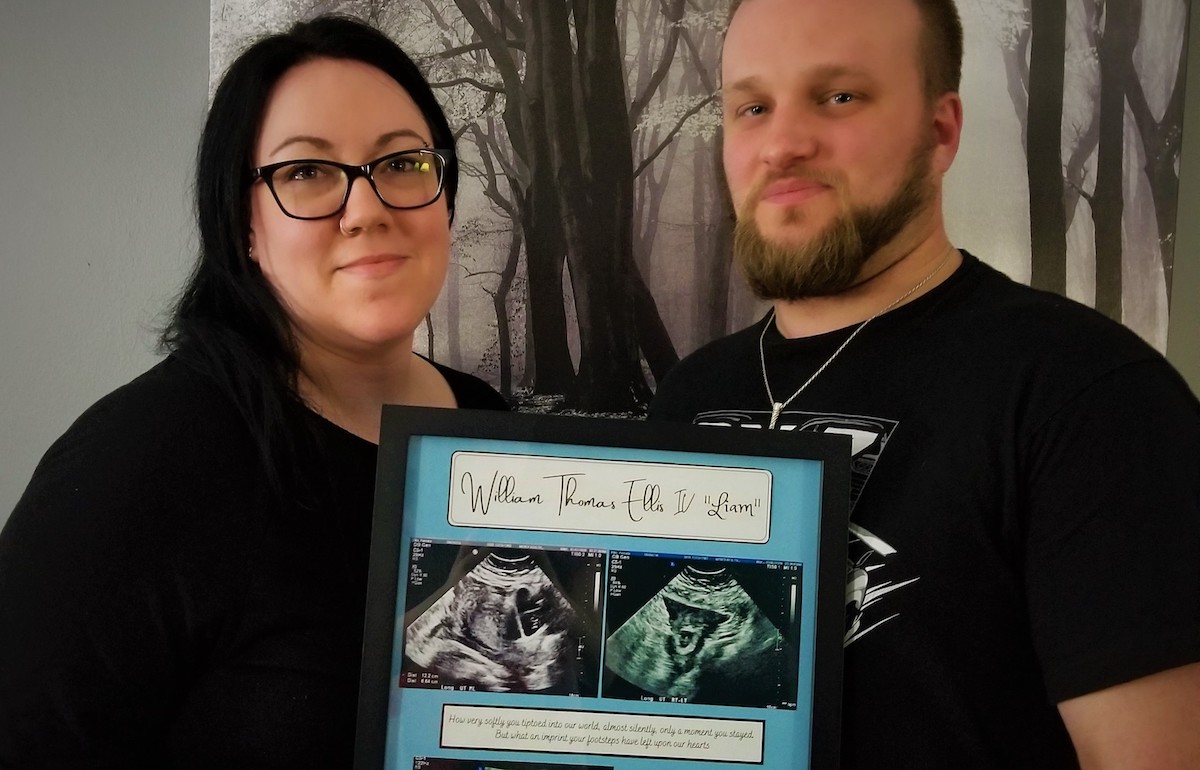
“Me and my husband holding the frame I made of our baby’s ultrasound pictures.”
What was your routine like right after your ectopic pregnancy? What did you do to get better?
Right after my ectopic pregnancy, I spent a week on the couch. Because I had a rupture that caused internal bleeding, I had to have laparoscopic keyhole surgery to remove the live baby, my left fallopian tube, and save my life. I had 3 incisions on my stomach and was on heavy pain medication. It was very painful and it hurt to walk or move my stomach at all for a week. I couldn’t do much for 2 weeks. I rested as much as I could because I lost 2 liters of blood and needed blood transfusions which caused me to feel extremely exhausted for the first few days. Then the second week I was cramping badly while shedding the uterine lining from the pregnancy. Those contractions felt like labor pains! So I slept most of the time to help my body recover from the trauma.
Which 3 objects or people were most useful then?
My husband. He was my support system. He helped me so much! I don’t know what I would have done without him. I also had a walking stick he bought me that helped me to get around the house. Walking was extremely painful and I couldn’t stand up straight so that stick was my saver to getting around the house and grabbing things I couldn’t reach. I also bought a wedge pillow that helped me sleep in my bed instead of the couch. Because of the surgery and trauma to my stomach, I was unable to sleep on my side or lay flat on my back. So the wedge pillow allowed me to sleep comfortably upright for 6 weeks.
Which place was most useful?
The Ectopic Pregnancy Trust online. I had no idea what an ectopic pregnancy was, or what to expect in my recovery, or exactly what happened to me. I was completely left in the dark. In order to better understand what happened and what was to come, I lived on that website for weeks.
How long did it take you to get over the shock of having had an ectopic pregnancy? What really helped you feel better?
As of right now, it’s been 6 months since it happened and I don’t think it’s something that you can “get over.” I’m still in shock, I’m still in disbelief, I’m still recovering, I’m still trying to wrap my brain around the fact that I almost died, and I’m still brokenhearted over losing my baby. My baby was alive and well, just in the wrong location. I heard his heartbeat and the doctors kept reminding me that he was a fully formed living baby with a face, fingers, hands, toes and feet. It was also a boy. Someone made me a baby blanket with the baby’s initials on it and my mother made me a trinket with angel wings and the baby’s name. I found that comforting. I have an angel candle that I light every day in remembrance of my baby and I also created a shadow box frame with the ultrasound pictures in it along with my favorite sayings to help me cope with the loss a bit. It’s been rough for me.
“A picture of the angel candle I light every day in remembrance of my deceased son I lost.”
What did you learn from having had an ectopic pregnancy that you didn’t know before?
Good question! The one thing I learned from this is how precious life really is. I came face to face with death at 38 years old. I can honestly say I took a look at my life and thought – I’m not ready to go this young. I have so much more I want to accomplish and do with my life. It’s like I got a second chance. It also made me cherish what I do have even more. The people in my life mean so much to me and they almost lost me. All the little things that irritated and stressed me out I realized weren’t that big of a deal. Life is much more than that petty stuff.
Also, as a very anxious person that worries a lot, I realized more than anything not to worry about things I cannot control. Worrying is a waste of time. We spend so much energy worrying about things that haven’t even happened as a way to prepare but whatever does happen will never be anything that you conjure up in your head. So worrying is a big waste of time. If something does happen, you’ll just figure it out as you go. Nothing can be prepared for ahead of time in life.
This also made me realize how much I love being a mother. Motherhood can be stressful and having raised 3 children already, one on the autism spectrum, there were times where I was frustrated with being a mother. Losing my baby made me realize more than ever how precious my children are. I may have taken that for granted a bit.
If you could go back and replay your experience with the ectopic pregnancy all over again, what would you do differently?
If I could do it all over again I would go to the doctors as soon as something felt off instead of waiting it out. My body was telling me for a couple of months that something was wrong and I waited hoping it would resolve itself instead of just going to the doctors. Because of Covid-19, I was avoiding the hospitals. Waiting almost cost me my life. I was unaware that what was happening was an ectopic pregnancy. I had no idea what an ectopic pregnancy was or what any of the symptoms were. I also had no idea I was even pregnant in the first place because I didn’t have the same experiences or symptoms as I did with my other 3 pregnancies. I should have just taken a pregnancy test and went to the doctor the second I noticed something was wrong. The second I missed my period I should have gone to the doctors and it would have been discovered and resolved without me almost dying.
What advice do you have for those who are presently going through or getting over an ectopic pregnancy too? And what advice do you have for their family and friends?
For those that are going through this just know that everything that is happening with your body and everything that you are feeling is absolutely normal. That is the biggest question I see most women who have gone through or are going through this ask. You just went through, or are going through, something very traumatic and very terrifying. It is normal to be upset, to be scared, to be grieving. To grieve the loss of your fertility, to grieve the loss of a piece of your body now gone, to grieve almost losing your own life, and most importantly the loss of your precious baby and the hopes and dreams that came with it. For those close to someone going through this, they need as much support, patience, and compassion as possible. Hold space for them to talk about it as much as they want, and share as much as they want about it if they choose without judgment or advice. Give them the space to heal in their own way. They just lost a lot and it’s very traumatic. Love is the best medicine.
Lastly, how are you doing these days?
I’m doing much better actually, thanks for asking! I didn’t think I would because I took this so hard. I cried every day for 6 months. My body ached for a long time and it felt like it was taking forever to get past this. I just started my exercise routine back up and I’m starting to feel much better mentally, emotionally, and physically.
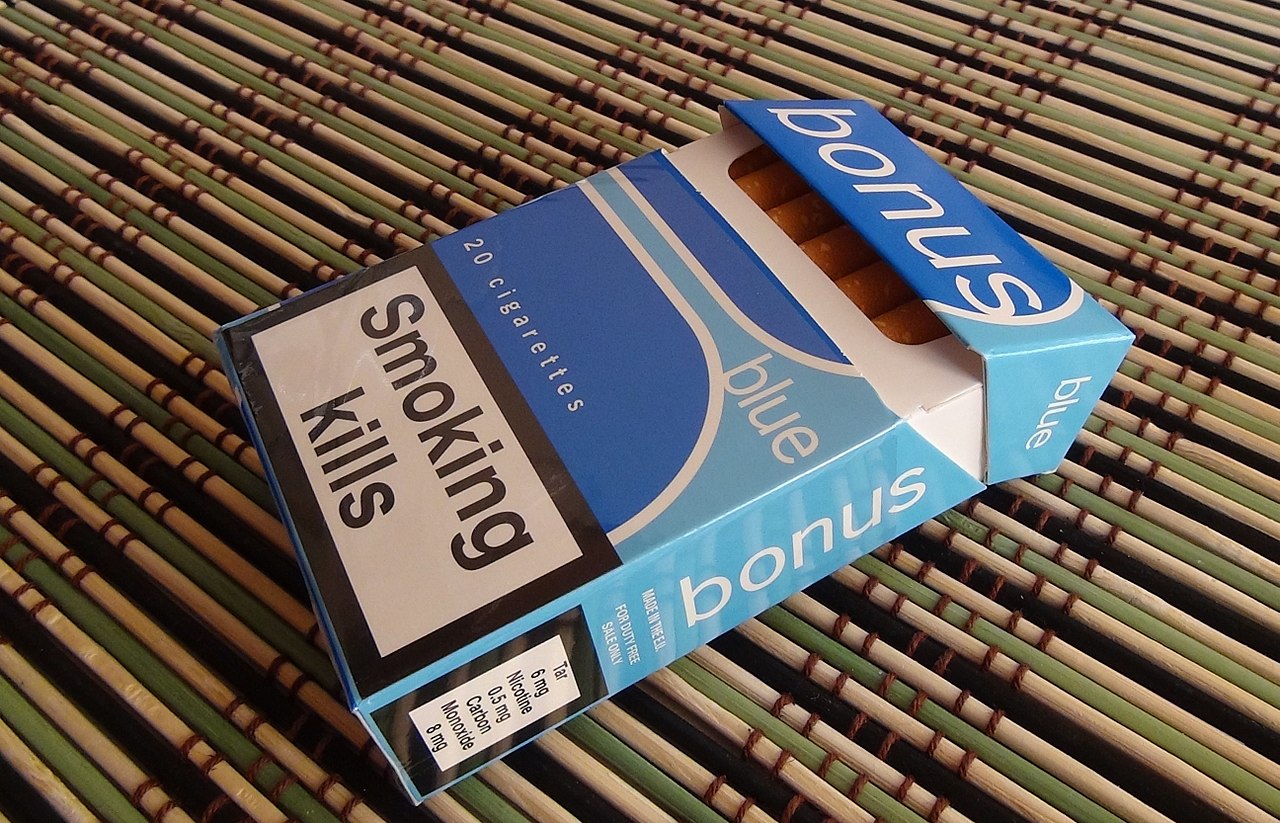
Happy 2021 everybody! I’m Sy, founder of LUCK-IT and as part of tradition, I’m going to get the interview ball rolling by doing a self-interview to show all potential interviewees how safe and not scary it is to be doing so. Since Singapore (where I’m at) announced this year a change in the legal age for smoking (now 21 instead of 20), I’m going to dig up my past this time and share my own experiences with smoking.
“You don’t get fat when you quit smoking.”
Q: How did you end up as a smoker?
A: When clubbing with a schoolmate, she asked me if I would like to try smoking. She had a pack. I said yes without hesitation and we shared a cigarette. Sometime later, I bought myself a pack of cigarettes just to hold and smell and imagine what it would be like to be a proper smoker. I eventually smoked one when having a bad day. And another on another bad day. Then I began smoking only when clubbing. Then it became a regular daily thing. All before I reached the age of 21.
Why do you think you said yes to smoking?
Back then, smoking was something cool, rebellious and emo people did. You saw it a lot in films and pop photography, always glamorously presented. It was also often said to be a good way to lose weight, de-stress and make friends. Because of that, I wanted to be a smoker from the time I was a teenager. Coming from a broken home also contributed in a way. I simply connected better with the types of young adults who would smoke and wanted to belong with them.
What was your routine like as a smoker?
A smoke after meals. A smoke before returning home. Smokes during stressful periods. Many smokes when out for drinks with smoker friends. Smokes when clubbing (back when that was still legal and a thing).
Why did you eventually decide to quit smoking?
The appeal of being a smoker faded as I got older. Eventually I came to view smoking to be not so much a way of looking “cool” but more like an indicator of having poor self-control. I tried to quit smoking 3 times in my life, mostly out of a desire to be healthier and save myself from that dreaded lung cancer everyone was always warning smokers about. The first time, it lasted for a week until I had drinks with a smoker friend and decided to just bum one when I saw how much she was enjoying hers. The second time happened abruptly after I contracted pneumonia and finally understood how wonderful and important having a healthy functioning lung was. That lasted a couple of months but ended when I found myself needing an escape from work stress. The third attempt was successful. It’s now been about 8 years since I last smoked.
How did you quit smoking?
First, I grew older and changed my mind about what I wanted in life. Second, my scary experience with pneumonia made me care a lot more about my precious, very important lungs. Third, I quit my stress-causing job and set myself up in the direction towards a more ideal type of future. On the night of my last day of work at that job, I felt a great weight lifted from my person and was hyper excited about what was coming next. I didn’t smoke before returning home that night because I was no longer feeling distressed and didn’t want to screw up the good things I now had going with something as crappy as lung cancer. I never smoked again after that.
Which 3 objects or people were most useful when you were trying to quit smoking?
1) Having a plan for the future that I was excited to work towards. After leaving my job, I was euphoric and preoccupied for weeks and I think that kept me from feeling any urge to smoke in the immediate aftermath of quitting smoking. 2) A straw cut to the length of a cigarette. At some point, I did miss the act of smoking, especially when at work. Those straws allowed me to partake in the action of smoking without actually having to smoke at all. 3) The change in government policy. When I was younger, you could smoke practically anywhere which made it easy to take smokes. In later years, the government began confining smokers to increasingly smaller and more awkward locations so finding a place you could legally smoke at became a huge PITA.
What setbacks did you have when trying to quit smoking? How did you move past those?
I didn’t have any setbacks after my third attempt because my mindset was that I no longer wanted smoking to be part of my identity. Although I had been seduced by friends and stress the first 2 times, once I got my mindset fixed, I no longer felt the urge to resume smoking even when surrounded by smoker friends or stress.
What’s life like now that you’re no longer smoking? Do you think it’s better or worse?
Better. I feel much healthier, look much healthier and smell better. It’s also nice to not to have to make the effort to go somewhere designated to smoke a couple of times each day, not to have to carry a photo of a dead premature baby, gangrenous hand or bleeding smoker’s lung* in my bag at all times, and not to have to worry about “smoker’s wrinkles”. (*Those were images pasted on every cigarette box in Singapore during my last years of smoking.)
Is there any part of being a smoker that you miss?
The camaraderie of smokers. I made a lot of friends both at school and at the workplace in my time as a smoker and I do feel nostalgic about having somebody or a group of people come up to me out of the blue and, with a tilt of the head, saying, “Let’s go.”
Can you list 3 things you realised only after quitting smoking?
1) Smoke smells really bad. You don’t realise it as a smoker but once your body has detoxed for a while, being near a smoking person is unbearably unpleasant. 2) Smoke lingers on your body and non-smokers can smell it from a mile away, all day long. Again not pleasant for non-smokers. 3) You don’t get fat when you quit smoking. That was my biggest worry as an appearance-conscious 20-something but it never happened.
Lastly, what advice do you have for those thinking of quitting smoking too?
From my own experience, deciding I no longer wanted to be a smoker was the single most important thing that enabled me to quit. From watching my other smoker friends who have also since quit smoking, gradually cutting down the number of sticks a day and replacing the smoking habit with daily routine exercise also helps with stress and the urge to smoke. I don’t recommend vaping or e-cigarettes as I’ve heard they cause more respiratory problems than regular cigarettes. I don’t know anyone who’s tried nicotine patches so I can’t comment on that. Most importantly, I’m not a doctor so do seek some medical advice if you run into health problems while trying to quit smoking on your own. Help for smokers is everywhere these days. If you’re in Singapore, you can find it at places like this.
Sy is presently looking for people to interview and working on developing more games for LUCK-IT’s PLAY-IT segment this year. You can see more of what she’s doing here or chat with her using the comment box below. If you would like to be interviewed for LUCK-IT (and she hopes you would), contact us here.
More interviews with those who’ve quit habits of all sorts here.
77 days ago, we interviewed James from Canada who was on extended vacation in Seoul during the height of the coronavirus pandemic in South Korea. Now that things in South Korea seem to be under control, we checked in on him to find out what’s changed.
“I’m extremely thankful I decided to stay in Seoul rather than head home.”
Q: Hi James, welcome back! What’s happened since the last time we spoke? Are you still in Seoul and have you been well?
A: It feels like the time has flown by without much really happening. I’ve been hanging around Seoul, bouncing between a few guesthouses (and the odd hotel room when I’m feeling decadent, haha). I’ve spent a lot of the time seeing what I can of the city and some of the surrounding areas like Paju, although a lot of attractions like museums and sporting events remain closed. Parks and restaurants have remained open the entire time here, so they’re what I’ve been focused on. I’ve also been taking some online courses to keep my mind engaged.
One of the parks James has been walking around in.
Heard you’ve since found yourself a job in Ireland? How did you manage to do that when most companies around the world are either in lockdown or cost cutting?
I’d like to say it was wise planning on my part but it was a lot of luck. When I arrived in Korea in January I knew I’d needed to start looking for work soon, and even though I wasn’t searching that aggressively I saw one job I was extremely interested in and applied. After a couple interviews and a skills competition I was offered a position and immediately took it—by this time, the effects of COVID-19 on the economy were becoming apparent and new job postings were drying up fast.
Earlier in March many countries restricted entry for visitors from South Korea. Will that pose any problems for your move to Ireland?
I’m planning on riding it out here as long as possible to make entry into Ireland as trouble-free as I can. I’ve got permission to stay until July 8th but I’ve heard of tourists able to get a month extension, so I might try to do that. I’m also waiting on a work visa and I have no idea how the virus will impact the timeline of receiving that, either. Fortunately my new employer put conditions in my contract that allow for the start date to be pushed back in the event the virus impacts my arrival.
What are the numbers of COVID-19 infected, recovered and demised in Seoul right now? What about in Korea as a whole?
I’m not really sure about the numbers specific to Seoul, but I believe the country is around 11,000 total infections. For a while it seemed like it was done with, as there was a span of numerous days with zero community transmissions, but there’s been a recent spike around the neighbourhood of Itaewon, with 25-35 new cases per day for much of this week.
South Korea began easing restrictions a month or so ago. How did that change life for you?
Honestly I barely noticed the change. The impact has mostly been limited to students, sporting events and cultural sites, and the easing of restrictions didn’t apply to those. Compared to discussions I’ve had with friends and family in Canada and the US regarding the conditions in those places, it feels like we haven’t even had restrictions here.
LUCK-IT will earn a tiny commission when you purchase this product.
Now that there’s been a new outbreak in Seoul in recent days, how do you think things will change again in South Korea?
I’ve definitely noticed a bit of an anti-foreigner sentiment following this new outbreak. The neighbourhood the new outbreak occurred in, Itaewon, is very popular among expats, so I think some residents are more wary of foreigners. I’ve had a couple of negative interactions with strangers in recent days, situations that were clearly due to me being a foreigner, and that’s extremely unusual for Korea.
You’re from Canada so what are your thoughts on the situation there in comparison to the situation in South Korea?
Even though there have been stints of boredom here, I’m extremely thankful I decided to stay in Seoul rather than head home. Most people I’ve spoken with back home are a bit stir-crazy now, unable to go out or do much.
Another park James has been walking around in.
What advice do you have for people around the world who have lost their jobs because of COVID-19 and are hoping to get a new one too?
That’s tough, as I feel I was extremely fortunate to get the one I did. I guess I would suggest doing anything they can to advance their career prospects with their time off, through online courses, practicing as much as they can, or whatever could apply to their line of work.
Which 3 items or people are now most important to you?
My laptop, my boots, and my backpack.
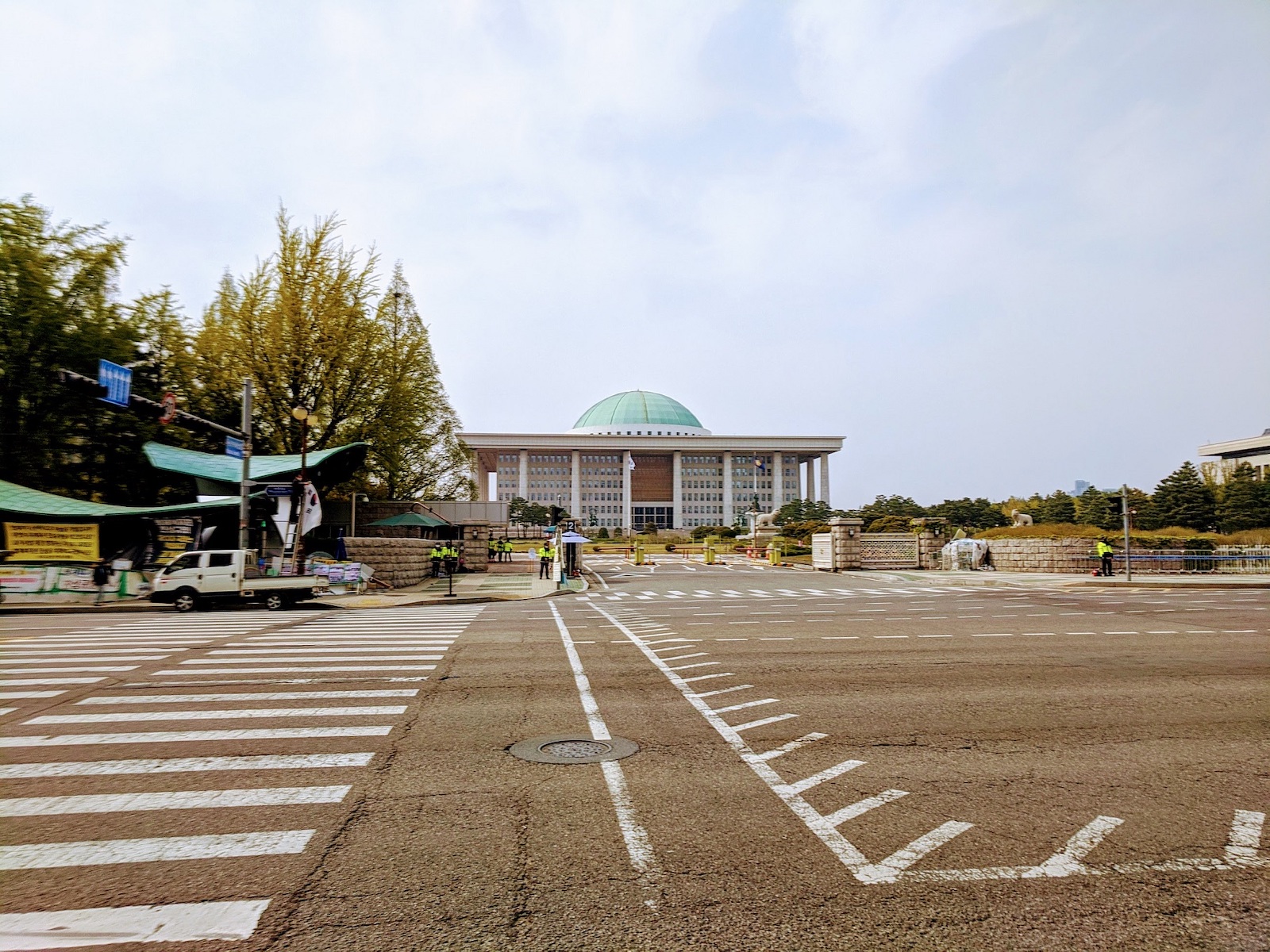
The National Assembly in Seoul during the COVID-19 pandemic.
Lastly, what else have you learned in the time since we last spoke that you didn’t know before?
I kind of knew this already, but it’s really becoming apparent to me how much I miss work. I’m extremely stoked to get to Ireland and start working again.
Once James gets to Ireland and settles in, he plans to return to Nova Scotia in Canada to visit his family for a bit. “And then get to know Ireland as well as possible. I’m interested in learning the Irish language as well, and hope to take some night courses in Dublin.” You can follow him as he does this through his blog, distancefromnormal.com.
Follow the latest in our COVID-19 Diaries series here.
If you’re in a country that has been affected by the novel coronavirus and would like to share information about the situation where you’re at, do get in touch with us here.
Lorne Anderson is a human rights consultant from Ottawa, Canada who is living temporarily in the southern Black Forest region of Germany while working to support the persecuted church in the Middle East and North Africa—“My German is limited, and no-one speaks English so we have a certain amount of normal social distancing.” We asked him what’s been going on with the COVID-19 situation in Germany.
“If this situation lasts much into June I expect people will start ignoring the social distancing provisions.”
Q: Hi Lorne, thanks for speaking with us all the way from Germany! When did you first hear about the novel coronavirus and what did you think of it then?
A: I first heard it in news reports in early January. I thought the Chinese would manage to contain it and it wouldn’t affect my life at all.
How concerned are you and the people of Germany now?
I’ve never been that concerned. Even though I am technically “higher risk,” I am healthy and take precautions not to be unnecessarily exposed. The German people have had a wide range of reactions. Some have been paralyzed by fear, others, especially the young, don’t see the problem, or think it is overblown.
Who were the first few coronavirus-infected people in Germany and where did they contract COVID-19 from?
There were cases in the northern part of the country that were reported in late February (I think), people who had traveled or been exposed to travelers from China. I live in the south, where France, Germany and Switzerland meet. Our first cases crossed the border from France, from Mulhouse. Many people who live there work in Germany, and Mulhouse was where one of the first outbreaks happened in France.
Can you tell us about the biggest COVID-19 clusters in Germany?
I haven’t paid that much attention—unnecessary travel is discouraged, so I haven’t paid much attention to what is happening in other areas. There are daily statistics published, but I haven’t followed them since late February.
Lorne before COVID-19: “Travel can take you to some strange places—like standing in the ruins of Iraqi dictator Saddam Hussein’s bedroom in northern Iraq.”
What measures has the government of Germany imposed to keep the COVID-19 outbreak under control thus far, and how have those measures affected you personally?
There have been many shop closures and travel restrictions, and gatherings larger than two unrelated people (with social distancing) are forbidden. I work from home, and my village is so small that 2020 doesn’t seem much different from 2019. The biggest difference was probably not being able to go to church—online worship isn’t the same. And it would be nice to go to a city if I get stir crazy, but there is nothing open there. I now have to wear a mask in the grocery store, but that only became mandatory at the end of April. I had some business and leisure trips canceled, but that wasn’t a government decision.
How did it feel when German Chancellor Angela Merkel ended up in quarantine because of COVID-19?
I thought it was a smart display of leadership. It showed that the government took the issue seriously, and that no-one was above the rules.
LUCK-IT will earn a tiny commission when you purchase this product.
Germany began easing its lockdown measures at the end of April. How has that been going?
Germans are tired of the restrictions, as are people worldwide. The sense I have is that there are still too many rules, that people are impatient for an end to them. If this situation lasts much into June I expect people will start ignoring the social distancing provisions. So far though people have been pretty accepting of the need for restrictions. The economic fallout will be huge though.
Have you and those around you done anything to prepare for the possibility that the novel coronavirus pandemic might get worse?
Germany has probably handled the situation better than any European country. Hospitals have not been overtaxed (which was a fear in March) and the number of new cases is slowing. I don’t expect a worsening. I haven’t even stocked up on toilet paper.
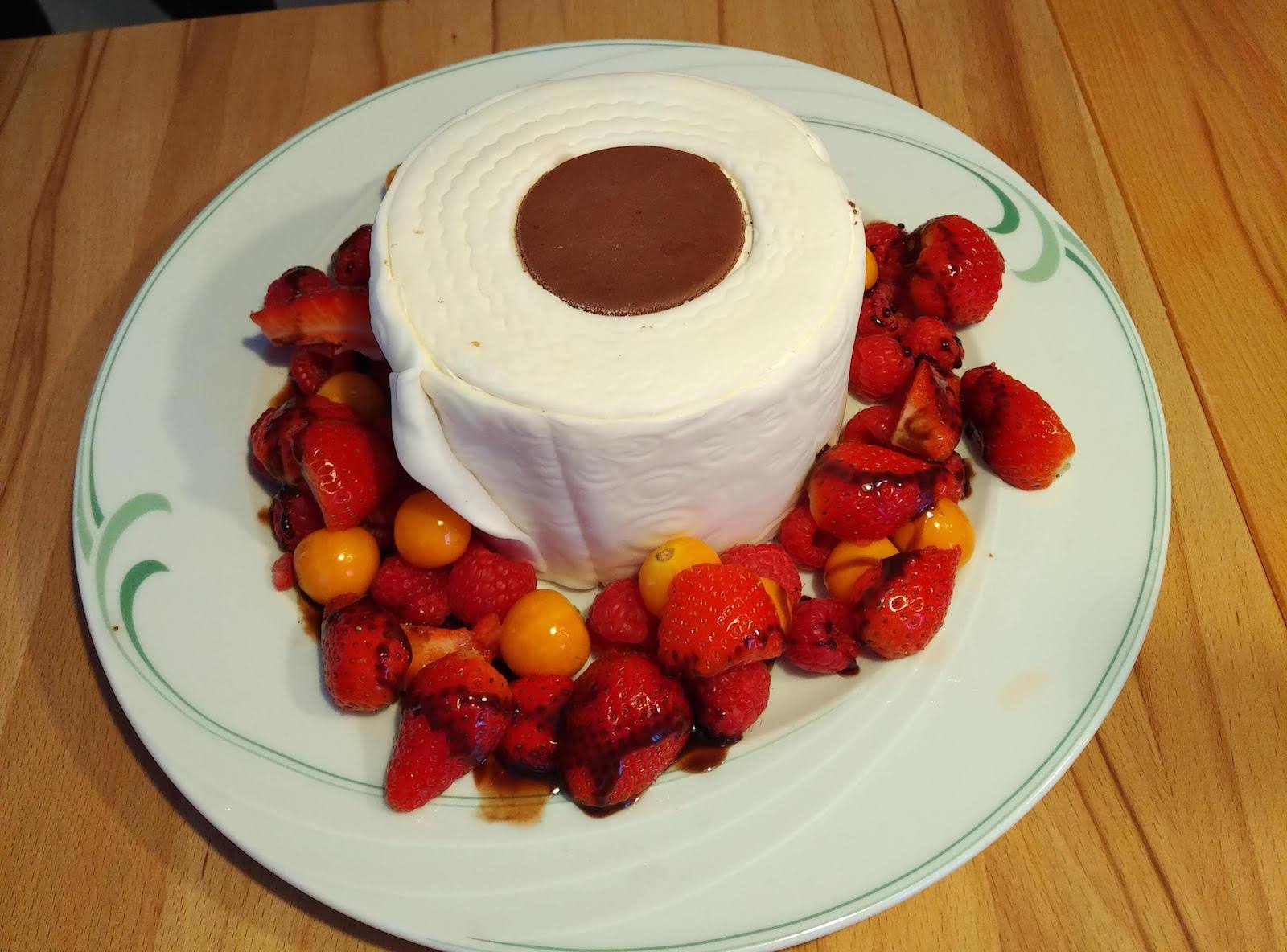
“Toilet paper cakes became popular in Germany in March 2020 when hoarders bought up every roll of the real thing in every store in the country.”
What will you do if you or those who live with you develop symptoms of the virus? What do the authorities of Germany want you to do?
My understanding is people are expected to self-isolate for two weeks if they may have been exposed and see if anything develops. My neighbors did test positive for COVID-19 (and one was hospitalized), so I have done that already. If I contracted the virus, I was asymptomatic. At some point I hope to get tested to find out—international travel might be difficult otherwise.
If you did contract COVID-19, what do you think your odds of surviving it are?
I’m an optimist. I would expect to survive. The death rate in Germany isn’t that much different from the death rate from seasonal influenza, 1.5%.
When do you think this COVID-19 pandemic will end?
I am hoping by July—but that hope is because I have travel planned, and is probably not realistic. The end of 2020 is a more likely date for the lifting of all restrictions, and I wouldn’t be surprised if that was optimistic.
When do you think life in Germany will go back to normal again?
At this point the word “normal” has no meaning. Restrictions are slated to gradually ease, but some may remain in place permanently to create a new “normal.” Will people be willing to attend large gatherings like football games and concerts? Will face masks be required on public transit? At this point no-one knows.
“Easter Sunday 2020–a spontaneous service outside the thousand-year-old church in Sulzburg—with appropriate social distancing.”
What are the best and worst examples of humanity you’ve seen since the COVID-19 crisis broke out?
I’ve seen a lot of people willing to help others. I can’t say I’ve seen bad examples—just a lot of ignorance. Those who were hoarding (toilet paper, flour and pasta seemed to be the biggest items here) were doing so out of fear. I don’t condemn people for fear, even if it is irrational.
Which 3 items or people are most useful for you right now?
The Zoom teleconferencing platform has been very useful. I already used it for business, but there have been new uses. My wife celebrated her birthday on Zoom, with more than 90 friends joining the party. Other than that, I can’t think of anything. My life hasn’t changed that much.
Lastly, what have you learned from this pandemic that you didn’t know before?
How incredibly unprepared governments are for emergencies. I have worked in government and know that emergency planning has been done, but this pandemic seems to have taken everyone by surprise. That needs to be addressed moving forward.
You can find out more about Lorne at his website, lorneanderson.com—“I post most days on whatever strikes my fancy: travel, politics, religion, society, leadership, music and pretty much anything you can think of. Eclectic and interesting is my goal.”—or chat with him using the comment box below.
Follow the latest in our COVID-19 Diaries series here.
If you’re in a country that has been affected by the novel coronavirus and would like to share information about the situation where you’re at, do get in touch with us here.
Photographs courtesy and copyright of Lorne Anderson. Interviewer: Sy Sponsor or support the COVID-19 Diaries series here. If you found this article useful:
W.F. from Hong Kong moved to London almost a year ago for a job, only to find herself having to deal with the coronavirus pandemic away from her family when it struck. We asked her what that feels like.
“Prince Charles and PM Boris Johnson caught COVID-19, but I don’t think people are in fear.”
Q: How panicked are the people in the UK now?
A: The situation in the UK now (April) is a bit similar to the situation in China in January. The government announced a nationwide lockdown in late March. People stayed at home and piled up food during the lockdown. There were less people taking the train while social distance was practiced. However, less than 5% of the people here are wearing masks. Prince Charles and PM Boris Johnson caught COVID-19, but I don’t think people are in fear.
A lot of immigrants living in the UK went back to their countries after the PM announced the UK’s “herd immunity” strategy. As a foreign work pass holder, do you plan to go back to your country?
I don’t plan to go back at this moment. I rather follow the government guideline: to stay at home (share rent with flatmates) during the lockdown. I am not specifically afraid of the herd immunity thing.
LUCK-IT will earn a tiny commission when you purchase this product.
You seem to be fearless and strong. Have you ever felt weak or afraid during the lockdown?
I really miss my family in Hong Kong and want to have dinner together. The last time I went back to Hong Kong, my sister was not there, so I only saw my parents. Now I really don’t know when all of us can have dinner together.
If you did contract COVID-19, what do you think your odds of surviving it are and why do you think so?
50%. Because I think I have a strong immune system but I had asthma when I was young. So I am categorised into the group with a slightly high risk of contracting the virus I guess.
What will you do if you or those who live with you develop symptoms of the virus? What do the authorities of the UK want you to do?
I will keep social distance with people who develop symptoms of virus and I will provide assistance if I am able to. UK wants people who develop symptoms of virus to stay at home, and they advise that if the symptoms are getting serious, they need to call the NHS [National Health Service].
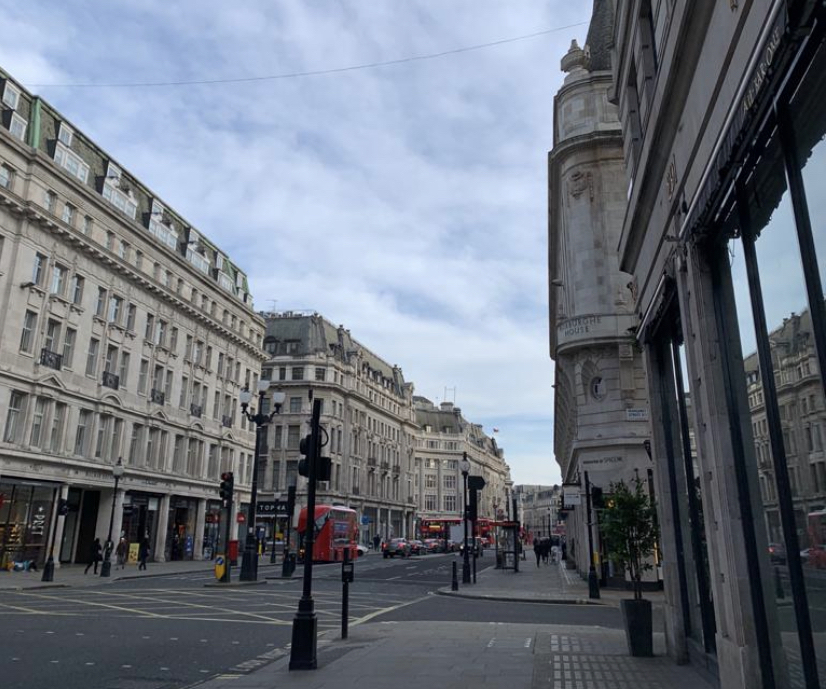
A street in London during the lockdown.
How did most people in the UK contract COVID-19? Can you tell us about the biggest clusters and how those happened?
I think because of social activity. I don’t know the details of how it happened.
How do you think Boris Johnson and Prince Charles contracted COVID-19?
I have no idea. When you are a human being, you have social activity. It is possible for anyone to get COVID-19.
What will you be doing over the next year?
Hopefully COVID-19 is gone and everything is back to normal next year. This will only happen if people practice social distancing and take it seriously. I am not sure how long will I stay in London, I may or may not extend the work permit.
If you’re in a country that has been affected by the novel coronavirus and would like to share information about the situation where you’re at, do get in touch with us here.
Photographs courtesy and copyright of W.F. Interviewer: Kauai Sponsor or support the COVID-19 Diaries series here. If you found this article useful:
68 days ago, we interviewed Greg who had just returned to Shanghai after a trip abroad only to find himself caught up in the growing COVID-19 epidemic there. Now that it’s been almost 3 months since then, we asked him—a kindergarten teacher who lives alone—to give us an update on what’s being going on in Shanghai since.
“There are now new lockdowns going on up north, though this is not made public.”
Q: Hi Greg, welcome back! What’s happened since the last time we spoke? Are you still in Shanghai and have you been well?
A: Yes, I’m still here in Shanghai. I haven’t left the city since I returned at the beginning of February. I seem to be OK.
What restrictions presently remain in Shanghai and which have been lifted? Have you yourself gone back to work in person yet? Sat down for a meal in a restaurant?
Checking people’s temperature at all residential compounds and many restaurants continues. A few weeks ago, we were notified that some public tourist spots, like the big towers across from the Bund and the Aquarium were ordered to shut down again without an explanation. We have not returned to the classroom, but the school is anticipating that we will return before the end of the term, so they are busy getting things prepared.
What are the numbers of COVID-19 infected, recovered and demised in Shanghai right now? What about in China as a whole?
If you rely on the official government approved data, it says that the numbers are as follows: infected – 640, dead – 7, recovered – 532. The latest update on “One Tube Daily” lists China’s numbers as: total – 84,302, asymptomatic – 984, imported – 1,616, recovered – 78,147.
How accurate do you think those numbers are? And do you think this means the COVID-19 crisis in China is getting close to being over?
Whether those numbers are accurate, that’s anyone’s guess. China has repeatedly trumpeted that they have successfully defeated the virus, yet there are now new lockdowns going on up north, though this is not made public. There has also been talk about reinfections and more asymptomatic people not being properly reported. You must seek news sources outside of China to find this out, though. There is plenty of reason to believe that the official narrative is not accurate, so I’ll leave that to the discretion of the reader. But as for how it feels, it feels like things are returning to normal.
This is Greg.
When did the coronavirus situation in China first start getting better? In hindsight, what were the signs that suggested the epidemic was beginning to end?
So much time has passed in just a few months that it’s hard to keep track of exactly when things started to change. I would say maybe 2 weeks ago things started to feel more like they were returning to normal, especially when food deliverymen were allowed back into the compound for door deliveries.
Now that the rest of the world is just as affected by the coronavirus as China had been, how do you think China’s response to the virus compares to that of most other countries?
If you only follow Chinese media and believe the government propaganda, then it seems like China did a great job. However, the world knows by now that the government knew about the virus back in December and willingly covered it up until it became uncontrollable by mid-January. This topic is too complex to talk about in this format, though. As I said, if you only follow Chinese media and propaganda, then it seems like they did an amazing job. But if you view media outside of China (and the Great Firewall) then there is tons of evidence and reports that very much contradict that narrative.
LUCK-IT will earn a tiny commission when you purchase this product.
You’re from the US so what are your thoughts on the situation there now that they are presently the country most affected by COVID-19? How do you think they ended up with so many more infections and what do you think they can do to get the number of infections down?
As an American, I feel embarrassed by how it was initially handled. Trump has gone back and forth between saying everything was fine to now having to pass all kinds of measures to try to ensure that people steer clear of each other. I hate that the US (as well as the rest of the world) did not have enough PPE on hand to better deal with this crisis. This has been a major wake-up call for companies to return to manufacturing important goods back in their home countries. People in the US understandably don’t like authoritative measures, but on the other hand, some people need to be more careful and responsible rather than being selfish and reckless.
What advice do you have for the people all around the world who are presently still stuck in their homes because of lockdown measures, with no end to the COVID-19 pandemic in their countries in sight?
I think if people utilize more technology to socialize then this could help (Skype, FaceTime, etc), as well as Netflix and all those free concerts/performances being offered, especially if you have kids at home. Some people around Europe have also had local neighborhood celebrations from their balconies, playing music and cheering to keep everyone’s spirits up. Getting outside to walk around and exercise (with social distancing and masks) is also critical. I would also look at some of the early videos that people in China made of things they did indoors. Some of them are quite funny and creative.
Which 3 items or people are now most important to you?
1) Online groceries 2) Didi drivers 3) My friends
Lastly, what else have you learned in the time since we last spoke that you didn’t know before?
I didn’t know just how many people could contract this virus in less densely populated countries and how unprepared many places were. It’s nice to learn though, that Taiwan has done a great job with how it handled the virus. I wish they were getting more attention for it because the situation there has been very different from that of China.
Greg hopes to be able to work towards a master’s degree moving forward. You can ask him more about the situation in Shanghai using the comment box below or follow his adventures in Asia through his blog, globejournal2.com.
Follow the latest in our COVID-19 Diaries series here.
If you’re in a country that has been affected by the novel coronavirus and would like to share information about the situation where you’re at, do get in touch with us here.
Photographs courtesy and copyright of Greg. Interviewer: Sy Sponsor or support the COVID-19 Diaries series here. If you found this article useful:
When the novel coronavirus outbreak in China first began, we interviewed Thomas who had been put under lockdown in Beijing and found him to be calm. Now that almost 2 months have passed and the numbers of reported COVID-19 cases in China appear to be falling, we had another chat with him, hoping for light at the end of the tunnel, but were surprised to find him a tad less calm than before.
“COVID-19 is certainly, definitely not over in China, not even close.”
Q: Hi Thomas, welcome back! What’s happened since the last time we spoke? Are you still in Beijing and have you been well?
A: Hi Sara, it’s good to be back! The couple of months since we spoke have been sort of a blur, which is to be expected if you’re spending most of the time inside, with no real schedule. I am still in Beijing, and have been physically well, but have admittedly started to go a bit loopy.
What restrictions presently remain in Beijing and which have been lifted? Have you yourself gone back to work in person yet? Sat down for a meal in a restaurant?
Beijing is seeming to relax, partly because of the weather. Some people are back to work, but the universities remain closed. Places like malls are a bit more lively than they had been. At their worst, public spaces were really ghost towns. Restaurants are now back open for dine-in—but customers are still pretty thin on the ground. Places like McDonalds are doing huge takeaway business.
LUCK-IT will earn a tiny commission when you purchase this product.
What are the numbers of COVID-19 infected, recovered and demised in Beijing right now? What about in China as a whole?
I do hear about new cases in Beijing, but my impression is that these are primarily people who have come back to China from outside.
How accurate do you think those numbers are? And do you think this means the COVID-19 crisis in China is getting close to being over?
I can’t comment on the accuracy of the numbers, but COVID-19 is certainly, definitely not over in China, not even close. This is a virus that spreads exponentially among asymptomatic carriers—so it remains as insidious as ever.
A brochure stating laws related to controlling the novel coronavirus.
When did the coronavirus situation in China first start getting better? In hindsight, what were the signs that suggested the epidemic was beginning to end?
Until there is a cure and/or a vaccine, getting better will consist only of managing the spread. While people have certainly gotten better about washing hands and other hygienic measures, progress can only be temporary. People are certainly relaxing, but the fact is that another outbreak could occur at any time.
Now that the rest of the world is just as affected by the coronavirus as China had been, how do you think China’s response to the virus compares to that of most other countries?
Again, I can only comment on what I have seen publicly, but there’s no question that China took this very seriously, and coordinated its response at a central level. Given that China was the first to deal with the outbreak, it’s inevitable that mistakes would be made, but on the whole, the response has been remarkably well coordinated. The ability to keep consumer goods in stock remains a testament to the miracle of modern logistics. The switch to online learning has gone without a hitch, which again is pretty remarkable considering the sheer numbers of people involved.
LUCK-IT will earn a tiny commission when you purchase this product.
You’re from the US so what are your thoughts on the situation there now that they are presently the country most affected by COVID-19, with more than 3x as many cases of infection compared to China? How do you think they ended up with so many more infections and what do you think they can do to get the number of infections down?
Well to be fair, it is hard to compare data from different countries, since there is no standard for reporting criteria. But that said, the US federal response has by any measure been an absolute clown show, with neither moral nor operational leadership coming from the White House. I am not a particular fan of our current president, but even by the low standards of the past three years, the response of this government has been abysmal. On the other hand, states have shown real leadership. Governors of California, New York, Ohio, Maryland, Michigan and Washington have been standouts. The lineup of people prepared to return the US to a state of competent governance is growing longer and more coordinated. As a historian, I can only hope that this moment represents the low point of a longer cycle in US politics.
What advice do you have for the people all around the world who are presently still stuck in their homes because of lockdown measures, with no end to the COVID-19 pandemic in their countries in sight?
My advice is to embrace the slow erosion of your sanity. It’s gonna happen, so just belt up and enjoy the ride.
This is Thomas.
Lastly, what else have you learned in the time since we last spoke that you didn’t know before?
Oh all kinds of things. I have learned that you really want to brush your teeth before putting on a face mask, and that going running with a mask on is a great way to make yourself pass out. I have learned that animals are pretty quick to fill up spaces that humans have vacated, and that stray dogs lead surprisingly rich and fulfilling lives.
I have been learning to make better use of the Internet for my teaching. My class on food studies is still on, but we have adapted our assignments so that students trapped at home can interview their relatives, and conduct ethnographies of e-commerce sites like Taobao.
I have also been listening to a lot of podcasts, and even doing a few of my own. This is truly a golden age for sitting around and yapping into a microphone.
Thomas is a historian of modern China who presently just hopes to be able to get back to his work on China’s food eventually. You can read more about him and his work at thomasdaviddubois.com and bnu.academia.edu/ThomasDavidDuBois or ask him about China’s anything using the comment box below.
Follow the latest in our COVID-19 Diaries series here.
If you’re in a country that has been affected by the novel coronavirus and would like to share information about the situation where you’re at, do get in touch with us here.
Photographs courtesy and copyright of Thomas. Interviewer: Sy Sponsor or support the COVID-19 Diaries series here. If you found this article useful:
Italy has been reporting a consistent reduction in daily new cases of COVID-19 this month. Back in March however, this wasn’t the case with the country fresh in lockdown and hospitals worrying about how they were going to cope with the rapidly increasing number of infections. Here’s a look back at what the situation was like in Italy just a month ago, as told by Roberto who lives in the Umbria region of Central Italy.
“Lots of people are reporting horrible flu with chest pain but until they need to be hospitalised they won’t be counted. Basically, we’re ignoring the mild cases.”
Q: (Asked on 16 March) Italy has been in lockdown for more than a week but infections have not slowed. How do you feel about it? Are people taking the lockdown seriously?
A: People are pretty scared. Grocery stores are open. You need to sign a declaration with the reason why you’re around to get there, though. There are people around… going to the grocery store, taking the dog out, having a walk with their children… But they keep much more than 1.5m among them.
My mindset about these arguments when they happened in Italy was “just relax, stay at home, be safe and wait a couple of weeks”. And it worked. Stressing out about it is a huge waste of time, some people won’t understand until it begins impacting them personally.
Under what conditions can a person go out?
If you’re out you must have a reason. They will stop you and you need to provide a signed declaration. Valid reasons are commuting to work and going to buy groceries/to the pharmacy. You’re also allowed to take the dog out and you must keep 1.5m from everyone.
LUCK-IT will earn a tiny commission when you purchase this product.
Can someone move from one city to another by showing a signed declaration?
They are pretty strict about town borders. You can only move for work, basically.
What happens if anyone breaks the rules?
There have been like 7000 people reported breaking the rules in 3-4 days. They’ll all face a big fine and could go to jail—also, they’ll have that on their records. Besides that, there is news saying a prison riot happened in Italy over the lockdown measures. Probably something organised by the Mafia. 12 inmates dead while 16 escaped. They’re probably back with their families and will be caught again in a while.
I found that the mortality rate for COVID-19 is very high in Italy. Why do you think that is the case? I read from the newspaper that it is because hospitals in Italy don’t have enough beds and ICU machines, is that true?
Regarding the higher lethality: It’s widely believed to be because of a combination of A—the bigger population of elderly people (average age in Italy is pretty high) and B—the fact that the infected are many, many more than reported. At least double the official number, according to The Lancet.
Probably many, many more are unreported. To get tested nowadays in most of Italy you need to be on the verge of death basically. So it’s not that it’s much more lethal here than in China, it’s that we’re only testing people who are coughing their lungs out. They don’t test you if you have symptoms but no history of contacts with a known infected person. Lots of people are reporting horrible flu with chest pain but until they need to be hospitalised they won’t be counted. Basically, we’re ignoring the mild cases.
We still have enough beds and pulmonary ventilators—not for long though. Especially in Lombardy, the situation is critical and they could have to choose who to save soon. That’s not happened yet though.
With regards to the elderly patients issue, I heard a rumour saying that hospitals in Italy are choosing to not treat the elderly because of shortages of resources. Another rumour said that the Italian government has been using trucks to send corpses to crematoriums. Is that true?
No one’s stopped treating the elderly yet, they just said it could happen if we don’t slow the infection down. That is basically fake news. However, the ordinary crematory could not deal with the corpses and the military had a lot of trucks available. That one is not rumour.
Why are there so many COVID-19 infections in Italy? How did most of those infected contract the virus and are there any big clusters?
At first the government tried to follow contacts starting from patient zero for a while, but it wasn’t useful as multiple infection chains appeared and many are untraceable. Thus they failed to contain the virus.
If you’re in a country that has been affected by the novel coronavirus and would like to share information about the situation where you’re at, do get in touch with us here.
Photographs courtesy and copyright of Adert. Interviewer: Kauai Sponsor or support the COVID-19 Diaries series here. If you found this article useful: