Now that we’re coming close to the end of this decade, let’s take a few weeks to look at the other answers we’ve collected all through 2019: One of our interviewees, Bryan Yong, a young man who worked as a relief teacher while waiting to start his career as a pilot, asked for advice on saving for the future. Here’s what our other interviewees suggested he do.
“Secure yourself with the basics. And beyond that, you go for it, take a big bet.”
Q: What advice do you have for young adults with regards to saving for the future?
Russell Pensyl, who is an interactive media artist: The real solutions will be found, not by complaining about how the world and how society is, but by looking for a solution to a small problem. Small solutions build into big design.
Petrina Ng, who quit her 14-year teaching career to become a wedding photographer: Little by little goes a long way.
Elizabeth Seah, who has been cosplaying for 24 years: Make reasonable plans, start working towards it, stick by it! Try 40(saving)-60(expenses) for a start and slowly work towards 50-50, then 60-40/70-30. No point fixing a goal if you can’t follow through and feeling discouraged when you can’t produce results.
Nur Syahidah Alim, who is a world champion in archery: Be mindful about your daily and monthly expenditure. If you like going cashless, set a daily limit on your cards. Alternatively, I use a YouTrip card (which I use during my travels for competitions) to help manage my daily budget. In addition, explore investments with your local bank. Get in touch with your personal banker to explore various investment plans that suit your needs and level of comfort.
Syahidah’s first debut at the Asian Para Games 2018 in Jakarta, Indonesia. “Singapore was ranked 5th place. I was leading the Singapore Contingent as the flag-bearer. This is also the period where I was nominated into the Asian Paralympic Committee Athletes’ Commission.” Photo credit: Fiona Hakim / Sport Singapore
Kelvin Seah, who is a stay-at-home dad: To think carefully before making any purchase and ask if what you want to buy is a genuine ‘need’ or a fleeting ‘want’. To consider investing in things that will last, things that truly matter in the long-term.
Jeshua Soh, who dropped out of school, started a business at age 19 and started another business in Myanmar: Saving is good, investment is better and hoarding is dangerous.
Gwern Khoo, who is a Michelin Bib Gourmand certified hawker: Start saving and investing as early as possible.
Sheeba Majmudar, who has been a nutritionist for 12 years: Invest in your health and that way you will save more!
Loh Teck Yong, who is a security guard and author: Don’t get a credit card.
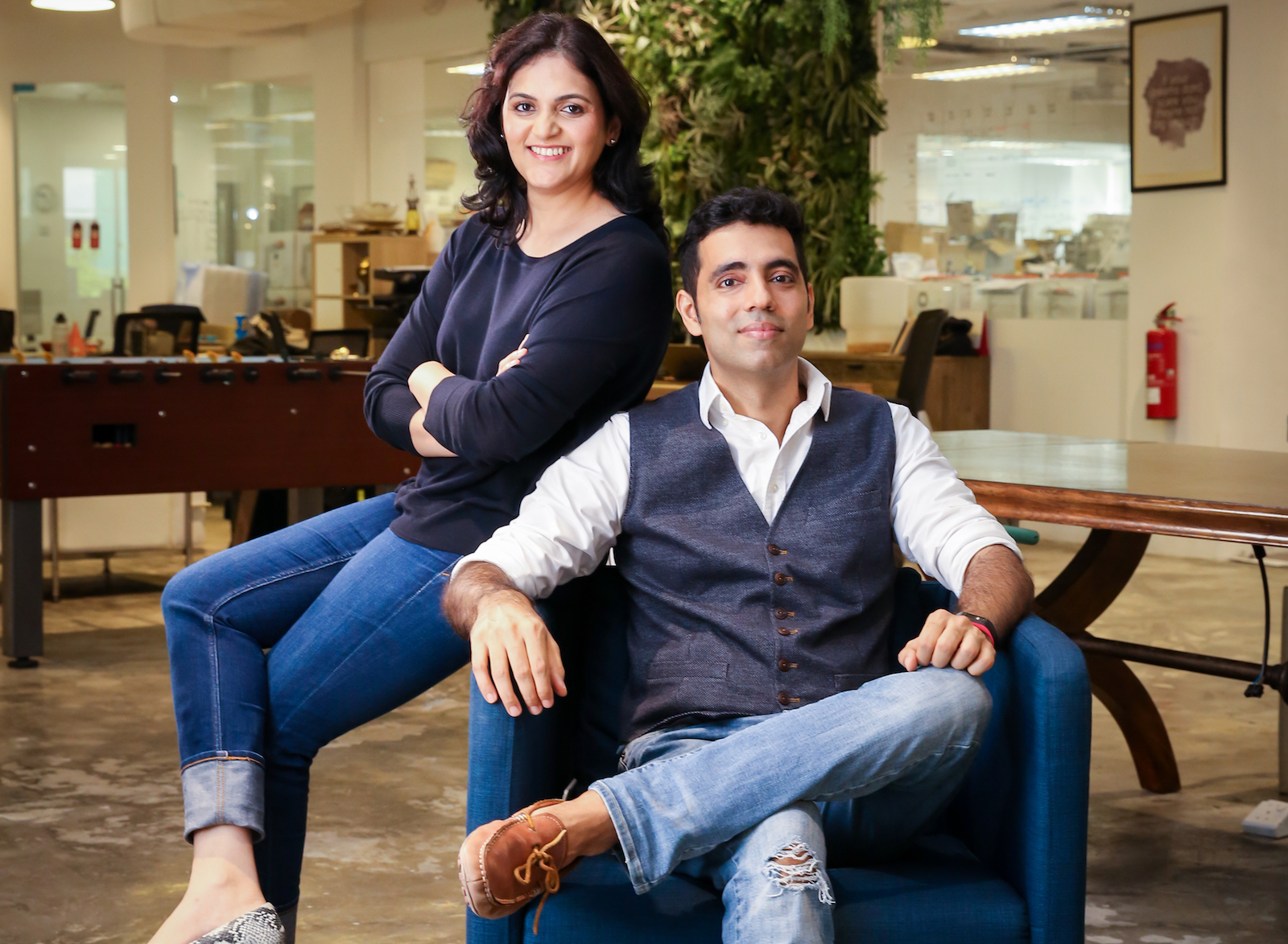
Rishi Israni, who married and built a million-dollar business with the inventor of the Rotimatic: I’m going to quote my father: Save at least 50%. Because at the end of it, the trash you buy doesn’t really make you happy. So it’s a waste of everything.
Evelyn Eng-Lim, who built her own retirement farm: One must save enough to see through retirement days for basic needs and personal insurance. This can be relatively easy if one lives an environmentally healthy lifestyle which will not require too much personal expenses.
Evelyn when working on her farm.
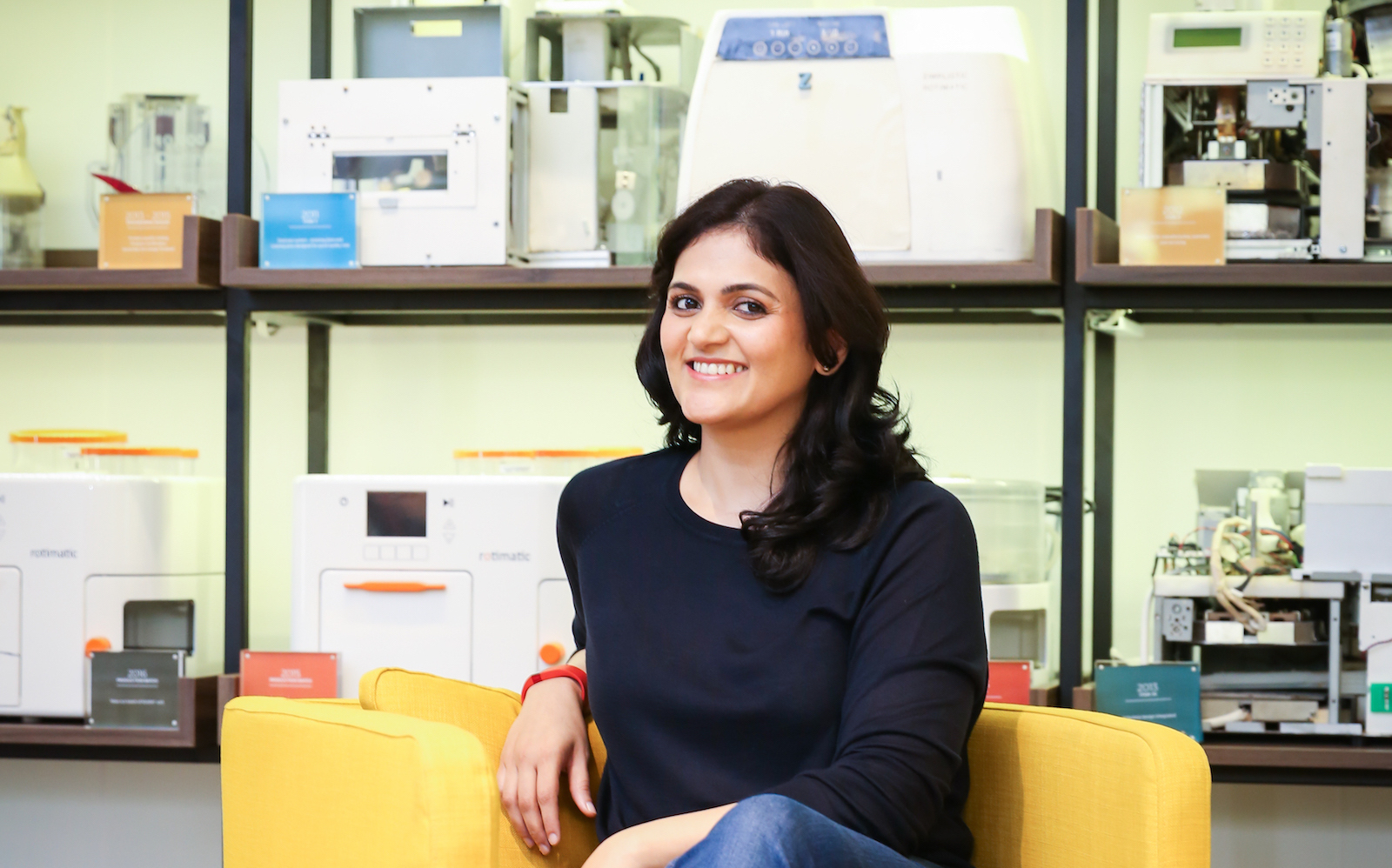
Pranoti Nagarkar, who invented the Rotimatic: I think it’s important to secure yourself with the basics. And beyond that, you go for it, take a big bet. There’s always the need to have a security blanket so start by asking yourself, what’s the worst that can happen? If the worst is manageable then you can really go for the big leap.
Sy, who runs LUCK-IT and interviewed all the above people: Make your money make money for you.
What advice do YOU have with regards to saving for the future? Drop your answer into the comment box below and we’ll add it to this list!
Photographs courtesy and copyright of those featured. Interviewer: Sy If you found this article useful:
At age 20, Rishi Israni met a girl at a cooking event in University and fell in love. 4 years later, they got married and eventually began working together on a business that would go on to make millions of dollars with its flagship household product—the Rotimatic. We pulled him aside to ask for his advice on doing big business with life partners.
“The first time we met, we chatted for about 5 to 6 hours, and then I said, “I’m going down to the vending machine to get a Coke, do you want to join me?” And she joined me.”
Q: Hi Rishi! Thank you so much for making the time to be here! Okay so tell us, how did you meet your wife and what did you think of her when you first set eyes on her?
A: She was the roommate of a friend I was on a committee with. I saw her a few times and she always came across as somebody who had a lot of zeal for life. Like I still remember her smile when I close my eyes—those moments I clearly remember. It just started like “oh, here’s another human soul who is very bright” and luckily, because of her roommate, I got to interact with her. We were trying to organise a large function, trying to cook for close to about 150 people for the first time ever, and her roommate was supposed to turn up but she was not well so Pranoti turned up. That’s how we got to know each other.
How long did it take for you to ask her out on a date? What about her made you want to ask her out on a date and how did you actually do the asking?
There was really no date per se. I remember the first time we met, we chatted for about 5 to 6 hours, and then I said, “I’m going down to the vending machine to get a Coke, do you want to join me?” And she joined me and we talked again for the entire night. So I think from the day we met, the first date was I think a week after, and within the next few days, we sort of knew that we were going to get married to each other. So it was like a whirlwind romance of sorts.
Rishi Israni is co-founder of Zimplistic, the company that produces the Rotimatic.
How did the first date go? Did you think then you would want to marry her and start a business with her?
Well, marriage, yes, certainly did cross my mind. But business, in the first date this was not something I thought of at all. The thing that attracted me to her was that she’d always been an engineer who wanted to solve problems. And she always used her own mind rather than just subscribing to the general narrative. She always understood that whatever the general narrative was, wasn’t always correct or doesn’t apply to you as is. So that is the thing I still find very attractive: she thinks on her own and has her own point of view.
How and why did you eventually propose?
There was no proposal. I like to believe that she is the one who proposed while she likes to believe I proposed, but actually, none of us proposed. And nobody ever asked, “Would you marry me?”—it was assumed. The bond, the chemistry was just so strong that we just assumed that we were going to get married at some point. Then, parents came into the picture.
I had graduated, I was working, and she hadn’t even graduated and we had started thinking where she would live after she graduated, would she live with friends, etc? Parents intervened and said she is graduating, she’s going to move out of university so you’re going to get married. And I asked myself, do I have a reason to not get married? And it was the same—getting married or not getting married, it was the same thing. So, we were all right and we just got married.
Was doing business together ever on your mind at that point?
Oh yes, absolutely. I always wanted to start a company. Pranoti always wanted to change the world and do something, but her articulation was never to start a company. But I wanted to start a company and build a business, and that had been the case right through university and even when I was growing up. I knew I didn’t want to work for somebody. So right out of university, for a year I was trying to find something, I couldn’t find anything, so I took up a job for a year and a half. That job, I quit 3 or 4 times. And I went back to the same job. I would go out, and I would get scared or realise it wouldn’t work or I do not have the money or the correct understanding—initial whims can be misdirected—and I would go back. Finally, after the fourth time, my boss said, “Look Rishi, don’t do this again. This is the last time.”
I never thought I’d ever work with Pranoti because our fields are so different. I am a software guy, she’s a mechanical engineer, and in the initial days, I was just interested in software. My first company was called tenCube, I started it with a few of my friends from NUS [National University of Singapore], and I sold that company in 2010. Zimplistic started in 2008 so I didn’t start Zimplistic. After I sold the company, Pranoti wanted me to come over, and there was a lot of negotiation because I was in a very difficult situation. In an acquisition you have some sort of commitment to your acquirer, to the team, to the company and to the product, so if you leave earlier on it’s not great. I was torn. Pranoti was also reaching the stage where Zimplistic was getting too big and it required software leadership, so I took the big decision and joined Zimplistic.
So how did the idea to do business together come about? Was it you or she who proposed to do so?
So when Pranoti decides on something, she will just get it. She is that determined. She knows how to convince and persuade one. She must have convinced me for a few months to join her. I was busy with my company, she was working on Rotimatic, we would talk about things but just on a very macro level because it was a different world and I was very busy. Once I sold my company, Zimplistic was running out of money, she was trying to raise money and I was trying to help out as an outsider, and I think that is when she and I realised, I must jump in, or it will get much harder. It was a very complex problem she was trying to solve.
How did you figure out how to work together? Did you have any major problems along the way and if so, how did you resolve those problems?
In the beginning, it was very difficult. I came in and I wanted to work on different challenges in my own way, from the way project management is done to different tools—the software industry is more tool-centric, the mechanical world is not as tool-centric, and now I realise why. Also, in the first year, she would mention, “This is my baby, you don’t really understand my world yet!” And I used to be a little more brash and arrogant like, “Oh? I have more experience in a start-up!” I think it took us one year to understand each other. But, I think the disagreements were momentary because we had respect for each other and different skill sets along with different strengths. Both of us took the time to understand each other.
What are the best parts about running a business together with your wife though?
There are many, many, many good parts. At the end of the day, what really matters is striking that work life balance and being able to spend time with the people you love. And running a business together, you get to be with the person you like or love all the time. So that’s phenomenal. The other thing is, when you are going through your ups and downs, they understand why. Some negatives also exist like that both partners may be going through some problems at the same time—so that’s another challenge you need to learn how to handle.
How different are your routines now that you’re working on a business together, as compared to before when you both had separate jobs?
I think when we both had separate jobs, we didn’t even have kids, so it was slightly different. We would see each other much later, many times after dinner, and I was also working till much later. Now, it is very different. Sometimes we catch up during the day for lunch and we get to manage our kids better—we go home early, spend time with the kids—so basically the juggling of work is much easier. So I feel, as a father, and Pranoti as a mother, we spend more time with our kids than most people with jobs. So this is a phenomenal outcome.
What about weekends? Have those changed, and if so, how?
Weekends haven’t changed much. They remain more or less the same. It is just that now you have somebody else to talk to about the same problems and the same challenges and it’s actually more exciting. I feel that most couples don’t have many things to connect at an intellectual level. They might be romantically connected, but intellectually, sometimes, they don’t have common interests. And now that Zimplistic and product innovation are our interests, they keep us much closer together.
What advice do you have for couples hoping to start and run a business together?
I say this to many people–what most people don’t look at is that co-founders, they are also a couple in a way. By the end of it, they go through so much ups and downs, they end up having a very strong bond. And sometimes, if you look at the start-up world, there’s a lot of falling out amongst co-founders. They go through the same cycles so you should just regard your spouse with an objectivity. Know that the ups and downs, they are not just because of your spouse—it would be exactly the same if they were somebody else and not your spouse. For your spouse, the silver lining is, if you have a strong bond, you will definitely sort it out and get over it. Sometimes with a co-founder, you just can never bridge that gap. My only advice would be that one must know and be able to assess whether the bond is really strong or not. If so, it’s an enriching experience. Otherwise it can pull you further apart.
Can you map out a recommended plan of action for the above couples to follow?
A tactic that has worked for us is, ideally, have complimentary skills. That’s the best. If both partners have the same skills, then it’s going to be much harder. It’s the same with a co-founder. When both people want to do the same things, the difference of opinion is too much and it’s much harder. Sometimes people start with a spouse because it’s the easy way out. Like, oh I can’t find anybody else, let me start with my spouse because working with her would be cheap, free labour, right? It shouldn’t be one of those reasons at all. That’s very hard to sustain and you lose respect over time if your spouse is not capable.
I think one thing you should not do is get yourself into a situation where you end up losing respect because you didn’t think it through. For example, if you get your spouse to do business development but they are not the sort who can do it and they don’t want to do it, but are just doing it because they want to help out a little bit. Most couples are not very honest with each other but if two people can be absolutely honest with each other, that is a very strong foundation to start on. Otherwise it can derail your family life.
How did growing a business with your wife change you as a person? What do you know now that you didn’t before?
Pranoti has always had a more balanced perspective. I’m a bit more of an extremist. I think that is where it’s really helped me. Most people get swayed by either their greed or fear, and they can’t handle them. Pranoti has taught me balance. I have a tattoo on my hand that says ‘Play The Game’ and it’s about always making sure you know that all you can do is just try very hard. Not every time things work out but that’s part of the game; it’s okay, you’ve tried hard. So Pranoti keeps that perspective and even Zimplistic alive. If you see her around me, she’s always the more chirpier and happier one. I’m a little bit more serious.
If you could go back and replay your entire journey of starting and growing a business with your wife all over again, what would you do differently?
I would be less stressed about things.
What were you like as a child? What about as a teenager and young adult? How did you change at every decade? Or did you not change?
I think I’ve changed a lot. As a teenager, I always felt like I understood things at least a year later than I should have understood them. Like whatever was taught in Primary 3, I would only understand in Primary 4. It took me one year longer than everybody else because I would just go deeper and deeper and deeper into my head and I would just keep talking to myself and try to figure things out by myself. Slowly, over time, I realised most people don’t go so deep and they are more happy with a quick, simple answer. The other thing I realised in my later years was that I was very careless about sustained discipline work. I always thought I could just study at the last minute and do okay. And the truth is, I always did okay. But I only realised later that that okay was not okay. Because I really enjoyed my subjects; whatever I studied, I really liked those subjects. But studying at the last minute, I didn’t get all the knowledge I needed. I realised if you do things properly, compound interest has merit when it comes to knowledge accumulation. And it makes a huge difference.
At every decade, I realise more that almost every human being is the same. I actually believe that people are not different. They all have the same fears, they have the same aspirations, people are just the same. So it just helps me connect with human beings better and be more comfortable because we’re the same, so there’s nothing to hide or either be arrogant about or be ashamed about.
Rishi and his wife, Pranoti Nagarkar, who we interviewed last week.
Which event in your life made you who you are? Why do you think so?
There was this one very, very big event… So computer science has always been a very old lover of mine, I’ve always enjoyed computer science, always loved it, and I was also extremely undisciplined. For example in NUS, they had these mid-term exams and I would either just not go for them or not study for them because I came from the thinking that only the final exams matter—that’s what the education I came from taught. And I knew in my heart that everybody would do the past year papers before the exams and I thought, you know, why should I do the past year papers? I thought it would be cheating by doing the past year papers. It’s a stupid thought, thinking back now, but I thought it wasn’t really the right thing to do so I never really did very well. I did not end up getting honours and that was the turning point because I realised it doesn’t really matter how much you like something, it doesn’t really matter how good you are at something, sometimes you have to work within the system. You can’t always beat the system.
Which 3 objects/people in your life can you presently not live without and why?
I think people would be my son (I should say sons but my newborn is too new, we are yet to get close), my wife and my family. Objects would be my computer.
Of all the objects you bought in the past year, which has been most useful? Why?
All objects are useless. I think the one object that has been most useful, that I buy every 1-2 years is my Kindle. I have 3 or 4; I keep one in every place. One in the office, one in my bedroom, one of the other bedrooms, because I like to read every now and when I feel like reading I don’t want to be in a situation where oh, I left it in the office or it is in the other room with my son who may be sleeping or my wife is in there, so it’s just good to have a few.
Which place in Singapore is your favourite? Why?
I have very, very fond memories of NUS and the west of Singapore. All my life has been just here—my first company, my second company, my education; from NUS to Block 71 to Science Park 1, Science Park 2… This part of Singapore, I have a lot of memories.
Which person do you wish LUCK-IT would interview for you to learn from? Why?
There is this guy, Chade-Meng Tan who is running something called Search Inside Yourself. This guy is a Google employee and he now talks about—and the name probably gives it away—how you can get to know yourself better. I think few people realise most successful people, the people you look up to, are also very wise. Sometimes you hear what they say and it’s like oh my god, this guy sort of understands how all of humanity works and just because of that understanding, he can solve problems better than everybody else. So I think this guy understands. He’s also taken the steps to get others to dig deeper and understand themselves.
The other guy, I don’t know his name, is a young, charismatic, dynamic guy who heads EDB [Economic Development Board of Singapore]. Even though he’s in the system which is so traditional, public sector, old school, he has maintained his identity and his perspective, so I find that commendable. Because it’s easy for the system to beat somebody into compliance, and if you get beaten into compliance then you don’t really think different, you don’t really think out of the box, you do what’s always been done before, whether right or wrong, it doesn’t matter. But some challenge the status quo.
What’s the worst advice you’ve been given, or have heard people giving? And what’s the best?
I think all advice is useless. I think when advice is given, most people lose the context of the advice. No two contexts are the same so everybody should–and this is also advice so this is also useless–take everybody else’s advice with a heap of salt.
The advice I found to be most useful is a quote by Steve Jobs who said, “Everything around you that you call life was made up by people that were no smarter than you.” Hence, we are capable of change. As a young child, you start your life in a situation where you think you don’t know enough, and you think others know better than you and that’s your existence for the longest time, or at least for the 15-16 years you’re in school. But it doesn’t switch for many people when they grow older. So I think that’s one of the best advice that I’ve heard. I don’t know if I have implemented it, but I find it to be the most wise advice.
Lastly, is building a business as a married couple something you would recommend?
I would recommend it. But again, like with all advice, it’s a very complex piece of advice. Because Pranoti and I are not a traditional marriage couple. We are more friends than a married couple so if there is no strong friendship and no strong bond within a marriage, which does happen quite often, then one must be very, very careful. But if there is, then it can be a very, very wonderful experience.
Rishi is presently working on taking the Rotimatic to more markets, especially India. You can find out the latest in Rotimatic’s developments at rotimatic.com or ask him and his wife about inventions and running businesses using the comment box below. For the super, super enthusiasts of the Rotimatic, their doors are always open for you to walk in and chat with them.
Photographs courtesy and copyright of Rishi Israni. Interviewer: Sy If you found this article useful:
When Pranoti Nagarkar was 25, she had an engineering job away from home which left her with very little time to cook… and that gave her a big idea. 5 years and quite a few failed prototypes later, she successfully invented and brought to market the world’s first roti-making machine—the Rotimatic—which has since sold more than 60K units and served up more than 66M pieces of flatbread. We grabbed a few minutes with her to find out what she had to do to turn her idea into a revolutionary household product.
“You always learn on the job. You’ve never done it before but what is it you’re trying to do? You’re trying to tell them: This is my dream, this is a big problem, if we crack it there’s going to be a lot of benefits, not just to the people who use the product but financially also, because nobody has done this before.”
Q: Hi Pranoti! Thanks for taking time out of your crazy schedule to do this! First off, can you tell us a little about this machine you invented to make flatbreads. What does it do and how does it work?
A: Rotimatic is the name of the machine and it’s essentially a robot that makes any kind of flat bread automatically. The user just puts in the flour and the water, puts in the preference—how they want it: thickness, roast level and what sort of flour thereby defining the flatbread output—and that’s about it. The machine mixes, measures the flour, kneads the dough with water and oil, makes the dough balls, flattens the dough ball into discs and after that roasts it to dispense puffed and hot flatbreads in 90 seconds.
Pranoti’s invention, the Rotimatic, makes any kind of flat bread in 90 seconds.
Can you describe the precise moment at which you got the idea to invent that machine? When was it, where were you and what was going on in your life at that time?
It was the beginning of 2008. By then, I had completed two years of my first job after graduating as a mechanical engineer, I was working as a product designer and all through the two years, I was constantly thinking about a big problem that I was surrounded with and coming up with an idea or product for a solution. I wanted to fix something with a machine. I wanted to build a product and invent a solution that would address a larger problem. That was the time when coincidentally in my personal life too, I experienced a challenge in cooking food after wee hours of working, especially after Rishi and I got married. We started cooking at home and we realised to be healthy you have to eat healthy, and to eat healthy you have to cook at home because that is when you have control over the ingredients. And, as an Indian, roti-making is a staple and yet, so difficult to make. So, there it was. The big problem, an age-old problem nobody had looked into—there were attempts but only on an industrial scale and nobody had done a home appliance in this case. So that was it—the big idea—a roti-making appliance. It was beginning of 2008 when we had this idea and in June 2008, we formed the company.
As a kid, I had this book called ‘Who Invents What’—about who is the inventor of what, the who’s who or the great people in the world who had life-changing inventions. I would read about them and I would get really inspired; I always felt that if I could do something to fix a big problem in the world, I would feel fulfilled. That would be my purpose. So as a kid, that was what I dreamt of and I grew up with the idea of building a future around those aspirations.
How is it you know how to invent a functioning machine? Was it something you learned in school or something you picked up on your own?
Both my parents had a very engineering outlook. My father was a mechanical engineer, my mum was an architect so they both had this hands-on, spatial/physical sense of engineering. I grew up in that environment, building stuff from arts and crafts to engineering stuff so when I went into mechanical engineering, I was always looking out for what I could do too. I worked in the industry also, as a product design engineer, and so I knew how to take a paper concept all the way to manufacturing—because that’s the real world challenge. I learned that, then along the way when this problem was lurking in my head, I realised this is a great and big idea for which a great product can be worked upon, thereby embarking on the journey that would lead to Rotimatic.
How difficult or easy was it for you to invent the Rotimatic? What was the process like and where did you build it?
Inventing a product like Rotimatic, completely new product without any benchmarks to follow was indeed a huge endeavour. I was like this tiny person standing in front of a big mountain when I began designing and conceptualising it—I knew it wasn’t going to be easy. The machine had to have so many moving parts—it needed to deal with sticky dough, it’s food, there is chemistry, there’s art, there’s science—all of it had to come together and it had to be a certain price point. There were many complexities to it but I knew this and I was willing to do it, one step at the time because it was such a big problem—if I would be able to crack it, it would be a big one! So, yeah, the process was one step at a time.
How then did you manage to get the finances, resources and support to have your Rotimatic manufactured at an industrial level?
First three years was pure R&D, which was completely self-funded with whatever savings we had. Rishi was doing his first start-up as well so when I decided to quit my job and start Rotimatic, we had very little money. That’s another other funny story. But as we had a prototype to show to investors, we started looking for private investment. So, we got our first angel investment which funded us to the next level and we built another level of prototype which got us to another level of funding. Resources wise, we started hiring a team and putting together what was needed from an engineering point of view. Then we decide to manufacture the product in Malaysia through a contract manufacturer. Everything else was done in-house, from the concept to the R&D to the design building.
You always learn on the job. You’ve never done it before but what is it you’re trying to do? You’re trying to tell them: This is my dream, this is a big problem, if we crack it there’s going to be a lot of benefits, not just to the people who use the product but financially also, because nobody has done this before. That’s how I sold the idea to investors. And I did go for a business plan competition. Start-Up@Singapore was like a strategy for me because the thought was that if I win it, I’ll get $40,000—which was quite substantial at that time—and you get some credibility.
It seems not many women aspire to be inventors, and yet you believed you could be, then you got it done. How? Was there something in your upbringing or early experiences that made you that way?
Absolutely. I think growing up, somehow, my parents almost encouraged us to be rebels. Everything was “you can’t assume anything so you must question, you must be curious, you must enquire.” So that was the upbringing my parents gave me. And my brother and I are so blessed to have them because, as kids, we were brewing with questions and we only wanted answers, and my parents entertained all those questions. They never really gave up or told us that those were enough questions. Secondly, as a woman, I never felt like there was some advantage or disadvantage—either way there was none. In fact, mostly I would say there was always an advantage because you get to be the first one to do it.
Did being a woman pose unique challenges in your quest to get the Rotimatic made? How did you overcome those challenges if so?
There were minor challenges and there will be biases people have because there will be their own pre-existing conditions. They wouldn’t think of me as an engineer, they will assume I am the sales and the marketing person, not the engineer who designed the product. Those were some biases I had to fight but once you start talking, once you start talking technical facts, they understood and would think, “This person understands and knows what they are talking about.” Technical know-how is very key. If you’re technically sound, people understand that once you talk.
The other way I broke certain barriers was by a little bit of projection—I rode a motorbike, a really big, heavy cruiser bike, and of course, I enjoyed it and it was very convenient for me, but I very smartly sometimes took it to the meetings when I felt I needed to break the gender biases. This would essentially be to prove a point—‘Don’t assume that I am a fragile little woman or a fragile person.’
Watch the Rotimatic in action.
What was your routine like when you were inventing the Rotimatic? How did you juggle home life and work life then?
Back then, life was simple. It was all merged—work and life together—because we didn’t have kids, Rishi and I, both dedicated our lives to the start-ups we were working on and that was life for us. The fun part was the engineering of Rotimatic. It’s like when your inventing, you’re working with all these materials, you’re fixated on the small issues everywhere: How am I to move the robot from point A to point B; once that’s done you move on to the next like, now how do I make the Roti puff… Every day you’re fixing these challenges so… life used to be full of sleepless nights. But, great ones.
What about now? What is your routine like? How has the Rotimatic improved your life?
(Laughs) Rotimatic, of course we use it every day—we are the first users of the Rotimatic. But now, I’m a mum of two kids—I just had a baby a few months back—so right now, time spent is all around my older kid and the baby. On a normal day, both Rishi and I have this evil tussle of “Whose idea is better?”—and we enjoy that, constantly talking about different problems—“Okay, so what can we do?”—to this idea and how we should execute it? Still having fun.
How were weekends when you were inventing the Rotimatic and how are they like now?
At that time, weekday, weekend, it was the same thing, there was no real difference because it’s your own baby you’re working on. Now, weekends are dedicated for kids. So we take our son out for different activities, provide him with the exposure and experiences that will enhance his outlook towards life.
What advice do you have for women, and men, hoping to invent machines to improve lives?
The biggest thing that worked for me was that I personally felt the pain myself. So I knew exactly what I needed as a user. To invent, I went with my gut and my own know-how. I understood the problem really well but what really is the cause and what would I like as a user? Would I want to compromise on health for a convenient product? No. I wanted both. I wanted convenience but I also wanted to make sure the flour I use to make rotis by hand is the same flour I put in there, that it’s the same instant fresh process. So real world experiences are important. Thinking and being the consumer first really helps. I think that would be the advice if you’re going to solve a problem: Make sure you understand the problem. Don’t borrow the problem from someone and then work on it.
Can you map out a recommended plan of action for them to follow? Where should they start and how should they proceed?
I think the number one thing is that for any problem you’re trying to solve, pick a problem that has the requirement of a certain skill set that you can fulfil. For me, it was Rotimatic as a hardware product, because I was a mechanical engineer and knew product design and how to take it all the way to manufacturing and launching. If it were service-based, let’s say I make rotis by hand and deliver it to your house, then it would need a different kind of skill set. So for me, the advice I would give myself is that if you have a certain skill set, you make sure that the problem comes from that skill set. Because then, you are in control. Therefore, you pick the problem accordingly.
What key things/people/situations enabled you to successfully invent the Rotimatic, in your opinion?
I think the key thing would be the equation that Rishi and I share as the inventors of Rotimatic. It was the brainstorming we would both do—he is the software guy and I’m the hardware person—so the amalgamation of the ideas that would come from my end and his end, and the know-how that we had in terms of experience, would always enhance the solution. And of course, the financing is so key—without that, you can’t go anywhere.
How did successfully inventing and bringing the Rotimatic to market change you as a person? Did you learn anything through the process that you didn’t know before?
There were many things we had to pick up on the job. The engineering phase, I was quite confident of—as an inventor, you fail and then you try again; you keep trying until you succeed—I was pretty confident of that phase. But then, once it comes to the launching of the product, the financing, and the operational phase of it, all that had to be picked up and learnt on the job. I had no idea, I had no experience whatsoever. So, the way we launched Rotimatic was completely in Kickstarter style: Online, we used a social media platform, built community around users. Customer support was such a big piece and for such a technical product, it wasn’t easy. So, I think those were the challenges we had to face but we learned along the way, by talking to the right people and by involving the right people.
If you could go back and replay your entire process of inventing the Rotimatic all over again, what would you do differently?
The only thing I can think of is that I wish I knew a better hiring process that would enable us to gather the right people at the right time. I think that’s a challenge—to get the right people—because everybody has to be equally driven and motivated but not just that—that’s not enough for start-ups—you also need a very strong skill set. It’s very hard to find people who have both and that was something that was very difficult. You use your common sense, you put a few tests and case studies and some interviews and everything else is then left to luck. (laughs) Honestly, it’s still a trial and error but we’re hoping that in the next start-up, at least we’ll have a better start. (laughs again)
This is Pranoti Nagarkar, inventor of the Rotimatic, with all the previous iterations of the Rotimatic behind her.
What were you like as a child? What about as a teenager and young adult? How did you change at every decade? Or did you not change?
I was a very aware child. I was quite aware of a lot of nuances and subtleties of life, aware of the thought process for example, which I remember now, though obviously I don’t know how much of it is accurate. As a kid, I knew—okay this is my thought that is making me do a certain thing. So I would actually work on my thought—“Okay, why am I thinking like that?” I was a very thinking kind of child, quite serious for my age perhaps. But then as a teenager, I knew much more about the mind and you know, you go through a lot of internal turmoil during the teenage years which then makes you think more, makes you more aware, you become more conscious. And I think as a young adult I was a rebel. I was like, okay, nobody knows what’s the right answer in the world, you don’t have to look up at somebody or look down on somebody but just question everything. So I think for me that’s what made me a rebel. That’s also what made me bold and brave because I didn’t have the conditioning that made me think—“Oh no, how do I talk to this person? This person is so senior!” I never had that change at every decade—I think that my consciousness and that awareness just kept getting deeper and deeper.
Which event in your life made you who you are? Why do you think so?
That’s a very deep question. There is one event I remember. As a kid, I was in grade 2 or 3, around 10-years-old, when I had a major argument with my teacher. According to me, as a kid back then, my memory tells me, she was a very unfair teacher. She was very partial, she was rude, she would punish us, so I actually confronted her in front of the entire class and I actually questioned her like why are you like this and why are you doing this… And she cried. Literally. I made her cry, basically. Whatever I said made her cry. And that was a big event for me because I was like why is she crying? What did I say? What was so wrong? She’s crying? Obviously, I didn’t know then that your personality has many layers to it and there’s the ego… It actually brought this to the forefront of my mind and I became aware of those issues at that age—that okay, that’s what ego is and that’s why she felt bad, that’s why she cried. And maybe she’s going through something else in her own personal life which is why she’s being so bad with the kids. It made me think of all these things that made me, at a very young age, become very aware of these things.
Which 3 objects/people in your life can you presently not live without and why?
I think people are easier to name. I think my kids and Rishi and Violet—who is our caretaker/helper/guard. I think it’s this small unit of family that I have here which I can’t live without. And of course the next layer which is parents and siblings.
Of all the objects you bought in the past year, which has been most useful? Why?
My laptop, my phone. A breast pump. The first week, my baby wasn’t latching properly and getting enough milk by himself so the doctor said we needed to supplement his diet but I didn’t want to give him formula so I started expressing to feed him. So I’m here because of that. Because there is milk in the fridge and I don’t have to worry.
Which place in Singapore is your favourite? Why?
I like MacRitchie a lot. The feel of nature, its unruliness, that it’s not really manicured. Home and office too. I think my office is beautiful and the people here are beautiful so home, office, and MacRitchie.
Which person do you wish LUCK-IT would interview for you to learn from? Why?
Razor Inc. CEO, Min-Liang Tan. He has built a big company and I think it will be interesting to know how he hired the right people at the right time. And Elon Musk and, if you could go back in time by building a time machine, Steve Jobs. It’s very intriguing to see how these people think and how they operate. Marissa Meyer, former Yahoo CEO and currently co-founder of Lumi Labs. She has kids and I don’t know how she juggles everything. And Ho Ching. She seems like a very, very intriguing person, she’s done a lot of work and handled a lot of big problems. I would love to hear from Ho Ching too.
What’s the worst advice you’ve been given, or have heard people giving? And what’s the best?
Rishi had finished his first company, got acquired, and I was persuading him to join Zimplistic because it needed a software brain, and around that time a lot of people were telling us—“Don’t do it! Don’t do it! You know, you’re married, it’s going to complicate your life…” I don’t know if it was good or bad advice but it was an advice we didn’t really pay heed to because for us, Rotimatic was such a huge problem, we were like, anything for it! So we decided we’ll figure it out along the way, and we ended up having kids along the way, going through a lot of complications… When going through it, there were times where I felt maybe I should have waited a few more years, not done this, but those were only momentary. Now that I’m out of it and have the privilege of looking back and connecting the dots, I feel there’s no better way to grow as a person than to go through certain hardships. I think we’ve only grown stronger and become better people.
Lastly, will you be inventing anything else? Or is it a secret?
Currently, because I’m using the breast pump so much, I feel there is so much more we can do about it and that it can be designed in a much, much better way, so maybe something along those lines. But with Zimplistic, I think it will be a secret. What is on top of my head right now is—the breast pump. Because I’m facing that problem personally and my own advice to myself would be to solve your own problems! (laughs)
Pranoti is presently working on improving the Rotimatic and on entering the Indian market and expanding there. You can find her at the Zimplistic office where she is co-CEO or follow the latest in Rotimatic’s technology at rotimatic.com.
Photographs courtesy and copyright of Pranoti Nagarkar. Interviewer: Sy If you found this article useful:
Back in 1999, curiosity about what security guards really did at work led 23-year-old Loh Teck Yong to take on the job of security guard when the opportunity presented itself. He remained in the industry for the next 2 decades, wrote a book about his adventures on the job, and recently gave us a rundown on the ugly and beautiful sides of being a security guard in Singapore.
“If you are considering a career in the security industry, you have to steel yourself for the scoldings and beatings that come with the job.”
Q: Hi Teck Yong! How did you end up as a security guard? Was it a life-long dream or pure chance?
A: Neither. I took my first security job out of curiosity. At that time, I didn’t know much about the industry and was somewhat fascinated by the existence of security guards. I had run-ins with security guards at shopping malls during my teenage years, and I noticed that they didn’t seem to serve any discernible function at the mall. They didn’t sell merchandise. They didn’t clean. So what’s their purpose?
And eventually, my curiosity prompted me to accept a security job when the opportunity presented itself.
Teck Yong in 2009. “A friend asked me to show him what I looked like when I was working.”
What academic certifications, training or experience does a person need to be qualified to work as a security guard, and how did you acquire those yourself?
You have to complete the following WSQ (Workforce Skills Qualifications) [Singapore’s workforce credentials system] modules:
1—WSQ Basic Licensing Units 2—WSQ Recognise Terrorist Threats
NTUC LearningHub is one of the largest WSQ security training providers so you can visit their website for more information.
How much, approximately, did acquiring the above qualifications cost and how did you pay it off?
If you haven’t used your SkillsFuture credit [credit given to all Singapore citizens to use to pay for training courses] yet, you should have enough to pay for the compulsory modules.
How long after becoming qualified did it take you to get your first job as a security guard? How did you know of the job opening and what did you have to do to get hired?
If I remember correctly, I completed the WSQ Basic Licensing Units back in 2009 and got a job shortly after graduation.
But my first security job was in 1999, one decade before I even attended the WSQ course for security guards. Back then, the security industry wasn’t strictly regulated and you could work as a security guard without any professional qualifications.
Job openings in the security industry are advertised in the newspapers and, nowadays, security agencies have also turned to using Facebook groups to find job seekers.
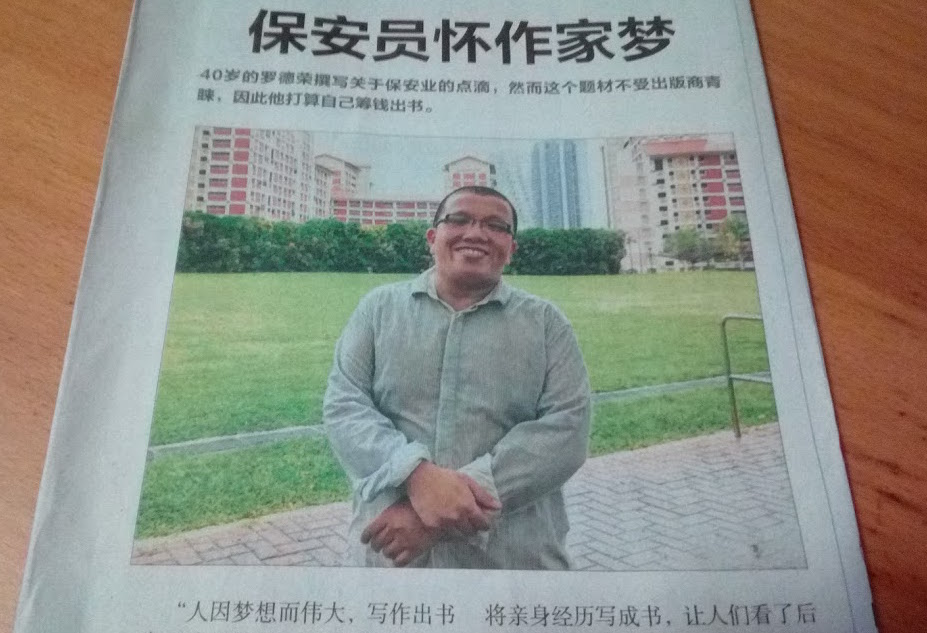
“2017. A photo of a newspaper clipping from Lianhe Zaobao. I had a dream and now I am living it!” The title of the article reads: ‘Security guard dreams of becoming an author’.
Which 3 aspects of the job were most difficult for you at first and how did you figure out how to overcome them?
One: The long hours. Full-time security guards have to work 12-hour shifts for 6 days a week. I depended heavily on energy drinks to keep myself awake when I worked full-time.
Two: Late or non-payment of wages. It’s a chronic problem in the industry but, thanks to the proliferation of social media, this problem is less severe nowadays than when I first started working as a security guard. And some security agencies are trying to attract the guards with trust issues by offering the daily-pay system. You get paid on each and every day that you work. There. Late payment problem solved.
Three: The abuse. We security guards tend to be on the receiving end of abuse—perhaps it’s because we are not armed with degrees from top universities. If you are considering a career in the security industry, you have to steel yourself for the scoldings and beatings that come with the job. I was harassed by gangsters at a shopping mall and threatened by a knife-wielding supervisor at a department store. On both occasions, I tried to reach an understanding with my superiors. And on both occasions, I lost my job.
But despite my grim tidings, don’t despair just yet! Thanks to the proliferation of social media, more and more incidents of abuse involving security guards are seeing the light of day. If you are a victim of workplace abuse, then my advice to you is this: Facebook is your friend.
What is the work schedule of a security guard like? Did you have to work on weekends?
Full-time security guards work 12-hour shifts for 6 days per week, but some agencies are reducing the work hours to 60 hours per week. And if you look hard enough, you can also find assignments that offer a 48-hour work week.
Security has to be in place 24/7 at most facilities so security guards are expected to work on weekends and public holidays.
Are there benefits to being a security guard?
In my work life, I had the opportunity to meet people from all walks of life and, because I was just a security guard, many of them didn’t think twice about parading the ugliest sides of their personalities in front of me. Interactions like those are a gold mine for any writer who wants to write interesting characters.
So the benefit to being a security guard is you never run out of muses. And that’s a useful benefit to have if you are aiming to become a writer.
“2019. Unsold copies of my book sitting on a shelf. Take them home!”
Name 3 people you’ve ever tried to emulate over the course of your career and explain why.
Gordon Ramsay. In order to protect myself from the unreasonableness in the industry, I tried to emulate Chef Ramsay’s take-no-nonsense attitude and outspokenness. Tried to. I didn’t succeed but at least I tried.
Professor Snape. Because there were occasions when swearing was inappropriate, I had to resort to using cutting sarcasm.
Mother Teresa. Because you need to have the patience of a saint to be able to do the job.
What did you learn from becoming a security guard that you didn’t know before?
I learned that not all women are attracted to men in uniform. But all kidding aside, I did learn something important. Before I joined the industry, I was looking at security guards as an outsider and didn’t see the whole picture. I ended up falsely assuming that security guards were lazy and did no real work.
But after I became a security guard myself, I began to understand the pressures of the job. Today, the stories of the abuse and injustice I faced together with my colleagues have been published into a book. If you are interested, you can look for ‘Guards Gone Wild!’ at the Kinokuniya bookstore at Takashimaya or the LocalBooks.sg webstore.
Teck Yong’s book, Guards Gone Wild! is a memoir of his experiences in the security industry.
What’s the worst advice you’ve been given, or have heard people giving, with regards to being a security guard, and what’s the best?
Okay, the worst advice came from the people who told me not to take security work because the job was too menial.
The best advice was my comeback to the people who gave me the worst advice. I told them that all jobs should be valued equally and they should stick their bourgeoisie mindset where the sun doesn’t shine.
If you could replay your entire career all over again, what would you change?
I would probably tweak my personality a bit. I was too meek most of the time. If I had adopted the Gordon Ramsay persona right at the beginning of my career and stuck to it, I would have had a happier work life.
Lastly, what advice do you have for those hoping to make a living as security guards too?
Use your own money or SkillsFuture credit to take the WSQ modules. Do not rely on company sponsorship. Once you accept sponsorship from a security agency, you become indebted to them and lose the freedom to switch from one agency to another. In an industry so fraught with abuse, it’s a bad idea to lose that freedom.
Teck Yong is presently working on marketing his book, Guards Gone Wild! You may follow his adventures with his book through his website, guardsgonewild.wordpress.com, or ask him questions about being a security guard and the security industry using the comment box below.
Photographs courtesy and copyright of Loh Teck Yong. Interviewer: Sy If you found this article useful:
In June this year, we interviewed a protester from Hong Kong after she’d been caught in the most violent protest of that time, when tear gas and rubber bullets had been unleashed on civilians by the police. Since then, the violence in Hong Kong has escalated, with the police using live ammunition and water cannons on protesters, and the protesters in turn barricading streets, disabling public transportation and setting buildings on fire. We checked in on her to see how she’s doing.
“My mum is very scared.”
Q: Hi Wing* (*not her real name), nice to see you’re okay. How’s the protest situation in Hong Kong been since the last time we spoke?
A: Protesters have been getting more violent recently because the police have been using real bullets to shoot protesters. Molotov cocktails and fire are now used in weekly protests. People even tried to assassinate the police. On the day Carrie Lam [Chief Executive of Hong Kong] announced the emergency law, there were massive destructions including burning of MTR [Mass Transit Railway] stations, burning the trains, burning the railway in New Territories, burning the Bank of China…
People protest every weekend now. Sometimes, people also protest on weekdays if there are special situations like suspicious dead bodies being found.
The scene in Hong Kong, July 2019.
The last time we spoke, you said you were satisfied with the suspension of the extradition bill and would not be participating in any more protests—did that change in the weeks after?
Um, I no longer go to protest, but when the government implemented the anti-mask law, I thought it unreasonable. Schools even asked kids not to wear facial masks when sick. I think the government just wanted to make people more angry. They did it on purpose.
Public transportation has been disrupted by both protesters and riot police, traffic blocked by both barricades and fire, so how do people in Hong Kong get around these days? How have you been getting around?
People like to use the bus nowadays, and avoid taking the MTR. Because in August, police closed off one MTR station suddenly and asked the press to leave, then beat random passengers including disabled old people in wheelchairs.
But I still take both the MTR and bus, and sometimes drive. I enjoy hanging out. Indeed, streets are empty with no noisy tourists. I still go out during weekends but will go home before night. The police are more violent at night. Sometimes they just catch young people randomly. They also throw tear gas randomly. I am most scared of the tear gas because it has been everywhere in Hong Kong now. It is toxic to the human body and we cannot avoid it.
Shops have been closed for protests and because of related vandalism, and many shop owners have reported a decline in business. Has there been any consensus as to how businesses are going to be able to stay afloat if this situation continues for a long time?
Only the pro-China chain shops have been destructed. Those affected shops mostly make money from Chinese tourists. Over-tourism led to high rents. They better think of other businesses to do. I hope there will be business transformation for Hong Kong in the future.
Police fire a gun at protesters for the first time, August 2019.
How has daily life for the average person been affected by the protests? How often do people still go out for fun these days?
My mum is very scared, and she always asks me not to go to crowded places. She seldom goes out but I think she has over-reacted. Young people and people of my age still go out for fun. We just avoid going to places like the Legislative Council building and government buildings.
Has there been any concern that food and supplies will run out or become inflated in price if the protests persist? Have people been stock-piling at home in case of emergencies? Have you?
No way. Unless food is not allowed to be imported into Hong Kong.
The stock-piling thing only happened once. It was the day Carrie Lam implemented the anti-mask law under emergency conditions. People lined up in the supermarket because they thought the supermarket wouldn’t open the next day. They were right. Supermarkets really didn’t open the next day but restaurants remained open. So I just went to have lunch in a restaurant because I didn’t prepare for that.
Hong Kong protesters destroy China’s national flag, September 2019.
What about public services like law enforcement and the fire brigade? Are they still up and running like normal? If you called the police because of, say, a burglary or murder situation during a major protest, would the police be available, and willing, to assist you?
Public services are still running but if there is a burglary, I wouldn’t call the police because I don’t think it will help.
If somebody beat me up during a protest, I surely wouldn’t call the police for help. The police catch protesters, regardless of whether they have been beaten by triad members or have beaten people. Once, one taxi driver hit protesters, causing several injuries. The police only caught the protesters hit by the taxi and prosecuted them, while the taxi driver was rewarded.
How safe is Hong Kong for tourists right now? Would you recommend tourists come to Hong Kong anyway since flight and hotel prices are at a low?
Unless you have frontline war experience, I don’t think you should come. We local people understand where is safe and where is not because we read updates from local channels quite often. Tourists love to go to Central, Admiralty, Tsim Sha Tsui—places which, I think, are extremely dangerous.
Shops and the MTR have also been closing very early ever since the emergency law was enacted. Most shopping malls and shops close before 9pm on weekdays. For weekends, if there is a protest, shops are all closed in the area.
What in Hong Kong has not been affected by the protests?
People still need to go to work.
Lastly, is there anything you would like the world to know about the situation in Hong Kong, while you still can, in case the proposed ban on the internet as suggested by a member of Hong Kong’s executive council does come into effect?
Hong Kong people just ask for justice, like not allowing policemen to beat and kill people randomly. People cannot be extradited to China. I don’t understand why the government doesn’t listen and even asks the police to beat people more. What I see now is: the more the government suppresses, the more violent the protesters are.
20th straight weekend of protests, October 2019.
Wing is presently working on cooking and running because those things make her feel relaxed. (“Reading the news every day makes Hong Kong people tense.”) She hopes to see ‘One Country, Two Systems’—the arrangement that grants Hong Kong autonomy from China until 2047—continue. To send her words of encouragement or share your thoughts on the present situation in Hong Kong, you may use the comment box below.
Last week, we spoke with Evelyn Eng-Lim who, when in her 50s, set up a farm at the edge of the city of Singapore. This week, we find out more about her struggles with being an organic farmer with no prior experience, and how she got over those hurdles.
“Treat Mother Nature as THE Teacher.”
Q: Welcome back, Evelyn! Now that you’ve shared how you built your farm, can you share some of the challenges you’ve faced as a farmer? And what you do to try to overcome them?
A: The biggest challenge was altering the mindset of a commercial farm worker who had never farmed organically. Secondly, some foreign workers who arrive in Singapore do not speak English and, if that’s the case, I have to demonstrate and execute each task to them, which is exhausting. Another challenge was a reduced workforce, from 6 to 3 workers. With less workers to manage, I had to mull over problems to develop more creative and efficient solutions.
In the last 5 years, wild pigs invaded our farm to dig for sweet potatoes, tapioca, earthworm and bananas tubers. Initially, the damage to the crops was bearable and so we let them be. However, the frequency of intrusions increased and the damage became more extensive. We resorted to using discarded furniture items to plug holes and strengthen our fences. We hoped that with difficult access they would migrate to other nearby areas. It was a battle of wills. Since mid-2019, our fences are now pig-proof!
Which 3 objects or people are most useful to you as a farmer?
See below picture of farming tools. 1–Spade – Digging 2–Iron Bar – Digging and loosening 3–Changkol – Digging and loosening 4–Watering Can – Watering plants 5–Containers – Moving soil, stones and plastic litter 6–Wheelbarrow – Moving compost 7–Metal mug – Distributing of soil and compost, watering of plants 8–Jute bag – Carrying soil, plastic litter or stones
Objects most useful to Evelyn during farming.
What do you consider to be the most fulfilling part of your job?
Living off our land and zero waste! The satisfaction of harvesting and eating our own produce grown strictly according to organic principles to live the adage of “Let food be thy medicine and prophylaxis.” Making a healthy smoothie with various combinations of sweet, sour and bitter fruits each morning. The use of suitable fruit wastes to clean and slightly exfoliate my face. Discarded stems and leaves used as scouring pads for cleaning stained pots, pans and dishes. Bio-wastes then used for mulching or composting instead of incineration into greenhouse gases. Only rainwater used for farm irrigation as we minimise the use of PUB [Public Utilities Board of Singapore, which provides the water supply across the country] water and every drop of PUB water recycled into the tanks for making liquid fertilisers.
Last but not least, minimal plastic use!
What would you advise Singaporean professionals who are thinking of doing the same—leaving the corporate world behind to be farmers?
A solid year of farming experience is minimal. Learning all aspects of setting up a farm and the day-to-day operation, including the ever-changing weather conditions. Prudent choice of a farm site that it is not waterlogged, does not have buried building waste, and soil that has not been without vegetation for years. Moreover, set aside enough capital to finance at least 5 years and keep all costs low. Treat Mother Nature as THE Teacher.
Evelyn when working on her farm.
What setbacks have you had in all your years as a farmer and how did you get past those?
Just when we were poised to enjoy our food forest, a setback came in 2010. A chicken farm nearby started operations but their facilities were not fully in place to treat chicken waste. The horrendous stinking smell of chicken and their dung was unbearable for us.
At the same time, the conventional vegetable farm near us was making piles of sky-high compost beds so they had to resort to using building cranes to turn their compost. And when they did so, it was as if they were piling dead bodies everywhere.
Both these situations became so horrendously intolerable that I complained numerously to the AVA [Agri-Food and Veterinary Authority of Singapore]. The AVA took almost a year before they were able to gather all responsible parties to find a resolution. Until today, when there are high winds, chicken feathers and the stench of chicken dung still lingers on Neo Tiew Road.
What did you learn from setting up a farm and working on it that you didn’t know before? How did you change as a person?
I have realised that when I have a poor harvest for a particular crop, it is not that I am a bad farmer but that the weather is the ultimate determinant as my fellow organic farmers will also be in the same situation. So one has to accept what Nature provides and eat what is in “season”.
For instance, we tried very hard to produce all year round the popular leafy brassicas like caixin, Chinese cabbage, pak choy and kailan but without success when the weather turns very hot or has continuous heavy rainfall. The vegetables then weaken, pests set in and the yield becomes very low. One day it dawned on me that the vegetables are not native. They had been introduced from Southern China, a cooler climate, as I remembered my father recounting that those vegetables were so much tastier at his birthplace, Shantou, China. So I began to educate our customers to eat rural greens like ulam raja, asystasia, wild watercress, wild bayam, tamarind leaves, noni leaves and moringa leaves. These vegetables thrive in our climate. And so I became more convinced that each and every one of us must live by the Rule of Nature to survive Climate Change!
If you could go back and replay your entire process of setting up a farm in Singapore all over again, what would you do differently?
With the experience that I have now, I would better design the Food Forest and water management layout, and then seek an experienced permaculturist familiar with our climate to critique and discuss and improve. This is now possible with the convenience of Social Media. The farm would be a Social Enterprise with a work force of paid, experienced organic farmers and passionate volunteers.
Evelyn’s workplace.
What’s the worst advice you’ve been given, or have heard people giving, with regards to farming? And what’s the best?
The worst advice was that fruit vegetable crops like brinjal should not be planted near to trees and that I should make sure there are no weeds growing in the same bed.
The best advice is that I shouldn’t be afraid to mulch thick in between, but not too close to the food plants to prevent root and stem infection from pathogenic fungal growth.
Lastly, what else do you hope to achieve in the future and who can LUCK-IT interview to assist you in achieving those?
I hope to convince the relevant Singapore authorities that they should not just emphasise high-tech farming but instead advocate and promote diversity in farming. They should also embrace the Food Forest concept of farming—an eco-system in which Mother Nature has proved to be most resilient and sustainable.
I wish to convince our government that our food forest legacy should be carried forward. Physical security of our country is of utmost importance but so is our food security. All they need is a few willing National Service men and I would be happy to conduct courses and give them practical training in farming.
Evelyn is presently networking with communal groups to raise awareness and get communities interested in Food Forest Farming and improving yields. You can find her at her farm, Green Circle Eco-Farm (www.greencircle.com.sg) or chat with her about farming and becoming a farmer using the comment box below.
Photographs courtesy and copyright of Evelyn Eng-Lim. Interviewer: Sy If you found this article useful:
At age 55, when their peers were thinking about retirement, Evelyn Eng-Lim and her husband bought a farm at the edge of a city. It took them 6 months to grow their first vegetables and more than 5 years to break even, but their farm home has been thriving for almost 2 decades since. We asked the now 75-year-old how they did it.
“Now I had control over what I ate!”
Q: Hi Farmer Evelyn! What made you and Farmer Tian Soo want to start a farm and live in it as a retirement home? What was going on in your life when you made that decision?
A: When my husband & I decided to start our farm, it wasn’t for retirement. We were rather at a crossroad of our lives.
It all started in 1984, when I volunteered for the Malayan Nature Society (Singapore Branch), which later became Nature Society Singapore (NSS). For 15 years, the society was my full-time job as I operated and managed its office.
During those years as a volunteer, I read of numerous cases of pesticide contamination of imported vegetables which the Agri-Food and Veterinary Authority of Singapore (AVA, now known as Singapore Food Agency, SFA) had rejected because pesticide residues had exceeded the allowed limits.
As a vegetarian, those cases shocked me because I did not have full control over what I ate!
Evelyn, before she had a farm.
I realised I had to take action, in pursuit of a self-sufficient and sustainable lifestyle, by growing my own vegetables, rearing my own chickens and making my own compost. As a result of this self-sufficient and sustainable lifestyle, I would also reduce the greenhouse effect and do my part to combat climate change. How exhilarating!
I understand you now grow your greens organically—without chemicals and pesticides. Why so?
Synthetic man-made chemicals in the form of fertiliser and pesticides are not in a bio-chemical structural form so they are like foreign invaders into our biological entity. Organic matters and living organisms like insects, bacteria, fungi, earthworms exist in all healthy soil. When humans apply synthetic fertilisers, weedicides and insecticides, these soil organisms get ‘sick’ and slowly die, leaving the soil dead.
Soil organisms in their natural cycle of life and death are providing nutrients back to the soil which can nourish plants. Plants provide animals with food and in return, animals help in pollination or dispersal of seeds. All living things are interconnected through the Food Web. We should not decimate so called “pests” to produce food. “Pests” such as caterpillars are food for some birds and insects that may help in pollination and seed dispersal. Eventually, caterpillars become butterflies which are efficient pollinators. Without these pollinators, there will be no fruits and vegetables for consumption.
Humans tend to forget that we are part of the Food Web. Out of ignorance, commercial farmers produce vegetables laced with synthetic chemicals which are now known to mimic human hormones, upsetting the delicate balance in our bodies. Some scientists even believe that these exposures could be one of the causes of cancer, diabetes and allergies, which are so prevalent even in young people.
How then did you manage to acquire farmland in Singapore when the country is mostly all city?
In 1995, I called the AVA and was informed that tenders for farmland were regularly conducted in the newspaper. While we waited for the farmland tenders, I grew some vegetables in a common area at my condominium and at the same time, the AVA’s farmland regulations also evolved to allow the building of a home on farmland. This was a new clause which further appealed to me. Now I can live and immerse in nature. Perfect!
The Neo Tiew area was one of our prospective sites to tender but the frequent bombastic sounds of fighter jets from the nearby Sungai Tengah Military Airport was a major concern for us. There were other tender options at that time but they were mostly for shorter periods, versus Neo Tiew’s 20-year lease. Another option would be to operate in Malaysia but with Singapore as our home.
Having weighed our options carefully, we decided to proceed with the Neo Tiew area. So in 1999, we took possession of farm parcel 41, Neo Tiew Road and I resigned from all posts with NSS.
How did you build and set up your new farm and home? Can you share your entire process?
Our philosophy was to only clear when we needed to plant or build.
1–Pond Excavation:
The first task was to excavate a seven meter deep pond to hold rain water for farm irrigation. As we had heard stories of some contractors and site owners profiting from the burial of construction and non-biodegradable waste, we had to be there to closely monitor the excavation process to avoid that from happening on our leased land. We can’t afford any pollution here.
2–Compost Production:
Compost is crucial for our soil because being in an equatorial climate, Singapore land has very little top soil due to intense plant growth all year round. I first learnt about bio-dynamic composting from Mr. Peter Proctor, a consultant from New Zealand.
In March 2000, we set up our tractor and a chipper and we were able to source for free carbon-rich tree waste from the nearby area. We then had to source for nitrogenous waste like cow poo, soya bean waste and rejected mung bean. In the beginning, it was just me and my husband working in the hot sun as I chipped away the free tree waste while he drove the tractor to move the chippings and nitrogenous waste and mix them into heaps of compost neatly arranged in rows.
Compost made from urban bio-degradable waste helps replenish the fertility of the soil. This makes agriculture more sustainable instead of using short term synthetic fertilisers which cannot sustain other living organisms in the soil. Long term use of synthetic chemicals produces dead soils. After 4 months of daily compost production, we were ready to clear some land for planting.
Evelyn and husband Lim Tian Soo, when GreenCircle Eco-Farm first opened for business.
3–Land Clearing and Planting:
Our plot of land was densely covered in wild vegetation, mainly elephant grass. We had to use our tractor to clear them which later became additional compost material. However, we had to use our tractor sparingly as the tractor would compact the soil in its path.
Providence brought us a worker who specialised in making raised planting beds. In the meantime, we sought advice from a Malaysian agriculture consultant, who was aligned with our organic farming philosophy. He helped to kickstart the operation of planting long beans, corn, lady’s finger, cucumber, sweet potatoes and tapioca.
Our clearing and planting process was executed in stages as I did not want to bare the soil to heat or rain, which would kill off soil organisms or wash away nutrients hidden in the soil. As we progressed, I hired two temporary workers to plant more beds and lay irrigation pipes under my husband’s supervision.
4–Infrastructure:
While all of the above were in progress, my husband was also busy executing the farm’s infrastructure plans, overseeing the building of our office, visitors’ hall, workers’ quarters and our residence with an engineer and contractor.
By 2000, year end, these structures were ready and we had planted about one fifth of our plot. It was time to generate some income.
5–Operation:
As the farm’s initial operation stabilised, we needed income to offset our operating costs. We first sold our organic produce to relatives and friends by private delivery. Our workers harvested according to what was ordered, packed them with minimal packaging materials and private deliveries were scheduled as early as possible to ensure freshness upon reaching our customer’s doorstep.
During the internet growth phase in 2001, when information exchange wasn’t as readily available on the internet yet, my husband attended a website development course and built our website for our marketing and promotion purposes. As a result, our sales volume increased so he purchased a van and delivered the vegetables commercially. At the same time, we gained more attention from the media and the public. Schools and corporate clients were enquiring about farm tours so I seized the opportunity to design informative educational tours, which became one of the most important aspect of our farm. I am most passionate about using our farm as a platform to raise awareness on sustainability and environmental issues.
By 2005, my husband and I were still without salaries but our farm had broken even. Instead, we were remunerated by the presence of the wildlife: birds, bees, butterflies, squirrels, garden lizards and the wide variety of chemical-free vegetables and fruits for our own consumption. This was what we had envisioned, a self-sufficient and sustainable lifestyle.
Now I had control over what I ate!
What about farming techniques and processes? Where did you learn those from?
We learnt some of it from Peter Proctor and our Malaysian consultant but a lot of it was self-taught and through a series of “trial and error”.
What is your routine like now that you’re a farmer? What do you do on weekdays and what do you do on weekends?
During 2005 to 2010, a typical day for us was:
7am—Check crops (>100 varieties).
Most workers only had experience in planting rice and growing vegetables in the conventional way by using lots of synthetic pesticides and fertilisers. They often wondered why I would forbid the use of pesticides to eradicate pests. Hence I had to educate and change their mindset and supervise them on how to care for the plants, to increase efficiency of their assigned tasks such as weeding, planting and harvesting.
1pm—Lunch break.
2:20pm—Continue work on the farm and supervision.
As if that was not challenging enough, residue building debris from the mid-1980s was littered under the surface of our plot. The debris was supposed to be carted away but instead they had been unscrupulously buried and old foundations were not dug up. It was discouraging for us, when tilling in the hot sun, to find these residue debris. We also had to dig out historic mortar using only a straight steel rod to check for deeply embedded ones. When I wasn’t around, our workers turned a blind eye, resulting in the poor growth of deeply rooted vegetables and fruit trees.
Things around the farm started to improve after 2010. I was more experienced and our workers were more efficient. I spent less time in the field and more time in the office, responding to customer feedback and queries; hosting group tours for kids, students and the elderly.
By 2015, competition had intensified and I had to increase our marketing efforts by promoting our group tours. A typical day for us now still starts at 7am with 3 foreign workers reporting to me and telling me what they planned to do for the day. Farming and housekeeping tasks are then assigned on a priority basis based on weather conditions and the efficient use of our resources.
To some, weekends may be a time for rest but since we live within our farm, we are never fully rested as there are endless tasks at hand and improvements to be made. However, we do enjoy a good meal and a movie occasionally to unwind. My husband loves listening to music and golf while I am an avid supporter of local theatre and stage productions.
Do you think it’s important for Singapore to have its own farms?
It is very important! Singapore must have its own farms so that our citizens and younger generations can obtain an understanding of the farming process, which results in what goes into our diet. We must create little food forests for healthy and efficient growing of food to promote sustainable farming.
Although it is almost impossible for Singapore to be fully self-sufficient in farming due to our limited land mass, we can still create sustainable farms in Singapore to be used as farm models for other regional farms where we import food from.
Evelyn giving a talk at her farm.
What do you hope to achieve when you conduct tours on your farm?
In 2015, we actively marketed our informative educational group tours to schools, universities and corporations. Our primary objective was to educate each participant to not fear nature because all living things are interconnected and we depend on each other for our survival.
During our group tours, participants learn:
a—To SHARE food with insects and animals: nothing wrong with eating vegetables with holes.
b—Why a 50% plant based diet is important for their health and why walking under the sun for half an hour is healthy.
We particularly like to influence the preschoolers in their early formative years (we try our best to do it in a fun, creative and activity based way).
Evelyn’s farm, Green Circle Eco-Farm (www.greencircle.com.sg), presently conducts cooking and farming courses and provides farming consultation, on top of selling vegetables and running group tours. Next week, we’ll have another chat with Evelyn about the challenges of being a organic farmer and what she’s learned from dealing with those. See you then!
Photographs courtesy and copyright of Evelyn Eng-Lim. Interviewer: Sy If you found this article useful:
Kelvin Seah’s second child was diagnosed with autism when almost 7, while coming to the end of pre-school and on the verge of transitioning into primary school. We asked Kelvin how his family adapted and changed to accommodate the new reality they had been confronted with.
“Those who choose to deny and refuse to upend their lives to adjust to these changes are short-changing their kid’s future!”
Q: Hi Kelvin! Thank you for coming on to share your experiences a second time. First off, can you tell us a little about how your son was diagnosed with Autism Spectrum Disorder (ASD)? What led to his diagnosis?
A: My son Caleb was born in January 2011. He wasn’t the easiest of babies to care for, especially during his first year. He had acid reflux for most of that year which meant he neither ate nor drank well. He also cried a lot and didn’t sleep well, which meant that his parents didn’t either! He often had breath-holding spells when he cried too much, and sometimes his face would turn blue as a result. It would often appear like he had fainted! When he was 5 months old, he actually had a mini “fit” and fainted while we were shopping at Marina Square, and we had to rush him to KK Hospital where he then stayed for four nights, subjected to various tests to ascertain the cause. None were found.
Looking back, these incidents invariably set us up to expect the unexpected with this child. And he didn’t disappoint! He was developmentally slower compared to his older sibling when he was a toddler. He wasn’t very verbal right up to age 2 and he also took longer to master walking. At around 2, he developed a fixation with spinning objects incessantly, especially round ones. He also continued to drool and wet his bed well into his pre-school years, and so a bib (plus a diaper every night) is still part and parcel of his “gear” today so to speak!
Kelvin’s son, Caleb, before his diagnosis, when at his grandparents’.
Did the doctors who diagnosed your son give you a crash course in how to raise a child with autism, or did you learn most of what you know now on your own?
No such crash course exists in Singapore. It’s essentially a diagnosis that is pronounced by clinical/child psychologists, not doctors. Though they can offer general advice and schedule periodic (annually or bi-annually) follow-up appointments to track a child’s progress, the responsibility of identifying and using suitable intervention techniques on a day-to-day basis must still fall squarely on the shoulders of parents like myself. That is the reality, simply because since every special needs child is unique, there isn’t a one-size-fits-all technique or crash course to suit every parent and/or child. Since parents are the ones in closest contact with their kids, it stands to reason that parents play the biggest role in helping their kids with special needs.
What do you know now about autism that you didn’t know before?
I didn’t have much knowledge about autism prior to having Caleb’s diagnosis. But once his diagnosis was confirmed, my wife and I started to research actively. Of course we also had to go through a “grieving process”, individually and as a couple. This is because when one has a special needs child, the initial reaction is always one of shock and disbelief, followed by sorrow and oftentimes denial. In worst case scenarios, there’s blaming and quarrels over how best to proceed. With autism, major life adjustments will need to be negotiated, including what specific and immediate help the child will need to manage his special needs, what schools or therapies he should attend, how our lifestyles will need to be adjusted to accommodate the child better, etc. The list is just too long to itemise here, but safe to say that parents with new/recent diagnosis of this nature must be mentally and emotionally prepared to deal with the huge change and upheaval to their lives.
Those who choose to deny and refuse to upend their lives to adjust to these changes are short-changing their kid’s future! This is because, early and intentional intervention has so far proven to be the best safeguard against real life challenges for special needs kids growing up into adulthood and the real world.
How did life change after your son was diagnosed with autism? Were there activities you and the rest of your family stopped doing because of his diagnosis? Were there any activities you picked up?
As said earlier, lots of things had to be re-looked at, from education to day-by-day intervention and activities. While we still do stuff like most families, i.e. go shopping, sight-seeing, taking part in outdoor play or events that are family-friendly (like SSO [Singapore Symphony Orchestra] performances at the Botanic Gardens or family fiestas and carnivals), we also have to carve out time for (speech, occupational, etc) therapy appointments and sessions. We also do stuff at home that helps with his motor skills development and drooling, on top of the usual school homework and other school-related stuff like packing bags for occasional field trips, signing approval forms for this and that, etc.
Did your plans or hopes for your son’s future change?
To a large extent, his diagnosis did make it very clear to us that Caleb will need more help growing up in a society where people with special needs form a minority (although that is gradually changing as there’s now an upward trend with more people young and old being diagnosed with special needs). Things that the majority in society take for granted like how to earn a living, find a life partner, etc will now require more planning and thought for us, since his life journey won’t exactly be typical in light of his special circumstances. Also, the ultimate worry is as to whether he’s able to continue on to live an independent and fruitful life when his parents are dead and buried. These are unavoidable realities that we agonise over and will continue to agonise over in the years ahead.
Kelvin and Caleb shortly after Caleb’s diagnosis, when on the way to a school field trip.
What is a regular day for your autistic child like?
During school term time, mornings will be spent in school. Then it’s back home by half past one for lunch followed by a bath and some self-play time. This will then be followed by homework (if none from school, then my wife and I will usually prepare some simple English, Math or drawing exercises for him), and home occupational therapy (OT) time. OT at home will usually take the form of arm muscle strengthening exercises like “wheelbarrows”, as well as fine motor skill activities like inserting coins into a piggy bank with a tiny opening. There will also be outdoor frisbee and football play time if the weather is good before dinner and a half-hour TV time. Post dinner will be followed by baths, clearing up the room of messy toys before settling down for some reading time before he goes to bed.
What do you regularly do to help him grow and thrive?
Whenever we can, we encourage him to read and learn new things, through books and exposure to outdoor events or indoor stage performances of different kinds. These help open up his world to new sensations and experiences that will hopefully expand his capacity to embrace diversity and not stick merely to the few things he likes, as it’s typical for most kids with autism (as in they only like a few things). We also don’t agree with giving our kids (including my son with autism) too much screen time as we subscribe to research that proves over-exposure to screens daily alters the brain structure negatively.
Which three toys/books/shows/educational materials does he enjoy the most, and what is it about them he enjoys?
Caleb loves Awbie (an iPad-enabled coding game from the Osmo series), his Duplo set of construction pieces as well as his collection of cooking and superhero toys. He loves the colourful images on the iPad screen that respond when he assembles the code pieces, and the opportunity to build skyscrapers and be a pretend chef or superhero. Other than Awbie (which we restrict him to playing for just 30mins once a week), the rest he gets to play for up to an hour nearly everyday when he has his own play time.
Which three toys/books/shows/educational materials does he want nothing to do with, and what is it about them he dislikes?
He dislikes long-form reading materials with minimal or no pictures. He’s not fond of balloons as he’s always afraid they might suddenly burst (he’s sensitive to sudden loud sounds). He also doesn’t take well to live shows/films that have large crowds, loud sounds and pyrotechnics (like live band concerts), or darker themes and treatment (like “Kubo and The Two Strings”) .
Caleb’s Duplo construct with a toy frying pan.
Which place in Singapore does he enjoy the most, and why? And which place does he dislike the most?
He loves the downtown skyline, especially that of Marina Bay Sands and the office buildings at Raffles Place. His favourite vantage point to watch these would be at the promenade beside Esplanade—Theatres on the Bay. He likes unique architecture and their shapes and silhouettes/lines.
What is a bad day for your autistic child like and what do you usually do to help him (and yourself) get through those difficult moments?
That would be any day he throws a tantrum or has a meltdown because he didn’t get what he wanted. No different from other kids I suppose, but with him, it can take a lot longer than most to calm down. I remember one Saturday afternoon his tantrum was so bad we had to physically restrain him. And as he grows bigger, that can prove a huge challenge! But thankfully he doesn’t really have many such days and generally once he calms down, he’s alright. The key to managing is to stay with him throughout the tantrum or meltdown to ensure he doesn’t accidentally harm himself by tripping over, or banging into furniture.
What about a good day? What is that like for him (and yourself) and what, from your experience, usually enables that to happen?
When he gets plenty of time to do the things he loves. That usually comes as a “reward” after he’s done what he’s supposed to do like homework, etc. Of course the “rewarding method” doesn’t always work, and it shouldn’t be the only way kids get to do what they want. Cos after a while, it becomes too “forced” and doesn’t really help the child see that doing stuff like homework and occupational therapies is also worthwhile and deserving of their time.
What do you wish more neurotypical adults knew about children with autism?
Many times co-morbidity exists in children with autism. That means that apart from autism, they will also have other conditions and challenges such as attention deficit, stimming (i.e. wildly flapping their arms), and acute sensibilities related to one or more of the 5 senses. In my son’s case, sounds and noises in the background can be too loud for his hearing to bear e.g. fireworks, thunder, furniture/construction drilling or hand-dryers being used in public toilets. So it’s important for any adult to know that if you have met a kid with autism, that’s just one kid you’ve met. He/she doesn’t represent all kids with autism cos no one kid’s autism traits are exactly like another’s, so don’t generalise even though you might be tempted to.
But perhaps top of the list for me as to what adults should know is that autism is a life-long and invisible disability. There are a few schools of thought which assert that autism is “curable” but insufficient evidence exists to support such claims. Neurotypical adults need to pause for a minute each time they encounter “odd” behaviours displayed in public by seemingly “normal-looking” kids or adults, and ask themselves before reacting if this person might have autism or some similar disability. That might explain any meltdowns or temper tantrums displayed. Try to show understanding or offer to help if possible.
Caleb with grandma, viewing the Marina Bay Sands building in Singapore.
But most of all, don’t stare in disapproval or disparage the parents/caregivers for failing to discipline the kid or the adult for his/her own inability to self-regulate. They’re doing the best they can, and the last thing we should do is cast judgment without knowing the full context of what’s really going on. This is counter-intuitive unfortunately, as human nature (especially in many parts of Asia with our more reserved and conservative history and disposition) is, by default, judgmental. But it begins with awareness, which when exercised long enough, can lead one to be more accepting and ultimately more inclusive.
Following from the earlier point, we as a society need to acknowledge, accept and even embrace the reality that people come in all shapes and sizes, and that “different” doesn’t always mean “less”. I like what A.J. Liebling once said: “Cynicism is often the shamefaced product of inexperience”. Everyone should step out of their comfort zone once in a while to experience and encounter people different from us. Everyone should show a little kindness, a little empathy and a little helpfulness more often. All these can go a long way to help make special needs and disabled kids/adults feel included. They too can positively contribute to society if given half a chance so let’s give these special folks that chance!
What do you wish more neurotypical children knew about children with autism?
That having a friend in school who acts or behaves differently from the rest is no reason to make fun of or bully that kid. These “special” kids just have different ways of interacting with the world, and if we just take a bit of trouble to understand and accept them (and render help if needed), we may be rewarded with a really fun playmate, and a precious/loyal friend for life.
What’s the best advice you’ve been given with regards to parenting a child with autism, and what is the worst?
Best: The best one I heard recently is that when it comes to choosing a school to best help the child learn, the question isn’t whether that should be a mainstream or special needs school. Rather, the question should be which learning environment at the point of consideration is the one this child will best learn and develop in.
Another advice that proved really helpful was taking deep breaths during tense moments. When things with my kid go out of hand, that’s the time to take several deep breaths, counting slowly to 10 each time. I’ve tried it, and it really does help “bring down the blood pressure”!
Worst: Any of the following useless advice (or similar) that essentially says: “Oh your kid’ll be alright…”, with no clear explanation as to how this person knows that for a fact. Or “…everything will work out fine”, without defining what that “work out fine” looks like. Or “don’t worry too much”, even though we all know that suppressing and ignoring any genuine feeling is rarely helpful in the long run (actually, in my humble opinion, worrying isn’t a bad thing if it leads to concrete and fruitful action that will help a child). In short, any advice given superfluously because the speaker actually wants to cover up his/her embarrassment of not being genuinely interested or lacking knowledge about what to do is just plain unhelpful. Better just to listen attentively, and say nothing.
Caleb now, at Fort Canning Park.
Lastly, what advice do you have for parents whose child has only just been diagnosed with autism?
Grieving is a given. And since grieving is an absolutely necessary, normal and often iterative/non-linear process (you will invariably oscillate over time between grief and action), don’t resist it. I’m speaking especially to fathers, who typically bottle up their grief, sometimes without even realising it! It’s more than okay (and I dare say even critical) to embrace the grief and to weep. It will help you move along in the process towards affirmative action that will help your child have as meaningful and fruitful a life as possible.
Begin to increase your engagement with your child, and prioritise your daily time to include either more quality and quantity time spent with him/her, or more time to investigate/research more about his/her condition, and what possible intervention methods can help. And of course to apportion time to intervene; don’t just leave it to therapists, domestic helpers or teachers! Know that there’re no short cuts and cookie-cutter methods that will work, but the committed involvement of a parent is the most important ingredient. This is because every intervention method must be tweaked to suit your child, as no two autism children have exactly the same symptoms. Hence, never “outsource” everything to “experts” because the parent is the true expert of his/her own child and his/her needs.
Very important: treasure your child as a special gift from God, and love him/her unconditionally, no matter how things pan out in his/her life journey, and no matter what relatives, friends and society say, especially if what they say is negative and unhelpful. Along the way, rope in the neurotypical sibling too (if there’s one or more), and let him/her know that you love them just as much too, and how their role as a support and fellow caregiver to the special need sibling is very important for the family to enjoy many good years together. The neurotypical sibling, who isn’t envious but feels secure in knowing that his/her needs are also being well cared for by the parents, can prove a formidable ally in helping your special needs kid develop well.
But most of all, don’t lose the marriage! Both parents need to stay united in this journey, and to take time away regularly to connect in order to keep the sanity and sanctity of the marriage intact. Your marriage is a non-negotiable anchor your child needs every step of the way. Take time to “date” each other regularly too, but also take time to do stuff individually that you love (self-care), so you can return to helping your child with a rested mind and renewed resolve and rigour.
Kelvin is now a full-time stay-home dad who lectures part-time occasionally and is working on more intervention sessions in the form of art and music therapy for his son. You may follow up on his son’s progress at his blog, kelvinsmusings.home.blog or share your own experience with raising autistic children using the comment box below.
At age 9, Russell Pensyl saw a painting in a castle in Nuremberg, Germany which was designed so that the lines within it would turn as you moved around the painting. That triggered within him an interest in the arts which led him to become a life-long interactive media artist from age 21, way before interactive media as it is known today even existed. We asked the now 60-year-old about his transformation through the decades and learned a few things about creating your own opportunities.
“I saw a small card stuck on the wall that said a company was looking for an artist who had computer science experience. I was the only person who applied for the job, and I was hired.”
Q: Hi Russell! How did you end up as an interactive media artist? Was it a life-long dream or something that came about only later in life?
A: It would be nice to say that I had a plan and the path I ended up on was what I chose. But this career path and even interactive media didn’t even exist. By accident, I studied both computer science and art/design. Those two domains were not even remotely connected at the time. But the knowledge and skills in both areas turned out to be perfect for the newly developing fields. I took my first professional position in “computer graphics” while still in University. I was hired at a small company that had a large presence in education content. We developed many educational titles for use on Apple II computers. Following this, I worked the field called multi-image, creating large scale photographic slide presentations. We developed the images using a digital production tool, a high-resolution photo slide imager, and an antiquated slide presentation controller software that then sequenced up to 36 slide projectors. My next gig was in computer animation. I was fortunate to be able to start a company doing digital animation, and one area we successfully moved into was interactive systems using animated content.
Russell when still a student at UCLA, in 1978.
Can you explain, for the benefit of those who might not properly know, what interactive media is?
Interactive media could be defined as any activity that is design using digital software and hardware to create experiences for viewers. In the early days, these systems required huge expensive computers, video disk systems, and very clumsy interactive interfaces—mostly using keyboards and game controllers. Today, we could say that interactive media encompasses everything from the internet, to kiosk systems like the ATM, to touch surface enabled mobile devices. The thing we carry around in our pockets, by any standards of the early days—a super-computer, is not a phone. It has a phone in it. But what this thing is, it is really very difficult to specifically define.
To simplify the answer, we can say that interactive media is a flexible platform or system that provides agency for a participant to achieve a goal. The interaction is mediated and afforded by digital technology.
What academic certifications, training or experience does a person need to be qualified to work as an interactive media artist, and how did you acquire those yourself?
Still today, the field is segmented in the overlapping domain of computer science, design and art and content creation. University degrees should provide the requisite skills and knowledge to allow those interested to forge successful careers in the field. Regardless of one’s focus—one needs to be able to work across the domains. Artists and designer should be able to write code. Computer scientists should be able to do some design or understand what design is. Writers and content creators should know both design and coding.
As I said before, I learned this stuff by accident, and by a deep interest in both digital technologies and the arts.
How much, approximately, did acquiring the above qualifications cost and how did you pay it off?
I attempted to pay for my education by working and via government study grants. I worked through college. But inevitably ended up with a substantial student loan debt. It took a while to pay off and [I have] worked very hard to gain the success I have had. It was by no means easy and there were deprivations. But over time, my success in the field proved a good return on the investment in time and money. I cannot even say how much it cost…
How long after becoming qualified did it take you to get your first gig as an interactive media artist? How did you know of the job opening and what did you have to do to get hired/featured?
My case was unusual, since I started working in the field even before graduating college. The first job came about though some funny and coincidental circumstances. I was working for a major department store as a window dresser, posing mannequins with the latest fashions that I could never afford. This company was horrible to work for. They kept scheduling me for 35 – 40 hours per week, even though in the original agreement I was only supposed to work 20 hours per week. After all, I needed time to study. After this went on for some time, I finally became so angry I quit. After I left I then wondered, how the hell am I going to pay the rent? The very next day, in the university building, I saw a small card stuck on the wall that said a company was looking for an artist who had computer science experience. I was the only person who applied for the job, and I was hired.
Russell’s very first interactive media show—his graduate thesis performance in 1988.
Which 3 aspects of being an interactive media artist were most difficult for you at first and how did you figure out how to overcome them?
Running a company was a new and extremely difficult lifestyle. This took a long time to get the business to have enough clientele to keep the doors open without having constant worry of failure.
It was difficult to come to terms with the fact that the business of making media is a “service.” Virtually all of the work I created was disposable—used only for the time of its need. As an artist, one expects [for] the time and emotional investment in creating the work is that it has a longer and more important value. It finally, it does not—the product is really the service one provides in helping the client get the message out to potential consumers. Once the work is complete, there is no ownership that the creator can maintain.
My career eventually moved into academia. In the IM domain, we sit at the crux between technology and science on one axis and the arts and design on the other axis. Both areas have radically different criterion for valuing the contributions made. Interactive works that are highly technical, are viewed with suspicion by artists. The arts are viewed with suspicion by computer scientists and engineers. I have never been able to resolve this. But over time, it is less uncomfortable.
Which 3 aspects of being an interactive media artist do you enjoy the most?
The variety of experience one encounters is exciting. Crafting a work of art that is used by and enjoyed by a lot of people has an intrinsic value. One of the most interesting experience I ever had was creating an interactive sculpture installation that encouraged children to push, pull, run around inside the installation, having incredible amounts of fun. This was one of the most rewarding experiences I have ever had.
Once one is able to master it, to have control of electronics, sensors, systems, the interaction and the content will make your dopamine level rise till you feel a sense of accomplishment that is perhaps the same as an athlete, or mountain climber. Sometimes just building an interesting experience using the technology is the same as skiing down a slope. You do it just for the fun of it, and if you are good at it, it is even more fun.
What do you currently do to grow your interactive media portfolio on a regular basis?
Go to the studio every day I can. A day in the studio is like a day off and yet it is work. I call it hard fun.
Russell at Siggraph Asia—a conference and exhibition on computer graphics and interactive techniques in Asia—in 2008.
What is the work schedule of an interactive media artist like? When do you create?
These days, my work is creating only my own work. I am designing and building large-scale, and small-scale, interactive works. I have had the good fortune to be able to focus my efforts on creation of new work, that I envision, conceive and produce. I still teach 2 classes per semesters, but the stuff I teach is within my area of expertise. The other days, I will be in the studio working.
What is the salary of an interactive media artist like? Are there other benefits?
In the U.S., the starting salary can be anywhere between $45K to $70K. For those with a highly technical background, the starting salaries are substantially higher. If one is able to run one’s own company, this will be where the potential for making lots of money is at. There are trade-offs between security and the risk of investment. You will be secure in a job working for others, but the likelihood of generating wealth is limited. Investing in your own start-up, is exciting, and has the potential for generating wealth, as well as the risk of losing everything. If one has the stomach for it, I always encourage young people to start a business.
Which 3 objects/people are most useful for you when you are working on your interactive media projects, and why?
A ruler, I always need to measure and I design by drawing by hand a lot. A good text editor for coding, and a really big table to spread the project out on.
Which place is most useful?
The studio, one cannot under estimate how important it is to have a place that you can go and focus you energies and play with stuff. Experimentation is invaluable.
Russell’s summer studio.
Name 3 people you’ve ever tried to emulate over the course of your interactive media career and explain why.
I have tremendous respect for pioneers like Douglas Engelbart, Myron Krueger. As well, I read everything written by Philip K. Dick. But I don’t seek to emulate anyone.
What did you learn from becoming a professional interactive media artist that you didn’t know before?
Even after all the advances in technology, people have not changed.
What’s the worst advice you’ve been given, or have heard people giving, with regards to developing an identity as an interactive media artist, and what’s the best?
The worst advice I hear is to adopt social justice as reason to make “art.” My recommendation is to write a new story, create a new piece of music, create a new art work, that is only derived from your own imagination.
If you want to be successful now, follow the trends. If you want to be remembered later, forge your own path and have your own ideas.
Russell these days.
Russell was recently described by a friend as an ‘art clown’, which he likes (“I like it when my works or even the lectures make people laugh.”) and is presently working on a large scale interactive work that detects the clothing colours of viewers and modifies images to compliment those colours, as well as trying to get an installation into Clarke Quay in Singapore. If that is successful, you will be able to find him hiding over by the Mexican food place nearby, watching for the reactions of people. Alternatively, you may also find out what he’s up to via his website (pensyl.com) or ask him questions about interactive media and life using the comment box below.
The above interview is sponsored by:
Photographs courtesy and copyright of Russell Pensyl. Interviewer: Sy If you found this article useful:
Nur Syahidah Alim was 18 when she first tried archery and 30 when she became a professional archer. Over the next four years, the now 34-year-old amassed seven gold, two silver and eight bronze medals, and was recently crowned World Champion at the 2019 World Archery Para Championships. We asked her for sporting tips and sought a peek into the secrets behind her success.
“Breathe in confidence, breathe out anxiety.”
Q: Hi Syahidah! What made you pick up archery? What was going on in your life during that time?
A: I first learnt about archery at a disability expo at the age of 18. I picked up archery because I loved the feeling of seeing my arrows at the centre of the target. At that time, I shot as part of my recreational activities during the weekends. I enjoyed learning about the sport, which in turn became a passion.
I only started shooting competitively in 2015; ASEAN Para Games in Singapore was my debut. During the time I was representing Singapore, I was working at Sport Singapore as an executive in the Strategy and Planning division.
Syahidah at her first training camp in Bangkok, Thailand, in Sep 2014, when still in the development para team. She eventually got selected to represent Singapore for the first time in the ASEAN Para Games in Aug 2015.
Did you think, when you first started, that you would become a World Champion Archer someday? Was it a goal you worked towards or just… luck?
Becoming a world champion was one of my goals during my career as a competitive archer. It took 4 years for me to achieve that goal.
How did you start representing Singapore in the sport? What did you have to do to get on the national team?
After I graduated from NTU [Nanyang Technological University of Singapore], I was in a dilemma: if I should focus on my work or continue archery. It was through the encouragement of my Mom that I tried out for the national team. I went to one of the selection trials for the para archery teams, with no expectations, and (surprisingly) got in.
I had to train in the development team for one year before I was able to represent Singapore in archery in 2015.
Looking back, it was a long and hard road of sacrifices to reach and continue to be part of the national para team. However, I tried to enjoy the process as much as I could.
“My first debut at the ASEAN Para Games 2015 in Singapore. This would be the first historic gold medal for Singapore in archery.” Photo credit: Ben Cho / Sport Singapore
You’ve got more than six gold medals so far, so what’s your secret? What do you do before every game to get into the zone?
Archery is both a mental and physical game. Before every game, I will remind myself to focus on my process and simply enjoy the game. Breathing exercises (“Breathe in confidence, breathe out anxiety.”) help to keep me calm before I begin shooting.
What about your training routine, what is that like? How do you train on weekdays and how do you train on weekends?
I train about 30 hours per week, both weekdays and weekends. My training programmes include both archery training sessions, gym sessions and other SSI [Singapore Sport Institute] support such as nutrition, psychology, biomechanics and medical sessions (e.g. physiotherapy).
Syahidah during a practice session at the ASEAN Para Games 2017 in Kuala Lumpur, Malaysia. Her sport assistant (Nasrul Haq) is helping her to spot and retrieve arrows.
Which 3 objects or people are most useful for you when you’re preparing for a game?
1—My coach (Pang Qing Liang), 2—Saunders’ Firing-Line (i.e. my travel-friendly bow trainer), and 3—my visualisation audio clip.
“This picture was taken at the ASEAN Para Games 2017 in KL, Malaysia. Singapore successfully defended the gold medal for archery.” Photo credit: Dyan Tjhia / Sport Singapore
What setbacks have you had in your career as an archer? How did you move past those?
I had many setbacks during my career as an archer, from not having a dedicated training venue for para archers (which [meant we] ended up with jumping from [one] archery range to [another] range), to injuries and naysayers. At one point, I experienced a very bad slump that almost made me give up archery.
But what kept me going were the reminders from my support system and sponsors about my passion for the sport and grit. I felt that I still had more to give to and for Singapore. I am very grateful for them having my back when I am down in the slumps.
What did you learn from becoming World Champion Archer that you didn’t know before? How did you change as a person?
I think having a champion’s mind is important in sports. I learnt that having a process-oriented mindset in competitions helps me to be at the present moment and focus on the most important thing—i.e. process. Archery, in general, has made me into a stronger, resilient and confident person.
Syahidah’s first debut at the Asian Para Games 2018 in Jakarta, Indonesia. “Singapore was ranked 5th place. I was leading the Singapore Contingent as the flag-bearer. This is also the period where I was nominated into the Asian Paralympic Committee Athletes’ Commission.” Photo credit: Fiona Hakim / Sport Singapore
If you could go back and replay your entire archery career all over again, what would you do differently?
I wouldn’t do anything different.
“This picture was taken at the World Indoor Series 2018 in Macau. Singapore won the Silver medal.” Photo credit: World Archery
What advice do you have for those who hope to become world champions too?
My advice is to be 100% committed to your goals and dreams. Work with those who can help achieve your goals. Communication, clarity of roles and trust is important—i.e. once you have identified who you can work with, have a short meeting with them to discuss a training plan, have a clear understanding of your roles and expectations as an athlete and the role or the coach and other support personnels, as well as ensure that trust and open communication/feedback with everyone is always available.
Remember that this is a team effort.
A picture taken after the finals at the World Archery Para Championships 2019 at ’s-Hertogenbosch, Netherlands. “I was named Singapore’s first World Champion. Singapore is currently ranked 3rd in the world by the World Archery Federation. Beside me is my coach, Pang Qing Liang.” Photo credit: World Archery
Syahidah is presently a spexScholar and Paralympian, busy with competitions and training camps in preparation for Tokyo 2020, and also with competing at the Asian Para Archery Championships 2019 in Bangkok this October. You can follow her on her Facebook page (@nsyah.alim) to see where she will be training at next (“Feel free to say Hi when you see me, I promise I won’t bite.”), see her full sporting portfolio on her website, or ask her questions about sports and personal success using the comment box below.
Photographs courtesy and copyright of Nur Syahidah Alim, Sport Singapore, World Archery. Interviewer: Sy If you found this article useful:
At age 17, when most of his classmates were gearing up for the big A-Level examinations, Jeshua Soh chose to drop out of school. Because he had been enrolled in Hwa Chong Institution’s Integrated Programme—a six-year course which skips the O/N-Level examinations to prepare students directly for the A-Levels—he had only the PSLE certificate he had gotten at age 12 to his name. We sat him down to find out what happened next.
“I believe that it has helped me, ironically, to see the importance of learning.”
Q: Hi again, Jeshua! Can you introduce yourself to those who haven’t read you before—share where you’re from and why you wanted to drop out of school?
A: I’m a filmmaker by training and an accidental entrepreneur who has started 3 companies and 1 Facebook channel to date. Examinations have never been a big focus for me, having entered Hwa Chong Institution’s (HCI) Integrated Programme (IP) through the Direct School Admission route after primary school, and skipping O/N-Levels as a result. At the age of 17, I chose to drop out of Year 5 in HCI to read Film, Sound & Video in Ngee Ann Polytechnic’s School of Film and Media Studies. At Ngee Ann Polytechnic, we were assessed based on project work and not examinations, owing to the nature of our course being practical and team-based.
A photo Jeshua created before he decided to drop out of school.
How does Singapore, your home country, view school dropouts? What were you taught to think of it as a child, and how did you feel about it then?
Dropouts are one of many kinds of people who break from the conventional ‘path’. In my case, it was a voluntary action, and I appreciate that I had done so having weighed both options (of completing IP and of studying film). I feel that many people in Singapore are conditioned through their growing up environment and societal structures to stick to a well-trodden path, and hence dropouts may be viewed as unconventional at best, or crazy, at worst.
How then did you manage to drop out of school? Can you share your entire process and also how you figured that process out?
Dropping out of HCI was actually pretty simple: I just had to walk into the general office and meet the vice principal, sign a form, pay the remaining school fees and I was out. As for securing a place in Ngee Ann Polytechnic without an O-Level certificate, I needed to apply under a direct admission exercise and sit for an interview before being offered a place.
What did your parents think of your decision? What about your teachers and classmates?
Initially, there was the usual and warranted concern, but I am glad that my parents became supportive of my decision to pursue an education and career in media/entrepreneurship as time went along. The teachers and classmates who I’ve kept in contact with are also happy for me, and I hope that those who I’ve not spoken to in years will feel the same way 😛
What was your routine like before you dropped out of school? What did you do on weekdays and what did you do on weekends?
I was going to school/CCA [co-curricular activities] and church on weekends. It was actually at the age of 9 that I started volunteering in my church’s media team and gaining exposure to different aspects of audio/video/live production. I joined the media club during secondary school and a lot of CCA’s during my 3-month stint in JC [Junior College; the later segment of HCI’s Integrated Programme] (as I was already quite sure I wasn’t staying for long).
Jeshua (first row, middle) around the time he decided to drop out of school.
What about after you dropped out of school? How did your routine change?
There was no longer a big A-Level examination to look forward to, and classes in polytechnic were much shorter, though much more time and emphasis would be spent on project work/assignments. I had the opportunity to go overseas 6 times as part of my 3-year curriculum and couldn’t have asked for a better course to study in (not sponsored by NP to say this!) because of the teachers, curriculum and amazing people whom I met along the way.
Which 3 objects or people were most useful to you right after you dropped out of school?
Camera, Laptop & EZ-Link card? I didn’t start using a smartphone until late 2015, when I enlisted into NS [National Service], so my MacBook Pro was what got me around the assignments/projects that we had to do. My camera was useful as I took on freelance jobs doing corporate videos, weddings and also joined the photography club in NP [Ngee Ann Polytechnic]. Lastly, the EZ-Link card was a good way to get around Singapore in pre-Grab/Uber days!
Which place in Singapore was most useful?
School and ‘virtual school’ (i.e. the internet) was and still is useful for learning and picking up many interesting skills and knowledge. Post dropping out, I was still immensely interested in current affairs, economics and philosophy, and decided to continue pursuing some of these interests outside of my polytechnic. I would also remember what one lecturer advised me: about how film is just a medium and knowing more about the world we live in is key to the stories that we can tell through this medium—hence continual learning from different sources is something that I believe has played a big role in making me who I am today.
What were the biggest obstacles you faced when trying to drop out of school in Singapore, and after you dropped out of school, and how did you overcome them?
I believe the biggest obstacle was perceived risk—this was contributed by society, family and myself, that I had come so far only to drop out with just a PSLE [Primary School Leaving Examination] certificate, and if I didn’t do well for polytechnic—where would I go/what will I do? Perhaps this is also the reason why I often argue that people see that they have too much to lose, instead of too much to give. When we change our frame of mind/perspective, to question the possible outcomes of giving our best shot at something, instead of remaining in a worried/paranoid state of mind, I believe that one opens him/herself to much more opportunities!
A photo Jeshua created shortly after he dropped out of school.
Now that you’ve done it, would you recommend dropping out of school in Singapore?
Don’t drop out of school for the sake of doing so. But if you’re able to learn outside of the structured environment, and are looking to take advantage of a unique opportunity that may not present itself to you again, consider it carefully. Talk to some friends and family, perhaps even folks from the area that you’re looking to step into, but don’t be overly swayed by any group because as I mentioned earlier, chances are that you will be called unconventional, or even crazy. There is certainly a risk/opportunity cost in every decision you have to make.
What have you learned from having dropped out of school that you didn’t know before? How have you changed as a person since?
I didn’t know that people would one day be asking me this question. I guess I didn’t really think that it was any big achievement/something to be proud of 9 years back, but today I believe that it has helped me, ironically, to see the importance of learning—whether in or out of the education system. In my work overseas in Myanmar, I constantly advocate a mindset of continuous learning and discovery and for students to give their best in the environment they are currently in.
What advice do you have for those who hope to drop out of school too?
If you’ve already carefully considered this decision and consulted your various circles of friends/families as recommended above, the advice I would have is to own the decision (if you had a choice) and make the best use of your time, energy and resources in the new path you’re choosing to take without looking back. If you don’t have a choice, work hard and smart during your next phase in life (be it another educational institution/working life) so that you may have more choices and opportunities in time to come.
What’s the worst advice you’ve been given, or have heard people giving, with regards to dropping out of school? And what’s the best?
The worst advice someone has given me is that without a university degree, you can’t do much in Singapore. I must admit that that is true for certain professions such as doctors/lawyers, but, at least for what I’m doing, I don’t feel like I’ve been hindered by not having that piece of paper.
Jeshua (seated) with a person and the objects that really helped him after he dropped out of school.
What other bold things would you try to do next and who can LUCK-IT interview to give you some tips on how you can achieve those?
I will like to cycle from Singapore to Thailand perhaps? Probably only hard work and training can help in achieving that… but perhaps someone who has done so before and can share his/her experience of doing so and the possible pitfalls to avoid, or nuggets of wisdom [attained] while attempting such a long ride.
Lastly, what would you be teaching your kids, or the kids around you, about school and academic qualifications?
Academic qualifications are important to some but not all, and school should be taken seriously because not everyone has an opportunity to go to school. At the end of the day though, neither should be worshipped as they are a means to an end—learning and a never-say-die attitude is more important.
Jeshua is presently a 24-year-old entrepreneur/film-maker who’s been going around the world to introduce the services of his businesses while continuing his own learning journey. He does not have a bucket list but believes that the world is his classroom and Singapore, his homeland. You can spot him at JRC.sg‘s City Hall collection point in Singapore or the Crossworks office in Bahan Township in Myanmar, or just get his advice on quitting school through the comment box below.
He also wants to say: “I have recently taken an interest in flood prevention in Myanmar and released two videos (here and here) thus far, concerning the problem and causes of the yearly floods. This year along, over 200,000 people have been displaced and if you would like to contribute in some way/shape/form, please comment on the second video and share it as well!”
Interviewer Note: Like Jeshua, I too dropped out of school at about 19, except, unlike him, I was in university, didn’t have any idea what I wanted to do with myself next, didn’t consult anyone before making the decision, and was eventually made to feel a lot of shame for having done that.
Fast forward almost two decades, I can now tell you, I do not regret dropping out, nor have I ever felt much of a pinch for being a school dropout. In fact, rather than destroy me, dropping out opened new opportunities, experiences and conversations I never would have had had I stayed on the route I had been on.
It’s not that I recommend dropping out: dropping out is not a walk in the woods and comes with emotional and financial challenges the dropout will need to be ready to deal with at short notice; plus like Jeshua said, nobody wants to be operated on by a surgeon with no certificate so if that is what you want, hell yes, get that certificate. But all the same, I do think those kids who have dropped out or are thinking of dropping out should know that quitting school is hardly the end of the world.
Life options don’t just freeze after you end school. You have till your dying day to go back to school. There is always a new day, a new chance to try and attain success in your own way (like Hui Ling, the Young Artist Award winner we interviewed earlier did).
More importantly, as another school dropout, Steve Jobs, once said, “Your work is going to fill a large part of your life, and the only way to be truly satisfied is to do what you believe is great work. And the only way to do great work is to love what you do.” So that is what you really should be figuring out, not just how to attain better certificates. 😉
Photographs courtesy and copyright of Jeshua Soh. Interviewer: Sy If you found this article useful:
How do you succeed as a hawker in the food utopia that is Singapore? We ask former fine-dining chef turned ramen hawker Gwern Khoo who’s been dealing with long queues outside his Michelin Bib Gourmand certified noodle stall—A Noodle Story—for seven years now.
“It’s a continuous cycle of repeated improvement.”
Q: Hi Gwern! How did you end up as a hawker? Was it a life-long dream or pure chance?
A: I’ve always loved to create new dishes, even when I was a chef. I’m very happy when people come up to me and say they like my food.
What I really want is to start my own business and let customers enjoy my creations. The hawker centre is a cheaper way for me to test out my ideas and concepts.
There was an uptrend in Japanese cuisine, especially ramen, 6 years ago. I knew I couldn’t fight head-on with those famous chains from Japan so to leverage this trend, I started my S-style ramen. Somewhat same but still differentiated from the usual ramen and hawker fare.
I chose the CBD [central business district] because of the demography. Now, more youngsters are well-travelled and willing to try new things. And they are willing to pay for quality and unique concepts.
What academic certifications, training or experience does a person need to be qualified to work as a hawker, and how did you acquire those yourself?
You don’t need any certification. Of course, experience in cooking is a must. And passion and hard work, lots of it.
How much, approximately, did acquiring the above cost and how did you pay it off?
Although certification is not a must, I do have a diploma in culinary skills. [It took me] 2 years to get that.
Gwern (middle) when still in culinary school.
How long after becoming qualified did it take you to get your first job as a hawker? How did you know of the job opening and what did you have to do to get hired?
My first job was Cook at a restaurant. Got it immediately after graduation. There’s a shortage of able staff in this industry.
How old were you when you started training to be a hawker?
I started my cooking course when I was 26.
How old were you when you finally became a professional hawker?
I ventured out when I was 32 years old.
Which 3 aspects of the job do you enjoy the most?
The joy of happy customers. Creating my own flavours and dishes. Learning deeper about the subject.
Gwern at his first job—making pasta.
What do you currently do at work on a regular basis?
Training and teaching my team.
What is the work schedule of a hawker like? Do you have to work on weekends?
Long hours. I work on Saturdays.
What is the salary of a hawker like? Are there other benefits?
It depends on your popularity. It can be anything from losing money to making many thousands.
Which 3 objects/people are most useful for you when you are at work?
Cooking is all about senses. I rely on my senses for work. Eyes to see, observe and judge. Hands to feel and touch. Brain to think and create.
Gwern when working as a chef in a fine-dining restaurant, with his idol Thomas Keller.
Which place in Singapore is most useful?
Home for rejuvenating.
Name 3 people you’ve ever tried to emulate over the course of your career and explain why.
Ferran Adria for creativity. Thomas Keller for excellence. Tetsuya Wakuda for his simplicity.
What did you learn from becoming a professional hawker that you didn’t know before?
Tougher than I thought.
What’s the worst advice you’ve been given, or have heard people giving, with regards to being a hawker, and what’s the best?
For worst: “It’s easy to make money, most hawkers drive Mercedes.”
For best: “People will come if the food is good.” That was most helpful when I just started out building a sustainable base of customers.
Gwern (extreme left) outside his hawker stall, with his current team.
If you could replay your entire career all over again, what would you change?
Perhaps increasing my selling price earlier. I was selling like mad, working 16 hours a day for 3 years. No life, no time and income was low. I was naive and set my prices based on my neighbours’. But our rental, food costs and production are different from theirs. I was selling way too cheap.
What advice do you have for those hoping to become professional hawkers too?
Be prepare to work long hours. Listen to customers’ feedback, improve and make it happen. It’s a continuous cycle of repeated improvement. Sooner or later, you will succeed.
Gwern at an overseas event.
Lastly, when do you think you will retire or quit from this job?
Not sure, it’s still a long way to go.
Gwern is presently busy with opening new hawker concepts, which he hopes to be able to set up within the next year. You can follow him on his Facebook page, or let him know if you’ve enjoyed his S-style ramen using the comment box below.
Interviewer Note: Sometimes I go to Amoy Street Food Centre for lunch. Every time, without fail, there would be a queue outside Gwern’s noodle stall. I’ve never actually tried his food (ironically because of the queues) but my gut’s telling me the guy must be doing something right. So I am curious: What is it about his noodles that makes people brave hunger and heat and having to stand in limbo for tens of minutes at a go? 😮 If you’re a fan, please do tell.
Photographs courtesy and copyright of Gwern Khoo. Interviewer: Sy If you found this article useful: