Last week, we spoke with Evelyn Eng-Lim who, when in her 50s, set up a farm at the edge of the city of Singapore. This week, we find out more about her struggles with being an organic farmer with no prior experience, and how she got over those hurdles.
“Treat Mother Nature as THE Teacher.”
Q: Welcome back, Evelyn! Now that you’ve shared how you built your farm, can you share some of the challenges you’ve faced as a farmer? And what you do to try to overcome them?
A: The biggest challenge was altering the mindset of a commercial farm worker who had never farmed organically. Secondly, some foreign workers who arrive in Singapore do not speak English and, if that’s the case, I have to demonstrate and execute each task to them, which is exhausting. Another challenge was a reduced workforce, from 6 to 3 workers. With less workers to manage, I had to mull over problems to develop more creative and efficient solutions.
In the last 5 years, wild pigs invaded our farm to dig for sweet potatoes, tapioca, earthworm and bananas tubers. Initially, the damage to the crops was bearable and so we let them be. However, the frequency of intrusions increased and the damage became more extensive. We resorted to using discarded furniture items to plug holes and strengthen our fences. We hoped that with difficult access they would migrate to other nearby areas. It was a battle of wills. Since mid-2019, our fences are now pig-proof!
Which 3 objects or people are most useful to you as a farmer?
See below picture of farming tools. 1–Spade – Digging 2–Iron Bar – Digging and loosening 3–Changkol – Digging and loosening 4–Watering Can – Watering plants 5–Containers – Moving soil, stones and plastic litter 6–Wheelbarrow – Moving compost 7–Metal mug – Distributing of soil and compost, watering of plants 8–Jute bag – Carrying soil, plastic litter or stones
Objects most useful to Evelyn during farming.
What do you consider to be the most fulfilling part of your job?
Living off our land and zero waste! The satisfaction of harvesting and eating our own produce grown strictly according to organic principles to live the adage of “Let food be thy medicine and prophylaxis.” Making a healthy smoothie with various combinations of sweet, sour and bitter fruits each morning. The use of suitable fruit wastes to clean and slightly exfoliate my face. Discarded stems and leaves used as scouring pads for cleaning stained pots, pans and dishes. Bio-wastes then used for mulching or composting instead of incineration into greenhouse gases. Only rainwater used for farm irrigation as we minimise the use of PUB [Public Utilities Board of Singapore, which provides the water supply across the country] water and every drop of PUB water recycled into the tanks for making liquid fertilisers.
Last but not least, minimal plastic use!
What would you advise Singaporean professionals who are thinking of doing the same—leaving the corporate world behind to be farmers?
A solid year of farming experience is minimal. Learning all aspects of setting up a farm and the day-to-day operation, including the ever-changing weather conditions. Prudent choice of a farm site that it is not waterlogged, does not have buried building waste, and soil that has not been without vegetation for years. Moreover, set aside enough capital to finance at least 5 years and keep all costs low. Treat Mother Nature as THE Teacher.
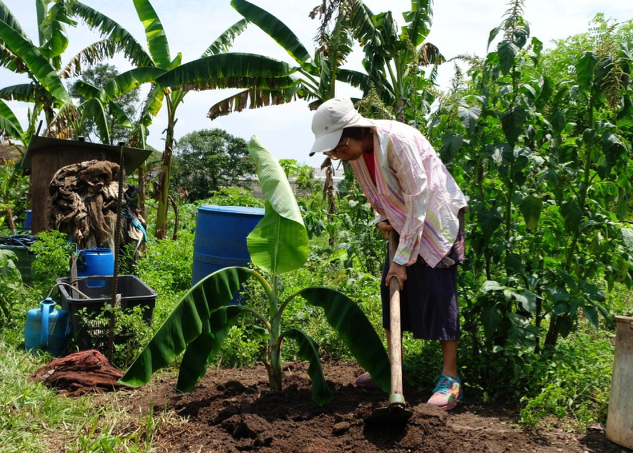
Evelyn when working on her farm.
What setbacks have you had in all your years as a farmer and how did you get past those?
Just when we were poised to enjoy our food forest, a setback came in 2010. A chicken farm nearby started operations but their facilities were not fully in place to treat chicken waste. The horrendous stinking smell of chicken and their dung was unbearable for us.
At the same time, the conventional vegetable farm near us was making piles of sky-high compost beds so they had to resort to using building cranes to turn their compost. And when they did so, it was as if they were piling dead bodies everywhere.
Both these situations became so horrendously intolerable that I complained numerously to the AVA [Agri-Food and Veterinary Authority of Singapore]. The AVA took almost a year before they were able to gather all responsible parties to find a resolution. Until today, when there are high winds, chicken feathers and the stench of chicken dung still lingers on Neo Tiew Road.
What did you learn from setting up a farm and working on it that you didn’t know before? How did you change as a person?
I have realised that when I have a poor harvest for a particular crop, it is not that I am a bad farmer but that the weather is the ultimate determinant as my fellow organic farmers will also be in the same situation. So one has to accept what Nature provides and eat what is in “season”.
For instance, we tried very hard to produce all year round the popular leafy brassicas like caixin, Chinese cabbage, pak choy and kailan but without success when the weather turns very hot or has continuous heavy rainfall. The vegetables then weaken, pests set in and the yield becomes very low. One day it dawned on me that the vegetables are not native. They had been introduced from Southern China, a cooler climate, as I remembered my father recounting that those vegetables were so much tastier at his birthplace, Shantou, China. So I began to educate our customers to eat rural greens like ulam raja, asystasia, wild watercress, wild bayam, tamarind leaves, noni leaves and moringa leaves. These vegetables thrive in our climate. And so I became more convinced that each and every one of us must live by the Rule of Nature to survive Climate Change!
If you could go back and replay your entire process of setting up a farm in Singapore all over again, what would you do differently?
With the experience that I have now, I would better design the Food Forest and water management layout, and then seek an experienced permaculturist familiar with our climate to critique and discuss and improve. This is now possible with the convenience of Social Media. The farm would be a Social Enterprise with a work force of paid, experienced organic farmers and passionate volunteers.
Evelyn’s workplace.
What’s the worst advice you’ve been given, or have heard people giving, with regards to farming? And what’s the best?
The worst advice was that fruit vegetable crops like brinjal should not be planted near to trees and that I should make sure there are no weeds growing in the same bed.
The best advice is that I shouldn’t be afraid to mulch thick in between, but not too close to the food plants to prevent root and stem infection from pathogenic fungal growth.
Lastly, what else do you hope to achieve in the future and who can LUCK-IT interview to assist you in achieving those?
I hope to convince the relevant Singapore authorities that they should not just emphasise high-tech farming but instead advocate and promote diversity in farming. They should also embrace the Food Forest concept of farming—an eco-system in which Mother Nature has proved to be most resilient and sustainable.
I wish to convince our government that our food forest legacy should be carried forward. Physical security of our country is of utmost importance but so is our food security. All they need is a few willing National Service men and I would be happy to conduct courses and give them practical training in farming.
Evelyn is presently networking with communal groups to raise awareness and get communities interested in Food Forest Farming and improving yields. You can find her at her farm, Green Circle Eco-Farm (www.greencircle.com.sg) or chat with her about farming and becoming a farmer using the comment box below.
Photographs courtesy and copyright of Evelyn Eng-Lim. Interviewer: Sy If you found this article useful:
At age 9, Russell Pensyl saw a painting in a castle in Nuremberg, Germany which was designed so that the lines within it would turn as you moved around the painting. That triggered within him an interest in the arts which led him to become a life-long interactive media artist from age 21, way before interactive media as it is known today even existed. We asked the now 60-year-old about his transformation through the decades and learned a few things about creating your own opportunities.
“I saw a small card stuck on the wall that said a company was looking for an artist who had computer science experience. I was the only person who applied for the job, and I was hired.”
Q: Hi Russell! How did you end up as an interactive media artist? Was it a life-long dream or something that came about only later in life?
A: It would be nice to say that I had a plan and the path I ended up on was what I chose. But this career path and even interactive media didn’t even exist. By accident, I studied both computer science and art/design. Those two domains were not even remotely connected at the time. But the knowledge and skills in both areas turned out to be perfect for the newly developing fields. I took my first professional position in “computer graphics” while still in University. I was hired at a small company that had a large presence in education content. We developed many educational titles for use on Apple II computers. Following this, I worked the field called multi-image, creating large scale photographic slide presentations. We developed the images using a digital production tool, a high-resolution photo slide imager, and an antiquated slide presentation controller software that then sequenced up to 36 slide projectors. My next gig was in computer animation. I was fortunate to be able to start a company doing digital animation, and one area we successfully moved into was interactive systems using animated content.
Russell when still a student at UCLA, in 1978.
Can you explain, for the benefit of those who might not properly know, what interactive media is?
Interactive media could be defined as any activity that is design using digital software and hardware to create experiences for viewers. In the early days, these systems required huge expensive computers, video disk systems, and very clumsy interactive interfaces—mostly using keyboards and game controllers. Today, we could say that interactive media encompasses everything from the internet, to kiosk systems like the ATM, to touch surface enabled mobile devices. The thing we carry around in our pockets, by any standards of the early days—a super-computer, is not a phone. It has a phone in it. But what this thing is, it is really very difficult to specifically define.
To simplify the answer, we can say that interactive media is a flexible platform or system that provides agency for a participant to achieve a goal. The interaction is mediated and afforded by digital technology.
What academic certifications, training or experience does a person need to be qualified to work as an interactive media artist, and how did you acquire those yourself?
Still today, the field is segmented in the overlapping domain of computer science, design and art and content creation. University degrees should provide the requisite skills and knowledge to allow those interested to forge successful careers in the field. Regardless of one’s focus—one needs to be able to work across the domains. Artists and designer should be able to write code. Computer scientists should be able to do some design or understand what design is. Writers and content creators should know both design and coding.
As I said before, I learned this stuff by accident, and by a deep interest in both digital technologies and the arts.
How much, approximately, did acquiring the above qualifications cost and how did you pay it off?
I attempted to pay for my education by working and via government study grants. I worked through college. But inevitably ended up with a substantial student loan debt. It took a while to pay off and [I have] worked very hard to gain the success I have had. It was by no means easy and there were deprivations. But over time, my success in the field proved a good return on the investment in time and money. I cannot even say how much it cost…
How long after becoming qualified did it take you to get your first gig as an interactive media artist? How did you know of the job opening and what did you have to do to get hired/featured?
My case was unusual, since I started working in the field even before graduating college. The first job came about though some funny and coincidental circumstances. I was working for a major department store as a window dresser, posing mannequins with the latest fashions that I could never afford. This company was horrible to work for. They kept scheduling me for 35 – 40 hours per week, even though in the original agreement I was only supposed to work 20 hours per week. After all, I needed time to study. After this went on for some time, I finally became so angry I quit. After I left I then wondered, how the hell am I going to pay the rent? The very next day, in the university building, I saw a small card stuck on the wall that said a company was looking for an artist who had computer science experience. I was the only person who applied for the job, and I was hired.
Russell’s very first interactive media show—his graduate thesis performance in 1988.
Which 3 aspects of being an interactive media artist were most difficult for you at first and how did you figure out how to overcome them?
Running a company was a new and extremely difficult lifestyle. This took a long time to get the business to have enough clientele to keep the doors open without having constant worry of failure.
It was difficult to come to terms with the fact that the business of making media is a “service.” Virtually all of the work I created was disposable—used only for the time of its need. As an artist, one expects [for] the time and emotional investment in creating the work is that it has a longer and more important value. It finally, it does not—the product is really the service one provides in helping the client get the message out to potential consumers. Once the work is complete, there is no ownership that the creator can maintain.
My career eventually moved into academia. In the IM domain, we sit at the crux between technology and science on one axis and the arts and design on the other axis. Both areas have radically different criterion for valuing the contributions made. Interactive works that are highly technical, are viewed with suspicion by artists. The arts are viewed with suspicion by computer scientists and engineers. I have never been able to resolve this. But over time, it is less uncomfortable.
Which 3 aspects of being an interactive media artist do you enjoy the most?
The variety of experience one encounters is exciting. Crafting a work of art that is used by and enjoyed by a lot of people has an intrinsic value. One of the most interesting experience I ever had was creating an interactive sculpture installation that encouraged children to push, pull, run around inside the installation, having incredible amounts of fun. This was one of the most rewarding experiences I have ever had.
Once one is able to master it, to have control of electronics, sensors, systems, the interaction and the content will make your dopamine level rise till you feel a sense of accomplishment that is perhaps the same as an athlete, or mountain climber. Sometimes just building an interesting experience using the technology is the same as skiing down a slope. You do it just for the fun of it, and if you are good at it, it is even more fun.
What do you currently do to grow your interactive media portfolio on a regular basis?
Go to the studio every day I can. A day in the studio is like a day off and yet it is work. I call it hard fun.
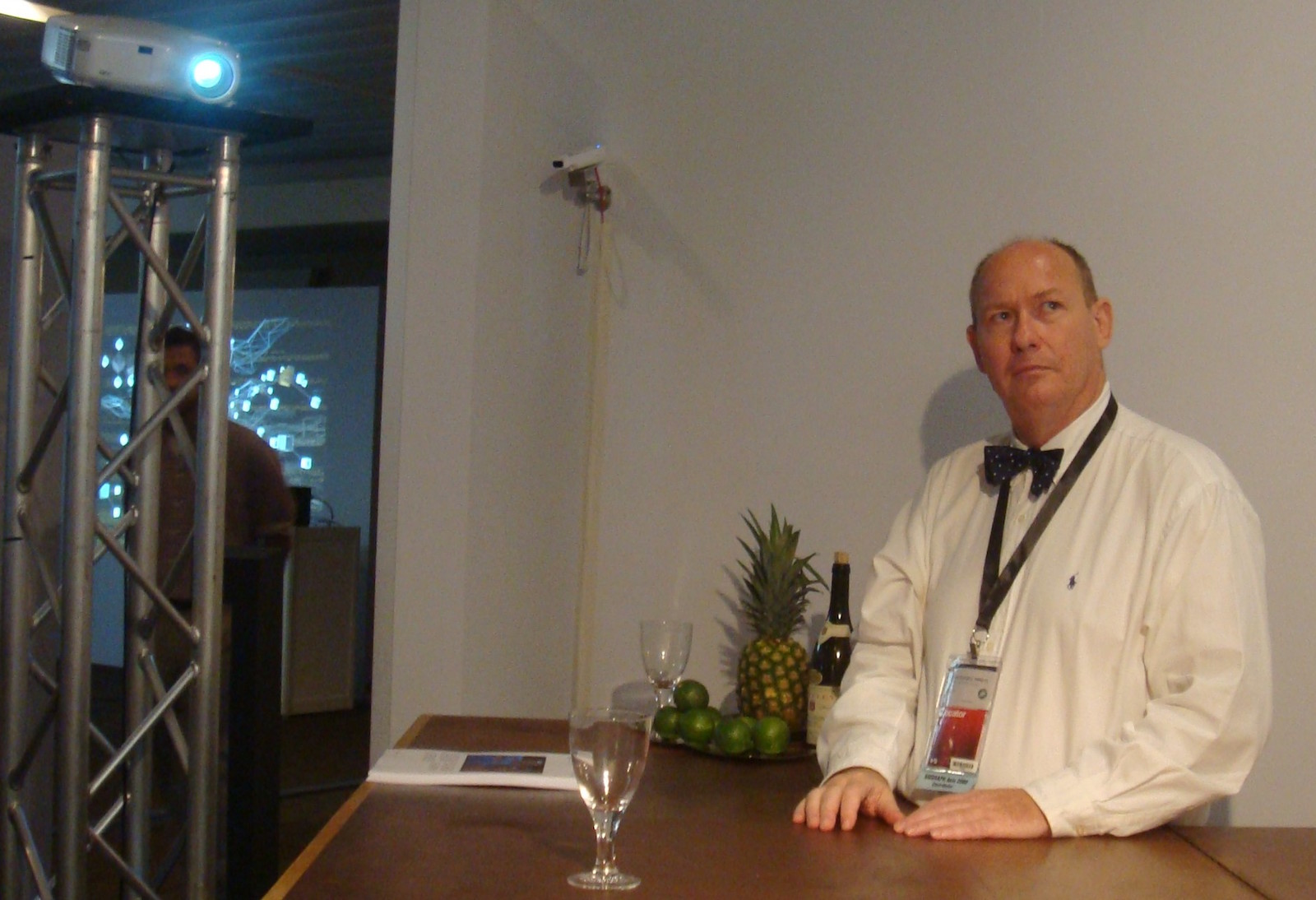
Russell at Siggraph Asia—a conference and exhibition on computer graphics and interactive techniques in Asia—in 2008.
What is the work schedule of an interactive media artist like? When do you create?
These days, my work is creating only my own work. I am designing and building large-scale, and small-scale, interactive works. I have had the good fortune to be able to focus my efforts on creation of new work, that I envision, conceive and produce. I still teach 2 classes per semesters, but the stuff I teach is within my area of expertise. The other days, I will be in the studio working.
What is the salary of an interactive media artist like? Are there other benefits?
In the U.S., the starting salary can be anywhere between $45K to $70K. For those with a highly technical background, the starting salaries are substantially higher. If one is able to run one’s own company, this will be where the potential for making lots of money is at. There are trade-offs between security and the risk of investment. You will be secure in a job working for others, but the likelihood of generating wealth is limited. Investing in your own start-up, is exciting, and has the potential for generating wealth, as well as the risk of losing everything. If one has the stomach for it, I always encourage young people to start a business.
Which 3 objects/people are most useful for you when you are working on your interactive media projects, and why?
A ruler, I always need to measure and I design by drawing by hand a lot. A good text editor for coding, and a really big table to spread the project out on.
Which place is most useful?
The studio, one cannot under estimate how important it is to have a place that you can go and focus you energies and play with stuff. Experimentation is invaluable.
Russell’s summer studio.
Name 3 people you’ve ever tried to emulate over the course of your interactive media career and explain why.
I have tremendous respect for pioneers like Douglas Engelbart, Myron Krueger. As well, I read everything written by Philip K. Dick. But I don’t seek to emulate anyone.
What did you learn from becoming a professional interactive media artist that you didn’t know before?
Even after all the advances in technology, people have not changed.
What’s the worst advice you’ve been given, or have heard people giving, with regards to developing an identity as an interactive media artist, and what’s the best?
The worst advice I hear is to adopt social justice as reason to make “art.” My recommendation is to write a new story, create a new piece of music, create a new art work, that is only derived from your own imagination.
If you want to be successful now, follow the trends. If you want to be remembered later, forge your own path and have your own ideas.
Russell these days.
Russell was recently described by a friend as an ‘art clown’, which he likes (“I like it when my works or even the lectures make people laugh.”) and is presently working on a large scale interactive work that detects the clothing colours of viewers and modifies images to compliment those colours, as well as trying to get an installation into Clarke Quay in Singapore. If that is successful, you will be able to find him hiding over by the Mexican food place nearby, watching for the reactions of people. Alternatively, you may also find out what he’s up to via his website (pensyl.com) or ask him questions about interactive media and life using the comment box below.
The above interview is sponsored by:
Photographs courtesy and copyright of Russell Pensyl. Interviewer: Sy If you found this article useful:
How do you succeed as a hawker in the food utopia that is Singapore? We ask former fine-dining chef turned ramen hawker Gwern Khoo who’s been dealing with long queues outside his Michelin Bib Gourmand certified noodle stall—A Noodle Story—for seven years now.
“It’s a continuous cycle of repeated improvement.”
Q: Hi Gwern! How did you end up as a hawker? Was it a life-long dream or pure chance?
A: I’ve always loved to create new dishes, even when I was a chef. I’m very happy when people come up to me and say they like my food.
What I really want is to start my own business and let customers enjoy my creations. The hawker centre is a cheaper way for me to test out my ideas and concepts.
There was an uptrend in Japanese cuisine, especially ramen, 6 years ago. I knew I couldn’t fight head-on with those famous chains from Japan so to leverage this trend, I started my S-style ramen. Somewhat same but still differentiated from the usual ramen and hawker fare.
I chose the CBD [central business district] because of the demography. Now, more youngsters are well-travelled and willing to try new things. And they are willing to pay for quality and unique concepts.
What academic certifications, training or experience does a person need to be qualified to work as a hawker, and how did you acquire those yourself?
You don’t need any certification. Of course, experience in cooking is a must. And passion and hard work, lots of it.
How much, approximately, did acquiring the above cost and how did you pay it off?
Although certification is not a must, I do have a diploma in culinary skills. [It took me] 2 years to get that.
Gwern (middle) when still in culinary school.
How long after becoming qualified did it take you to get your first job as a hawker? How did you know of the job opening and what did you have to do to get hired?
My first job was Cook at a restaurant. Got it immediately after graduation. There’s a shortage of able staff in this industry.
How old were you when you started training to be a hawker?
I started my cooking course when I was 26.
How old were you when you finally became a professional hawker?
I ventured out when I was 32 years old.
Which 3 aspects of the job do you enjoy the most?
The joy of happy customers. Creating my own flavours and dishes. Learning deeper about the subject.
Gwern at his first job—making pasta.
What do you currently do at work on a regular basis?
Training and teaching my team.
What is the work schedule of a hawker like? Do you have to work on weekends?
Long hours. I work on Saturdays.
What is the salary of a hawker like? Are there other benefits?
It depends on your popularity. It can be anything from losing money to making many thousands.
Which 3 objects/people are most useful for you when you are at work?
Cooking is all about senses. I rely on my senses for work. Eyes to see, observe and judge. Hands to feel and touch. Brain to think and create.
Gwern when working as a chef in a fine-dining restaurant, with his idol Thomas Keller.
Which place in Singapore is most useful?
Home for rejuvenating.
Name 3 people you’ve ever tried to emulate over the course of your career and explain why.
Ferran Adria for creativity. Thomas Keller for excellence. Tetsuya Wakuda for his simplicity.
What did you learn from becoming a professional hawker that you didn’t know before?
Tougher than I thought.
What’s the worst advice you’ve been given, or have heard people giving, with regards to being a hawker, and what’s the best?
For worst: “It’s easy to make money, most hawkers drive Mercedes.”
For best: “People will come if the food is good.” That was most helpful when I just started out building a sustainable base of customers.
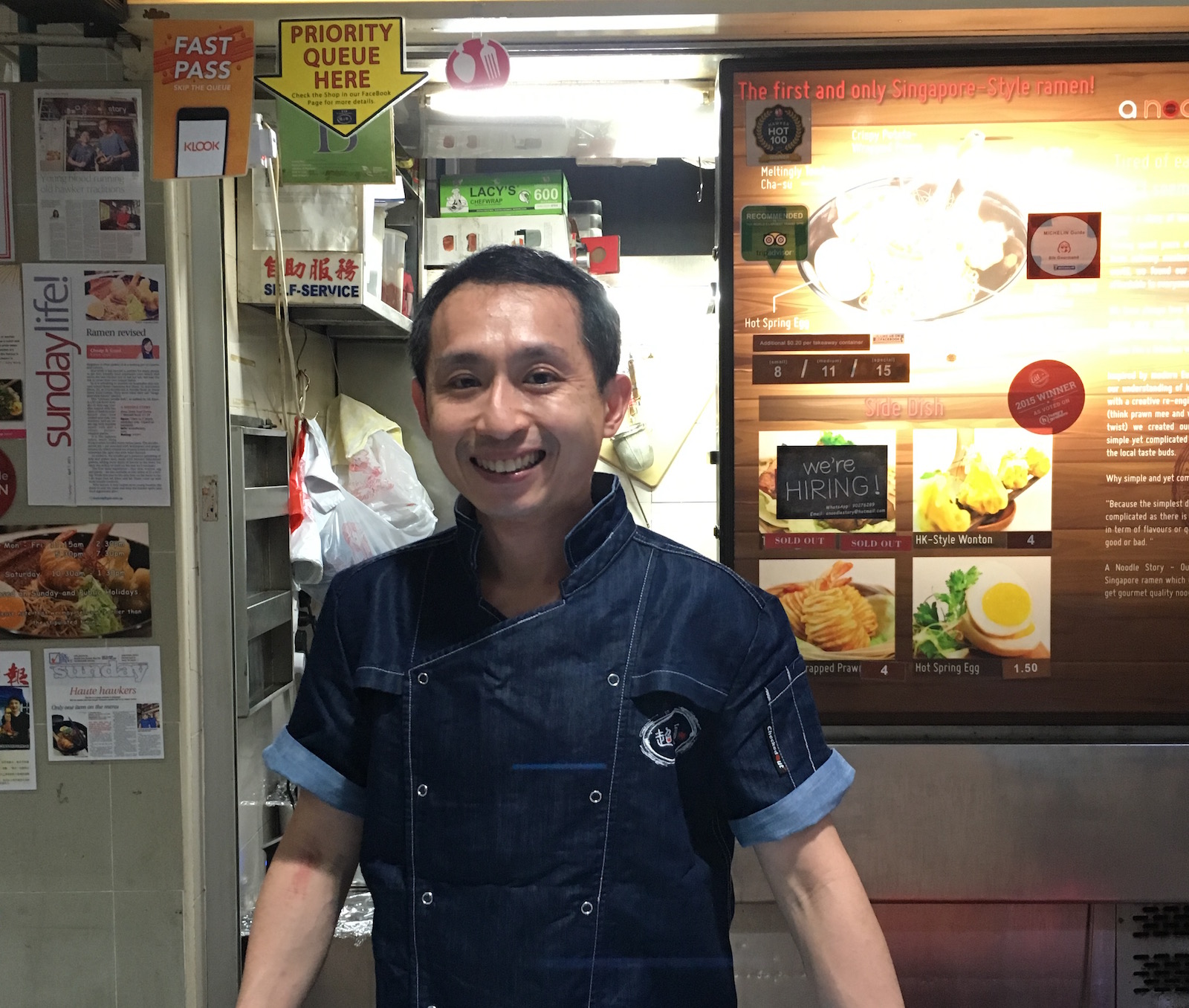
Gwern (extreme left) outside his hawker stall, with his current team.
If you could replay your entire career all over again, what would you change?
Perhaps increasing my selling price earlier. I was selling like mad, working 16 hours a day for 3 years. No life, no time and income was low. I was naive and set my prices based on my neighbours’. But our rental, food costs and production are different from theirs. I was selling way too cheap.
What advice do you have for those hoping to become professional hawkers too?
Be prepare to work long hours. Listen to customers’ feedback, improve and make it happen. It’s a continuous cycle of repeated improvement. Sooner or later, you will succeed.
Gwern at an overseas event.
Lastly, when do you think you will retire or quit from this job?
Not sure, it’s still a long way to go.
Gwern is presently busy with opening new hawker concepts, which he hopes to be able to set up within the next year. You can follow him on his Facebook page, or let him know if you’ve enjoyed his S-style ramen using the comment box below.
Interviewer Note: Sometimes I go to Amoy Street Food Centre for lunch. Every time, without fail, there would be a queue outside Gwern’s noodle stall. I’ve never actually tried his food (ironically because of the queues) but my gut’s telling me the guy must be doing something right. So I am curious: What is it about his noodles that makes people brave hunger and heat and having to stand in limbo for tens of minutes at a go? 😮 If you’re a fan, please do tell.
Photographs courtesy and copyright of Gwern Khoo. Interviewer: Sy If you found this article useful:
How do you become a nutritionist and what is that job really like? We ask Sheeba Majmudar, a 45-year-old with 12 years experience in the business, who had been a housewife until her struggle with her son’s health made her want to understand nutrition better.
“I didn’t wait to find a job. I started on my own and through word-of-mouth got my practice going.”
Q: Hi Sheeba! How did you end up as a nutritionist? Was it a life-long dream or pure chance?
A: My 2-year-old son started developing bronchitis and the doctor started him on a inhaler. It was so traumatising for him and for me, it started me wondering if there would be a better, more natural way, to improve his health rather than to just medicate. I started to read more and look for ways to work on him naturally. That’s when I stumbled on nutrition as a lifestyle and was fascinated enough to do my Master of Science in Human Nutrition.
Sheeba on the BBC talking about why obesity rates are on the rise in Malaysia.
What academic certifications, training or experience does a person need to be qualified to work as a nutritionist, and how did you acquire those yourself?
You can get a Diploma in Nutrition from colleges in the U.S.A., Australia, U.K. or a Master’s degree. I did it at a U.S.A. university. But after I finished my program, I realised that this field of study is huge and I was only on the top of the iceberg. This lead me to study other areas related to nutrition like becoming a Clinical Herbalist (and many more such explorations). I started my own practice straight after my degree through word-of-mouth recommendations.
How much, approximately, did acquiring the above qualifications cost and how did you pay it off?
It cost over USD$22,000 as it was a full-blown Master’s program. I paid it per semester. Fortunately, my husband was working and supported my studies.
How long after becoming qualified did it take you to get your first job as a nutritionist? How did you know of the job opening and what did you have to do to get hired?
I didn’t wait to find a job. I started on my own and through word-of-mouth (no website then!) got my practice going.
Which 3 aspects of the job were most difficult for you at first and how did you figure out how to overcome them?
1— Information in this field is always in a flux. The danger of this is that your knowledge may really be an opinion. 2— What I knew never felt enough. 3— You need to have a high EQ (emotional quotient) to work with clients, to get them to start making changes and get them to feel better.
I overcame all these by always remaining a student and learning from every circumstance and person.
Sheeba (right) at the launch of her book, ‘Edible to Incredible’, which tells of how readers can improve health by identifying root issues and blind spots much overlooked by the medical profession.
Which 3 aspects of the job do you enjoy the most?
1— The gratification of having helped improve even one life.
2— Complete satisfaction in having helped improve my own and my family’s health.
3— The joy of learning new things and being open to all possibilities.
What do you currently do at work on a regular basis?
I practice what I preach.
What is the work schedule of a nutritionist like? Do you have to work on weekends?
I schedule my own time as I work for myself.
What is the salary of a nutritionist like? Are there other benefits?
Am not familiar with the market for salaries as I have my own business.
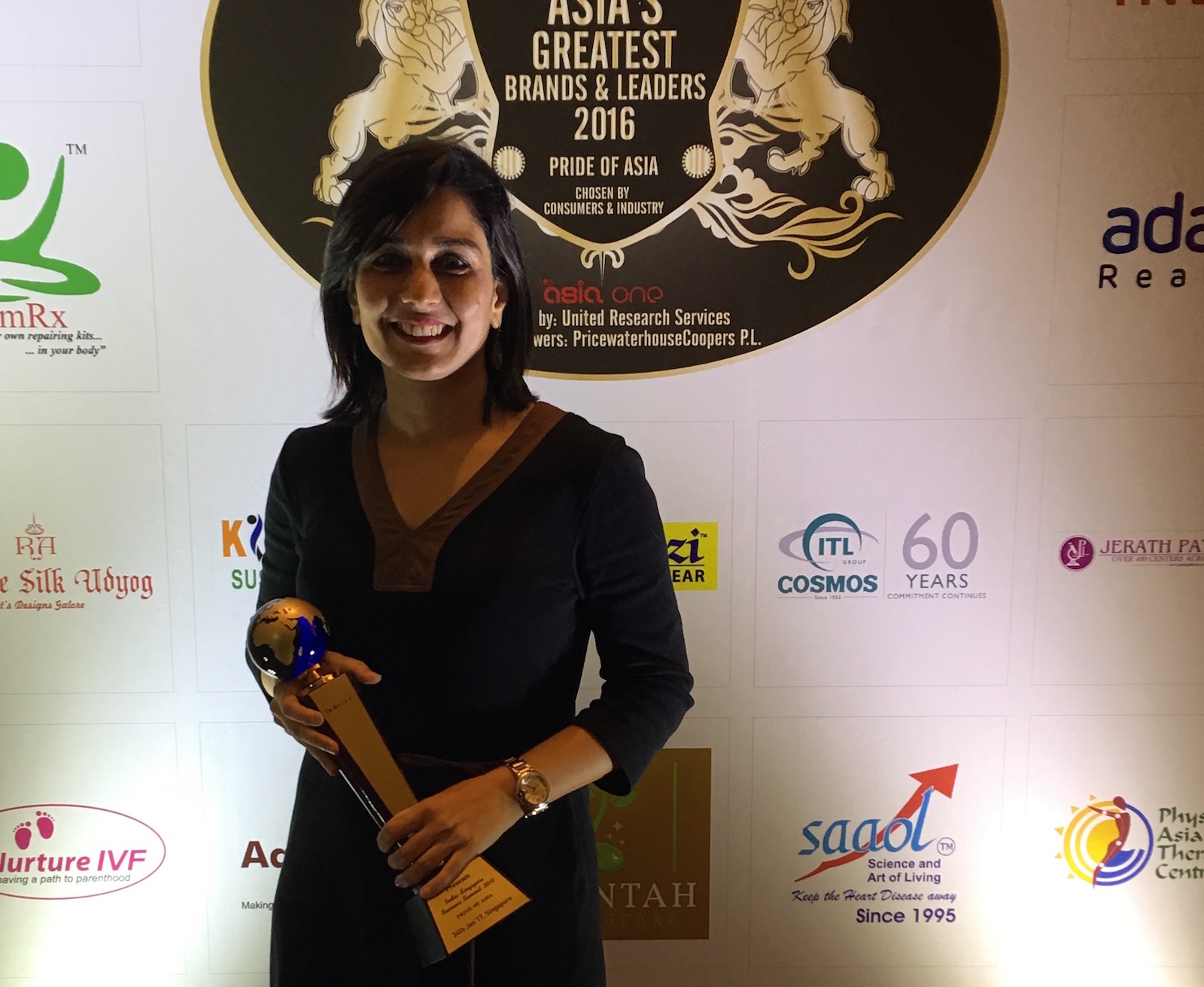
Sheeba winning an award for ‘Best Brands’ in 2016.
Which 3 objects/people are most useful for you when you are at work?
Be prepared for it to be a lonely journey.
1— My Surface Laptop is really all I need. 2— I use a standing desk with my super awesome foot Kybun kyBounder cushion. That’s it… I am a no frills person.
Which place in Singapore is most useful?
Cold Storage for all my healthy grocery needs.
Name 3 people you’ve ever tried to emulate over the course of your career and explain why.
I have carved my own path from the start because I don’t know any mentor or person who does or offers all that I do. I have had great teachers for that. I do like to read some of the blogs of Naturopathic doctors and world fitness experts (from Germany and U.S.A.).
What did you learn from becoming a professional nutritionist that you didn’t know before?
That we are responsible for creating health and how we choose to live. It’s our story and we are the authors.
Sheeba’s book is available for purchase on Amazon.
What’s the worst advice you’ve been given, or have heard people giving, with regards to being a nutritionist, and what’s the best?
The worst advice I got was from a doctor who said there were not many jobs available for nutritionists so it was not a promising career.
The best advice I got was from my husband who really asked me a question that changed my life: “Is this something you want to do for the rest of your life?” It’s easy when the answer is a resounding YES.
If you could replay your entire career all over again, what would you change?
It’s a journey of learning and evolving. So nothing needs to be changed.
What advice do you have for those hoping to become professional nutritionists too?
Be child-like and continue to nourish your curiosity.
Lastly, when do you think you will retire or quit from this job?
Not likely I will.
Sheeba is presently busy running between Singapore and Japan as she is setting up an office in Tokyo. You may follow her progress at www.sheebathenutritionist.com or share your own experience with the nutritionist career by using the comment box below.
Photographs courtesy and copyright of Sheeba Majmudar. Interviewer: Sy If you found this article useful:
At 21 years of age, Hui Ling began working in the theatre industry of Singapore as an actor and teacher of speech and drama. In 2013, when still in the industry as a director, educator and facilitator, she won the National Arts Council’s Young Artist Award which, on top of a trophy and certificate, provided her with a $20,000 grant to further pursue her craft. We spoke with her to find out what made her eligible for the award, and what the life of a theatre professional is really like.
“It didn’t change me, but it changed the way some people see me.”
Q: Hi Huiling! First off, can you tell us what the National Arts Council’s Young Artist Award is all about? Who gets it and what prizes do you get when you win it?
A: Every year the National Arts Council [of Singapore] awards to selected practising artists under 35 the Young Artist Award (YAA). There is also the Cultural Medallion (CM) awarded. There is prize money awarded for both YAA/CM recipients as support for their upcoming projects (we need to submit a proposal).
It seems to even qualify for the Young Artist Award, you have to be nominated. Do you know who nominated you, and why?
Yes, a nomination is required. Honestly, I can’t remember who nominated me, I think it was Heng Leun [Artistic Director of the theatre company she works at] haha~ I am not sure. Mainly it was for my pursuit of practice in the theatre scene and for developing a practice around the application of theatre in different contexts (such as with young people, communities).
Hui Ling (on right with ponytail) in 2012, before winning the Young Artist Award, doing a workshop for ‘Our 11th Brother’—a play she wrote and directed herself about Singapore’s war hero Lim Bo Seng’s formative years.
How did you even get into the arts in the first place? And how did you figure out how to make a living while doing it?
I had been in speech and drama classes since I was 8 years old and have never stopped since. It was an environment I grew up in and it naturally became a part of my life. After my A-Levels, I did contemplate choosing to study Theatre in university, but gave that up for the more “stable” Business degree while doing theatre part-time. In the end, I chose to stop my Business degree mid-way and plunged into doing Theatre full-time (I was already doing it part-time while in university). It felt like the thing I had to do for myself at that point. So I started out really early.
How long did it take for you to go from starting out in the arts industry to winning the Young Artist Award? Did you have any setbacks or other wins along the way?
Well, I didn’t set out with the goal of being awarded the YAA, I was just working on the things that fascinated and intrigued me, in the practice of connecting with people through the theatre/arts. I probably received it around the 10th year of me being in the industry.
I guess it had been a journey of understanding myself and my connection with the world. And it was a path that not many had taken so it was difficult to articulate or get others to understand why I made the choice to leave university with 1.5 years left to graduation. I had been really lucky after pursuing theatre, met many wonderful practitioners who gave valuable advice on how to continue in and navigate the industry. I am also very grateful for the belief people had in me. One major influence is Kok Heng Leun, my mentor, and boss.
Why do you think you got selected to win the Young Artist Award? Was there something you did in particular that your peers did not do?
Honestly, I am not too sure. I guess I was the only one at that point who had been consistently doing theatre in non-conventional contexts and seeing it as my practice.
Hui Ling winning the Young Artist Award in 2013.
What was your routine like in the years/month/weeks leading up to you winning the Young Artist Award?
Long days and late nights. There was a lot of self-directed learning, to read up and learn about things related to the practice that I was never taught. I spent a lot of time going into communities and chit-chatting with people as well.
Did your routine change in any way after you received the Award? If so, how?
No.
How do you presently spend your weekends?
It depends on whether we have projects ongoing. If we do, then I would either be in rehearsals or doing production preparation. We also have a youth group, ARTivate, where we do training for young people who are keen on theatre. Those sessions are usually on weekends as well.
What advice do you have for someone hoping to win NAC’s Young Artist Award too?
Focus on the work, not the award.
Can you map out a recommended path for people who want to win NAC’s Young Artist Award to follow?
Unfortunately, no. I really just focused on the work I wanted/needed to do.
What are the key things/people/situations that have enabled you to work in the theatre industry and win the Young Artist Award, in your opinion? Who/What was/is indispensable?
As mentioned, it would have been Heng Leun. I am one of the lucky few who have had a direct mentor to help me develop my voice/exploration and I am eternally grateful to him for his guidance as well as for being such an exemplar of his ethos.
Another group of people would be my other team mates at Drama Box—most of them have been with the company for 10 years! And so we grew together as a team.
ARTivate, the youth group which I founded, is very important as well. To see hope, and being there as a [form of] support for young people who are considering this path, and seeing them blossom after graduation has been very humbling.
All the people who have worked with me. Be it fellow arts practitioners or the people in the community, all of them have taught me so much about life, and I am immensely indebted.
Hui Ling in 2015, after winning the Young Artist Award, out with the community on a Sunday, doing a Forum Theatre show.
How did winning the Young Artist Award change you as a person? Or did it not change you?
No, it didn’t change me, but it changed the way some people see me.
If you could go back and replay your time in the arts industry all over again, what would you do differently?
Nothing!
What were you like as a child? What about as a teenager and young adult? How did you change at every decade? Or did you not change?
I grew up in a kampung [a traditional rural village], so I really love nature and being free and curious. I guess this formed the basis of my being and has aided me in my practice so far. My parents are actually pretty liberal but I guess I still had to struggle with societal expectations as a young person living in Singapore and [with figuring out] what success means versus the pursuit of what I really feel happiness means to me.
Which major event in your life has made you who you are, in your opinion? Why do you think so?
Quitting university was definitely 1 major event. I quickly learnt how I had to be an adult: being responsible for my actions/decisions as well as affirming that I can/do have the courage to step into the unknown.
Another was taking my Master’s [degree]. I had the time to sit down and devour all the books I always wanted to read and it nourished what I really needed to further understand and develop my practice. It also challenged and opened me to new perspectives and approaches when working, which actually moved my practice to the next level.
Which 3 objects/people in your life can you presently not live without and why?
Water. Air. Sleep. Without these, a human is dead. I am grateful to be able to wake up each morning and to still be alive.
Of all the objects you bought in the past year, which has most positively impacted your life? Why?
Books and music always. Whenever I feel lost, down or tired, I seek solace in these.
See Hui Ling talking about her most recent show, the TripAdvisor #1, immersive, site-specific theatrical tour, ‘Chinatown Crossings’.
Which person do you wish LUCK-IT would interview for you to learn from? Why?
Women in India or people working in NGOs in developing countries. Because I always wanted to do it!
Lastly, what’s the worst advice you’ve been given, or have heard people giving? And what’s the best?
My friend had a challenging schedule for 3 performances so I agreed to help her out and stand-in for her as a friend. The boss of the company who contracted her told me I had to prove myself before I was worthy of the fee that was to be paid to me. It was the one and only time I quarrelled with anyone over work.
In my 2nd year of joining the industry, a big brother figure advised me to start thinking about what it is I want to do and not just take up any acting shows that came along—that I needed to be selective. I believe that was what led me into the doors of Drama Box eventually.
Hui Ling is presently Associate Artistic Director of Drama Box and, having just wrapped up her last show, ’Chinatown Crossings’, is now preparing for Drama Box’s 30th Anniversary in 2020. You may check out her latest works at www.dramabox.org or share your own experience with winning awards here using the comment box below.
Photographs courtesy and copyright of Drama Box & Hui Ling. Interviewer: Sy If you found this article useful:
At age 18, Petrina Ng embarked on a career as a primary school teacher and over the years, rose through the ranks to become head of an English department. After 14 years of teaching, however, at the age of 34, she decided to leave all that behind to focus on a career as a wedding photographer instead. We asked the now 37-year-old how she did it and how her choice played out in the three years that followed.
“I did not think about succeeding, but I was determined not to fail.”
Q: Hi Petrina! Nice to have you with us! To start, can you tell us a little bit about yourself as a teacher? Why did you want to become one and what subjects and CCAs [Co-Curricular Activities] did you teach when you were one?
A: I was inspired by my own teacher from Primary 6 to want to be one and to have the opportunity to change someone else’s life like she did mine. I loved interacting with children and loved sharing life stories with them. Watching them grow in so many ways, big and small, brought joy every working day. As a Primary School teacher, I had to teach most subjects, except Mother Tongue. Over the years, I’ve been in charge of many CCAs as well, from Art Club to Tennis.
Petrina (left) when still a teacher, at a Ministry of Education promotion ceremony.
Why then did you suddenly decide to change the trajectory of your career to become a wedding photographer instead? Was there something or someone that inspired you to do so?
There were many push and pull factors. I had always loved photography and my boyfriend had been shooting weddings for a while (will explain more in the next point). But a major push factor was the lack of time. It was getting way too busy in school and I was doing everything but teaching. I spent less time in the classroom than I was doing other things, while getting 4 hours of sleep a day. I hung on for a long time but one single incident made the decision for me…
One day, my mother came into my room and showed me something on her hand and she wanted to borrow my hand cream. I held her hand and it suddenly struck me how wrinkled her hand was and how old she had become. During the time I had been so busy, time had passed so quickly and I had not spent enough time with her. There and then, I decided I would quit and make time to take her overseas whenever I could.
So how did you get started as a wedding photographer? From where did you learn the skills needed for professional photography and what other things did you have to do to get yourself set up as a wedding photographer?
A good friend was getting married and asked me to snap some photos for her (as a second photographer) and create a montage for her dinner banquet. I went and enjoyed myself completely! Everyone was so happy during the wedding and the day went by so quickly. I was on a high. I decided to try going for more weddings just for fun. I borrowed my boyfriend’s camera and lenses, made him teach me how to use them, and went out to look for weddings to shoot. I approached friends and colleagues. I even went online to look for brides-to-be to offer my services as a second photographer for free. I did not really think of it as a career at that point but I was really enjoying myself. After every shoot, my boyfriend would look through my photos and critique them so I learnt as I went along. Those, of course, formed my portfolio when I was ready to go full-time.
Did you think you would succeed as a wedding photographer or did you have no idea what to expect?
I did not think about succeeding, but I was determined not to fail. A lot of people think that I took the leap because I didn’t have bills to pay since I wasn’t married and didn’t have kids. But I am singly responsible for the 5-room HDB flat my family lives in and making payments and paying bills isn’t a walk in the park. But I’m lucky to have my boyfriend and I quickly made many friends in the industry who were happy to share with me tips on what I could do. All that helped better prepare me.
How long did it take you to get your first ten customers? Did you learn anything important along the way? If so, what?
It took a few months to get the first ten. But we were really happy that we got our first 2-3 in the first month alone. We’re really blessed. I definitely learnt how to read couples faster and present relevant information to them properly as I went along. One very important thing I had learnt was how to say no nicely.
One of Petrina’s favourite shots.
Did having been a teacher before help in any way when you were trying to get customers and build your business?
Definitely! In the years I’d been a teacher, I learnt to be really patient, good at explaining things, staying calm in emergencies and dealing with more challenging people. All those really helped me deal with clients and guests during actual day weddings. I also multi-task pretty well, replying most emails within 24 hours. Many clients give feedback about how they like our speedy replies and how much it makes them feel like they can trust us for their day.
Have you gotten to the point where you’re earning, annually, the same as what you used to as a teacher or more? If so, how long did it take to get to that point? If not, have you at any point in time felt the teeniest tinge of regret?
I do currently earn what I used to and it didn’t really take me long. I don’t regret anything but I do miss my colleagues and students a lot.
What about satisfaction levels? Which job gives you more satisfaction? Why?
It’s a different sense of satisfaction and I feel good in both. When I was teaching, when the children surprised me with their little acts, or even how they remembered something I’d taught previously, made me really happy. Now, when I know that couples are happy with my service and work, when they thank me at the end of the day, when they use one of the photos I took as their profile picture, that makes my day.
What was your routine like when you were a teacher?
Wake up at 4.30am—mark and eat—get to school—prepare—rush around like mad—dismiss the kids—rush around like mad—get home—eat—mark—sleep after midnight—repeat.
Yes, there were times when I only ate a proper meal once a day.
Petrina (middle) with her teaching colleagues during Racial Harmony Day celebrations.
What is your routine like now that you’re a wedding photographer?
On non-working days, I would wake at about 8am, answer all enquiries, messages and tend to all the social media platforms. I try to spend lunchtime with my parents, after which I will begin editing. On some weekday evenings, I’ll head out to meet clients. Now that we have a studio, I’m sometimes there during the day as well.
How have your weekends changed from before?
Drastically! I used to sleep 18 hours each on weekends but now weekends are work days for me.
What advice do you have for people hoping to switch to entirely different careers in their 30s?
Do your homework and know what you’re in for. Make sure you have enough to last you for a year or two at least if things don’t turn out so well at the beginning. There’s no point switching if you intend to go back after the first few challenging months. If you’re able to spare a little time working at your new job during the weekends before you quit your full-time job, that’s the best.
What key things/people/situations enabled you to switch careers in your 30s, in your opinion?
I simply couldn’t have done this without family support. Even though I’m paying for the flat, my parents and siblings didn’t even flinch when I told them my plans. My siblings also offered to help if I needed it and that gave me the courage to switch.
Having a reliable and trusted mentor (my boyfriend) helped a lot as well. As someone who was somewhat in the industry, I learnt faster and I felt more sure of myself because of what he shares with me and the support. Him being my business partner helps as well because I did not have to make all the difficult decisions alone.
Another one of Petrina’s favourite shots.
How did becoming a wedding photographer and having your own business change you as a person? Or did it not change you? Did you learn anything through becoming so that you didn’t know before?
I don’t think it has changed me much actually but I’ve learnt that I can be very shrewd and passive-aggressive when I want to be.
If you could go back and replay your entire career all over again, what would you do differently?
I’m not sure I would have done anything differently. My boyfriend and friends have commented that I should have always run businesses and I should have started out earlier. But I felt that if I had not taught, I wouldn’t have the wealth of skills that allow me to handle the pressure of running a business. I think every step we have taken in the past leads us to where we are today and I’m grateful for the person I am today.
What were you like as a child? What about as a teenager and young adult? How did you change at every decade? Or did you not change?
I was an independent child and teenager. I made a lot of decisions on my own with little consultation with my parents. I think I’m still a lot like that now but I’ve learnt to consult my loved ones out of respect. I’ve learnt to be more humble and accept constructive criticism better.
Which 3 objects/people in your life can you presently not live without and why?
My mother—she’s an inspiration to all 3 of us kids. We learnt how to be resilient and to work smart AND hard. My siblings—they are my pillar of support, all the way. My boyfriend and my best friend—as above. (I know that’s more than 3.)
Of all the objects you bought in the past year, which has been most useful? Why?
My Nikon Z6 which I recently acquired is a boon to have. My previous DSLRs were getting really slow and I was looking for an upgrade and the Nikon Z6 launched at the right time. I hope to get another one to replace my other camera soon.
Petrina (left) with one of her clients at a wedding she was working at.
Lastly, what’s the worst career advice you’ve been given, or have heard people giving? And what’s the best?
‘Just do it.’ is probably one of the worse ones. I think for younger people who are just starting out, that’s fine. It’s a time for them to explore and make switches to find what really suits them. But for someone like myself, I think it’s only responsible to plan ahead and reduce the chances of failing (if any at all) in order to still meet monthly commitments.
Petrina is presently busy with weddings, weddings and more weddings. You will be able to see her progress on her websites www.amerrymoment.com and www.thewhitespace.sg or chat with her using the comment box below.
The above interview is sponsored by:
Photographs courtesy and copyright of Petrina Ng. Interviewer: Sy If you found this article useful:
Elizabethheartz first began cosplaying at age 15 for Speech Day at her secondary school. At 26, she began getting paid to do it. Now that she has 24 years of cosplaying under her belt and is the organiser of many cosplay events in Singapore, we decided to find out what keeps her at it.
“Cosplay is a form of art—it should be respected as well. However, there tend to be some who try to underpay or, sadly, don’t pay cosplayers for their work. This should not be encouraged.”
Q: Hi Elizabeth! Nice to have you with us today! Tell us a little about yourself—who are you when not cosplaying and who are you when you cosplay?
A: I tend to be more image-cautious when I’m cosplaying, as a form of respect to the character I’m cosplaying. Especially when the public eye tends to fall on you more, I’ll take extra note of my actions, etc.
How did you start cosplaying? When was the very first time you ever cosplayed and what about it made you want to do it again… and again?
I first started cosplaying during 1996? Then, as I started a store, catering to the needs of local cosplayers, I felt it important to get into the action to bond with my customers too. From there, I learned to understand them better and how to operate the business smoother. Slowly, I started enjoying it as [the extent to which I could] transform myself into character seemed quite fun.
The first time Elizabethheartz cosplayed, it was for a play at school in 1996. “Back then, Cosplay wasn’t exactly popular. I had to be in character, then danced and sang LIVE.”
When you first became an active cosplayer, how did you figure out where to get your costumes and accessories from and how did you know where there would be events you could go to dressed in cosplay get-up?
Back in 1996, there weren’t any stores catering to such. It was for a musical play with my teacher’s help. After I started the store, I slowly created more events to cater to the needs of more cosplayers joining the community.
How did you choose which character you wanted to be? Did you have to watch the anime of that particular character over and over like an actor to learn how to behave as her?
Usually it’s from an anime that I enjoyed, which makes me want to cosplay the character. Having a store has its pressures—people expect much from you especially [when you’re] being a judge for cosplay competitions in Singapore and regional countries. It is the basic [requirement] for each cosplayer to do homework on their character inside and out, to check the suitability and weigh the possibilities.
How did your family and friends react when they first saw you dressed that way, behaving like an anime character?
As it wasn’t common back then, people tended to be so curious, but perhaps it also depends on what character you started off as, etc. Thus for me, it was a pleasant experience.
I know you’re also a professional cosplay artist and rather well-known in the cosplay scene in Singapore, so please share—when and how did you start getting paid to cosplay and what did your very first paid gig require you to do?
Honestly, most clients have a budget allocated for marketing. When I am engaged for work, it is natural for the client to pay. If it’s for a local gig, transportation and meal allowances are to be considered as well. If it’s an overseas gig, transportation, accommodation, meal allowances, helpers/translators should be provided too.
Cosplay is a form of art—it should be respected as well. However, there tend to be some who try to underpay or, sadly, don’t pay cosplayers for their work. This should not be encouraged. I’ve always [told] the community that, since we also put so much effort into outfits, makeup, time, effort, etc, for any form of engaged work. In fact, we should be paid higher because we usually come with our costume/makeup/styling done before starting any form of work.
Elizabethheartz in 2018, at AFA, a Jakarta-based event.
Is being a professional cosplay artist a sustainable career, in your opinion? Or do you have to do anything else to supplement your income when trying to be one?
From time to time, yes I do get offers to make appearances for events, etc. However the market demand in Singapore isn’t that big compared to overseas [markets]. Unless you have connections and know your rights, it is quite hard to sustain [yourself with cosplay as a career]. However, if you have your own merchandise, depending on your popularity, it is also possible to bring in extra income.
Also, to be respected on a professional level, you should know how to do your own costumes/wigs/props. Others will tend to respect you for your talent more [if you can do so].
What is the routine of a professional cosplayer like? How often do you get gigs and what do you have to do on a regular basis to promote yourself as a cosplayer for hire?
Every professional cosplayer should have their list of rate cards and profiles available when approached. Our costumes/wigs/props/etc are usually kept in mint condition, with slight repairs/touch up [done to them] after every use. So they will be either busy at gigs, with costume/prop-making, photoshoots, interviews, meet & greets, appearances online/offline or handling collaborations, etc.
[Gigs come] about a few times a month (it is up to the individual whether to accept or not) and can come in many different forms. I will usually share my work proofs on my social media platforms.
Cos-tume in the making—a hair piece made by Elizabethheartz herself.
Do you still cosplay simply for the fun of it? When and how often do you do so if so?
Yes I still do but not as often as before as I’m usually tied up with other events. It has been quite busy for me in the recent years especially now that I’m more active in my collaborations.
What are weekends like for a cosplayer?
For most cosplayers, it could be a private photoshoot indoor (with studio booking) or outdoor. Other than that, they still hang out together but on a budget basis, to save up for materials/costumes.
Elizabethheartz (middle, in blue), with guests of Jakarta-based event, CLAS:H in 2013.
What advice do you have for people hoping to become cosplayers too?
Be humble and be hardworking. Check out Haru House’s monthly gathering for rookies/seniors where we chill and hang out, and are more than willing to share tips and information about cosplay! Do research, lots of it before jumping into the community. Last but not least, have fun, lots of it while at it!
Can you map out a suggested path for people who want to make a living from cosplaying to follow?
Always be humble and polite. Strive to be better each time and observe/ask the seniors how they do it. It is never the same path for everyone.
What key things/people/situations enabled you to cosplay throughout your adult life, in your opinion?
Effort and determination. Having a supportive family also helps a lot.
How did cosplay change you as a person? Or did it not change you? Why?
Having been the one many new cosplayers come to [when needing to] share their concerns or even family issues, I’ve become like a sisterly character to hundreds or even thousands. Somehow a lot of them look up to me, thus it pushes me to stay strong even during down times, just to be around for them!
Elizabethheartz (right), with fellow judges at Jakarta-based event, ITGCC in 2015.
If you could go back and replay all the occasions you’ve cosplayed at all over again, what would you do differently?
To date, I’m satisfied with all my cosplay plans so far, and have enjoyed the growing process too!
What were you like as a child? What about as a teenager and young adult? How did you change at every decade? Or did you not change?
I’ve become more experienced with life for sure! Seeing a lot of different types of people & situations has helped me grow to who I am today!
Elizabeth in 2018, doing a cosplay makeup demo at GameFest in Singapore.
Which major event in your life has made you who you are, in your opinion? Why do you think so?
I would like to thank [those who] invited [me] overseas as a cosplay guest and judge back then in Jakarta because it allowed me to make friends with so many awesome guests as well! It also kick-started my blogging career!
Which 3 objects/people in your life can you presently not live without and why?
1.My phone. Due to my job nature, it is hard for me to be away offline for long, so I definitely need it! I can connect me to my love ones, take pics (for memories/work) and connect to my work online!
2.My parents. I am grateful for them always letting me be who I want to be, and often checking on me [to see] if I’ve eaten, etc. I really appreciate them and want to bring smiles on their faces whenever I can.
3.My daughter. As a single parent, I want nothing more than to be supportive and provide as much as I can so she can spread her wings as much as she wants as she blooms.
Of all the objects you bought/received for cosplay purposes, which was most useful? Why?
Cos Cos Face Glue! It sticks the wig to my face so I don’t get those fly-ends and it helps to frame my face smaller!
What’s the worst advice you’ve been given, or have heard people giving? And what’s the best?
People who just jump into cosplay just for the fun/fame of it. It takes more than that sweetie~
And finally, at what age do you think you will finally stop cosplaying?
I will still do it, for as long as I want!
“Me when I’m not in my Harajuku fashion outfits.”
Elizabethheartz is presently a content creator busy with managing her social media platforms and running Haru House online at this page (“Left segment for all my blogging content, right segment for Haru House!”). She does appearances and filming and modelling gigs as and when they arise and will be more than happy to answer any questions you may have if you drop them into the comment box below.
She is also presently running a Haru Pop Up Store at Scape #02-17D from now till 14 Sep 2019 so you may hop on down to catch her there or get yourself some cosplay merchandise!
Interviewer Note: I first met Elizabethheartz almost a decade ago when I went to interview her for an NHK documentary on cosplay in Singapore. She had Haru House as a physical store at Scape then and there were always these youths and students in there, sitting at the tables deep within her shop, working on their own cosplay props or simply having a take-out or hanging out. It was like their ‘place to be’; their community; where they went after school and hung at till late. Because of them, I came to understand the appeal of cosplay and the full magic of what Elizabethheartz had created for the youth of Singapore. Because of her shop, they had some place to go to where they could feel welcome and like they belonged. Because of her big sisterly presence and community-building efforts, they found a tribe which accepted and supported their desires to move beyond their circumstances and set free their inherent personalities. Because of that, I have always thought Elizabethheartz an awesome person. 🙂
You can watch the documentary we filmed at Haru House all those years ago on Haru House’s YouTube page:
I do wonder if those in it are still cosplaying/making costumes a decade on. If you are in it, please wave in the comment box below and share what you’ve been up to!
Photographs courtesy and copyright of Elizabethheartz. Interviewer: Sy If you found this article useful:
Ten years after graduating from Saint Andrew’s Secondary School, Bryan Yong went back and attended classes again—this time as a relief teacher. He told LUCK-IT how he got the gig and shares what the jobscope and schedule of a relief teacher entails.
“I was recommended by an ex-teacher.”
Q: Hi Bryan! How did you end up as a relief teacher at your alma mater? How did you know they were hiring and why did you want to do the job?
A: I had some spare time after graduating from university and before starting my first full-time job and was looking for something to do in between. I had taken up other part-time jobs before (e.g. car valeting) but was looking for something more fulfilling and better paying.
What does the job of a relief teacher entail? What are your main responsibilities and side responsibilities?
Relief teaching requires you to take charge of a class when the teacher isn’t present due to certain circumstances (sick leave/on course), mainly to ensure all students are present and to keep order. If work is assigned to the class, the relief teacher will carry out the instructions given, usually in the form of readings or worksheets. Basic knowledge of most subjects would be a bonus as you will meet inquisitive students who will need help with their work.
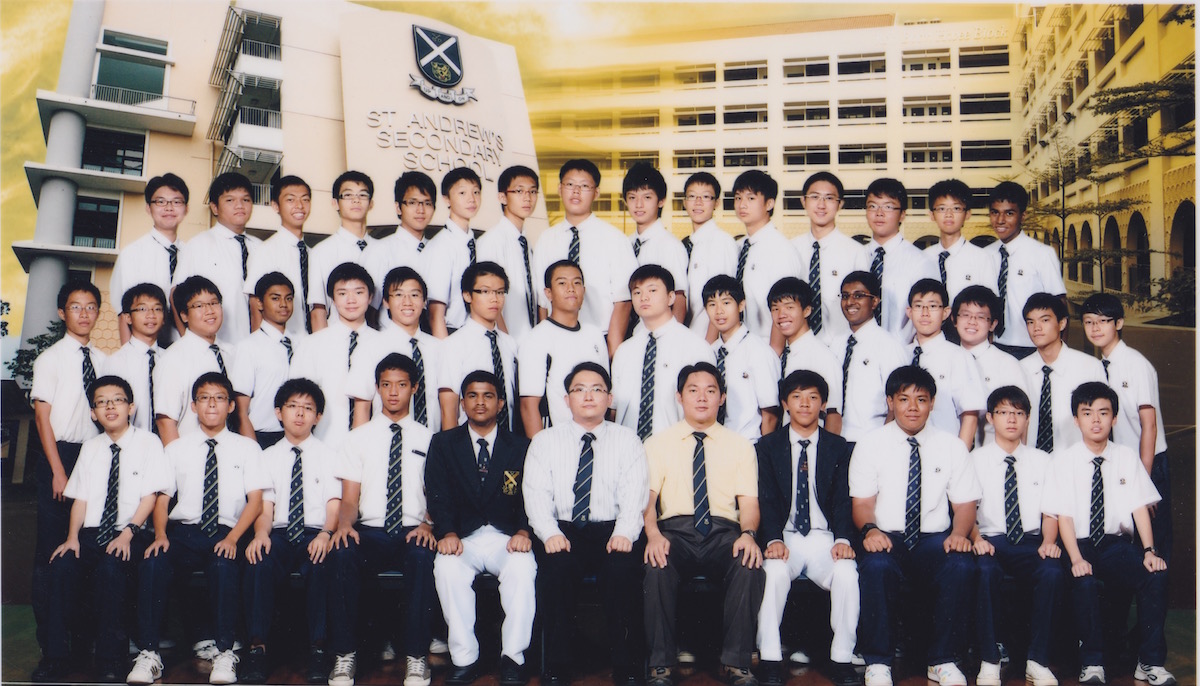
Bryan (front row, middle) in his Sec 3 yearbook photo.
How did you apply for the job? Did you have to do anything special in the process of applying for it?
Application is through a MOE [Ministry of Education, Singapore] portal, where you have to first create an account and thereafter furnish your details for registration. In short, the documents you need at hand are your past education result slips and personal information. Upon registering, MOE will review the documents submitted and decide whether you have the qualifications to become a relief teacher. If approved, the next thing is to make a trip down in person to your desired school to register with the school. (Proximity to the school plays a considerable part in whether the school will accept you or not.)
Applications can be made throughout the year but will only be reviewed in 2 windows, 1 January to 28 February and 1 July to 31 August.
To be eligible as a Relief Teacher, you have to possess either: 1) an on-campus Degree or be an undergraduate pursuing an on-campus degree; 2) have a diploma from a local polytechnic/IB Diploma; 3) with at least 2 GCE ‘A’ Level/H2 and 2 GCE ‘AO’ Level/H1 passes (including General Paper); or 4) 5 GCE ‘O’ level passes (including English and Mathematics) with L1B4 of ≤ 26 points.
More details on application and eligibility can be found in this link. [LUCK-IT disclaimer: This post is not sponsored by MOE. All MOE links are provided purely because of Bryan’s enthusiasm.]
How long did it take for you to go from applying for the job to getting hired for it?
Approval can take roughly 3 weeks to 1.5 months from submission of documents. After which, registering with the desired school can take an hour or 2 depending on the availability of the Head of Departments (HODs) or Principal/Vice-Principals who will interview you to determine your suitability for the school.
Why do you think they hired you for the job?
I met the minimum requirements meted out by MOE, and I was recommended by an ex-teacher from my alma mater (St. Andrew’s Secondary School).
What is the work routine for a relief teacher like?
The school(s) that you’ve registered with successfully will call you in the morning (on the day itself) if they require your assistance. The school that I was registered to would call between 6:45am and 7am if they required me to come in that day. This may differ from school to school. Relief teachers are required to come in by 7:30am to collect the relief schedule for the day. The first period starts at 8am and the last period typically ends at 2pm or 2:30pm. There is no dictated lunch period–teachers normally take the chance to grab a bite or drink during their free periods, whenever that may be.
How do relief teachers spend their weekends?
Unlike full-time teachers, relief teachers do not have to prepare materials for class or bring worksheets/exam papers back to mark. Hence during the weekends we are free to enjoy the time at our own pleasure.
Bryan (middle, with hands on side) in Sec 4.
What advice do you have for someone hoping to become a relief teacher at their alma mater?
If you have teachers who have taught you in the past and are still teaching at the same school, you can reach out to them for advice on how you can go about applying to the school. If you have left a good impression on your teachers upon graduating, they may put in a good word for you with the school’s upper management.
Can you map out a recommended path for people who want to be relief teachers at their alma maters to follow?
As mentioned, apply through MOE and get yourself approved to relief teach first. Then proceed down to your alma mater’s General Office to apply as a relief teacher. Knowing an ex-teacher that you have built a good rapport with in the past is beneficial as they can put a good word in for you with the HODs/Principals who are going to interview you.
What has the experience of being a relief teacher been like for you?
The first few days/weeks will be a bit of a challenge as you have to first discover ways to teach or discipline students. But as time passes, you will pick up skills from your fellow teachers and colleagues on how to deal with more difficult students. As an ‘old boy’, students tend to look up to you as they know that you’ve once been sitting in the very seat they are in now.
Have you changed as a person since becoming a relief teacher? Or learned some things you didn’t know before?
Relief teaching has taught me patience when it comes to educating the younger generation. I have had the chance to see how both the students and the education system has changed since my days as a secondary school student 10 years ago. There are now other schemes for Normal Academic students to through-train into polytechnics without having to take their ‘O’ levels, as well as a major change in the education system to look forward to in the next few years.
The school which educated Bryan and later became his source of temporary income.
If you could go back and replay your time as a relief teacher all over again, what would you do differently?
Wouldn’t change a thing, the students and teachers I’ve met really do bring back memories of those carefree days as a student.
How have you changed since secondary school? Or have you not changed?
My thoughts have definitely matured since. In secondary school you’re kept in this protected environment and things that happen around the world don’t really affect to you. I’m glad to know that the education system has opened up to give students a more worldly perspective.
Do you think your secondary school has had an influence on your personality today? If so, how? If no, why not?
Yes! Saint Andrew’s is an Anglican mission school teaching Christian values, which has definitely made an impression on me even through my young adult years.
Which 3 objects/people in your life can you presently not live without and why?
Friends, good ones. They stick with you through good and bad times and provide valuable perspective on matters to help you better see a situation you’re in.
Of all the objects you bought in the past year, which has most positively impacted your life? Why?
In this technological age it would be my new phone [the iPhone XS]. Eons faster than my previous one and with a better camera, it has made me more productive as I use my phone a lot for work/keeping up with friends.
Which person do you wish LUCK-IT would interview for you to learn from? Why?
Anyone who can give young working adults good advice on saving for the future.
[UPDATE: We have found some answers on saving for the future for Bryan. Click here to read them.]
Bryan now (middle), on the job as a relief teacher.
Bryan starts working at Singapore Airlines as a Cadet Pilot this month but will try his best to answer questions on relief teaching when he has the time if you leave them in the comment box below. Aspiring pilots can also reach out to him via his Facebook page should they need help preparing for airline job interviews (at his discretion).
Photographs courtesy and copyright of Bryan Yong. Interviewer: Sy If you found this article useful:
Back in 2015, 19-year-old Jeshua made the decision to rent out his personal collection of camera gear and started a Facebook page titled ‘J Rental Centre’ to do so. Today, J Rental Centre has a website, an office, staff and three collection points all around Singapore. LUCK-IT asked the now 24-year-old entrepreneur/film-maker how he did it.
“I would say the reason we’re still here and still focussed on the same vision of connecting people is because of the community impact we have seen.”
Q: Why did you decide to start an equipment rental business? And how is it you could start it with almost $0?
A: We’re not exactly an equipment rental business but a peer-to-peer platform, something like Airbnb/Grab, that connects owners and renters of camera gears, event logistics and creative spaces with each other. I began JRC.sg in early 2015 as I saw that the existing rental houses were expensive and rigid, especially for students and smaller productions. We wanted to provide a rental service that is both affordable and convenient, while focussing on the people element, not just the hardware or spaces. There is nothing like getting tips directly from a professional owner and a few minutes chat can prove more useful than 2 hours of manual-reading or YouTube-watching.
The business was started not as a business but as a means of cost reduction and better utilising resources which I already had. There wasn’t capital investment that could be measured in $ but certainly a lot of time and energy in formulating the policies, writing agreements, developing the website, marketing, and the list goes on.
What was your first year of business like? How did you get customers and what did you learn along the way?
JRC began as a Facebook page with a list of stuff that I personally already owned. Shortly after, some friends also wanted to rent out their equipments and we grew the list, then created a blog-site. The first few customers came from people whom I had known through school and work and word slowly spread through word of mouth as well as our digital marketing efforts.
J Rental Centre’s first Facebook list of gear for rent.
How did you start expanding your business? Was it something you planned for at the start or something that occurred organically?
In 2016, we launched the first version of JRC.sg which listed camera equipment like DSLR, lenses, lighting, sound and support gear from 16 different owners all over Singapore. It was a huge step up from the Facebook page or blog-site but still largely manual in the way we cleared inquiries, created invoices and collected payments. More partners came on board—some customers and some who just had a spare set of kit they didn’t want collecting dust at home. Today, we have over 100 owner partners and are on our second version of the site which features two new verticals (event logistics and creative spaces), e-payments, user accounts, online ID verification as well as a host of other bells and whistles. We are always thinking of ways to add value and connect more people as we know that there is still a sizeable portion of the media and events industry that are more used to just walking into a shop to get what they need.
How long did it take you to get to the point where you felt like your business would be sustainable in the long run? Was there a significant turning point/course of action that got you feeling that way?
I don’t think that we have even reached this point today, despite being around for over 4 years. Reaching critical mass and achieving a network effect that is win-win for all parties is not easy, and even companies like Grab are not profitable yet. I think a better question would be at which point did I start taking this Facebook page that I created more seriously and try to scale up what we were doing, and that would have to be in 2016, when I saw that having a site which organises the listing information was going to be very important if we wanted to connect more people. So, I hired a developer to code the first version and started taking in some interns to assist with marketing as well as thinking of new ways to grow the platform.
J Rental Centre’s present website.
Did you have any setbacks or wins along the way while in the process of doing the above?
Our setbacks include lengthy development time, especially on the current site, as I was properly trained in film-making and not as a tech-geek, some mis-steps in terms of trying to penetrate the clothes rental market sometime in 2017 and a bunch of poor hiring decisions. I would say the reason we’re still here and still focussed on the same vision of connecting people is because of the community impact we have seen. The power of team cannot be underestimated, especially in a small industry like media. It is always good to know more people and the transactional value of renting out a piece of kit is actually far lower if this transaction actually leads to a friendship or even becoming acquaintances with each other.
What was your routine like when trying to expand J Rental Centre?
Routine would be the last word I’d use to describe a lot of things that I do but we’re really goal-oriented and try many different things to fulfil the goals that we have set out. A lot of focus would be on balancing the chicken and egg problem which would bug most platforms–having too many ‘suppliers’ would mean that each person has less transactions, while having too many ‘buyers’ would mean that each buyer has insufficient choice. So it is a balancing act and we are always trying to court both sides to tell them about why they should use the platform or how we can help them to achieve their goals (be it to save costs, learn more, increase revenues or worry less about safety and procedures).
J Rental Centre’s City Hall Collection Point.
What about now? What is your present routine like?
I now spend a good amount of time working remotely, travelling back and forth from Myanmar where I have started Crossworks since 2018. The company was started to help local Singaporean companies (such as my own) hire remote talent from Myanmar/Yangon to fulfil their manpower needs as well as lower their manpower costs, while stopping the brain drain out of Myanmar.
How do you presently spend your weekends?
If I’m in Singapore, I’d either be busy with productions, accounting, emails, or in church where I serve in the live production team as well. If I’m in Myanmar, I could be on a boat, up in the hills, by the beach or in a city–that’s really much less predictable.
What advice do you have for someone hoping to start their business at age 19, or with $0?
It’s not going to cost $0. Take into account the time and attention that will be the investment in whatever you’re doing but also don’t stop at ‘hoping’ and ‘dreaming’—the realistic chances of success are slim (statistically speaking) but I think that if you’re like me and don’t take it too seriously and are doing something that you like, it’s always worth trying and learning along the way.
Can you map out a recommended path for people wanting to start their business at 19, with $0, to follow?
I don’t have one and I don’t think one exists. I would suggest as above but if you have a clearer idea of the kind of business you’d like to setup, talk to some potential customers/partners and see if that is something that they would need. Don’t be surprised if there is hesitation or if they don’t sound supportive but take those initial observations in and remember why you started always.
This is Jeshua.
Which key things/people/situations enabled you to keep and grow the business you started at age 19, in your opinion?
The business began after a few other platform businesses like Airbnb, Uber/Grab, etc, started, and people became more open to the idea of resources being shared instead of just owned. The gig economy was also and is still continuing to expand such that people do not need to keep all the resources in-house and have them be less than optimally utilised but are able to ‘plug and play’ resources as and when needed.
How did starting your own business at 19 change you as a person? Or did it not change you?
It gave me the opportunity to interact with much more people and hence I would say that it has changed me for the better.
Jeshua’s present office in Tai Seng, Singapore.
If you could go back and replay the adventure of starting and running J Rental Centre all over again, what would you do differently?
I would focus on what I can do at this present moment.
What were you like as a child? What about as a teenager and young adult? How did you change at every decade? Or did you not change?
I never liked being bored. I don’t think that has changed but I have learned to value quiet and slow moments, grown in patience as well as increasingly seen the value in some routines.
Which major event in your life has made you who you are, in your opinion? Why do you think so?
Not one event per se but in general not having examinations being a huge part of my life at any point made me realise that there are more important priorities. Learning became a joy and something I still constantly try and do. With grades and accolades being something that many people in our society get caught up with, I think it gives me a different perspective when looking at issues or making decisions.
Which 3 objects/people in your life can you presently not live without and why?
Objects are easier. A laptop, phone and my passport. I use these to get work done and get around.
Of all the objects you’ve ever bought/received for the purpose of expanding or sustaining J Rental Centre, which has been most useful? Why?
We’re not really a brick and mortar store so I guess our website itself is our biggest asset to help connect people.
Jeshua’s studio at Tai Seng, Singapore.
Which person do you wish LUCK-IT would interview for you to learn from? Why?
Jony Ive—his design has had a huge impact on the world we live in today.
What’s the worst advice you’ve been given, or have heard people giving? And what’s the best?
I have forgotten most of the worst advice. Some of the best would be to take care of yourself physically and not neglect health while focussing on your other priorities.
Jeshua presently runs his two other businesses—Crossworks and Startupmedia—on top of running J Rental Centre. You can connect with him at those websites or his LinkedIn page, or drop him in a question in the comment box below.
Kamil Haque was just 24 when he got himself employed as an acting instructor at the Lee Strasberg Theatre and Film Institute in Los Angeles—the school which trained actors like Paul Newman, James Dean, Marilyn Monroe, Lady Gaga, Al Pacino, Claire Danes and Robert De Niro—and 30 when he started Haque Centre of Acting & Creativity (HCAC) in Singapore—the self-funded, diverse acting school which coached Henry Golding before he got the role in ‘Crazy Rich Asians’. Six years on, Kamil tells LUCK-IT all about getting employed in Hollywood right out of school and everything a person needs to do to become an acting instructor anywhere.
“If I told you I got employed by refusing to leave the administrative office until they promised to hire me, would you believe me? Well, that’s exactly how I got the job.”
Q: First off, can you tell us about the Lee Strasberg Theatre and Film Institute? What is it, where is it and how prestigious is it, really?
A: It was and is a school started by Lee Strasberg in 1969 to teach what Lee had become famous/notorious for which is the heavily misunderstood concept of method acting. Lee’s method had been shaped through over 30+ years of refinement in various capacities and for the first time in a major way, his work was made available to the masses in a consistent way via his two schools, one in L.A. and one in N.Y.C.
What makes a school ‘prestigious’? Is it the facilities? The location? The staff? The process to gain admission? The alumni? I’d say for the first four criteria there is hardly anything that would make it stand out to the casual observer. Where the Institute has really cemented its name is in the strength and sustained success of its alumni and the association Lee Strasberg had directly or indirectly in training some of the world’s greatest actors which in no particular order include Paul Newman, James Dean, Christoph Waltz, Marilyn Monroe, Lady Gaga, Al Pacino, Claire Danes, Steve Buscemi, Robert De Niro, and the list goes on.
What about your acting school? What is it all about, where is it and why did you start it?
My acting school, Haque Centre of Acting & Creativity (HCAC) was founded in 2013 as the culmination of a 20+ year childhood dream to have my own school that is in many ways modelled after the Strasberg Institute and also other acting schools and private acting associations I have been a part of over the years. HCAC is the first professional acting studio in Singapore. The school doesn’t subscribe to only one method of acting and has workshops that span across various modalities of performing arts. The school caters not just to actors but also to a significant group in Singapore I called Creative Double-Lifers—people who are in some sort of parent-approved profession from 9-6 but are in need of an outlet or who want to maintain a second parallel path in the creative arts that their personal or professional life does not provide them. Perhaps they even have no ambition at all to perform but they believe there are essential skills from the arts that might benefit their personal or professional lives. My studio is located in a shophouse in the heart of Little India at 89A Desker Road. I started the school as a place for artists to refine their craft in a professional environment, a place for people to figure out what stories they want to tell and to have my teachers provide them with the tools and skills on how to tell them better and lastly as a place where self-expression has a safe space to flourish in a country that perhaps doesn’t value it as much as it could.
Kamil (left) with one of his students at the Strasberg Institute in Los Angeles.
How did you even get employed as an acting instructor by the Lee Strasberg Institute anyway? How does one qualify to be an acting instructor anywhere?
If I told you I got employed by refusing to leave the administrative office until they promised to hire me, would you believe me? Well, that’s exactly how I got the job. I remember, the very first day I arrived in L.A. to register for classes at the theatre school as a student, I told the administrative head I wanted to teach there instead. She laughed and said I couldn’t simply because I didn’t know what they taught. I was really stubborn and I insisted we come to compromise. We agreed that if I could finish the 2-year programme (and many people don’t for various reasons) then I could possibly teach. Challenge accepted. Within the first 9 months, I identified my mentor and made my intentions known to her and she was generous enough to teach me acting as well as how to teach acting. With each lesson she would slowly let me teach parts of it in increasing increments eventually working my way towards being a substitute for her when she was unwell. Literally, the day after I graduated, I told them “I’m done with the program, I want to teach.” They saw that throughout the two years, I was willing to work hard, to grow, to learn and I was also helping people who were new to Los Angeles, the school and to the work. Because I had also established myself as a capable teacher and substitute, the transition to full-fledged teacher was easy. They saw the passion so they fulfilled my wish.
To be an acting instructor anywhere I think you first have to have a love for teaching. To be a teacher you have to be an activist and love to serve. Beyond that, as an acting instructor specifically, you have to have a keen eye for the human condition and be equal parts intellectual and instinctive in elevating your students and giving them ample opportunities to have lightbulb moments. Beyond that, of course as with any profession, having the appropriate credentials certainly helps.
I’m very sorry if this comes across as rude, but… why not just be an actor? Why be an acting instructor?
It’s not that I don’t love acting. Acting will always be my first love. Over time, I have realised while I love acting, it is something that feeds my ego. Teaching on the other hand is something that feeds my soul. I can’t imagine doing one without the other. After all, what is an ego without a soul and vice versa?
What do you presently teach at your acting school and how did you come up with the syllabus?
“Since the bulk of acting pedagogy comes from Lee Strasberg and I’m the only teacher in Asia who has credible experience teaching his work, I specialise in teaching all aspects of Strasberg’s work.”
Since the bulk of acting pedagogy comes from Lee Strasberg and I’m the only teacher in Asia who has credible experience teaching his work, I specialise in teaching all aspects of Strasberg’s work and by extension workshop-productions for all students to practice what they’ve learnt to test it outside the echo chamber of a classroom.
My syllabus and how I shape the syllabus for the other workshops not taught by me is really to ensure there is an egalitarian approach to actor training. I must stress again that HCAC doesn’t subscribe to just one methodology of acting and that all methods are welcome here and when taught, they are taught by specialists so students are exposed to the breadth and depth of acting so they can make informed and empowered decisions on how to create a method that works for them.
Kamil (foreground) facilitating a workshop-production at the Strasberg Institute.
Can you share what your schedule and weekly routine was like when you were an acting instructor at the Lee Strasberg Institute?
The schedule varied depending on the semester and the demand for workshops depending on the size of the student population. At its peak, I might have taught up to 12 hours a day but never more than 2-3 days a week.
What about now, what’s your present routine like now that you’re also a businessman on top of being an acting instructor?
I typically start my day around 10:30am. At home, I answer emails from potential students, corporate training enquiries and even production houses that need assistance with casting actors for their projects. My arrival at the studio usually coincides with a lunch meeting for upcoming projects or rehearsals. I might bookmark that conversation for the moment to welcome private clients who need coaching. Some are prepping for a role; others need a sounding board if they have already been cast. But the majority of my students are Creative Double-Lifers who need coaching on public speaking and presentations. If I’m not in the studio, I might be found at a bank teaching improvisation at the workplace or some such form of corporate training that incorporates acting.
When the afternoon flurry is done, there might be a lull to attend to emails for a couple of hours before it picks up again from 7pm when my teachers and I begin our acting workshops. Classes officially end about 11pm and unofficially, much later. When I’m finally done, usually around midnight or so, I stick around to answer questions from students and answer more Whatsapp messages or emails that have appeared in my Inbox That Never Empties™. I finally make it back home by about 1:20am or so and allow myself to binge on Netflix or football news (Go Manchester United!) to decompress before drifting off to sleep around 3am to start the cycle all over again. The work is taxing and I’m usually at my studio 6-7 days a week. I hardly see my own family and barely have time for a social life. I’m slowly learning to be better at that last bit with some amazing people in my life who balance me out.
How do you presently spend your weekends?
If I don’t have to be at work, I avoid it! Instead, I might watch a play or movie or binge on Netflix (I’m not ashamed to say I watch a lot of crap because most other times, it’s still like I’m working because I’m subconsciously analysing what I’m watching). Ideally, I’ll be with my partner and we’ll relax over good food, home-cooking, drinks with friends or decompressing from the week by relaxing at her home.
Haque Centre of Acting & Creativity (HCAC) is located in the heart of Little India at 89A Desker Road.
What advice do you have for someone hoping to become an acting instructor? What about for someone who hopes to open their own acting school one day?
Do it because you love it. Not because it’s a cash grab (because there isn’t much to grab!) or because you aren’t getting much work as an actor. The last thing the industry needs is a cynical ex-actor who is jaded and jealous of their students. If someone has hopes of opening their acting school one day, come talk to me. Maybe you can teach me something!
Can you map out a recommended path for people who want to be acting instructors to follow? What about for people who want to open their own acting schools?
Get solid training with specialists. Learn the breadth and depth of methodologies that inspire you. Find a mentor who is a said specialist. Learn how to teach from them. Learn how to create your own way of teaching. Get as many teaching hours in. Whilst doing so, get out there and act. Learn what it’s like by being an actual practitioner too so you understand what your students go through. If you approach such a hands on craft from pure academics and intellectualisation then you are not really doing justice to what you teach. If you want to open your own acting school, go work in one for several years first. Figure out what works and what doesn’t before you embark on your own initiative.
What are the key things/people/situations that have enabled you to be an acting instructor, then to set up and run your own acting school, in your opinion? Who/What was/is indispensable?
In my life, whether by my own doing or by mysterious forces I am not privy to, I’ve had the good fortune of always having mentors and guides to nudge me along, believe in me and call me out on my BS. To set up and run my own acting school, truthfully, six years in, I’m still learning how to do that. Come back and ask me again in 44 years time.
How did becoming an acting instructor and owner of an acting school change you as a person? Or did it not change you?
It made me more responsible because for my employees, their livelihoods are in my hands. For my students, their careers are in my hands. My own future and what I want to see happen in it is in my hands.
If you could go back and replay the whole process of becoming an acting instructor and starting your own school all over again, what would you do differently?
Had I more insight into the world of business, perhaps I would have done more research into the business climate of the arts in Asia and I would have ascertained how I could have gotten more business managerial support and other means of funding to scale the school up faster.
Kamil (with card on head) conducting ice-breaker games at an Improv & Think Fast Workshop with corporate clients.
What were you like as a child? What about as a teenager and young adult? How did you change at every decade? Or did you not change?
I was a pain in the ass. I was loud (I still am at times) but that was mainly from a constant desire to impress, or fit in or to shape shift without having a voice of my own. As I got older and certainly from my time in L.A., I discovered my own voice, my own body, my own mind and I had actual infrastructure to bring my childhood dreams to life.
Which major event in your life has made you who you are, in your opinion? Why do you think so?
I first got involved in acting in kindergarten in my stage debut of ‘The Bear Went Over The Mountain’ but it was in my primary one performance as the dog in ‘Old MacDonald’ that I caught the acting bug. My parents would also often take me to movies as a kid and I remember that it was after watching ‘Dead Poets Society’ that I knew acting (and eventually teaching) was what I wanted to do. I distinctly remember on the car ride home from the old Orchard Cinema (what is now Orchard Cineleisure), I was sitting in the backseat expressing my thoughts and opinions on the movie, specific events in the movie and their significance and what the movie meant to me. To that, my parents turned back to look at me and asked how I was able to have such thoughts that were apparently well beyond my years. Shortly after that, they also enrolled me into acting school with Julia Gabriel (who I remain eternally thankful to) and the rest they say is history.
Which 3 objects/people in your life can you presently not live without and why?
My parents (I collectively count them as one because they are divorced and I speak to them exclusively on separate matters so together they form one super human). My girlfriend who is my cheerleader, my rock and my biggest bullshit alarm. She helps me keep it real. Sambal belacan/chilli to spice up my food because I live for that pleasure from pain!
Of all the objects you bought in the past year, which has most positively impacted your life? Why?
A engraved bracelet I always wear around my right wrist that says ‘Know Thyself’ because it’s a constant reminder for me to be self-aware, sensitive to my own needs and boundaries and also because I’m too much of a coward to get a tattoo with the same phrase.
Which person do you wish LUCK-IT would interview for you to learn from? Why?
My parents because I don’t know enough about them and I doubt they would actually tell me if I sat them down to ask.
Kamil (in blue) on a set directing camera crew and actors.
What’s the worst advice you’ve been given, or have heard people giving, with regards to acting? And what’s the best?
Worst Advice: Don’t waste your time with acting. Get a real job.
Best Advice: Genius is inspiring. Smart and hard work gets results.
Kamil is presently working on HCAC’s current set of workshops, planning for the rest of 2019, developing the Haque System of acting, setting in motion the HCAC ensemble, doing more corporate training, figuring out how scale up his business and inviting investors and business angels to take a plunge with him—more details available on his website, www.methodactingasia.com. When he has the time, he will also answer queries about acting, teaching and starting acting schools so if you have any questions on those, drop them in the comment box below.
Photographs courtesy and copyright of Kamil Haque. Interviewer: Sy If you found this article useful:
When Liew Tong Leng was 23-years-old, he took part in his very first photography competition and won a prize. In the three decades that followed, he participated in more than 300 photo competitions and won more prizes in at least 200 of them—including $30,000 worth of cash and camera equipment on local reality TV competition ‘The Big Shot‘, $10,000 in a Great Eastern photo competition and another $10,000 in a Konota photo contest. He tells LUCK-IT all about his keys to winning and lets us in on what made him the man he is today.
“It’s the process of taking part in competitions that moulded me to be what I am today. There is no short cut.”
Q: How did you start taking part in photography competitions? Which was the first one you participated in and did you win that?
A: I started taking part in photography competitions in 1992 through the influence of friends. I happen to know many photography friends who take part in competitions and I joined them to benchmark myself and also to improve my skills.
How many photo competitions did you lose before you finally won a prize in one?
The first time I took part in a photo competition is also the first time I won a prize.
The last photograph Liew won a competition with — at the SAFRA members’ annual photo competition. (As of Apr 2019)
Which was the first photo competition you won first prize in?
I really can’t remember when I first won a first prize because it was a long time ago and it was still in the film era.
Now that you’ve won many competitions, what, in your opinion, are the key elements that make a winning photograph? And what are the skills a photographer must have in order to achieve that photograph?
I think a winning photo must contain three elements: good lighting, good composition and a good moment. The most important being a good moment. In order to capture a great moment, you have to anticipate and be ready.
How frequently do you take part in photography competitions? Is there a routine you have to keep track of all the competitions going on and if so, what is it?
I take part in photography competitions almost every month. I have a way of archiving all my potential winning photos and categorising them.
How often do you pick up a camera when not participating in photography competitions? What do you usually do with the camera then?
I shoot almost every weekend when I’m free. I don’t wait for a competition to be available to go and shoot. It’s the other way round—I shoot first, categorise them and then select the suitable photos for the theme of different competitions.
Liew’s entry for the Perspectives, Capture The Moment Photography Competition.
How do you presently spend your weekends?
Shooting.
What advice do you have for someone hoping to win not just one but many photography competitions?
Study competition photos. Learn the elements required in a winning photo and keep shooting different genres.
Can you map out a recommended path for people who want to win many photography competitions to follow?
As above.
What key things/people/situations enabled you to win so many photo competitions, in your opinion? Who/What do you believe you never would have succeeded without?
Passion and hard work. Again spending time and being hardworking is my key to winning.
How did winning many photography competitions change you as a person? Or did it not change you?
I always strive to be creative and shoot differently in order to win. Since 1992 when I started photography, I had that passion and till now I’m still burning with that passion to take great photos, but through the years, in terms of photography I see things differently now.
Liew’s entry for the 4th Great Eastern “Life is Great” Photo Competition.
If you could go back and replay all the competitions you’ve ever taken part in all over again, what would you do differently?
No, I think it’s the process of taking part in competitions that moulded me to be what I am today. There is no short cut.
What were you like as a child? What about as a teenager and young adult? How did you change at every decade? Or did you not change?
As a child I was quite an introvert. As I grew and started to win photo competitions, I was known and became more confident of myself.
Which major event in your life has made you who you are, in your opinion? Why do you think so?
Winning the first prize in the TV reality show, ‘The Big Shot‘. The photography competition was quite a major event in my life. I was on national TV and the attention increased. I had to learn to be humble and yet confident in what I do.
Liew’s photography gear.
Which 3 objects/people in your life can you presently not live without and why?
Camera equipment. Without it, I can’t shoot.
Of all the objects you bought for photography in the past year, which has most positively impacted your life? Why?
Photography equipment is just a tool to take great photos. It doesn’t really impact my life.
What’s the worst advice you’ve been given, or have heard people giving, with regards to photography? And what’s the best?
The worst advice I heard was to fix certain settings while taking a photo. I think the best advice was to explain the reason I do certain things instead of just telling others what to do.
Liew is presently an Airworthiness Manager with CAAS (Civil Aviation Authority of Singapore) and regularly posts his photographic creations on his Facebook and Instagram pages. He is also happy to answer questions on photography so if you have a burning question about photography techniques or competitions for him, drop them in the comment box below.
Photographs courtesy and copyright of Liew Tong Leng. Interviewer: Sy If you found this article useful:
Sean Cheong, a TV director/writer/producer/lecturer/course developer, was 17 when he began freelancing in the media industry on a part-time basis and 29 when freelancing became his primary occupation. Now with seven years of full-time freelancing under his belt, he tells LUCK-IT how freelancing in the TV/advertising/radio industries of Singapore really works.
“Always have a back-up plan, or a diversification in your industry. ”
Q: How did you end up freelancing in the media industry? Why didn’t you get a full-time job instead?
A: It was not really a conscious choice. I think it is the nature of the industry. Most of the work is freelance and full-time jobs are limited. So I started to freelance and then one thing led to another and it just happened naturally. So now I’m full-time freelance and have been for the last ten years.
What were the early days of you being a freelancer like? How did you get jobs? Did you think you would succeed or fail? Or did you have no idea what to expect?
The main thing it taught me was to treat every job that I do as if it is my last job, because sometimes it literally is. You won’t know where or when your next job will come. So this means that:
a) I do the best I can. b) I service the project/client the best that I can. c) I have to be frugal with every cheque that I get. d) You have to rely only on yourself. It’s up to yourself to hustle to find the next job, etc. Don’t expect it to come to you so simply.
Sean (with cap) directing TV drama, 2025.
How long did it take for you to end up with a sustainable income from freelancing? Did you have any setbacks or wins along the way?
If by sustainable, you mean stable, then it’s still not. It never was and I wonder if it ever will be.
What was your daily routine like in the early days?
It’s been so long ago, but if I remember it correctly, it was a lot of getting myself out there to try to find a new gig to do if I was not already on one.
What about now? What’s your current daily routine like?
Sean with actress, Huang Biren, when directing a Milo TV commercial.
Mostly hanging out with my wife and baby. I don’t see the need to be enthusiastically getting myself out there to try to find a new gig. On that front, I think I’ve reached a point where either people know me enough to know where to find me or they don’t know me/are not interested to, and as such, that won’t change very much.
How do you presently spend your weekends?
Again, hanging out with my wife and baby.
What advice do you have for someone thinking of becoming a media freelancer in Singapore?
1) Always have a back-up plan, or a diversification in your industry. I’m glad to currently have two other diversifications while still doing media.
2) Find a way to make your money work for you through investment or dividend revenue instruments. As it is, we work hard for our money, harder than perceived sometimes. It will be a waste not to make it work hard back for us.
Can you map out a recommended path for people who want to be media industry freelancers in Singapore to follow?
There is no such thing as starting out at the top from the start. Start from the bottom, do everything, do anything. If you move higher to the top, that’s good on you and that’s a bonus.
What are the key things/people/situations that enabled you to become a media industry freelancer, in your opinion?
I honestly don’t know because I am still finding it. But if I were to guess, I would say being reliable and positive is important. I have, at no point, let any project down (in terms of delivery schedule) or given up, no matter how tight or poor the conditions are.
If you could go back and replay your entire career all over again, what would you do differently?
I would have made some better decisions on some of my jobs. People have longer memories than we expect.
What were you like as a child? What about as a teenager and young adult? How did you change at every decade? Or did you not change
I don’t know about changes. I always wanted to work in television. I just grew up into a young adult and am doing it so, I lived the dream somewhat (and still am).
Sean (pointing) on another one of his many projects, in 2013.
Which major event in your life has made you who you are, in your opinion? Why do you think so?
Getting let go from a dream job (it happens) which I was convinced I could do until I was in my sixties, for reasons that is not related to my skill and competencies in the media. Other than the shattering of a dream, it made me realise the only reliability is me, myself and I.
Which 3 objects/people in your life can you presently not live without and why?
Of all the objects you bought in the past year, which has most positively impacted your life? Why?
I have not bought anything in 2018, unless it’s for my daughter so…
Sean (with cap) on the set of 2025 with cast—Nicholas Lee, Gerald Chew, Edward Choy, Melissa Yeo, Eunice Annabel Lim, Amy Cheng, Scoot Hillyard and Amesh Kumar.
Which person do you wish Luck-it would interview for you to learn from? Why?
A stock day trader. It’s something I would be interested to know more about. It’s also a skill that I am currently learning, that I wish to improve on.
What’s the worst career advice you’ve been given, or have heard people giving? And what’s the best?
Worst: (It was not given to me, but it is done and I have heard of people doing it.) “As long as you participated in it, just put it in your C.V., write ‘you directed/shot it’. You are not lying. You did participate in it.” As a means to make your C.V. look better. It has also been done to me when an intern on one of my productions said they directed a particular production when applying for the job. There are ways and things you may need to do to get ahead, especially in the early days when you are starting out fresh, but this is not the way. It’s actually stupid.
Best: “You can’t control what others think, but what’s within your control is to keep your nose clean.” I do that all the time.
Sean is presently still a full-time freelancer and TV director, busy with his 11-month-old daughter, managing his stocks portfolio on NASDAQ and the SGX and running two other businesses on the side. You may read more about him on his website or ask him questions about becoming a media freelancer by dropping them into the comment box below.