Greg from the USA has been living in China for over 6 years—first Hangzhou, then Guangzhou and now, Shanghai, the most populous city in China. He told us about the situation in Shanghai amid the coronavirus outbreak in Wuhan 690km away, and shared what he sees on the news within China that others outside of China might not see.
“The phrase that keeps appearing is “no other country could do this but China.””
Q: Hi Greg, thanks for connecting with us all the way from Shanghai! When did you first hear about the 2019-nCoV coronavirus and what did you think of it then?
A: At this point, I can’t quite remember when I first heard about it. Every day there are articles with updates, so it is hard to keep track. I’m pretty sure it was soon after it started, which would put it sometime between January 12-18.
How concerned are you now? How many people do you personally know who’ve been afflicted with the coronavirus?
I personally don’t know anyone who has been afflicted with the coronavirus. I suppose I’m not too concerned, mainly because I was still finishing my trip abroad when announcements of different quarantining measures were announced. As I was returning, I faced far less in terms of “extra precautions” than I expected.
How many cases are there in Shanghai at the moment of this interview? How concerned is Shanghai at this point?
At the time of filling out these questions (February 7), the official government approved stats say that Shanghai has 269 confirmed cases, 25 recoveries, and 1 death.
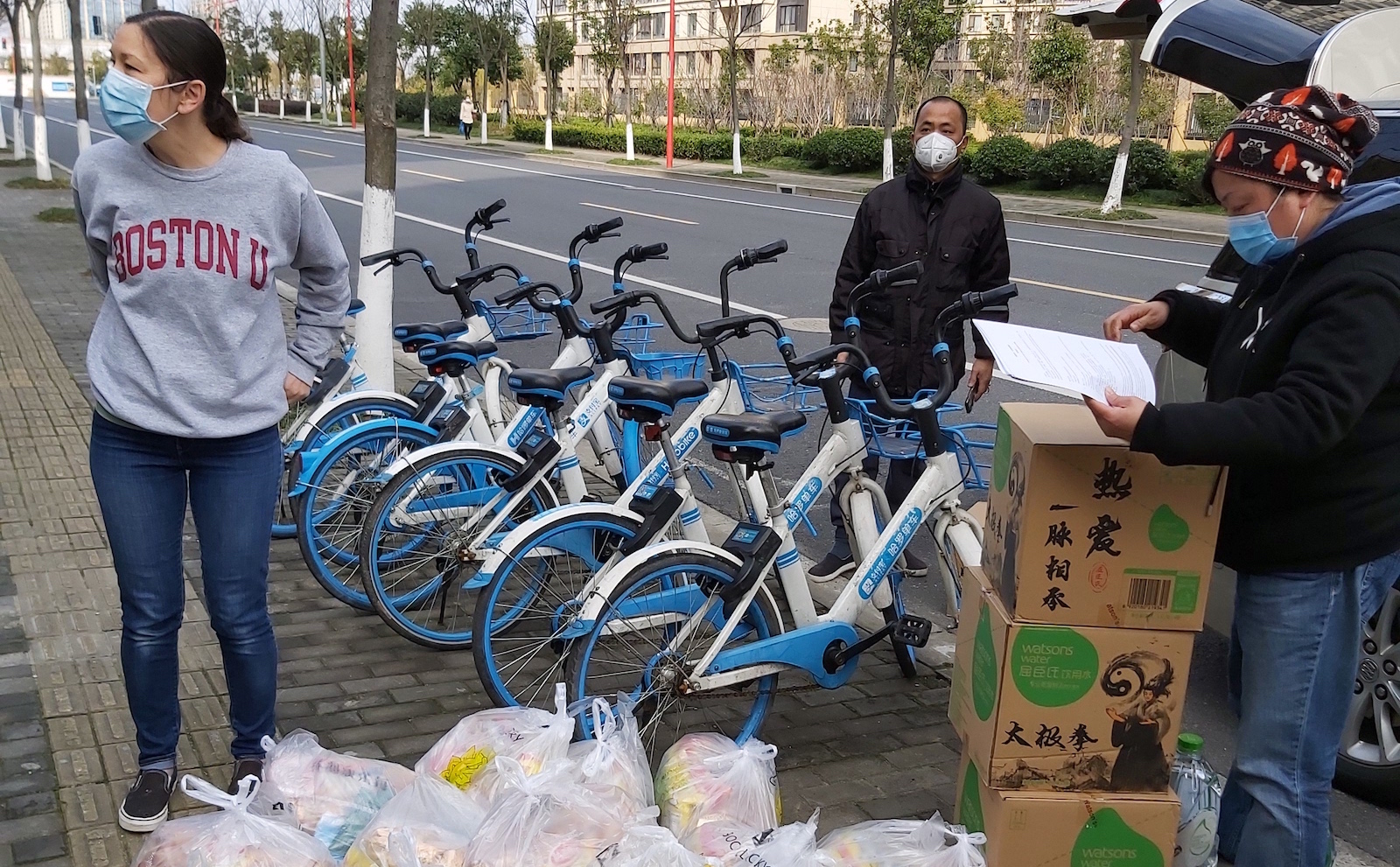
“Standing outside my apartment complex while the school helpers unload our “emergency” packages.”
Why do you choose to remain in Shanghai regardless?
I really didn’t choose to remain in Shanghai, my school repeatedly told us that if it’s at all possible to return then we should make every attempt to do so. Since I didn’t encounter any hiccups on my return flight to Shanghai (I expected there to be at least a delay if not a cancellation since a number of other coworkers noted that their flights had been delayed and cancelled), there was no reason not to return.
Is there anything you know about the situation within China or in Shanghai that has not been mentioned, or has been misrepresented, by news agencies outside of China?
Now that is quite difficult to answer. As I wrote about in my recent blog post about this, I mentioned how the news coverage inside and outside of China are quite different and the only numbers that everyone is looking at are the numbers released by the Chinese government. Whatever we “know” is whatever we read about in articles posted on WeChat (the biggest social media app in China).
What I can say is that inside China, what we are presented with is how fast and efficient the government has been at putting quarantine measures into place and how fast they were able to build the temporary quarantine facility in Wuhan (people refer to it as a hospital but it’s definitely not a standard hospital, it’s more like a holding facility). The phrase that keeps appearing is “no other country could do this but China.” People have also posted videos created showing the strength and tenacity of the Chinese people in dealing with this, as well as photos and videos showing how people have dealt with being stuck at home and even showcasing their resourcefulness in dealing with the face mask shortage. As for the expat community, many are hopeful and think that the media is over-hyping the seriousness of the situation, although there are still some who are more cautious about this.
Outside of China, we see stories that also focus on the swiftness of the temporary holding facility in Wuhan, specifically news about the WHO praising China for it’s efforts. However, there are certainly more stories focusing on the “human rights” aspect of the situation, such as the initial mishandling of the whole outbreak and of the doctor (along with the other doctors in their WeChat group) who was arrested, detained, and forced to sign a confession of “spreading false rumours” and just recently died of the virus after treating others, along with cases of people being forcibly quarantined in their apartments or forcibly removed from their homes and taken elsewhere. There is also more doubt as to the accuracy of the Chinese government’s outbreak statistics.
“Here are the supplies [from the “emergency” packages] (including the all-important cream cookies and Toblerone).”
Is there anything you know about the coronavirus that has not been mentioned in global news?
Again, that is difficult to say. There are so many constant posts and updates, it’s hard to keep track of it all. I read in an article from the website of Dr. Mercola about the bio-security level 4 lab in Wuhan that was created in 2018 and that it is located about 20miles from the wet market that is believed to be the epicentre of the outbreak. It goes on to suggest that possibly lower standards of safety and security protocol could have contributed to this outbreak, too. To my knowledge, I haven’t seen this discussed anywhere else inside or outside of China. It also seems like the situation in Wuhan is even worse than Chinese media is letting on.
What is the status of food, water and medical supplies like masks in stores in Shanghai right now? And how long do you think you can last with the stock you have at home at the moment?
Food and water supplies seem to be relatively normal. I haven’t gone shopping at the local supermarket yet but coworkers who have have posted photos of their carts and didn’t mention anything about being low on items. Because it’s possible to do all of your grocery shopping online in Shanghai, I just do it that way. Those online stores I use have been low or out of stock on numerous meat and dairy items, but they expect to restock their inventory soon. So far I’ve had 3 grocery deliveries, so I’m still able to get most of the items I need.
As for masks, those seem to be very difficult to find. Not only have they sold out in pharmacies all across China, but even in other countries. Even Amazon.com reportedly sold out of them. This has resulted in people trying to obtain whatever other masks they can, mostly surgical masks that fit loosely around the ears and don’t seal tightly around the mouth and nose. The only other concern I’ve heard from some people are those with prescriptions that aren’t sure now how to get them refilled with all the quarantine measures in place.
“Two different face masks (one is the N95 kind, the other is the surgical mask).”
Do you still go out? If so, what precautions do you take when, and before and after, going out?
I have only gone out once this week since I got back. I haven’t tried taking subway yet. At this point, it has become a requirement to wear your mask when out in public, regardless of where you go, but this is especially true for public transport. As of now, you won’t be allowed onto the subway if you are not wearing a mask. Food delivery drivers are no longer allowed inside of apartment complexes, although the other day it looked like mailed items were starting to be allowed back into the mail storage area. Everyone is also being told to wash their hands frequently, and even to wipe down any packages that you bring into your home. Also, whenever you enter your apartment complex the guards will take your temperature first.
When will you return to work? And what’s the plan in Shanghai for people who need a form of income to survive yet cannot go back to work?
My school was supposed to start again in February 3, but the weekend before I returned we were told that many schools in Shanghai would be delayed by 2 weeks. As a result, our school’s IT team helped to create an online file-sharing drive for teachers to upload materials and videos to assign to the students. I imagine that other schools will probably follow something similar to this. Later this week though, they updated us to say that now many schools will not start before March.
At my school we were paid on time but I don’t know about the other schools. It seems like it’s the training schools that are not in service, and one person I know who works at one says they have not been paid yet and is unsure what the pay situation will be. The only other thing I can think of that some might resort to if needed is to try to do some online tutoring.
What will you do if you develop the symptoms of the virus? What do the officials in Shanghai recommend you do?
Knock on wood that I don’t develop any symptoms, but if I do then I will need to notify my school immediately and then check into one of the recommended hospitals they told us about. Of course, I would notify my family back home immediately and give them the contact information of whichever hospital I would be at.
What will you do if the coronavirus situation in Shanghai takes a turn for the worse?
As of right now, it doesn’t seem like things will deteriorate since a lot of people seem to be disciplined in complying with their self-quarantine. I’m really not sure what I/we will do if things were to get worse, though. I think the food and water supply would dictate what people end up doing. I’m not sure if people would be able to leave the city easily if things got worse, so I think people would try to stock up as best they could and just wait to see how things go.
Which 3 items or people are most useful for you right now?
1–Masks (which are required but also in short supply). 2–Food/water/toiletries. 3–forms of entertainment (movies, games, cards, etc).
Lastly, what have you learned from this coronavirus outbreak that you didn’t know before?
I now better understand the importance of saving face here and the lengths that authorities will go to in order to save face. I also learned how tenacious the Chinese are when dealing with restrictions on travel and movement around town.
Greg is presently still uncertain about when he will be able to continue travelling around China like he planned to. In the meantime, you can read and see photographs about his previous travels and living experience around China and Asia at www.globejournal2.com or ask him questions about the coronavirus situation in Shanghai using the comment box below.
Next up is a young expat from the UK living in the Shunde District in the Guangdong province of China. Follow the latest in our 2019-nCoV Diaries series here.
If you’re in China right now or have been affected by the novel coronavirus and would like to share information about the situation where you’re at, do get in touch with us here.
Photographs courtesy and copyright of Greg. Interviewer: Sy Sponsor or support the 2019-nCov Diaries series here. If you found this article useful:
*EDITOR’S NOTE: On 12 Dec 2020, the World Health Organisation finally gave the 2019-nCoV a proper name—COVID-19. We have thus renamed our ‘2019-nCoV Diaries’ series to ‘COVID-19 Diaries’.
Thomas DuBois, from the USA, is presently living in Beijing, capital of the People’s Republic of China, where he works as a professor at one of China’s top institutions. We asked him how Beijing is holding up amid the novel coronavirus outbreak in Wuhan 1054km away, and why he chooses to remain in the country despite the U.S. government’s recommendation that its citizens “currently in China should attempt to depart by commercial means.”
“I have seen enough zombie movies to know that inside is always better than outside.”
Q: Hi Thomas, thanks for connecting with us all the way from Beijing! When did you first hear about the 2019-nCoV coronavirus and what did you think of it then?
A: I first heard of the virus some time in late January. I don’t remember the exact date because the news didn’t make much of an impact at the time. The severity of the outbreak only hit home when I started receiving notices from my university advising everyone to stay home. That was on February 1st.
How concerned are you now? How many people do you personally know who’ve been afflicted with the coronavirus?
I am calm. I stay in a low density part of the city, and have loads of supplies. Stores are open and well stocked. I do not personally know anyone who has been afflicted with the virus.
How many cases are there in Beijing at the moment of this interview? How concerned is Beijing at this point?
I believe that the current number in Beijing is around 300. I have not been following the local count as much as the national news.
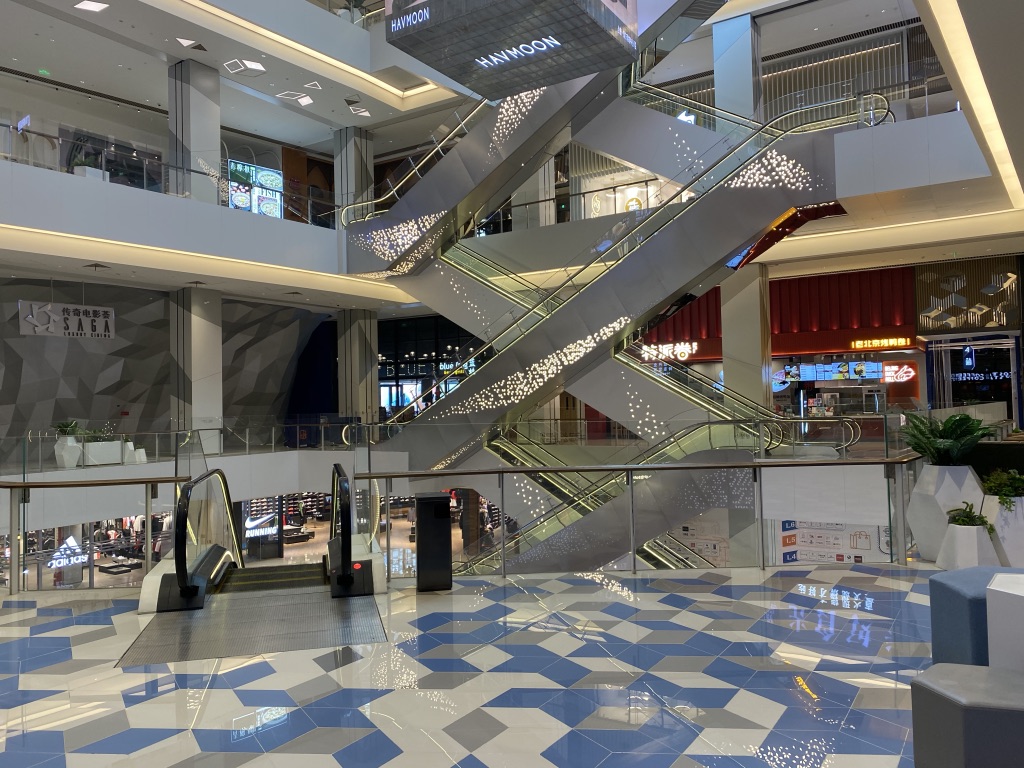
“A shopping mall in central Beijing on Feb 2nd. It’s likely even more deserted now.”
Why do you choose to remain in Beijing regardless?
From a safety standpoint, staying put is by far the best policy. The last place I would want to be is a crowded airport or airplane. I had planned to take research trips to Nanjing and Hong Kong but since libraries in both are closed, there’s no reason to go.
Is there anything you know about the situation within China or in Beijing that has not been mentioned, or has been misrepresented, by news agencies outside of China?
I can’t speak for Wuhan, which is where much of the reporting is coming from, but there are occasional headlines about panic in Chinese cities. Here in Beijing, I see nothing of the sort. People are generally calm, there’s no hoarding, although people are concerned about having enough and the right kind of face masks. Cases of antiseptic sell out fairly quickly.
“The snowy market was set up by a housing association, but it was overkill, since the stores just down the street were all open.”
Is there anything you know about the coronavirus that has not been mentioned in global news?
No, I have been following the global news quite closely.
What is the status of food, water and medical supplies like masks in stores in Beijing right now? And how long do you think you can last with the stock you have at home at the moment?
Supplies are not a problem. Regular grocery stores are open and well stocked. There are no lines or hot tempers. There are occasional runs on items like instant noodles, which is related mostly to the closing of restaurants and food delivery. To avoid going out, more people than usual are getting food and bottled water delivered to their doors.
There is concern about having the right kind of face mask. People follow this sort of news quite closely on social media. Friends from elsewhere in China have offered to send me masks if I don’t have enough.
A photograph of Thomas in a mask with the checkpoint at the entrance to Beijing Normal University behind him. “The universities are tightly closed.”
Do you still go out? If so, what precautions do you take when, and before and after, going out?
I go out at least once a day, all masked up. There’s no danger being in the open air, especially in frozen Beijing, so I go out for a long walk or occasionally a run. More important than the mask, I am very careful with what I touch, avoid touching my face, and thoroughly wash my hands when I get home.
When will you return to work? And what’s the plan in Beijing for people who need a form of income to survive yet cannot go back to work?
The work situation is “fluid,” which is probably all one could expect, given that the outbreak has likely not peaked. Students have been told not to return to university, and we are planning to teach courses online. I expect that we will probably be able to return to our offices within the month, but student dormitories are likely to remain closed for the semester.
Income will be a problem for a lot of people. Beijing relies heavily on outside labor to run, and the entire population that went home for the New Year has been prevented from returning to the city. Any manner of service industry is going to be deeply affected.
What will you do if you develop the symptoms of the virus? What do the officials in Beijing recommend you do?
I have not made a plan for getting the virus myself. Since I am well connected by social media, I would likely ask people at my university what to do, so as to avoid affecting others.
What will you do if the coronavirus situation in Beijing takes a turn for the worse?
I would likely continue to stay put. I have seen enough zombie movies to know that inside is always better than outside.
“Delivery trucks and packages are more common sights than usual.”
Which 3 items or people are most useful for you right now?
—Computer
—Cartoon Network
—10kg hand weights
Lastly, what have you learned from this coronavirus outbreak that you didn’t know before?
I have learned how quickly a health outbreak can change people’s behaviour. When I first lived in China in the early 1990s, hygiene was a real problem. SARS and the coronavirus have done more to change daily habits than years of government campaigns.
I have also learned that the response—at least in Beijing—has been very well coordinated and executed. There are a million things that could have gone disastrously wrong, and none did.
An image Thomas got sent on WeChat, depicting a medicine box titled ‘Bu Chu Men’—meaning: Don’t Go Out—with ‘Usage Indications’ made of advice on how to self-quarantine and stay safe from the coronavirus. “‘Bu chu men’ is a bit of quarantine humor that’s typical of how people are handling this.”
Thomas, being a scholar of Chinese history, presently still delights in being able to have the unique opportunity to work at China’s top institution, and intends to make the most of that by working extremely hard. You can connect with him at thomasdaviddubois.com, read his research work here, or ask him questions about the coronavirus situation in Beijing and China using the comment box below.
Tomorrow, we will interview another expat living in China’s largest city—Shanghai—to understand the present situation there. Follow the latest in our 2019-nCoV Diaries series here.
If you’re in China right now or have been affected by the novel coronavirus and would like to share information about the situation where you’re at, do get in touch with us here.
Photographs courtesy and copyright of Thomas DuBois. Interviewer: Sy Sponsor or support the 2019-nCov Diaries series here. If you found this article useful:
Icypriest, who prefers to be known only by his online handle, is a 30-year-old Wuhan resident and postgraduate student at a university in Wuhan. He is presently in lockdown in his home together with his parents, aged 63 and 59, and is only allowed to go out once every 5 days. We found our way past quarantine restrictions, oceans, military blockades, walls and viral risks to ask him what being quarantined in the epicentre of a global viral outbreak is really like.
“We are more tense than afraid.”
Q: Hi Icypriest, thanks for connecting with us all the way from Wuhan. When did you first hear about the coronavirus and what did you think of it then?
A: I heard about it in early December. I sensed the situation could be serious, so I told my parents to consider it as a “potentially cautious event”. We didn’t think of it as a serious event back then.
When did you start becoming more concerned about the virus? What triggered that?
I saw the official announcement by the Wuhan government that 27 people were infected. Then I became more aware of the virus.
How did you find out that Wuhan was going to be locked down and quarantined? What were you doing before that and what did you do right after that?
The lockdown was announced by the government several days before so we had time for preparation. We had already stocked enough food for the Chinese New Year [CNY] since most businesses were closing down during those weeks, so we just bought some face masks for potential outdoor needs. After the lockdown, we didn’t change much in our lives except to keep exercising indoors since we have a treadmill in our home.
Icypriest’s present stash of food: “(1) Cabbage, (2) Common Yam Rhizome (山药), (3) Bunching Onion (大葱), (4) Garlic, (5) Onion, (6) Potatoes. There is also ginger and chicken, pork, yogurt and frozen dumplings kept in the fridge. We also have a giant bag of rice (10kg).”
How did you feel about no longer being able to leave?
It doesn’t feel mandatory since most traditions during CNY are home-based except for visiting relatives, but we cancelled that because of the virus. We understand it’s a special occasion which won’t stop us from all indoor activities.
How long have you and your family been in lockdown thus far? What is daily life for your family like?
We have been staying home for 12 days. Since we limited our outdoor activities to none, we stay in bed every day until 10 and reduce the daily 3 meals to 2: one at about 11am and one at 5pm. We go to bed at about 12. The only differences between lockdown life and our previous CNY lives is: 3 of us are exercising daily on the treadmill, and we check the news about the virus frequently. Nothing else has changed much.
How do you get food, water and medical supplies right now? And how long do you think you can last with the stock you have at home at the moment?
We stocked masks in advance and cancelled our family trip during CNY. As we have the tradition of stocking food during CNY, we didn’t make extra preparations food-wise. Our stock can still last for about 2 weeks.
What will you do if your supplies run out?
The lockdown now is not a strict one—we can go out for emergencies and supplies, provided body temperatures are taken before going out.
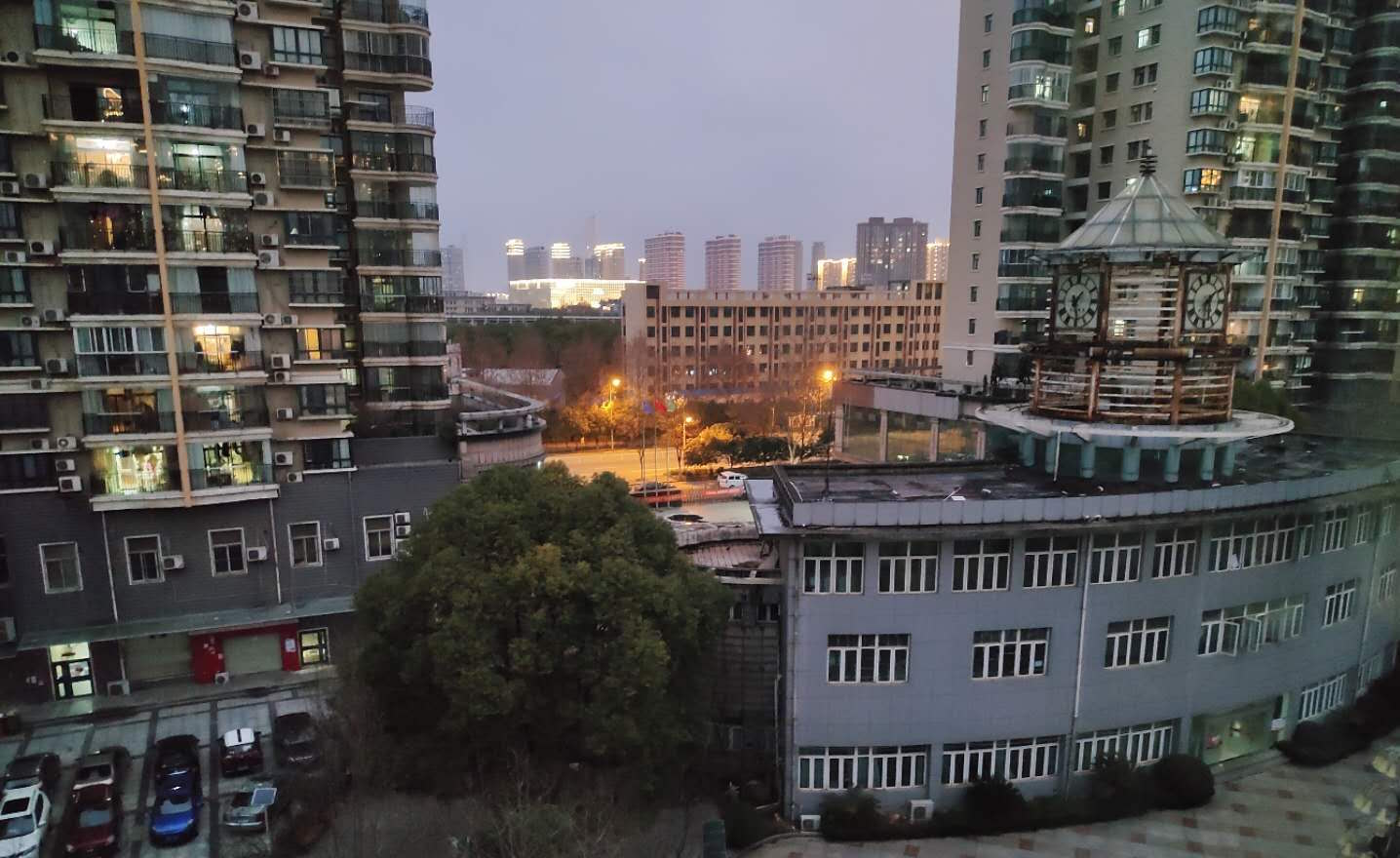
The scene from Icypriest’s home window.
Are emergency services (police, fire and ambulances) still in operation? What would you do in the case of an emergency right now?
All of the emergency services are still in operation. As almost everybody is in lockdown, I guess that police stations are not that much in need now. But if there’s an emergency, especially health-wise, there’s an appointed taxi to every xiaoqu(小区) [land plot] in Wuhan for that.
I’ve read that residents in Wuhan have been ordered not to leave their homes. Do you know what might happen if someone did leave their home?
As far as I know, all the quarantine protocols in Wuhan are not strict. But most people are aware of the situation and they are not intentionally challenging the law system.
How afraid are you and your family of the 2019-nCoV? How many people do you personally know who’ve been afflicted with the coronavirus?
We are more tense than afraid. I’m a little worried about the mental state of my parents but they clarified that they are not afraid or worried now. I don’t know anyone infected with the virus but I have an aunt, a friend’s mother and a friend working as nurses in different hospitals. They report daily on the situation and we’re informed about the virus and themselves.
What would you and your family do if one of you did develop the symptoms of the 2019-nCoV coronavirus?
If one of us have the symptoms we would voluntarily report to the community health centre. Since the big hospitals are stacked, the government has divided the responsibility to various communities. If they think it’s nCoV then we will be sent to designated hospitals.
When do you think you and your family will be returning to work and school? Which month will that be?
In my own optimistic view, I think things will start turning back to normal by 3-6 weeks. Traditional work and school days after CNY began a week before.
How are people in Wuhan and Hubei planning to get by without going out onto the streets to work? 手停口停的人怎么办 aka what would those with financial constraints do for income?
This is what I mainly worry about. People may be laid off if businesses go months without income, and all of them still have bills to pay. But I learned from the news that several cities are reducing taxes and rents to ease the burdens of people. I haven’t heard of similar news in Wuhan but I hope it would come soon.
Since we’re unable to go outside, my laptop is the most important thing in the world—it provides Internet, a work environment, most entertainment, news sources and communication. Headphones—because music is one of my main hobbies and it can be simultaneously enjoyed when I’m on the treadmill. The third is hand sanitiser—mostly not for hygiene but for easing our inner tension.
“Entertainment: guitar and Kalimba. My parents and I also enjoy TV shows.”
Lastly, is there anything you regret not doing earlier?
I regret not meeting all my friends for my birthday—I miss them. As my birthday is always during Chinese New Year, it was a great opportunity for me to meet many of them at once. But this year I hesitated and postponed my party plans.
Icypriest is presently still on lockdown inside his home but will be more than happy to answer any questions you may have for him if you leave them in the comment box below.
Next week, we ask him more about his feelings surrounding the racism that has appeared in the wake of the coronavirus, what he thinks of being barred from entry by numerous countries including Singapore, and what readers can do to help him and the rest of China get through this crisis. Stay tuned.
Photographs courtesy and copyright of Icypriest. Interviewer: Sy Sponsor or support the 2019-nCov Diaries series here. If you found this article useful:
4 days ago, just 4 days after Singapore (from which LUCK-IT operates) banned all travellers from China, Singapore announced its very first locally-transmitted cases of novel coronavirus infections—2 Singaporeans in the service industry who had attended to a vacationing group of China nationals from Wuhan (ground zero of the coronavirus outbreak).
2 days ago, just 2 days after the first Singaporeans had been infected, the very first case of locally-transmitted novel coronavirus infection of unknown origin was announced. The infected had not travelled to China or come into contact with any of the previous cases in Singapore.
Yesterday, 3 more locally-transmitted cases of unknown origin were announced, bringing the total number of cases within Singapore to 33. Panic-buying of groceries immediately ensued.
Today is the 69th day since the very first person known to be infected with the coronavirus in Wuhan reported feeling ill (on 1 Dec 2019), and a mere 16 days since the first case within Singapore (a 66-year-old tourist from Wuhan) was announced.
Singapore is now the country after China with the most number of confirmed cases. Masks have been out of stock for weeks and although the government has given each household 4 masks for use in emergencies, there is no information on when masks will be available for purchase again.
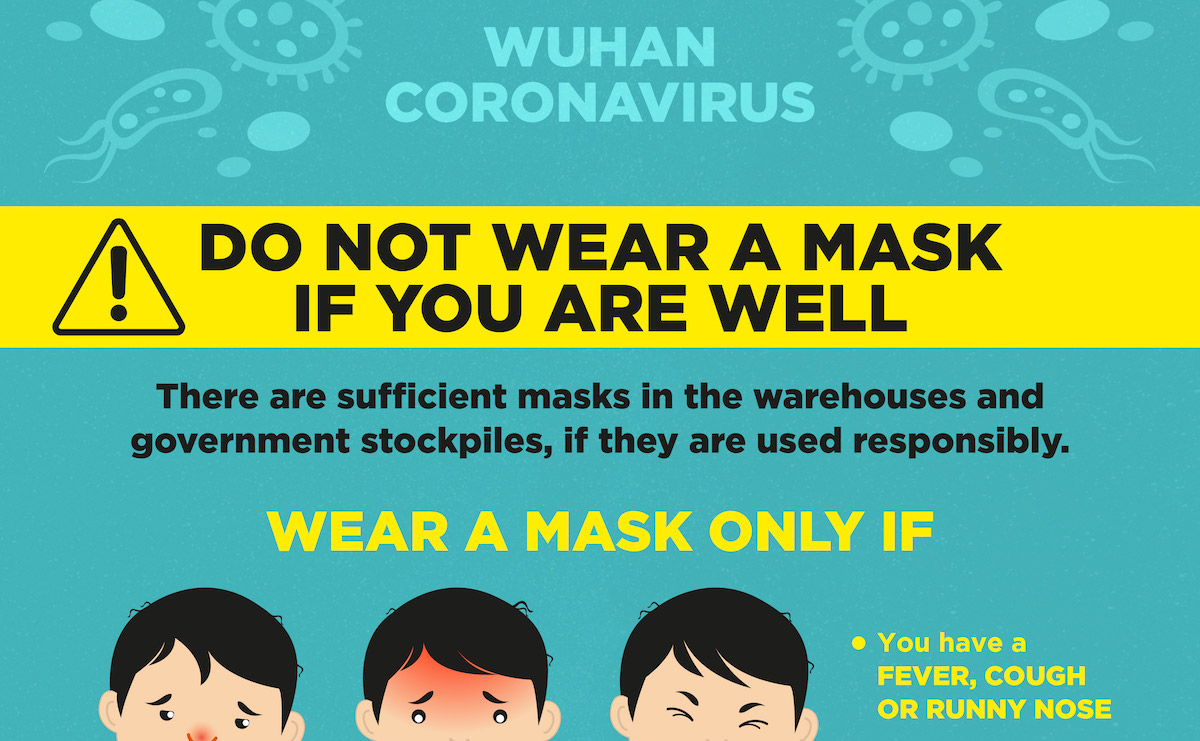
Advice from Singapore’s Ministry of Health, announced 10 days ago on 29 Jan 2020.
From here on, we are going to do a series called ‘2019-nCoV Diaries’ to document the developments of this new virus in Singapore and other affected countries—to assist with the understanding of this developing global emergency, and also for use for future outbreaks.
To start, tomorrow at 3pm, we’ll publish an interview with a Wuhan resident who’s been in lockdown in his home for 12 days. Beyond that, we’ll publish new interviews at 3pm on days when they are available.
You can read the whole 2019-nCoV Diaries series here.
If you’re in China right now or any other country that’s been affected by the novel coronavirus and would like to share information about the situation where you’re at, do get in touch with us here.
If you’d like to volunteer your time to help us gather more interviews with those affected by the coronavirus, you can also get in touch with us here.
Image Source: Ministry of Health, Singapore. Compiler: Sy Sponsor or support the 2019-nCov Diaries series here. If you found this article useful:
Nur Syahidah Alim was 18 when she first tried archery and 30 when she became a professional archer. Over the next four years, the now 34-year-old amassed seven gold, two silver and eight bronze medals, and was recently crowned World Champion at the 2019 World Archery Para Championships. We asked her for sporting tips and sought a peek into the secrets behind her success.
“Breathe in confidence, breathe out anxiety.”
Q: Hi Syahidah! What made you pick up archery? What was going on in your life during that time?
A: I first learnt about archery at a disability expo at the age of 18. I picked up archery because I loved the feeling of seeing my arrows at the centre of the target. At that time, I shot as part of my recreational activities during the weekends. I enjoyed learning about the sport, which in turn became a passion.
I only started shooting competitively in 2015; ASEAN Para Games in Singapore was my debut. During the time I was representing Singapore, I was working at Sport Singapore as an executive in the Strategy and Planning division.
Syahidah at her first training camp in Bangkok, Thailand, in Sep 2014, when still in the development para team. She eventually got selected to represent Singapore for the first time in the ASEAN Para Games in Aug 2015.
Did you think, when you first started, that you would become a World Champion Archer someday? Was it a goal you worked towards or just… luck?
Becoming a world champion was one of my goals during my career as a competitive archer. It took 4 years for me to achieve that goal.
How did you start representing Singapore in the sport? What did you have to do to get on the national team?
After I graduated from NTU [Nanyang Technological University of Singapore], I was in a dilemma: if I should focus on my work or continue archery. It was through the encouragement of my Mom that I tried out for the national team. I went to one of the selection trials for the para archery teams, with no expectations, and (surprisingly) got in.
I had to train in the development team for one year before I was able to represent Singapore in archery in 2015.
Looking back, it was a long and hard road of sacrifices to reach and continue to be part of the national para team. However, I tried to enjoy the process as much as I could.
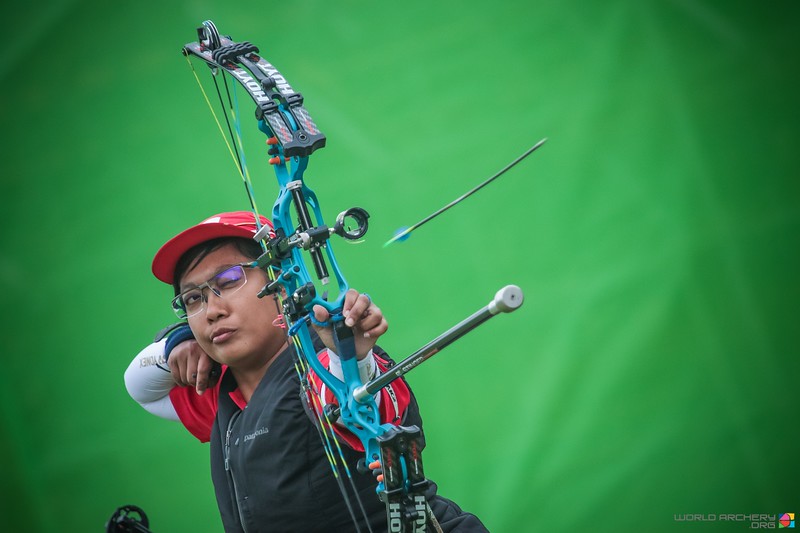
“My first debut at the ASEAN Para Games 2015 in Singapore. This would be the first historic gold medal for Singapore in archery.” Photo credit: Ben Cho / Sport Singapore
You’ve got more than six gold medals so far, so what’s your secret? What do you do before every game to get into the zone?
Archery is both a mental and physical game. Before every game, I will remind myself to focus on my process and simply enjoy the game. Breathing exercises (“Breathe in confidence, breathe out anxiety.”) help to keep me calm before I begin shooting.
What about your training routine, what is that like? How do you train on weekdays and how do you train on weekends?
I train about 30 hours per week, both weekdays and weekends. My training programmes include both archery training sessions, gym sessions and other SSI [Singapore Sport Institute] support such as nutrition, psychology, biomechanics and medical sessions (e.g. physiotherapy).
Syahidah during a practice session at the ASEAN Para Games 2017 in Kuala Lumpur, Malaysia. Her sport assistant (Nasrul Haq) is helping her to spot and retrieve arrows.
Which 3 objects or people are most useful for you when you’re preparing for a game?
1—My coach (Pang Qing Liang), 2—Saunders’ Firing-Line (i.e. my travel-friendly bow trainer), and 3—my visualisation audio clip.
“This picture was taken at the ASEAN Para Games 2017 in KL, Malaysia. Singapore successfully defended the gold medal for archery.” Photo credit: Dyan Tjhia / Sport Singapore
What setbacks have you had in your career as an archer? How did you move past those?
I had many setbacks during my career as an archer, from not having a dedicated training venue for para archers (which [meant we] ended up with jumping from [one] archery range to [another] range), to injuries and naysayers. At one point, I experienced a very bad slump that almost made me give up archery.
But what kept me going were the reminders from my support system and sponsors about my passion for the sport and grit. I felt that I still had more to give to and for Singapore. I am very grateful for them having my back when I am down in the slumps.
What did you learn from becoming World Champion Archer that you didn’t know before? How did you change as a person?
I think having a champion’s mind is important in sports. I learnt that having a process-oriented mindset in competitions helps me to be at the present moment and focus on the most important thing—i.e. process. Archery, in general, has made me into a stronger, resilient and confident person.
Syahidah’s first debut at the Asian Para Games 2018 in Jakarta, Indonesia. “Singapore was ranked 5th place. I was leading the Singapore Contingent as the flag-bearer. This is also the period where I was nominated into the Asian Paralympic Committee Athletes’ Commission.” Photo credit: Fiona Hakim / Sport Singapore
If you could go back and replay your entire archery career all over again, what would you do differently?
I wouldn’t do anything different.
“This picture was taken at the World Indoor Series 2018 in Macau. Singapore won the Silver medal.” Photo credit: World Archery
What advice do you have for those who hope to become world champions too?
My advice is to be 100% committed to your goals and dreams. Work with those who can help achieve your goals. Communication, clarity of roles and trust is important—i.e. once you have identified who you can work with, have a short meeting with them to discuss a training plan, have a clear understanding of your roles and expectations as an athlete and the role or the coach and other support personnels, as well as ensure that trust and open communication/feedback with everyone is always available.
Remember that this is a team effort.
A picture taken after the finals at the World Archery Para Championships 2019 at ’s-Hertogenbosch, Netherlands. “I was named Singapore’s first World Champion. Singapore is currently ranked 3rd in the world by the World Archery Federation. Beside me is my coach, Pang Qing Liang.” Photo credit: World Archery
Syahidah is presently a spexScholar and Paralympian, busy with competitions and training camps in preparation for Tokyo 2020, and also with competing at the Asian Para Archery Championships 2019 in Bangkok this October. You can follow her on her Facebook page (@nsyah.alim) to see where she will be training at next (“Feel free to say Hi when you see me, I promise I won’t bite.”), see her full sporting portfolio on her website, or ask her questions about sports and personal success using the comment box below.
Photographs courtesy and copyright of Nur Syahidah Alim, Sport Singapore, World Archery. Interviewer: Sy If you found this article useful:
At age 20, when reading a Japanese fashion magazine, Dreaming Asa saw a feature about ‘traps’—a boy dressing up like a girl and looking exactly like one, ‘trapping’ one into thinking it’s a female. One year later, he tried it himself and a couple of years after that, began doing it more actively. We reached out to him for a peek at the man behind all that women’s clothing.
“To look good as a woman, it does not just end with having good makeup. Body language, tidiness and fashion play a huge part as well.”
Q: Hi Asa! Thank you for coming on board to share your thoughts with us today! First off, can you introduce yourself? Who are you, where are you from and how did you end up with 8,000 fans on your Facebook page?
A: Nice to meet you too, I am Dreaming Asa from Singapore. My hobbies include cosplaying, gaming and hanging out with friends. I did not expect my Facebook cosplay page to be popular at first but it started to attract more and more people after they found out I’m actually male.
I understand, from your Facebook page, you consider yourself male but cosplay female anime characters and often go out dressed in female get-up too? Can you reveal more about why it is you do that and where you see yourself in terms of gender and sexuality?
I get attracted to female characters from games and animes more often and I felt that I didn’t want to be bound by gender to cosplay who I like. I also dress in female get-up once a while and try to learn more about different kinds of makeup styles while practicing as much as I can. I still see myself as a male though.
When did you first dress up as a female and how did you decide to do so? What did it feel like doing so for the first time and did you go anywhere in that outfit that day?
It was almost 6 years ago, I feared that my parents would be against it so I told my sister in secret about it. I had no idea where to start and she introduced me to friends from the cosplay community who taught me how to do female makeup. It felt really embarrassing because I was afraid it would not look good but they did a good job in teaching me. We did it in a cosplay shop at SCAPE but I didn’t have the courage to go anywhere so I just stayed there the whole day. (laughs)
The first time Dreaming Asa dressed up as a woman, he was 21-years-old. He was at Orchard Road when doing so.
When did you start wearing women’s clothes on a more regular basis? What, or who, gave you the confidence to keep doing it?
I started to wear [women’s clothes] more often about 3 years ago. After I was done with NS [compulsory National Service], I started working and bought more and more female clothes. My sister managed to persuade my parents that cross-dressing is quite common nowadays and even my mom started to support me. That really boosted my confidence a lot.
How did you learn how to do hair, nails and make-up? And do you have to do anything extra to look good as a woman?
Other than my cosplay friends, my mom and my sis also taught me the tips and tricks of makeup. I also look to famous cosplayers to learn their makeup techniques and find suitable hairstyles. To look good as a woman, it does not just end with having good makeup. Body language, tidiness and fashion play a huge part as well.
Who are you when you’re not Dreaming Asa? Can you tell us or is it a secret?
N/A (Pretty much nothing.)
Does your family know about Dreaming Asa? What about ‘otokonoko’ or ‘trap’ or cosplay culture? How much do they know about those? How did they react when they found out, or how would they react?
Yes, they do and they are not impressed at all. It was thanks to my sister that they know. She managed to explain this subculture to my parents.
How popular is ‘otokonoko’ or ‘trap’ culture in Singapore, you think? Are Singaporeans receptive to seeing otokonokos out on the streets, from your experience?
From what I know, a lot of people who are into or not into cosplay also gave negative views about this trap culture.
Dreaming Asa cosplaying in September 2017.
What is your day-to-day routine like? How often do you cross-dress or are you mostly dressed as a female these days?
I try to keep my skin hydrated because I have dry skin issues. I usually dress out once every 2 weeks if my skin is doing well.
What about weekends? What do you do then?
I will hang out with my friends or do makeup tests at home.
What advice do you have for men hoping to look like Dreaming Asa and go out on the streets as Dreaming Asa does?
Having perfect makeup will not be enough, they need to learn to be feminine as well. Fashion and hairstyle play an important part too.
Can you map out a suggested action plan for people who want to do the above to follow?
Read up more fashion magazines or check out the internet for fashions that suit your taste.
What key things/people/situations enable you to be Dreaming Asa, in your opinion?
My family who’ve supported and guided me. If not, I would have stayed as a closet cross-dresser.
Dreaming Asa in casual wear in June 2018.
How did becoming Dreaming Asa change you as a person? Or did it not change you? Why?
It definitely did. I made a lot of new friends and even had supporters from overseas, something I never would have expected to have.
If you could go back and replay your entire life all over again, what would you do differently?
There is nothing I regret because what happened in the past makes me who I am today.
What were you like as a child? What about as a teenager and young adult? How did you change at every decade? Or did you not change?
I used to be a shut-in gamer. Slowly, after I started dressing up, I learned so many different things and became more open to new things.
Dreaming Asa’s makeup collection.
Which 3 objects/people in your life can you presently not live without and why?
Of all the objects you bought/received for the purpose of cross-dressing, which was most useful? Why?
Contact lens makes a huge difference for me; it’s one thing I cannot do without. It creates attention to the eyes and eye contact makes the most impact during any conversation.
Which person do you wish LUCK-IT would interview for you to learn from? Why?
Elizabeth Seah. She is the owner of Haru House, who brought Japanese culture to Singapore.
What’s the worst advice you’ve been given, or have heard people giving? And what’s the best?
N/A (Even the worst advice could have been the best. It depends on differing situations and how you perceive it.)
Dreaming Asa when not dressed up as a woman. Taken in January 2016.
Dreaming Asa is presently a transport operator and single, and is convinced most people will not be able to recognise him when he’s out in public. He is busy making props for his next cosplan but will happily answer any questions you may have for him if you ask him through his Facebook page.You may also share your own experience with cross-dressing in the comment box below.
Photographs courtesy and copyright of Dreaming Asa. Interviewer: Sy If you found this article useful:
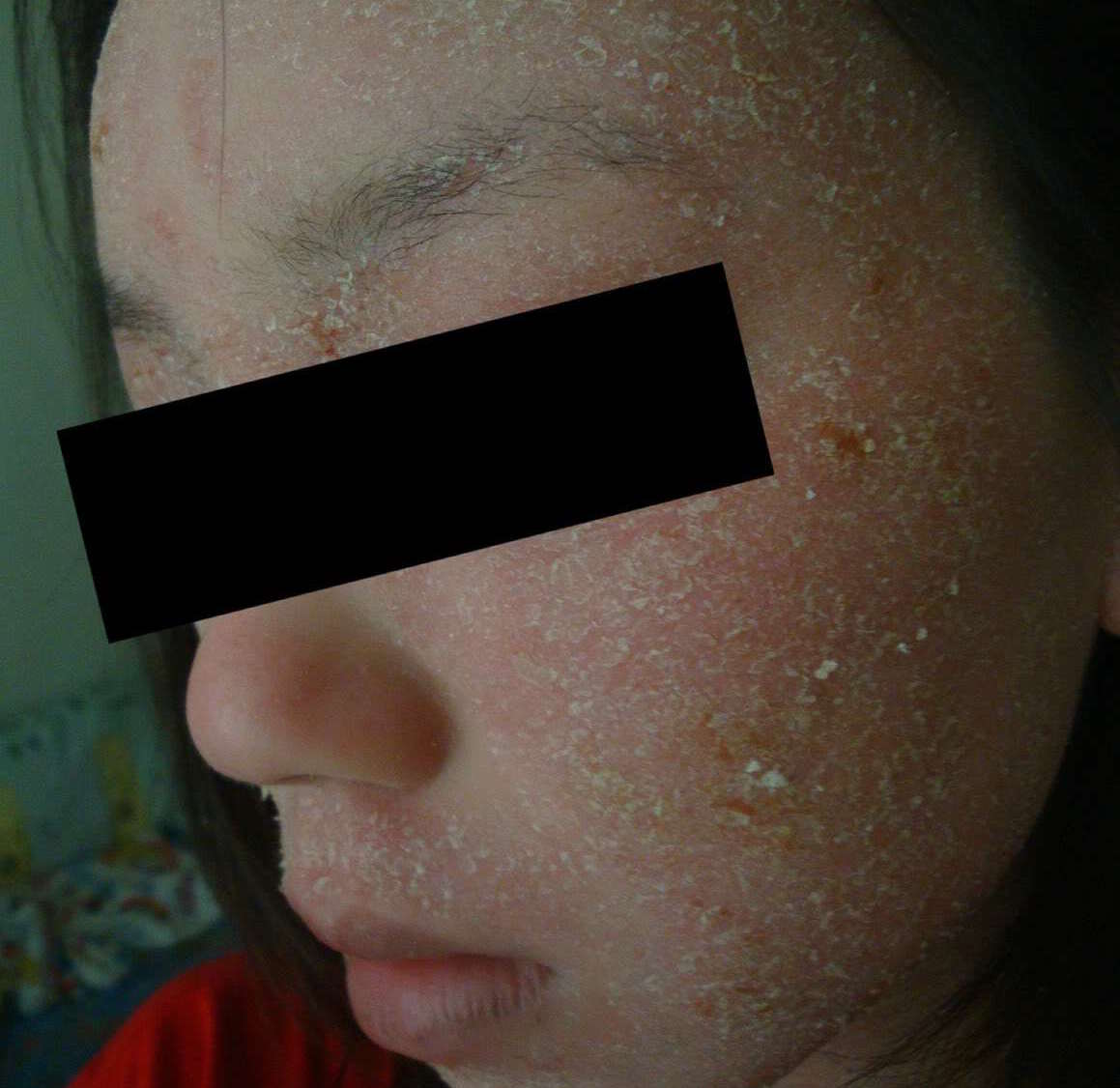
Juliana had a rash at age 12, for which she was prescribed topical steroids. Over the next eight years, plagued by persistent skin problems, she persisted with using topical steroids all over her body until, when aged 21, she decided to stop. Within a week or two, her skin became completely red and for the next four years after, she was ‘burning’, oozing and shedding from head to toe, to the extent she had to take a year off school. Four years after her ordeal with what the Internet terms ‘Topical Steroid Withdrawal’, Juliana tells LUCK-IT everything she’s learned from the experience and offers coping tips to others going through the same.
“Be reminded that you are stronger than what you believe.”
Q: Hi Juliana! First off, can you tell us what topical steroid withdrawal is and how someone can tell when it’s happening to them?
A: Topical Steroid Withdrawal (TSW) is a cluster of symptoms that happens when you stop using enough topical steroids after using them for prolonged periods of time. Now, just what exactly is ‘prolonged periods of time’? It’s advisable to continuously use topical steroids for not more than 2 weeks, so going by that, anything longer than 2 weeks is too long. Of course, it also depends on the strength of the topical steroids. The stronger you use, the shorter you should use them for. In general, the chances of someone having TSW is greatly increased if they have used it for months on end, and notice their skin worsening despite the usage. It can be hard to tell if it’s happening to yourself because you can never be sure if it’s just your eczema worsening or your skin craving more topical steroids (hence entering TSW unknowingly). I can’t really give a simple answer. The more complete one would require a look into personal history:
1.. Did you use potent topical steroids for more than 1 month continuously? Or weak topical steroids for several months/years? 2.. Has your doctor been prescribing you increasingly potent topical steroids to maintain your skin? 3.. Did you experience worsening of the rash, spreading of the rash, burning, oozing, more dryness than before? 4.. Does your skin worsen the moment you stop applying topical steroids? 5.. Do you feel like you can’t maintain your current skin without the topical steroids?
Actually, as long as your answer for 4 and 5 is a yes, I can say with 90% confidence that your skin is already addicted to topical steroids, and if you’re not applying more frequently, or more potent steroids, you will experience withdrawal symptoms, which is what I lined out in number 3.
Before Juliana went into withdrawal. “21 years old. Taken at a restaurant because why else would I be holding a basket of xiao long bao? This was Crystal Jade at Holland Village (if you really care for the details!) when I was still suppressing my rashes with a lot of steroid creams. It was barely manageable as I remember having a rash underneath my lips that was shedding that day. Still recall the Elomet cream stinging my skin.”
How did you realise you were going through topical steroid withdrawal yourself?
It was after I stopped my 9-day oral steroids treatment. My skin was worsening again and I was shedding, from my body, tiny skin flakes everywhere. My skin was red! My then ex-boyfriend told me I have TSA [Topical Steroid Addiction]. I didn’t believe him because as far as I knew, one can only be addicted to oral steroids, which I had been using very rarely. I googled ‘eczema red skin’ and chanced upon Kelly’s page about red skin syndrome. Her photos were what convinced me I was going through TSW, because we looked the same. Dry, red face. Which is also why I decided to take photos of my skin (even though I really didn’t want to look at them) and post them on my blog!
How did you even start using topical steroids in the first place?
The same as everyone I suppose! A doctor prescribed it to me! It was a general practitioner in the very beginning. I had some rashes, he prescribed it to me. End of story.
How much topical steroids were you using before you ended up with withdrawal, and how regularly were you using it? Were you following your doctor’s instructions when using or did you just use it whenever you felt you needed to?
Let’s just define ‘ended up with withdrawal’ as the point I decided to stop using topical steroids, because I believe my skin already went into withdrawal before I stopped using steroids although I’m not sure when that was exactly! I had been using topical steroids since I was 12? I was 21 when I stopped. Initially, I would only use them on the rashy bits, for a few days until they went away. Then repeat when they came back. During the last 5 years of my usage, I was using them twice a day, all over my body (because I had rashes almost everywhere). It was betamethasone valerate. I still remember it was quarter strength and half strength. My dermatologist prescribed me TUBS of that. Not tubes, but TUBS! Strangely, my doctor didn’t give me much instructions other than to “use them when itchy”. So I did use them every day because I itched every day. Also the rashes never really went away, so I gotta keep applying until they do, right? When I did withdraw from topical steroids, and was crying to a dermatologist at the NSC [National Skin Centre in Singapore] hoping to get them to diagnose my skin as a TSW case, she told me to “use the topical steroids every day until the skin clears up”. self-censored expletive
How long did it take for you to recover from topical steroid withdrawal? Did the condition affect your life in any way? If so, how?
I’ve quit topical steroids for 8 years now. It took me 2 years to heal from the worst flare. And then throughout the other years, I continue to deal with relatively minor flares. I feel like I never truly healed from my eczema, so I’m still working on that!
TSW left me quite debilitated at that time. I went from social butterfly to hermit. I couldn’t function normally as I was exhausted (from not being able to fall asleep at night) and couldn’t perform well at school. I had to take a year off school in fact. I even stopped watching TV in the living room because I didn’t want to leave a pile of skin there. I spent all my time in my room. I lost all self-esteem and confidence, got depressed, but not depressed enough to shut myself out from my friends completely. I also had thoughts of dying but I couldn’t bring myself to do that to my family. I felt like a constant burden to them, but it’s also this thought that makes me want to do anything I can for them right now.
Juliana’s feet, 7 months into withdrawal.“In 2011. 22 years old. Taken at home because I really didn’t wanna be in the outside world anymore. Skin was REALLLLLLY bad. My skin got to the worst stage around month 7. It was a gradual worsening. Imagine how hopeless I was. 7 months in and it was just the beginning.”
How did you finally get over topical steroid withdrawal? What was the turning point/course of action that got you there?
For me, it was Traditional Chinese Medicine (TCM). As I had to return to school after my gap year, I wanted a little help from someone experienced at treating skin conditions. I was really glad it worked for me, as it helped me go from 80% to 99% healed. Of course, I got complacent and stopped treatment 1 year in, and started adopting my previous unhealthy (but very fun) living habits. I guess the saying is true: live fast, die young. Or in this case: live fast, bad skin.
Did the process of going through topical steroid withdrawal heal your eczema too, you think?
Overall, it’s a ‘no’. I still have my underlying eczema that has been unresolved for too many years. It did get a lot better, like almost unnoticeable during my first stint of TCM back in 2013, but apparently the problem’s still not fixed! Especially when I went back to my old ways of partying and drinking.
What was your routine like during your worst phases of topical steroid withdrawal? How did you care for your skin, self and surroundings?
Oh my, the routine is depressing. I’d wake up around 8am, staring at the window as the sky brightened. I’d wish for the night to come faster because I didn’t want the light to show me how bad my skin was. I wanted to sleep my day away so I wouldn’t have to move or see much. When I finally felt too dry from spending too much time immobile in bed, I’d get up for a shower. I still remember I had to mentally prepare myself for the pain I’d experience when the water first hit me. I would spend 20 minutes just having water run over me—the only time I would feel rather normal again because my skin would no longer be dry and tight. But I knew after leaving the shower, I’d have to experience the dryness all over again. It is like going to heaven then going straight to hell, falling double the distance. I’d then sit in front of a fan to dry myself out, apply dollops of vaseline (when my skin could tolerate it. Otherwise I would just slowly let it dry up and turn into Groot? I imagine this is how he feels.) and enjoy the remaining bits of flexibility and elasticity in my skin. I think I spent too much time picking on my skin. I just hated how rough it felt when I ran my hands across my skin. Lots of scratching and rubbing later on to soothe the tingling and itch. I’d eat, drown myself out with TV shows because that was the only thing I could do that didn’t require my hands (as I needed them to scratchy scratch). Nightfall, I’d feel happier then head to bed hoping to fall asleep, but it would always take me a few hours as I would be tingling. When I was oozing, I had to pad those areas with cotton pad to prevent it seeping into my sheets too. I had to sleep in certain positions to limit contact with the bed. Still have no idea how I survived those days, other than the fact that the human body is a lot more resilient than you’d think.
I didn’t really care much for my skin and self back then. I really should have spent the time reading books good for my soul and mental state. Nothing I did seemed to help with the skin anyway, and creams were a big no-no during the worst as it stung so it was really just showering twice (with just water) and trying to keep my surroundings as clean as possible (thank god for my mom as she cleaned my room for me).
Now that you’re much better, what is your routine like? Do you do anything special to keep the topical steroid withdrawal flares or eczema at bay?
I can fall asleep around 11pm and wake up at 6am for work 🙂 I CAN WORK NOW! In fact I can do many things which I used to be able to do before TSW. I only shower once a day now! A HUGE improvement because my skin feels less dry now. I use creams to keep the dryness at bay, I really like Cetaphil Restoraderm cream as it contains a good blend of ceramides and niacinamide which restores the skin barrier and calms it down. It’s not too oily so it doesn’t leave my skin sticky. I’ve also switched to Avene products for facial skin care because they don’t irritate my skin! They keep my skin moisturised and supple most of the time, unless I have another tiny tiny flare (like real tiny, because it’s only 2 rashes on my cheeks) then the skin does its thing and goes through the red/itchy/dry/shedding cycle. Can’t say it prevents a flare from happening because I still have flares, especially before my period!!! But these are the things I find to not sting my skin even when it’s acting up.
How do you presently spend your weekends?
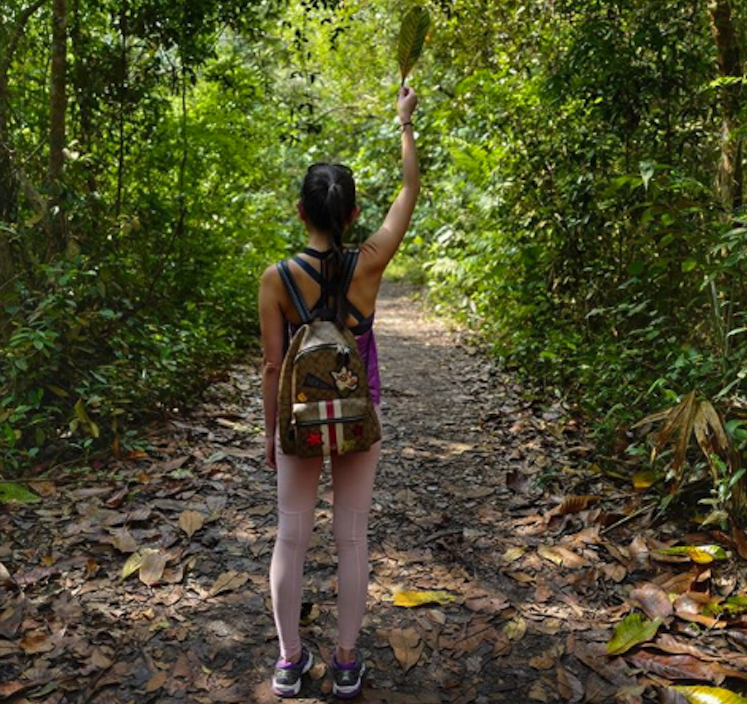
This question makes me guilty, because it’s kinda like how I spent it last time during TSW… at home and in front of my computer. BUT, on top of that, I cook, I do my laundry, I clean my room, I play games with my boyfriend, and occasionally, I go out for a hike or spend it with family. Okay, spelling those out makes me feel like I didn’t really waste my good skin time 🙂
“Take it one day at a time.”
What advice do you have for someone going through topical steroid withdrawal too?
Be mentally prepared for the shitty days you’re about to face, it really tests your sanity. If I can make it through, so can you. If it helps, visit my skin blog for some hope. A lot of readers told me it helps them when they read what I had written in the past. Maybe it’s the photos too? I don’t really know. Secondly, be patient. “Take it one day at a time” should be the tagline for TSW! Be reminded that you are stronger than what you believe. Lastly, if you see a lot of yellowish pustules that resemble pus (they have the milky yellow colour, unlike interstitial fluid that is yellow but a clear fluid), visit the doctor for a possible infection. You’d need antibiotics for that sh*t.
“Month 7 versus month 25. So that’s 22 vs 24 years old. There’s a lot more comparison on my blog. Of course, these are outdated by now. The photo on the right was taken in 2013, when I had great success with my first TCM doctor. Skin has since had several other flares.”
Can you map out a recommended path to healing for people going through topical steroid withdrawal to follow?
Stopping topical steroids is the first step. The rest is just a survival response. Seek support from friends and family. The ITSAN [International Topical Steroid Addiction Network] community can help you in the beginning so make sure to head over there for some moral support. But don’t linger because what else do you expect from a bunch of miserable people who are all suffering? Be patient; the worst is yet to come, but once it does, you know you’re half-way through the battle. It can take months just for it to get that bad. It really depends on your body. I notice the healthier you are, the faster you get worse and from there you’ll truly experience the recovery.
What key things/people/situations enabled you to make it through topical steroid withdrawal, in your opinion?
Hands down, my family!!! It wasn’t even myself, because I wasn’t myself back then. I was staying alive for my family because of their love for me. Some of my skin friends weren’t as lucky—their family didn’t support the idea of TSW, and insisted they go back to treatments. I was also very fortunate to have been able to rest at home for the entire year. I didn’t have the kind of financial burden others have. Nor do I have children of my own to support. I just had to make sure I was still breathing.
How did going through topical steroid withdrawal change you as a person? Or did it not change you?
Did TSW affect my life in any way? F*CK YES! It turned my world around, broke me down, built me up and gave me strength I never could imagine having. I never knew at that moment how I could survive the endless cycles of shedding, oozing, and itching but I made it through somehow. I started to appreciate my very supportive family, because if not for them, I couldn’t have made it. I earned that strength, and I use it as a reminder when I feel down in life. It has also given me the power to be more empathetic towards others. We’re all suffering in some way or another; why did I think I was the only one who had it the worst? I’ve learnt to be more kind towards others. So, even though it sucks to have had a few years of my life taken away from me, I think of it as a mental retreat where I learned how to be a better person, and also how to live in harmony with this world, my mind and my body. Also, it has given me a brand new perspective–now I am more appreciative and thankful of everything in life (I felt this the strongest right after I returned to school though as time goes by, I need reminders to remind myself how good I have it right now). Deprivation is the best spice in life!
If you could go back and replay your whole journey of healing from topical steroid withdrawal all over again, what would you do differently?
I would spend those times more productively. I could have read so many books during those times, learned so much more than I could have done. Books have given me some peace of mind, that I’m not wasting my life away because I am gaining something even though all I can do is read. Maybe pick up how to trade as well, so I could have earned some money on the side while being home-bound? Too bad!!!
How much topical steroids did you use as a child? What about as a teenager and a young adult? Have you noticed any patterns between the condition of your skin and your use of topical steroids?
Not much as a child, because when I was just a kid, I was clearly more wise. I refused to use the creams because I didn’t want to dirty my sheets. As a teenager, I got more vain and wanted to get rid of the rashes so of course I started using it more. As my skin got worse, I used more topical steroids. Sometimes I wonder if my increased use of topical steroids worsened my skin too.
Which major event in your life made you who you are, in your opinion? Why do you think so?
I was really lucky as a kid, I never had any huge problems or issues other than minding my grades at school. So as of right now, going through TSW, it has been humbling, and very educational for me, spiritually and mentally. You really have to fall to the lowest possible level in your life in order for you to evaluate what the most important things in life are. When everything is stripped away from you, you realise those are not essential. And from there, the mental world I build is laid on much stronger foundations. It’s weird because I didn’t want TSW to define who I am, yet it contributed a lot to who I am today.
Juliana now. “This was taken last month at home. 29 years old now. FML. Where did time go?”
(about the photo above, cont’d) “If you zoom all the way in, you can still see my neck is atrophied, and slightly rashy. Skin looked really good after my period and has fluctuated along with my hormones and flared a little since that week. So much has happened in one week! My neck is now recovering from a flare [that started] 6 days ago and it has gone through the same old ‘itch -> red -> dry and shedding -> smooth and fragile -> dry again but less red’ cycle. Same with the area around my lips too. Will it end one day? Yes. It just takes a long while because my skin has definitely atrophied and is even more easily irritated than before. Other than that I think I look spectacular in the photo. Only had some concealer underneath my eyes!”
Which 3 objects/people could you not live without when going through topical steroid withdrawal? Why?
My mother, my brother, and vaseline. My mother and brother are super supportive and helpful, and never once complained about my skin and its inconveniences. My mom worked, and had to cook for me and clean my room for me. She did so much for me. As for vaseline, it helped me retain a little elasticity in my skin moments after showering, giving me the ability to move without as much pain and skin tearing.
Of all the objects you bought for coping with the symptoms of topical steroid withdrawal, which has been most useful? Why?
Probably vaseline too, because it’s inexpensive, didn’t irritate (when my skin was better), and gave me some level of relief to function.
Which person do you wish LUCK-IT would interview for you to learn from? Why?
The Dalai Lama, because he contains so much wisdom and joy, I want to learn how to cultivate that too! Especially when life is filled with difficulties and hardship.
What is the worst advice you’ve been given, or have heard people giving, with regards to skin care? And what’s the best?
The worst would be the dermatologist who asked me to apply topical steroids DAILY, ALL OVER MY SKIN. No thanks.
The best would be to leave it alone as much as possible! If it’s not broken, don’t try to fix it.
Juliana is presently a sales and operations executive, working 9-6 for a brand she loves. She works on herself when not at work and of late has been figuring out and dealing with emotional issues. You can read more about her experience with TSW on her blog (although she hasn’t been updating because life has gotten in the way) or ask her to tell you more about it by leaving your questions in the comment box below.
Interviewer’s Note: A couple of years ago, a series of spreading rashes all over my body made me consult three different doctors over five months. All three—one of whom was even a skin specialist—diagnosed and prescribed the same thing: eczema of unknown origin and tubes of increasingly potent topical steroids (the final batch being Clobetasol, the most potent topical steroid of them all). The response of my skin was always the same: better with topical steroid application but way worse the second I stopped applying the creams. It took me many cycles of this to put two and two together but I eventually concluded my worsening skin condition might ironically be linked to the creams the doctors were telling me to apply. I figured I might be allergic to the creams so I stopped all at once and right away ended up house-bound for months when all of my skin immediately erupted in crazy itchy oozing sores that would grow dramatically in size and thickness before crusting over and flaking like snow over time. I was ghastly disfigured, scratching all the time, had insomnia and strange zapping sensations every single night, and I truly believed I was suffering a disease doctors didn’t yet know about. It was then I found Juliana’s blog on the internet, and more from others who looked just like her and myself, and finally realised what might really be going on. I told my doctor (the skin specialist) about what I found but he refused to acknowledge the link between the creams he’d prescribed and my skin condition. In the end, I had only Juliana’s blog and that of others like her to rely on for tips on what to do to feel better and function better. My skin is now back to normal and all I did to get it back was—not consult more doctors but, like Juliana and others said—wait it out and let my body heal itself. And for that information, I am forever grateful.
Photographs courtesy and copyright of Juliana. Interviewer: Sy If you found this article useful:
Bank Relationship Manager, Qiu Ruozhi was 28 when she first began running half marathons—a 21km run across varying routes. Having completed ten of them since, she tells LUCK-IT why she continues to do half marathons almost a decade on and lets us in on her preparation routines.
“With training, I believe that anyone can run a half marathon. It sounds like a really long distance but it really isn’t that bad.”
Q: How did you start running half marathons? Why did you do it?
A: I was taking part in 10km runs as a social activity with my friends and I decided to challenge myself to go for a run that is longer than the usual.
How did you train for your very first half marathon?
I searched online for a training schedule for a 21km run.
Did you think running it would be a breeze or did you have no idea what to expect?
I enjoyed running so it made it easier.
How long did it take you to prepare for your very first half marathon?
It took me about 6 weeks to prepare for it.
And how long does it take you to prepare for a half marathon now?
I am running/working out regularly, so I guess about 3 weeks would be sufficient.
How do you feel before, during and after a half marathon?
I always take part in the half marathons with friends so it is usually an enjoyable run. I would look forward to it and enjoy the run. After a half marathon, all I want to do is eat and lie down.
Ruozhi with her marathon essentials at The Straits Times Run 2016.
Can you describe your training/preparation routine for a half marathon in more detail? What do you do every week and how do you increase the intensity?
It is a 6-days-a-week training. It starts off Monday-Thursday with alternate running distances, i.e. 4.8km, 6.4km, 4.8km, 6.4km. Friday is a sport of your own choice. Saturday would be 9.6km. Every week, the distance increases by 1.6km for all the days. Ultimately, by the last Saturday, you will need to clock 19.2km. There should be 3-4 days where you rest and finally run the 21km race.
Now that you’re more experienced, how does your training routine differ?
I would run four times a week. Twice would be 6-8km, a 10km and one incremental distance, i.e. 12,15,18km.
How do you spend your weekends when you are preparing for a half marathon?
I would ensure I get at least 8-10 hours of sleep before I train, so that I am well rested. I will go running first thing before I go about my day.
And how do you spend your weekends when you are not preparing for a half marathon?
These days I will go to the gym, catch up with friends and family.
What advice do you have for someone thinking of doing a half marathon?
With training, I believe that anyone can run a half marathon. It sounds like a really long distance (given that we do not really walk anywhere these days) but it really isn’t that bad.
Can you map out a recommended path for people who want to complete a half marathon to follow?
There are many training schedules online available depending on fitness level and time available to train.
What, in your opinion, are the key things/people/situations that enable you to complete half marathons painlessly?
I was encouraged to run a half marathon by a friend who is a triathlete. She was the one who trained with me and forced me to chat while running. Running became an activity amongst a couple of us and we would use that time to chat and catch up. It probably made me enjoy running even more because I didn’t have to give up my social life entirely. I think having people around to exercise with makes it difficult to procrastinate.
Ruozhi trains in the gym on a regular basis, even when not preparing for a run.
Who/What can you not do without?
Apart from my dear friends and family, I cannot go through a week without exercising and coffee every morning is a must.
How has having completed numerous half marathons changed you as a person? Or has it not changed you?
“Perseverance is important in whatever we do. Running is a test of this because we have the choice to stop and give up whenever we want and not go anywhere.”
It has taught me that perseverance is important in whatever we do. Running is a test of this because we have the choice to stop and give up whenever we want and not go anywhere. I think this can be applied to almost every aspect in life. It has taught me how to self-motivate and keep going even when situations seem bleak.
If you could go back and replay your preparation for your first marathon all over again, what would you do differently?
I was actually pretty pleased with my preparation. I don’t think I would want to change anything about it.
What were you like as a child?
One trait that my parents still like to remind me of till this day is that I refused to ask anyone for help. I would do everything myself. Even if I didn’t know how to, I would try and figure it out on my own.
I was always the favoured child. My nanny doted on me more than her own grandchild. As I am the firstborn, my parents showered me with presents and let me do anything that pleased me.
It was a difficult time when I had to go to primary school because I was on holiday most of the time during my kindergarten years. I still remember crying every day and begging my parents to allow me to stay home.
What about as a teenager and young adult?
Ruozhi heading for fitness classes at the gym she frequents.
As I grew a little older, fitting in became really important to me. It was [the era of] the Baby-G fad and it was the first time I got rejected by my mother when I requested for it. She said it was ugly and refused to buy it for me. It felt like the end of the world for me.
Apart from being FOMO and wanting to always be hanging out with my friends, I would say that I was fiercely loyal to them. I valued my friendships and people who were close to me and I would drop what I was doing if they needed help or just wanted a listening ear. The friends that I have who were there during my formative years are the friends that I know for sure would be friends for life. However, I never much cared about what other people thought of me, I guess this trait has followed me all the way up till this day.
How did you change at every decade? Or did you not change?
I think it’s a constant learning journey. As I age, I control my temper more and I will ask myself if what is troubling me is very important to me. I realised that there are many trivial things that are not worth getting angry or upset about. I have also learnt not to be consumed by things that I cannot control and focus my energies on things that I can change.
I have also started being more appreciative of what I have and not comparing myself with others.
I have also realised that I am making life difficult for myself if I do not ask for help. I can’t know everything in this world and asking for help does not mean you are less of a person. It just makes life easier and more efficient.
Which major event in your life has made you who you are, in your opinion? Why do you think so?
I think that was the time when I first started working. I realised that I had been living in a bubble with idealistic thoughts that after graduating with a degree, I had all the answers to life. Obviously, I was wrong.
I had to learn how to communicate effectively with people and communication isn’t just about forming words. The difficult part is getting others to see your point. This requires you to speak their language and put yourself in their shoes. It was truly a steep learning curve for me and I went to my friends for advice. When that was not enough, I even went to buy books on communication to help me understand more.
It was then that I was truly enlightened. I may have education but having people skills is equally important. There is no point in having brilliant ideas when no one buys into your ideas.
Which 3 objects/people in your life can you presently not live without and why?
My iPhone, iPad and, recently, Kindle. My phone is basically required for work and to catch up with friends. My iPad is also needed for work, and for me to catch up on Netflix. My Kindle is for me to read whenever I have free time.
A route Ruozhi takes when exercising at MacRitchie Reservoir.
Of all the objects you’ve ever bought for half marathon preparation, which has been most helpful? Why?
My running shoes are the most important item as of far. When I first started running, I was buying the designs that I liked best across all brands or the ones my friends were recommending. I was throwing them away because they didn’t fit me. I would suggest to find a brand of shoes that fit your feet before you start running, as comfort is key. Ill-fitting shoes will make training difficult.
Which person do you wish Luck-it would interview for you to learn from? Why?
A monk because they live a completely different life from me.
What’s the worst advice you’ve been given, or have heard people giving, with regards to half marathon preparation? And what’s the best?
I’m not sure if this is a bad idea but during half marathons they usually give out bananas/energy bars. I have no clue how people eat while running. I certainly cannot eat before or during a run. The best advice I had was to sip water and not drink the entire cup at water points. That would give you a stitch.
Ruozhi is presently working on becoming more toned by adding body combat and yoga classes to her routine. You can find her in a gym or on Instagram @ruozhiq.
Photographs courtesy and copyright of Qiu Ruozhi. Interviewer: Sy If you found this article useful:

![“Here are the supplies [from the “emergency” packages] (including the all-important cream cookies and Toblerone).”](https://i0.wp.com/luck-it.net/wp-content/uploads/2020/02/100b-2.jpg?resize=1600%2C1200&ssl=1)